Posted in: Disc Reviews by Michael Durr on March 25th, 2007
Synopsis
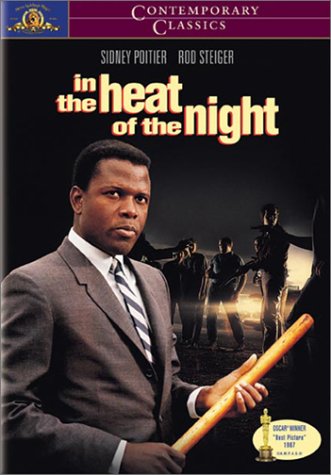
As I get older, I notice my tastes for movies change. Sure, I still like over the top action and if there is an attractive girl on the screen it gets my attention. I'm human, however as I get older I start liking films that are older. Now, I'm not talking about keeping true to films of my generation but I find myself engrossed in films that were made before I was born. There are some true classics out there such as In the Heat of the Night. This movie starred Sidney Poitier ...s Virgil Tibbs and Rod Steiger as Police Chief Bill Gillespie. A murder has gone down in the little town of Sparta, Mississippi of a prominent businessman Colbert. He was going to bring hundreds of jobs to the town for both blacks and whites alike with building a new factory. Virgil Tibbs, a black Philadelphia homicide detective is merely passing through town when he gets arrested by Officer Sam Wood (played by Warren Oates) for the color of his skin. When he is brought into the police station; the mistake is realized by Police Chief Gillespie. After a call to Philly; Tibbs is coaxed into helping out the local police solve the murder. As one would suspect from the era and the locale, this movie is steeped in race relations. This was one of the last states that was truly racist (some would argue it still is)in the middle of the civil rights movement. However, the movie brings this across in such a way as a backdrop, not the forefront. This movie is basically a whodunit where solving the murder is more important than the prejudice that surrounds it.
Posted in: Disc Reviews by Archive Authors on March 23rd, 2007
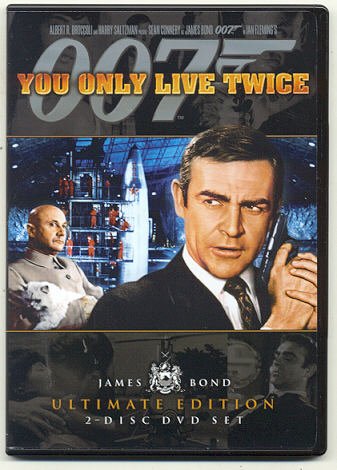
By the time of the fifth James Bond film, producers Harry Saltzman and Albert Broccoli decided to shake things up a bit creatively. Star Sean Connery was probably getting a little antsy inhabiting the suits and drinking the martinis and feared getting pigeonholed (sorry Sean) and announced he was stepping away from the role. However, he still had one more in him, and with You Only Live Twice there was a definite change in style. It may have been based on Ian Fleming's novel, but it was adapted for the screen by Roald Dahl, of Charlie and the Chocolate Factory fame. Lewis Gilbert began the first of his three Bond adventures as director of the Bond films, and in a surprise, Freddie Young took the cinematographer reins, quite a change of pace for the collaborator of such David Lean classics as Lawrence of Arabia.
Moreover, I think You Only Live Twice is probably one o the first Bond films I can recall seeing, growing up back in the day. It's probably because the pre-opening sequence where the spacewalking astronaut gets swallowed by the satellite always stuck with me, who knew? However, the bigger surprise should probably be that there was a pretty good story along with that stunt. In this installment of the film (out of order from the original intent of the producers, who wanted to shoot On Her Majesty's Secret Service), James goes to Japan to continue to thwart the attempts of SPECTRE and Blofeld (Donald Pleasance, Halloween). And because James is in Japan and is as obvious as any tall Englishman can be in Japan, there are some subtle things to make him blend more with the people and the culture.
Posted in: Disc Reviews by Archive Authors on March 21st, 2007
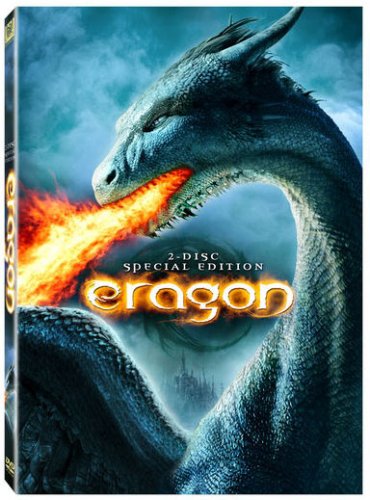
Eragon is based upon the best selling book, which was written by then nineteen-year-old Christopher Paolini. This film was met with much hype, but initially to me seemed to be another generic Lord of the Rings type rip-off, with the addition of a dragon. Not usually my type of movie, but The Lord of the Rings trilogy did more that just amaze me maybe Eragon has a trick or two up its sleeve.
Right from the beginning Eragon starts off shaky, a storyline that seems too have been done a hundred times before; a mesh of Star Wars and The Lord of the Rings. Eragon is a seventeen-year-old farm boy living in the village of Carvahall in the fictional world of Alagaesia. One night, while out hunting, he stumbles upon a dragon�s egg. At first unsure of what�s really going on, Eragon becomes enlightened that he is the chosen one to save his kingdom. It turns out that before the dark ages of Alagaesia�s dark ruler the land was ruled by Dragon Riders, who are just as they�re called, people who ride dragons. The evil king Galbatroix (John Malkovich) sends his evil minion and sorcerer Durza (Robert Carlyle) to kill Eragon and his dragon as they pose a threat to his dark rule of the kingdom. While trying to unite with the remaining rebels, Eragon is trained by Brom (Jeremy Irons) in the arts of magic, combat, and dragon riding.
Posted in: Disc Reviews by David Annandale on March 19th, 2007
Cupt Epics here presents five films identified as "underground" (a fluid term at the best of times). Certainly, they are all deliberately transgressive, though not all are equally successful. Two are by Nico B. - the perviously released "Pig" and "Hollywood Babylon." The former has been reviewed here before, but briefly, its catalogue of murder and S&M horrors, working out a killer's fantasies, is rather too self-conscious about its own transgression. The latter is a 4-minute tribute to Kenneth Anger, taking in exhibits at the Museum of Death. It's not a bad little piece, but it is interesting to note that its existence confirms once and for all that now even the underground film community has an established history to look back on. "Dislandia" is a half-hour, plotless portrayal of a little girl (whose face is covered in a mask) doing odd things and moving through a gritty, disconnected landscape. Interesting visually, the film is sufficiently obscure in its goals that one's mind does begin to wander. "Adoration," on the other hand, is gruelling, brutal, intelligent and effective. Based on an actual case, we see a young man invite a woman to his apartment, record her reading poetry, then kill and eat her. All of this is seen through the eyes of a camera he has place on a wall. The unblinking gaze is explicitly equated with the audience's own, and many uneasy questions about art and voyeurism are thus raised. Finally, "Le poéme" is the one that most viewers will find hardest to deal with: we watch an actual autopsy while listening to the poem "Le bateau ivre" by Arthur Rimbaud. Difficult though the film is, it is also, like "Adoration," quite beautiful.Audio
The sound is 2.0, and the actual sound quality depends primarily on the source material. In fact, "Adoration" is largely silent. But at any rate, the overall audio quality is perfectly satisfactory. There isn't too much by way of surround, and what emerges from the rear speakers isn't always perfectly placed, but the job is generally quite effectively done.
Posted in: Disc Reviews by David Annandale on March 17th, 2007
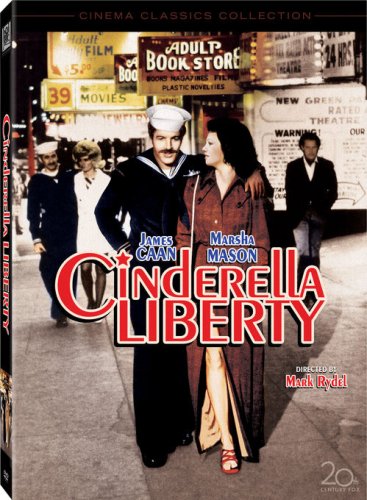
James Caan is a sailor whose stopover in Seattle becomes much longer than he expects, as first he has to wait for new orders when a medical exam forces him to miss shipping out with his crewmates, and then his records disappear. During this time, he meets Marsha Mason, a prostitute with an 11-year-old son. Caan falls for both of them, and a finely developed sense of responsibility sees him moving heaven and earth to make life good for all three. His task won’t be an easy one.
On the one hand, the film has the quality common in films of this era (it’s from 1973) to take its time and soak the audience in a convincingly quirky ambiance. Screenwriter Darryl Ponicsan (adapting his own novel) and director Mark Rydell have fun bouncing the various characters off each other, and we have fun as they do so. But the further into the film we go, the more predictable everything becomes, until there is a generalized collapse into hackneyed melodrama. Ponicsan also wrote the book that The Last Detail was based on, and here, as there, he seems incapable of conceiving of female characters who are not prostitutes (that is, when they are not needy, self-absorbed, neurotic, self-destructive prostitutes). The film has fine performances, is crafted well, but is also badly flawed at its core.
Posted in: Disc Reviews by Archive Authors on March 16th, 2007
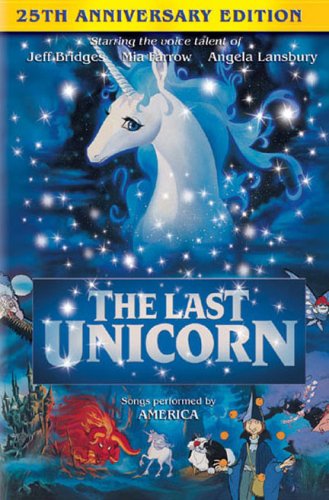
I can't say I'm too familiar with The Last Unicorn, I mean overall, animated children's films were in the midst of a decline in the '80s. However my wife was more than familiar with it and enjoyed it a lot growing up. And Lion's Gate has presumably cleaned up the film and thrown some extras on it just in time for the film's 25th anniversary.
Based on a novel by Peter Beagle and directed by the animation team of Jules Bass and Arthur Rankin (who helped produced such shows as the stop motion of Rudolph the Red Nosed Reindeer and The Hobbit animated version back in the '60s and '70s), the unicorn in question is named, well, Unicorn (voiced by Mia Farrow, The Omen), who walks around rather peacefully in the countryside. She is captured by a witch and is released by her assistant named Schmendrick (Alan Arkin, Little Miss Sunshine). So when Schmendrick and Unicorn are threatened by an ominous red bull, he turns her into a mortal named Amalthea, who finds love by Prince Lir (Jeff Bridges, Tron) and finds out why she was the last unicorn from King Haggard (Christopher Lee, The Lord of the Rings).

Posted in: Disc Reviews by David Annandale on March 15th, 2007
Long the bad boy of French novelists, Jean Genet directed this 25-minute short in 1950. Borderline pornographic, it is a silent portrayal of (literally) imprisoned desire. Two prisoners convey their longing for one another through the prison walls, while a voyeuristic guard watches, becoming aroused and frustrated to the point of violence. Poetic, fetishistic, and intensely personal, it is a startling and historic piece of underground cinema.Audio
Consider the rating a place-holder, because we don't have a star equivalent for "Not Applicable." This is a completely silent film. Not even a score. As for the extras, they are clear enough.
Posted in: Disc Reviews by Archive Authors on March 15th, 2007
At one point or another you�ve either seen Ghost, or have seen some of its memorable scenes parodied. Paramount is now releasing a new special collector�s edition of the 1990 Academy Award winning picture. Since then, star Patrick Swayze hasn�t really been up to much besides a Ja Rule video and a small role in Donnie Darko. Whether Demi Moore has seen success since this film is debatable, but for a while there in 1990 these two were the talk of the town. At the time I was too young to have any interest in the film, so prior to this review all I knew were the memorable clips I�d seen. I looked forward to finally viewing the entire film.
Sam Wheat (Patrick Swayze) and Molly Jensen (Demi Moore) are just your average happy couple living out their lives in New York City. Sam appears to have a problem expressing his feelings for Molly, only saying �ditto� when she tells him �I love you.� Apart from this obvious minor hindrance on the relationship, the two seem genuinely happy. That is until one night while walking back from the theatre the couple is mugged, Sam puts up a fight and is shot and killed. His soul doesn�t realize this and chases down the thief. When he returns to the scene, he realizes what has transpired but he doesn�t accept it and refuses to be taken by the light, leaving him on earth as a ghost. Sam follows the thief home and eventually finds out that none other than Sam�s best friend and co-worker Carl Bruner in fact planned his murder. Frustrated and feeling helpless, Sam enlists the help of the fraudulent medium Oda Mae Brown (Whoopi Goldberg), who appears to be the only one who can hear him. Through her, Sam contacts Molly and tries to remedy the situation, but things get out of control and quick.
Posted in: Disc Reviews by David Annandale on March 14th, 2007
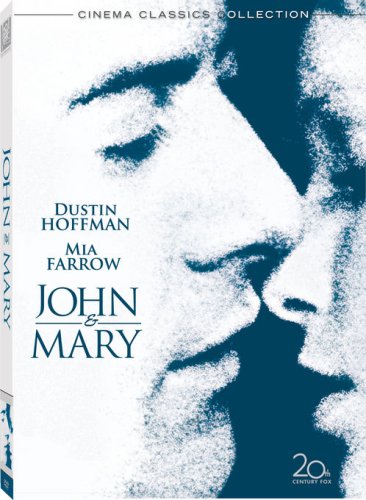
Dustin Hoffman and Mia Farrow wake up in bed together, having just met the night before. Much cautious circling of the one another ensues in the apartment, and as they go their separate ways, more anxious debating follows regarding whether they should get together again. Is Farrow the one for Hoffman, and what about the fact that he doesn’t even know her name?
This is a film that could only have been made in 1969 (unless your name is Woody Allen), what with its incessant interrogation of character neuroses and a very self-conscious attempt to present us with How Romance Works In The New Scene. The script is not as smart as it thinks it is, and a perfect example of this is the scene where are two characters first meet. The context is a disagreement over a movie that another character thinks is pretentious nonsense. The film, never mentioned by name, Jean-Luc Godard’s Weekend. So the reference is lying there for film-savvy viewers to catch and feel superior to the characters, this is hardly a film that can justifiably be name-checking that corrosive satire. In two words, the film is pretentious and contrived. In one word, tiresome.
Posted in: Disc Reviews by David Annandale on March 11th, 2007
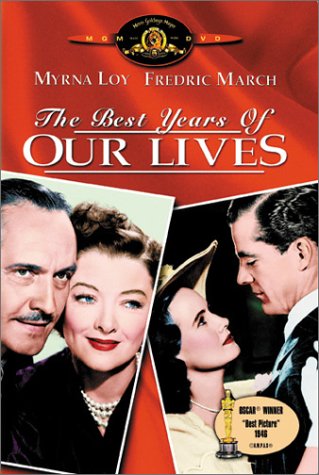
WWII over, three soldiers return to their home town of Boone City. Dana Andrews is the bomber officer unfit for any other kind of work, who foolishly married a party girl just before the war. Fredric March is the banker who is having trouble adjusting to the fact that his children have become adults in his absence. Harold Russell is the sailor who lost both his hands, and can’t bring himself to believe that his girlfriend still truly wants him.
Though clocking in at 168 minutes, this 1946 effort never drags, and does justice to all three characters, but Andrews is ultimately the real focus of the film. Russell himself really was a double amputee, and his scenes could easily have fallen into freak show elements or excessive sentimentality. Both traps are avoided. The film is powerful and moving without ever being sappy, and certainly earned its clutch of Oscars.