Special Category

“Symbols are a language that helps us to understand our past. As the saying goes, a picture says a thousand words, but which words? Understanding our past determines actively our ability to understand the present. So, how do we sift truth from belief? How do we write our own histories, personally and culturally, and thereby define ourselves? How do we penetrate years, centuries of historical distortion to find the original truth? Tonight, that will be our quest.”

Conspiracies can be fun. We all buy into them to one degree or another. I’m not talking about the paranoid nutjob who sees a conspiracy behind every closed door, and even a few open ones. Of course, there is something to the old axiom that just because you’re paranoid doesn’t mean they’re not really out to get you. Of course, we’re not talking about the persecution complex style conspiracy here. We’re talking about the old fashioned cover-up. It’s what made The X-Files so famous for so many years. It’s why JFK’s death is so much more interesting than anything he did in his remarkable life. There are still some crazy people out there that believe George W. Bush orchestrated the 9/11 attacks, or at the very least was complacent in them. Everywhere from Super Bowl outcomes to manned missions to the moon, someone somewhere thinks it was all a big lie. So, you might as well cop to it now. We all love a good conspiracy theory. In his second Robert Langdon novel, The Da Vinci Code, Dan Brown writes about what would be the mother of all cover-ups. As one character put it so well in both the novel and film, “What if the greatest story ever told was a lie?”

This is the second season of this prime time soap opera's fourteen season run. This show is the stories of three couples who all live in the same cul-de-sac, along the second season addition of single temptress Abby Cunnigham (played by Donna Mills), whose role inspires the packaging's amusing tag-line "Abby Cunnigham moves to Knots Landing. Do you know where your husband is?"

The show is a spinoff from the massively popular Dallas, and it contains much the same level of drama peppered with some sassy comedy, leading it to surpass Dallas in ratings for a time. This particular season kicks off with a two part story where one of our Californian cul-de-sac heroes is accused of rape and needs the aid of his lawyer neighbour. From there on we get stories involving the FBI, the mob, and an especially interesting episode where the women of the neighbourhood are held hostage at a baby shower and newcomer Abby uses her seductive powers to aid their escape.

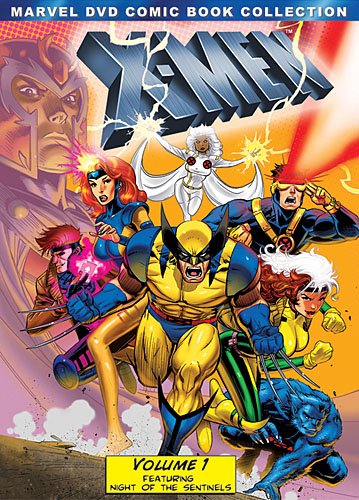
The day of October 31st is usually Halloween to most people. However, back in 1992 it was the day one of the best cartoon superhero shows premiered on the Fox Network. It was simply called X-Men. The show would last seventy-six episodes and five seasons while rising to considerable popularity. I’m not one to toot personal bias, but this is probably my second favorite comic book related animated show next to Batman: The Animated Series. Most of us X-Men fans have been waiting for these episodes to be released for as long as the dvd format has existed. Finally that time has come and I couldn’t be more delighted to watch these again.

Two parents sit in a living room wondering if they did the right thing. Their adopted child: Jubilee is a mutant. They have felt the best thing to do is file her name with the Mutant Registration Program, a privately funded program with ties to the government. The Mutant Registration Program is supposed to be a peaceful group helping humanity and the mutants carry on in their existence. However, things are not as they seem.

With so many cast changes, it didn’t really come as too much of a surprise to fans that the series was winding down. Only one more season would follow, and this year never clicked in quite the same way previous seasons had. By now the team was so significantly different that there was little of the cast chemistry that made this one such a winner. With its glory years behind and only one more struggling year to come, we reach the end of our journey with the IM Force.

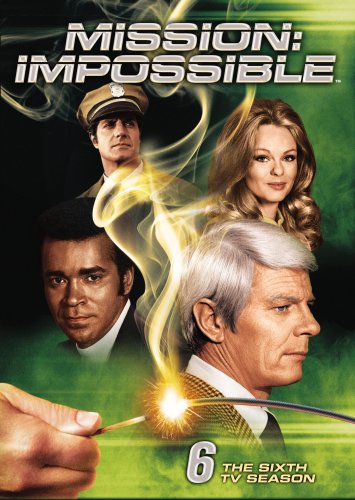
Jim Phelps (Graves) led his team in a sixth season of Mission Impossible starting in 1971. The show continued its trademark traditions. Jim would receive a mission from the “self destructing” tape and would gather his IMF (Impossible Mission Force) team. The team was necessarily eclectic in nature, and it changed significantly in the sixth season. Gone were Leonard Nimoy, Leslie Ann Warren, and Sam Elliott in his signature role of Dr. Robert. Still in the team we had Barney Collier, the gadget man, played by Greg Morris. The muscle was still supplied by Willy Armitage, played by brute Peter Lupus. Together they took on missions that the government could not be officially a part of. They were always admonished that should they be caught “the secretary would disavow any knowledge” of them. Usually they were sent somewhere to put some evil mastermind out of business. Their tactics ranged from scams to outright theft. Sometimes they were a rescue team, while other times they would infiltrate a group of bad guys. There were certainly cold war elements to the whole thing. Each week the team concocted some convoluted con to play on their mark, walking away at the end of each episode often without getting any credit or congratulations.

I’m not a wrestling fan. There is very little about that world that holds any charm for me. I find the grandiose posturing to be rather dull. The characters aren’t all that interesting to me, and I don’t find myself compelled to spend 100 bucks on a “free for all” pay per view event. With that said, this film did bring back a flood of memories for me. When I was a kid, perhaps 11 or 12, I looked at wrestling a little differently. I had an uncle who would watch it from time to time, but the television version never held much for me even then. I grew up in a relatively middle sized town in eastern Pennsylvania. If you play Monopoly, you’ve heard of the Reading Railroad. I grew up in Reading. By the way, it’s pronounced Red not Reed (ing). Nearby in a place called the Hamburg Field House, the regional wrestling federation of the time would film a month’s worth of television episodes in one night. Our parents found out that for about 5 bucks they could drop us off for 5 hours or so and we would be entertained. It didn’t hurt that the place featured 25 cent hotdogs. So my friend David and I would hang out at the joint every second Tuesday and watch live wrestling. To an 11 year old kid, it was as much about being trusted out on our own than it was the event. Still, we did become familiar with the regional names and characters. I even got smacked upside the head by one ranting wrestler’s shoes. It hurt, but it was a bump I wore with some kind of twisted feeling of honor for three days. I don’t even remember the name of the wrestler, but I remember that bump. Times have changed and Championship Wrestling has been gobbled up by the Vince McMahon empire that most of those regional outfits have succumbed to. I haven’t talked to Dave in years, and honestly I haven’t even thought of those summer Tuesday nights at the Field House in a long time, filled up with quarter hotdogs and plenty of soda. Then came The Wrestler.

Randy “The Ram” Robinson (Rourke) is at the end of his career as a superstar wrestler. He’s known for his trademark move, the Ram Jam, where he climbs up on the ropes and leaps down on his helpless opponent. You can feel the pain, not only of his current bout, but the decades of abuse he’s put his body through. In the ring he’s beloved by thousands and respected by his peers. Outside of the ring he’s alone. He seeks comfort in the guise of stripper, Pam (Tomei). Pam is also at the end of her career, finding it harder to compete with the younger girls at the club. She’s drawn to Randy, but resists hooking up with one of her clients. When Randy finally pushes his body over the edge, he has a heart attack. The doctors warn him that he’s got to stop pumping the steroids and growth hormones into his body, and worse, that he has to stop wrestling. Randy tries to acclimate himself to the outside world. He increases his hours at the Acme by working the meat counter and attempts to reconcile with his college age daughter. He even has hopes of breaking through Pam’s resistance. Perhaps it’s too late and he’s too old, but he learns that the only place he was ever really good at anything was in the ring. There he’s accepted and loved for what he is. Randy accepts a rematch, celebrating the 20th anniversary of one of his most famous matches. He’s determined to go through with it and please the crowd, if it kills him.

Sin City arrives in high definition with some pretty high expectations. You get both versions of the movie here, and I have to say that I’m very pleased to see that. By now fans of the movie have seen the recut version of Sin City and likely have your own opinions as to what you thought of it. The fan base appears to be somewhat divided on the effort. For me it’s never been a case of better or worse. It’s merely a case of different. The two versions are very different experiences. Watching the recut version is not really like watching a movie at all. Frank Miller presents them more akin to the original graphic novel experience. For those we don’t already know, this version offers the movie split into four very separate pieces. They each come complete with their own title page and closing credits. You should be warned that these closing credits actually account for more than half the promised 20 minutes of extra footage. They are not even presented in the same order as the original film. Watching the movie this way appears a bit disjointed and leaves many of the movie’s fans feeling like they have been served up their favorite movie in television-like installments. But, there is value to this presentation. It allows you to watch it with a new perspective and a new completeness, albeit within itself. The only segment that just totally doesn’t work is the short The Customer Is Always Right segment, which originally bookended the movie in theaters. On its own it feels rather incomplete and makes very little sense. It’s only after watching the final segment that a newcomer to this material will finally make any connection. There are also many moments where characters appear in the background of one segment leading directly to their own moments. These subtle touches are a bit wasted when one views the parts independently. Of course, there is no escaping the joy of merely watching the original film the way it was presented at the box office. I won’t deny that it is only in that form that the true movie experience can be realized. So what to do with this duality of purpose and divided audience? You give us two complete Blu-ray discs in one release and offer us the choice. That’s exactly what Dimension Films has done for us in this eagerly anticipated high definition release of Frank Miller’s classic Sin City.

For the purposes of this review I spent most of my time in the recut version. I’ve seen the film countless times by now in the theatrical cut and decided to experience my Blu-ray journey with the new version. The audio and video elements are virtually the same, so all aspects of the review remain unchanged. For those new to this incarnation of Sin City, here’s a breakdown of the four segments as they appear on the second disc of this set.

After five years on the air, Hawaii Five-O entered its sixth season pretty much unchanged. There was actually very little change over the years. McGarrett was still on the case with his trusted Danno and Chin-Ho. The Hawaiian settings continued to showcase the locations of the island chain as well as much of the state’s local acting talent. But most of all, the show kept up with the quality of stories. The season began with an armless man out to kill the cops he holds responsible for his condition. The episode, Hookman, would get the season off to a solid start. Charter For Death brings plague infested rats to the island and a quarantine. The Sunday Torch means there’s an arsonist on the loose who only sets fires on Sunday. Is a Federal officer to blame for the death of a wealthy tax evader? McGarrett must catch one of their own in Murder Is A Taxing Affair. McGarrett must protect a visiting dictator from a female hired killer who looks like the target’s own daughter in A Bullet For El Diablo. Is a cop on a rape and murder spree in Hawaii? Find out in Nightmare In Blue. These are just a few of the cases for the gang at Five-O in this 6th season collection.

Working in Hawaii on one of televisions hottest shows in the 1970’s was too good a job for most of the cast and crew of Hawaii Five-0. This meant that there was very little cast turnover for the series in general, and none going into the fourth year. Jack Lord saw his star rise considerably, and while he began to see some serious pay hikes, even he wasn’t about to kill the golden goose. With this kind of consistency, fans were never disappointed or turned off by drastic changes in the cast or formula. With this cop show, it was all about tropical locations and formula. The fifth season was no exception to the rule.

"Space...The Final Frontier. These are the voyages of the Starship Enterprise. Its 5-year mission: to explore strange new worlds, to seek out new life and new civilizations, to boldly go where no man has gone before!"

Star Trek: The Original Series finally makes it to high definition. If you’re anything like me, you’ve been waiting for this day for what seems like centuries. They’re here. One of the best features about this set is the multi-angle option. Remember how we were promised all of this control way back when DVD’s first hit the market? We got the same promises when Blu-ray arrived, and we weren’t going to hold our breath. Hey, I still have a red, yellow, blue, and green button on my Blu-ray remote. What are they ever going to be good for? Anyway, we finally have a use for the angle button. You can use it to toggle between the new digital f/x Paramount recently created for the show, or you can watch the original f/x if you’d rather. With that button you now have the ability to toggle between the two. Through the use of branching technology you can go between them as often as you like and never stop the show. I will warn you, however, that many of these shots occur so quickly that the second delay in transition might not allow you to see the entire segment. It also does not change while the video is in pause. It’s one of the best new features out there and perhaps the best reason to upgrade your recent purchase of season one to the Blu-ray release.

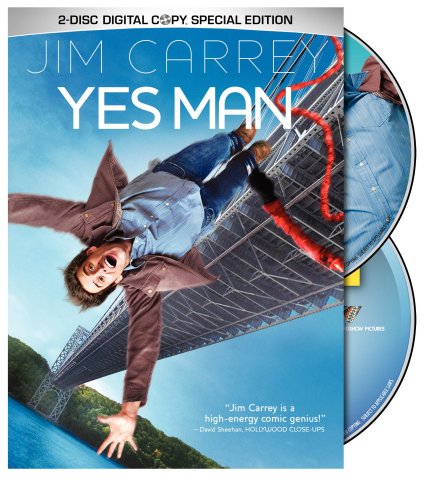
Jim Carrey’s life and career are in a sort of mid-life crisis. He has avoided doing his usual goofball comedy films and opted for more serious roles. His appearance in Number 23 was a bit of a shock for most of us, but he pulled it off reasonably well. Even his more recent comedies have often been less about one crazy character and more about the story elements. It seems that he has decided it was time to return to the parts that made him a household name with Yes Man. But after watching Yes Man,,I have to wonder if maybe that genre has passed him by. For the first time, you really start to see age catching up on the crazy actor, and while he still has tremendous timing, he doesn’t look altogether quite right when he brings out the twisted faces and expressions anymore. It’s not a dig at Carrey at all. Still, it can’t be very good for a comedy, particularly one with a romantic element to it, when your first reaction is that the lead’s starting to look a little old. It’s not even that he looks bad. He just might need to tone down the goofy and concentrate on being more sincere. When Carrey takes that approach in this film he’s far more believable and, yes, that much more funny.

The story is almost a direct riff from his Liar Liar plot. In this one Carrey plays Carl Allen. Carl is a loan officer at a local bank. He was divorced three years ago, but he still hasn’t gotten over it. He’s become somewhat reclusive and self absorbed. He finds all manner of excuses to avoid doing anything with his friends. Instead he spends each night falling asleep watching rented movies on television. What’s worse is that he doesn’t even know that he’s miserable. One day at lunch a former coworker, Nick (Higgens) approaches him as he’s eating lunch in front of the bank. He tells Carl about how a motivational seminar has changed his life. He invites Carl to come to a workshop, but Carl drops his usual no thanks on him. But later Carl begins to realize how detached he’s become and has a scrooge-like epiphany at just how lonely he is. So, predictably, Carl goes to the seminar. Here motivational Guru Terrance (Stamp) preaches the gospel of Yes. He challenges Carl to merely accept every opportunity that comes his way. He commits him to a covenant to say yes to anything. As soon as Carl leaves the building the expected situations arise, where most sane people would say no. In a series of Yes’s that involve a homeless man, Carl begins to have second thoughts when his affirmative replies appear to put him in a bad situation. That is, until he meets Allison (Deschanel). Suddenly his new life appears to bring him a bounty of experiences and pleasures. As you might expect, it’s all leading to some rather uncomfortable consequences. But, as all “feel good” films must, Carrey eventually learns to live his new life in moderation and lives happily ever after.

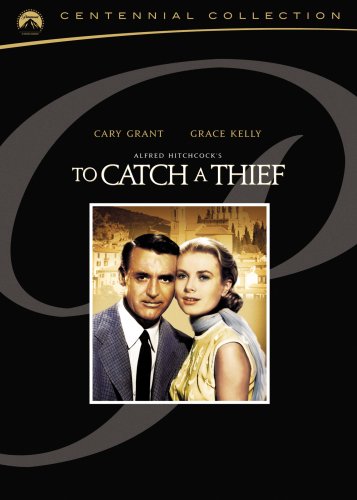
To Catch A Thief is not typical Alfred Hitchcock territory, but then again, it really is. It’s not a terribly suspenseful film coming from the acclaimed “Master of Suspense”, nor is it at all a frightening film even though it was directed by one of horror’s genius minds. What really is scary, however, is how close to a different film this almost was. Cary Grant had exiled himself into retirement. If you can believe his statements at the time, he was concerned that the moviegoing public was pretty much sick of seeing him and preferred the younger actors just then coming of age. He turned Hitchcock down for the role at least twice, before Hitch made a personal visit and appeal to the Hollywood legend. Grace Kelly was also reluctant to do the part. She did it because she loved working for Hitch. Unfortunately, Paramount had other plans. They were troubled that Grant was nearly twice Kelly’s age, and worried either the public or the standards censors would not accept the situation. They were half right. While the film was one of Hitch’s toughest battle with the Standards folks, the public flocked to see Grant and Kelly on the screen together. Grant would continue his return to acting for over a decade longer. Not so Grace Kelly. The Philadelphia native would have her faithful meeting with Prince Rainier of Monaco and would spend nearly 30 years portraying the larger than life, but real nonetheless, Princess Grace of Monaco, before a tragic automobile accident would end her life. All the same, To Catch A Thief would remain one of her last films. Hitch almost lured her out of retirement some years later, but she declined, saying that if she were to do a film, Hitchcock was about the only man she would have done it for.

John Robie (Grant) is a renowned jewel thief and cat burglar. While he’s been retired for fifteen years, he’s still the prime suspect when a rash of burglaries occurs on the French Riviera. The MO is the same as Robie’s, and before long the police are blaming him for the work of France’s newest celebrity thief, The Cat. Robie sees only one chance to get himself out from under the mess. He has to go to the area and catch the real thief. Once there he hooks up with insurance agent Hughson (Williams) who cooperates on the off chance his company can be spared these high payouts. Robie also meets young and attractive socialite Frances Stevens (Kelly), who sets her sights on catching this thief for her own. She constantly tries to seduce Robie, knowing who he is and suspecting him of being The Cat. When her own family jewels turn up missing, she begins to rethink the dangerous game she was playing. That only gives Robie even more incentive to catch the real crook. Will Robie catch The Cat? Will Frances catch Robie? Only Hitch knew for sure, and in 1955 audiences found out in the film classic, To Catch A Thief.