Cult Epics

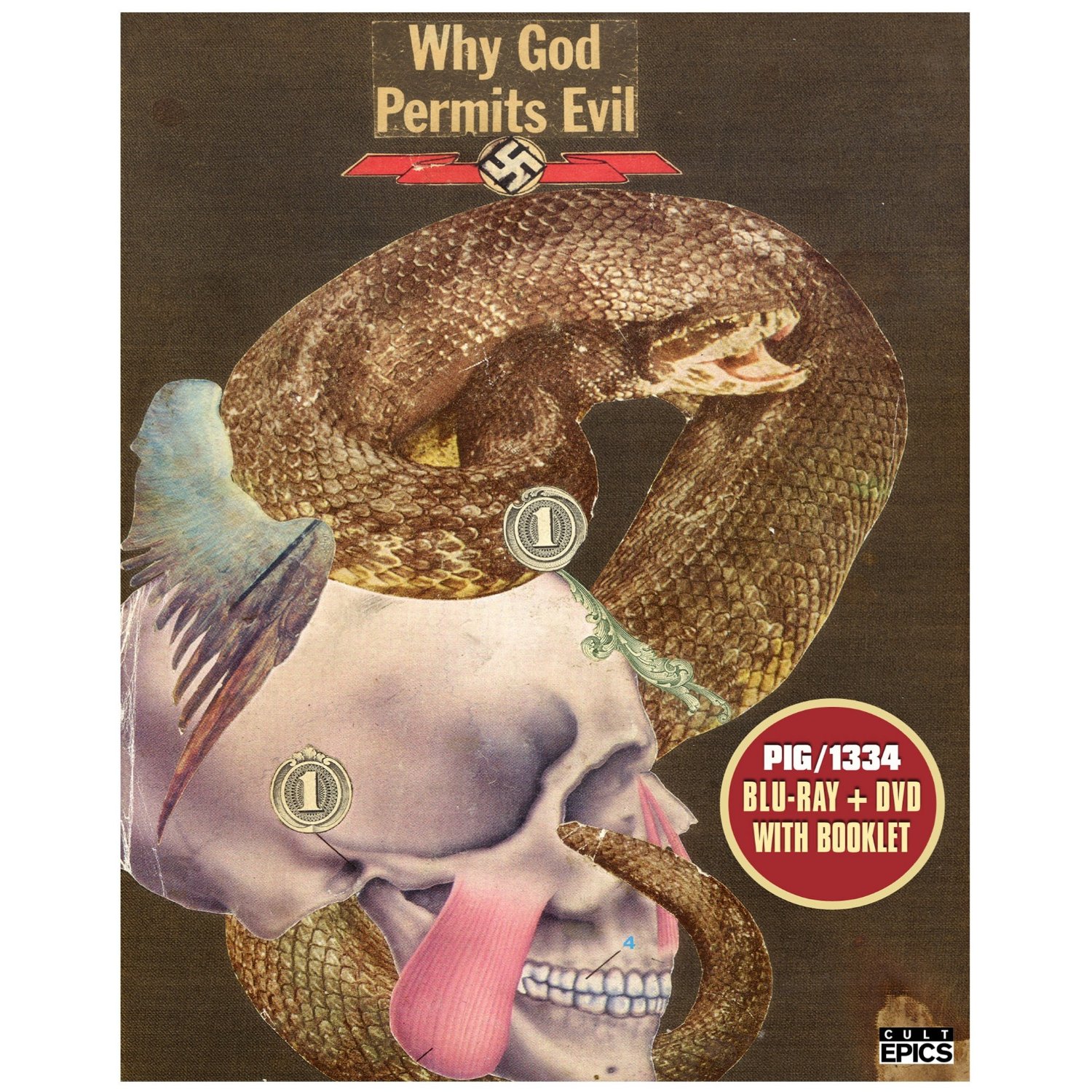
I didn’t know what to make of this Pig/1334 double bill when I took it on as my latest assignment. All I had to go on were the aggressively grotesque images on the Blu-ray case. I wasn’t yet familiar with the work of Dutch filmmaker Nico B. or former Christian Death frontman Rozz Williams. I did a bit of research, mostly because I wanted to make sure I wasn’t being handed a real-life version of the videotape from The Ring.  (Surely, there would be a less drastic way of informing me my services were no longer required on this site.) What I uncovered instead was an intriguing and haunting back story.

Pig is a 23-minute short co-directed by Nico B. and Williams, a pioneer of deathrock. (Unfortunately, I didn’t have access to too many deathrock records when I was growing up in Puerto Rico.) The short was filmed in 1997 and tells the story of a pig-masked serial killer (Williams) who ritualistically murders an unidentified man (James Hollan) in an abandoned house in the middle of Death Valley. Williams never saw the completed product because he hanged himself on April 1, 1998, shortly after finishing work on the soundtrack. (Pig premiered in Los Angeles in January 1999.)

A nunsploitation box set was always an inevitability, and here the good people at Cult Epics chime in with just such a collection, one limited to 2500 copies. There are only two films here, but they are two good ones, the works of strong directors. One is a distinctively idiosyncratic work, showing the unmistakable hand of its filmmaker. The other will quite simply knock you out the back wall.

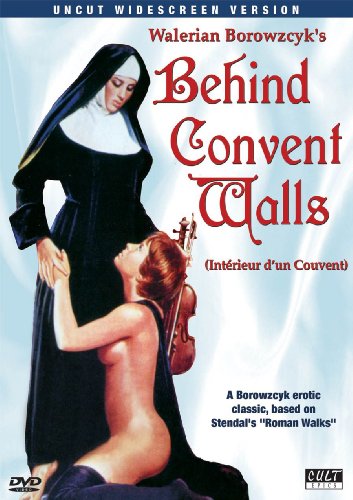
Behind Convent Walls is Walerian Borowczyk's contribution to the subgenre. A repressive abbess rules her convent with an iron fist (not to mention the blade concealed in her cane), but the sexuality of the nuns will not be repressed, and it will make its presence known, whether through rebellion or madness. The film defies any linear summary, given that it is almost impossible to tell the nuns apart, and the various incidents are not only disconnected, they take place with very little motivation or logic. Instead, we have a strikingly beautiful exercise in pure cinema. The Aurum Film Encyclopedia: Horror, on the subject of Borowczyk's Docteur Jekyll et les Femmes, notes, “Borowczyk's imagery, here fed by his fetishistic fascination with all things antiquarian, is often stunning and the film becomes a sort of still life in which familiar yet alien objects … seem imbued with a secret significance all their own.” Exactly the same is true for Behind Convent Walls. While nowhere near as powerful a film as The Beast, it is nonetheless well worth one's full attention.

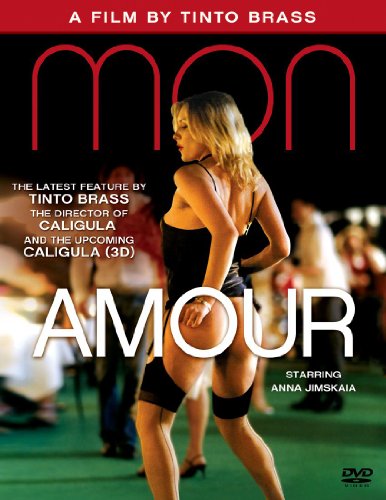
After a series of releases from erotic cinema specialist Tinto Brass's early career, Cult Epics now gives us one of his latest works. Marta (Anna Jimskaia) loves her husband Dario (Max Parodi), but he has become inattentive and selfish in bad, when he shows any interest in sex at all. Feeling lonely and unappreciated, Marta takes in the sights of Mantua, and in a museum she encounters Leon (Riccardo Marino, who is no more French than I am Martian), a sexually aggressive alpha male with whom she begins a passionate affair, with an eye (of course) to re-igniting Dario through jealousy.

As one would expect of a Tinto Brass film, this is a very handsome, lush affair, with some striking compositions and sets. There are moments at a swanky outdoor party that bring to mind the likes of Peter Greenaway. At this party, various characters (including Brass himself) get into a brief philosophical discussion on pornography and sex, and this moment encapsulates the Achilles' Heel of Brass's oeuvre. He has always struck me as a filmmaker who is nowhere near as clever as he thinks he is. His early work, especially Deadly Sweet, is, I think, the most interesting, because its self-indulgence is married to an insanely excessive cinematic frenzy. Bored with what's on screen? Wait five seconds. Here, though, the more disciplined technique is accompanied by a deeply pedestrian story. Revive your marriage through an affair? Ye godz, that's a storyline that dates back to the Triassic period. Meanwhile, Brass gives his obsession with rear ends free rein. He's certainly a filmmaker who is true to his passion, but the drooling male fantasy can get a bit embarrassing.

Cult Epics here presents us with their second box set of films by ex-pat Spanish surrealist/'pataphysician/provocateur Fernando Arrabal. These are more recent works, and are, arguably, even more of an acquired taste than the earlier set, though not necessarily for the reasons one might think.

Car Cemetery is the 1983 TV version of his 1958 play. In a dystopian future, the punk/S&M/whatnot inhabitants of the titular setting live through a rock-n-roll version of the Passion. What would have been a hell of a taboo-buster in 1958 hasn't aged well. Quite apart from the very 1980s costume design of the film (in the most unfortunate ways), the religio-political points, clearly aimed at Franco's Spain, no longer have the same bite when re-staged in the post-Franco era, and today seem altogether precious and rather twee.

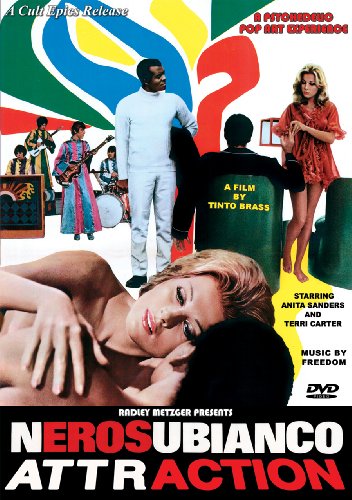
Only the most foolhardy of mortals would attempt a plot summary of this film, and I'm not quite that crazy. This is Tinto Brass's 1969 effort, coming between 1967's Deadly Sweet and 1970's The Howl. The former is a mad, pop-culture collage of noir elements, while the latter is a hallucinatory picaresque. This one is the most plot-free of the the lot. The original title is Nerosubianco, an untranslatable pun that combines “black on white” with the word “eros” (Attraction – note the word contains “action” – is an honorable attempt, and better than the theatrical title of “The Artful Penetration of Barbara,” which is what appears on the screen here, with the new name showing up as a subtitle), and that's about as much as can be summarized: this is an interracial romance. Beyond that, we have an exercise in pure formalism, an eye-popping collection of images and incidents as abstract as they are psychedelic.


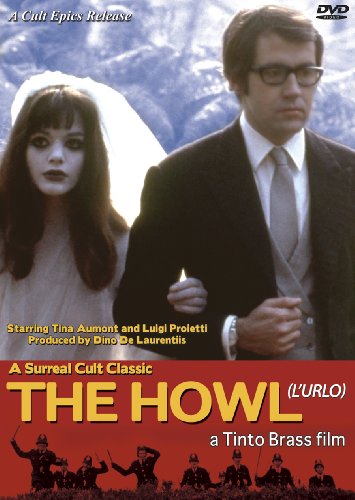
Cult Epics continues its love affair with director Tinto Brass, and here once again delves into one of his early works. For my money, for all that his later erotica is handsomely shot and produced, what I'm seeing of his 1960s output (so far Deadly Sweet and this) is far more interesting. If 1967's Deadly Sweet was demented, it at least followed a semi-recognizable mystery plot. The Howl (1969), on the other hand, defies description. It is basically a surreal picaresque, as a young woman (Tina Aumont) flees her wedding with a stranger (Luigi Proietti) who gives her a come-hither look. Already, this sounds far more sensible than the film really is. The couple race from one lunatic encounter to the next: a resort hotel apparently designed by Sade; a naked, cannibalistic philosopher and his family, and on we go.

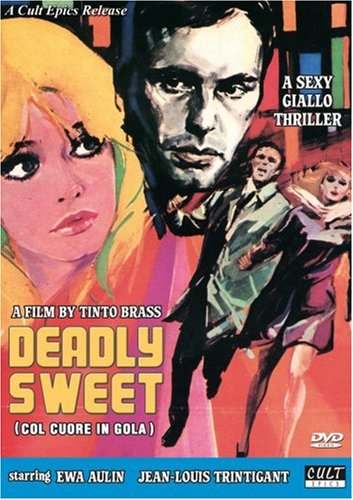
Jean-Louis Trintignant (here dubbed into Italian) is a hard-boiled actor (!). Arriving at a night club to meet the proprietor, he instead finds the man dead, and the luscious Ewa Aulin standing over the corpse, protesting her innocence. Trintingnant believes her, and decides to help her out. The quest for the truth leads them though a series of encounters with various aspects of London nightlife and lowlife, 1967 vintage.

This early Tinto Brass effort is nominally a thriller, though, as he himself points out on the commentary track, the film is only vaguely interested in its thriller aspects. The big influence here is Antonioni's Blow Up, which is name-checked a couple of times. Deadly Sweet has the same kind of meandering plot and love of lingering over various examples of Swinging London counterculture. The other guiding muse is comic book artist Guido Crepax, and Brass mimics comic panels with multiple split screens, shifts between colour and black-and-white, and the like. It is an open question whether all of these games work at a cinematic level, but they are certainly visually interesting. The films is, like so many of its contemporaries, self-indulgent, but in a rather endearing way. For my money, it's a more engaging viewing experience than many of the erotica exercises from the director's mature period.

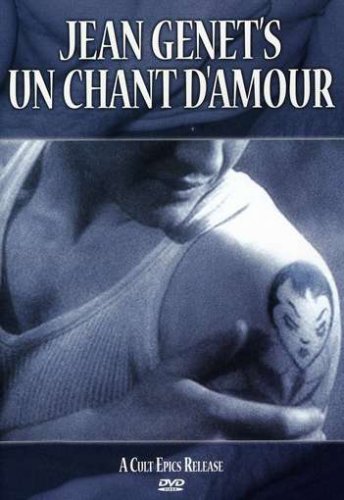
A while back, Cult Epics released a 2-disc limited edition of Un Chant D'Amour. This single-disc reissue features a number of the features (though not all) from the limited release. The actual film and transfer quality are the same, and so much of this review is likewise the same.

Long the bad boy of French novelists, Jean Genet directed this 25-minute short in 1950. Borderline pornographic, it is a silent portrayal of (literally) imprisoned desire. Two prisoners convey their longing for one another through the prison walls, while a voyeuristic guard watches, becoming aroused and frustrated to the point of violence. poetic, fetishistic, and intensely personal, it is a startling and historic piece of underground cinema.

Welcome to 1972, when the sexual revolution is simultaneously in full swing, yet also showing signs of exhaustion (all that swinging can wear a body down, don’t you know). Barbi (Anna Biller) is a model housewife who is awakening to the feeling that there is a world outside her four walls. When she and her husband have a falling out, she hooks up with her more extroverted neighbour Sheila (Bridget Brno), who is also in the midst of a marriage crisis, and the two of them seek new love by taking work at an escort agency. What follows is a picaresque series of encounters, with nary a sexploitation angle ignored.

This film is a textbook definition of “labour of love.” Anna Biller no only stars, she directed, scripted, co-produced, edited, and took care of production and costume design. The latter took ages, since she wanted the costumes to match the decor, but the result was worth it – no small part of the film’s humour comes from its rigorous fidelity to the worst of seventies’ sense of aesthetics. Biller has recreated the classic sexploitation film down to the smallest detail. There are just enough winks to the audience to acknowledge the passage of time (and there is one address to the camera, describing the era as a fleeting utopia for the male of the species, that is as incisive as it is hilarious). The performances perfectly nail their models, capturing stilted, unnatural expressions and their forced enthusiasm. But no matter how much fun is poked at those bygone films, Viva also radiates an enormous love for them. As funny as the movie is, though, at 120 minutes, it is simply too long, and the pace is too measured. Lost of fun, all the same.

Hedda and Neal (Lydia Lunch and Don Bajema) are a couple whose relationship needs work. They have retreated to an old plantation house for precisely that reason, but then Hedda invites over her former lover, Jackson (Henry Rollins). The inevitable triangle that occurs is intercut with flashes of other events from the house’s past.

The fact that the film is barely more than half-an-hour long will be perceived as either a blessing or a curse, depending on the viewer. While this is not as abrasive as Lunch’s collaborations with Richard Kern (Fingered), it will be a hard sell for many viewers due to technical aspects alone (see below). Lunch cuts loose as a femme fatale, but her revealing outfits and pale-face-and-crimson-lips makeup remain resolutely New York Underground, looking rather silly in the rural setting. Some evocative shots, then, and some amusing bits of dollar-store surrealism (check out the bunnies in the kitchen), but also rather more pedestrian than it thinks it is.