Cult Epics

Hugo (Mathieu Carrière) sets out on an errand, but is sidetracked in the Paris metro whenhe chances upon the seductive Myriam (Marino Pierro). Their eyes meet, he follow her, theybeing to chat, and a dance of seduction ensues. They make their way through Paris to anapartment where they have sex, and then nothing turns out as Hugo expected.

That’s about it as far as plot is concerned. So what? you ask. You wouldn’t expect anythingmore from an avowedly erotic film. Don’t be fooled into thinking that the rest of the film is anorgy of naked flesh, however. What you have instead is a film so talkative it makes BeforeSunset look like Gerry. In fact, this 1988 effort (director Walerian Borowczyk’s lastto date) has a rather similar structure to the Richard Linklater romance, but plays out to a muchdarker conclusion. The dialogue is surreal and unbelievably ornate, and one’s enjoyment of thefilm lives or dies by how one feels about all this palaver. The subtitles can only translate the gistof the script, but not its style, and the result might well be crashingly dull for non-French-speaking viewers. There are some visual compensations, as Borowczyk, that most obsessivefetishist of inanimate objects, here worships the everyday of Paris, and invites us to look at theleast romantic, most mundane objects in a new light. The sex scene builds to a denouement thatis a remarkable visual moment, and is worth waiting for. Surreal masterpiece or interminable artwank? My own jury’s out, but I’m glad to have had the chance to think about it.

Synopsis

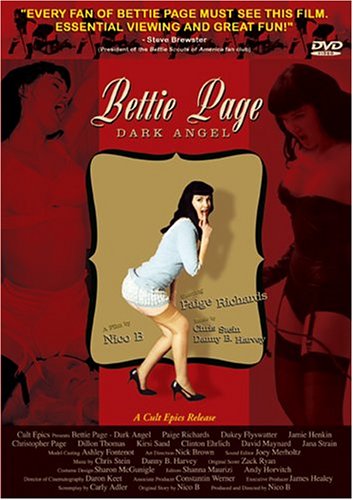
This is an episodic biopic about Bettie Page, moving from her glory days as a model for the pin-up photographer Bunny Yeager and fetish actress for Irving Klaw, maker of B&D shorts. All is well until a Senate investigation into obscenity, and Bettie herself pines for more mainstream, respectable roles. A fair bit of running time consists of B&W recreations of lost Klaw films, with Paige Richards doing a credible re-creation of Bettie’s look.

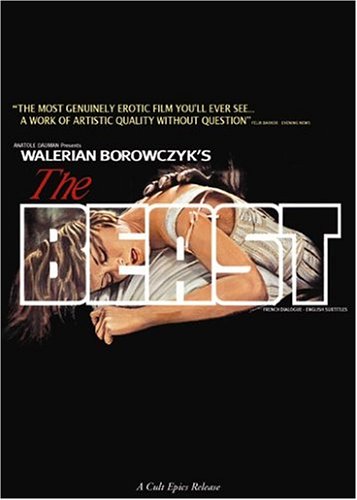
The setting is the home of a decaying family of French aristocrats. The Marquis del’Espérance (whose name is deliberately ironic) is desperate to marry his son Maturin to heiressLucy Broadhurst. Their marriage is in the will of ancestors, but with many conditions. Maturin’sgreat-uncle is desperate to stop the marriage, believing for some reason that it will kill Maturin.Meanwhile, Lucy has vivid dreams of Romilda de l’Espérance who, two centuries before, had avery erotic encounter with a beast in the woods.

Borowczyk takes the story of Beauty and the Beast to its logical conclusion, and the result isdream-like, surreal, poetic, shocking, and very funny. His style has long been noted for itsfetishization of inanimate objects and its attention to the erotics of the small details, and nowhereis this clearer than in The Beast. The visuals are gorgeously lush, drawing the viewer intoa world of heady eroticism. Among Cult Epics’ erotica releases, this is the jewel in the crown.A major release.

Synopsis

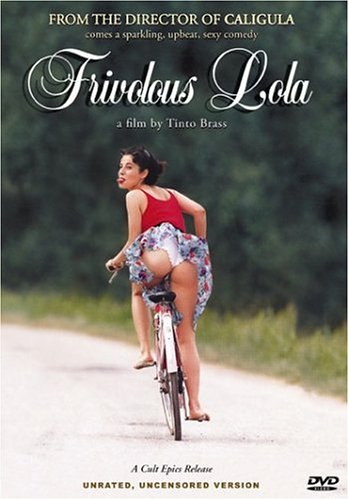
Lola (Anna Ammirati) delights in turning heads in her village, engaging in such antics as riding her bike with her skirt billowing up behind her. The men all think she's great, while the women aren't so fond of her (though the woman working on her wedding dress would clearly like to get to know her better, if you catch my drift). Her main problem is her fiance, who, much to her frustration, refuses to have sex before their marriage. Then there's her stepfather, who seems more than appro...riately interested in Lola, too.


No surprise that in Master and Commander and Pirates of the Caribbeanwould trigger the re-release of older pirate movies. And oh look: those two hits are the firstthings mentioned on the blurb!

Synopsis

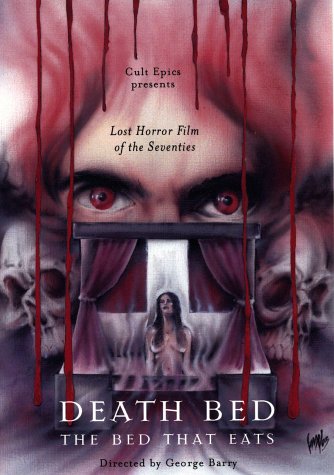
In a cellar (all that remains of a great mansion) lurks a demonic bed. Anyone who lies on it will be eaten (and being eaten involves being surrounded by yellow foam and dragged down into yellow liquid limbo and dissolved). Trapped behind his own painting is the ghost of artist Aubrey Beardsley. He witnesses the bed's depredations (and his narration explains the plot to us), but there is nothing he can do to stop the evil. That, more or less, is the plot. The 80 minutes meander along, and the...story is padded out with lots of scenes (some quite humorous) of one victim after another being devoured. Made for next-to-nothing, and looking it, Death Bed nonetheless benefits from some interesting camera movement and startling production design (especially of the bed itself). There is almost no direct sound, and with the majority of the story explained to us in voice-over, there is a distinct resemblance to the films of Doris Wishman (see A Night to Dismember). However, the off-kilter fairy tale qualities of the story, and some very striking imagery (especially at the end) raise Death Bed well above Wishman's so-bad-it's-great level. Fans of really obscure horror should check this out.

Synopsis

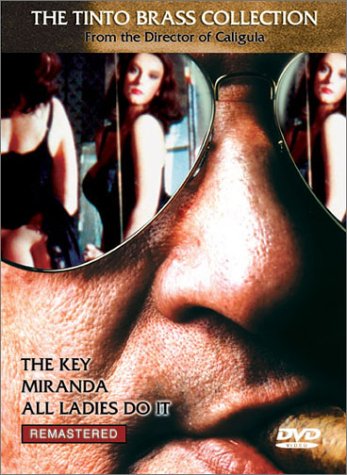
There are three movies here: Miranda, The Key and All Ladies Do It(whose Italian title, Cosi Fan Tutti sounds much less awkward). Though taking place indifferent periods (the first two are set in Fascist Italy, while the third is more modern), all threeshare some similarities in terms of plot: a dark haired-beauty has a long series of eroticencounters, but her true love belongs to one man. Handsomely mounted, with nice attention tocolour and costume, the...films have rather dull stories, and Brass has to ease up on the zoomlens.

There isn't really a plot, as such. In collaboration with director/photographer/scripter/editor Nico B, co-director/composer/writer Rozz Williams works out his serial killer fantasies through the images of a pig-faced man torturing another. The big influences here are equal parts Eraserhead-era David Lynch, the surrealist films of the late-20s-early-30s (especially Un ChienAndalou) and the contemporary piercing/SM scene. In fact, there are moments where this plays like an artsy infomercial for the latter. There is some nice imagery here, but Pig doesn't really go much beyond its influences. The torture scenes, while not for everyone (most of the needles-through-the-penis stuff is obviously real) lack both the emotional context that give similar sequences their power in films such as Sick (where they're for real) and Audition (where they're not). To the contrary, there's something a little too "look at us! aren't we gross!" here, not to mention the fact that, for a supposedly transgressive feature, the atrocities are mostly of the "been there, done that" variety. All this said, the black-and-white photography and ambient score generate some nice atmosphere.

Audio