DreamWorks

One of the more popular characters from the Shrek franchise steps into the starring spotlight here, in an adventure whose locale is rather different from the familiar swamp-forest-castle fairy-tale settings of the parent films. Seeking to steel magic beans from the husband-and-wife thugs Jack and Jill, Puss (Antonio Banderas) and rival Kitty Softpaws (Salma Hayek) become caught up in a wild scheme masterminded by the duplicitous Humpty Dumpty (Zach Galifianakis).

The plot is really more of a premise, serving as the means to set up a grab bag of set pieces (an extended flashback showing Puss and Humpty’s past, and how the latter betrayed the former; the spectacular sprouting of the beanstalk; the dance-off between Puss and Kitty and the Glitter Box). There is a lot going on here, and the jokes come a fast clip. Younger viewers will likely get the most out of this, but there are plenty of bones thrown to the adults in the crowd, including such touches as the in-joke casting of Banderas and Hayek bringing in a whiff of Desperado to the antics. The animation is stunning, and while I can’t speak to the 3D theatrical incarnation of the film, it looks simply stunning in 2D.

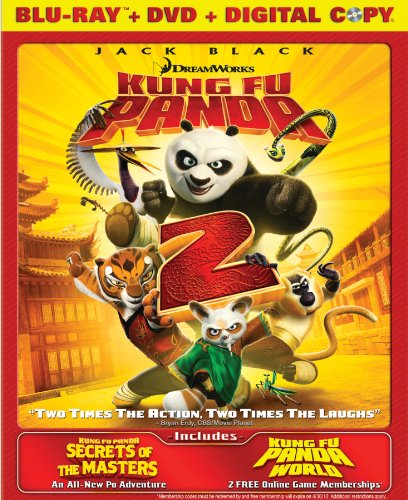
"Long ago in ancient China, the peacocks ruled over Gongmen City. They brought great joy and prosperity to the city, for they had invented fireworks. But their son, Lord Shen, saw darker power in the fireworks. What had brought color and joy could also bring darkness and destruction. Shen's troubled parents consulted a soothsayer. She foretold that if he continued down this dark path, he would be defeated by a warrior of black and white."

We all know who that warrior is, don't we?

Most film-goers could identify a Michael Bay film just by the techniques he uses — quick edits, sun drenched color palette, and lots of action. This usually means that Bay is suited more for low-brow action movies as opposed to high-concept films. In Pearl Harbor, Bay proved that he couldn’t handle anything that didn’t explode — resulting in a lopsided film. The first hour was a tedious love story; the last 90 minutes were better — including an excellent recreation of the surprise attack.

The same is true in The Island. Bay can’t wait to make things explode, and once they do — Bay is very much at home. Though while the explosions are very well choreographed, The Island becomes another action movie that would have worked better had the concept been given more thought.

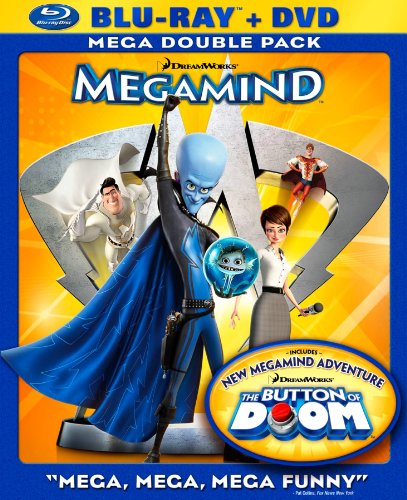
It's funny how the zeitgeist works, in that it is hardly unusual for two films with very similar high concepts to hit the screens at close to the same time. Dante's Peak and Volcano. Deep Impact and Armageddon. Hell, The Towering Inferno came about as a result of Fox and Warner cooperating in order to avoid making identical films. And this year, two animated features with super-villains as their protagonists: Despicable Me and our current subject: Megamind.

His childhood consistently ruined by the budding Metro Man (Brad Pitt), Megamind (Will Ferrell) becomes the super-villain he feels he was destined to be. But when his latest scheme actually succeeds in destroying Metro Man, he finds life curiously empty, and so sets about creating a new super-hero: Tighten (Jonah Hill). But Tighten, it turns out, is more villain than hero, while Megamind, thanks in no small part to a budding relationship with reporter Roxanne Ritchie (Tina Fey), moves ever closer to hero territory.

Alan Ball was pretty much an unknown to anyone but a few Hollywood insiders and fans of such television shows as Grace Under Fire and Cybill, where he wrote a mere total 10 episodes combined. When he began to shop the idea for American Beauty, he had originally conceived it as a stage production. Truth be told, he wasn't sure that there was a studio out there that would touch the awkward dark idea. But Dreamworks was still a young company with big ideas. If there was a studio out there that was going to take a flyer on a young talent with an oddball script, it was Dreamworks. Of course, they weren't going to take a very large flyer. The budget for the film was set at about $15 million. Not much even for 1999. The guys were willing to gamble. The gamble paid off.

The film didn't attract any of the established directors in the industry. I'm sure the budget had as much to do with that than anything else. Sam Mendes hadn't directed a feature film to this point. Actually, he hasn't directed all that many films in the decade since. With the small money and young, inexperienced director, this was looking more and more like an independent or festival film. But then something began to happen.

The cast and crew of I Love You, Man constantly refer to the film as a “bromance”. I’m not exactly sure what they mean by that, but I was actually pretty pleased with the clever turn on the typically droll romantic comedy. Maybe someone’s finally come up with a romantic comedy that actually can appeal to men. Whatever you call it, I Love You, Man is a bit of a refreshing take on today’s innuendo comedy. Writer/director John Hamburg has turned a pretty inane idea into a rather funny little comedy that just might be the compromise between a chick flick and something we won’t have to squirm in our seats just to make our dates happy. You know, to make up for all of those Clint Eastwood/Bruce Willis action flicks that have the same effect on most of the women as romantic comedies have on the guys. A hybrid is born. And it kind of works.

Peter Klaven (Rudd) has just proposed to his long time girlfriend, Zooey (Jones). She’s terribly excited and immediately wants to call her best friends to share the news. Peter is quickly uncomfortable with how much intimate information her friends seem to have. It hits home with him that he doesn’t really have any close friends to share the good news with. Apparently, Peter’s always been a better “girlfriend” and buddy friend. With an impending wedding and no one to fill the best man shoes, he sets out to make a close friend. Predictably, the results are some pretty wild and funny moments. One of his prospects mistakes his attention as a gay pass, and he ends up throwing up on another. All the while he’s trying to sell Lou Ferrigno’s house to make enough money to buy his own dream piece of property. At first Zooey encourages the friendship hunt, and Peter finally meets Sydney Fife (Segel) at one of Ferrigno’s open houses. He’s immediately attracted to Sydney’s brutal open honesty and unwillingness to put on pretenses. The two discover they share a few things in common. Both are garage band musicians with a hero worship for the band Rush. Before long they have become inseparable, and suddenly Zooey is getting jealous of Peter’s new best friend. Together they go through the ups and downs of making the many relationships work.

The Soloist is based on a book written by Los Angeles Times columnist Steve Lopez. The book was based on a series of columns the writer assembled involving his relationship with a street musician he happened upon while searching for material. Lopez was touched by the musician, Nathaniel Ayers, who was playing a violin with only two remaining strings. Still he was able to produce music that made the writer do a double take and begin to wonder what he was doing out on the street. Ayers’ ramblings made it immediately obvious that the man was suffering from mental illness. Their first contact revealed that the street performer was once a student at Juilliard. Lopez took a personal interest in the story, resulting in a series of columns that got him a bit of attention and a personal relationship with Nathaniel Ayers. When he finds out that Ayers was a classically trained cellist, his column ends up providing a nice cello for the musician to play. Lopez attempts to use the instrument as a way to coax Ayers inside and off the street. He exposes him to music instructors in the hopes of cultivating his talent more completely. Together they grow, in a way.

There really isn’t much more of a story than that. Credit director Joe Wright for not attempting to add the usual Hollywood flares in an attempt to make the film more of a commercial success. The story is very true to the real life events and never attempts the usual over the top approach that has become trendy in Hollywood today. Unfortunately, while the decision might have been an honorable one, it might not have been the right one for the film. It did rather poorly at the box office, pulling in a little over $30 million, which didn’t even cover the budgets costs. You have to look at this one strictly as a character study, because you won’t find a satisfying enough story in the film. It just kind of sits there and never really develops into any kind of cohesive form. It’s obviously the product of a series of loosely related pieces of work. We get the idea that Lopez is moved by this man and that he decides at some sacrifice to get involved, but where is the whole thing going? Again, they decide to forego the warm and fuzzy Hollywood ending that wraps things up in a nice tidy bow for everybody. Most of the story hasn’t been told; the relationship is, apparently, ongoing. Perhaps the story needed a proper ending before making its way to a movie.

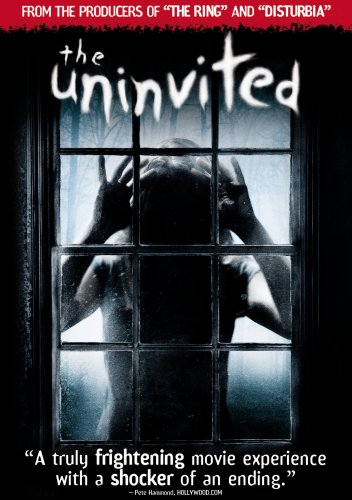
The Uninvited is yet another in a long string of Asian films that are translated and retooled for American audiences. It’s been a rather strong and long running trend that was kicked off with the wildly successful The Ring, from the Asian classic, Ringu. But, for every effective spooky thriller that comes out of this Asian pipeline, there appear to be a dozen or more complete failures. Some American directors think that all they need to do is throw fast moving creepy ghosts at us and often have them inhabit some modern electronic device. Presto! You have a horror movie for the purposes of generated cash. I’m happy to report that The Uninvited is a fresh approach that relies on almost none of these tired conventions to work. There is no morality tale about our modern conveniences here. No ghosts haunt cell phones, beepers, computers, video games, DVD’s, or even toaster ovens. The appearance of spectral creatures is actually quite limited and will disappoint the viewer who is there for the quick scare moments. This film uses the technique sparingly, and ultimately more effectively. The truth is that The Uninvited is really not so much a ghost story as a thriller in the vein of The Hand That Rocks The Cradle. It gives us one of those rare endings that you won’t easily see coming at all. Most importantly, this movie completely shatters the mold of these Asian remakes by making it all about the characters; the human characters, that is. Based on the Korean film that roughly translates to Tale Of Two Sisters, this is a refreshing take on a stale theme.

Anna (Browning) is just getting out of a mental hospital. She’s been there for some time, following the death of her mother in a terrible house fire. She had been haunted by nightmares of that tragic night. Her doctors now think she will be able to cope and return home. Her father, Steven (Strathairn) is hopeful about bringing her home. There she is confronted by a harsh reality. Her mother had been infirm at the time of the fire. Now Anna has discovered that her mother’s former nurse, the very young Rachel (Banks) has moved into the house as her father’s lover and future wife. She notices that in her absence, her mother’s presence has been erased from the home as Rachel has redecorated and removed any connections to her dead mother. She takes comfort only in the company of her sister, Alex (Kebbel) who also hates the woman they see as an intruder in their home. Anna begins to have visions that her dead mother is warning her about Rachel and suspects the fire was not an accident. The sisters investigate, only to find that Rachel’s name is not a real one. Anna is convinced that Rachel killed her mother and will now do the same to her and her sister. When a local boy who claims to have information about the night Anna’s mother died turns up dead himself, Anna decides to get help. But no one appears interested in her story, and now Rachel knows she’s on to her. The film ends in a sort of typical cat and mouse game that ends up not being so typical after all.

Citing personal history, I don’t do really well with horror films. As mentioned in other reviews, my parents let me see scary movies such as Exorcist & Poltergeist (as well as R-rated action films) when I was no more than ten years old. While, Poltergeist sits proudly in my DVD collection, I still have trouble to this day with Exorcist. Yes, I can be a scaredy cat at times. To be also perfectly honest, I was a bit worried when I received The Uninvited in the mail to review. After all, it proclaims proudly on the cover that it is made by the producers of the Ring(which I absolutely hated) & Disturbia. By the end of the movie, I was very pleasantly surprised.

Anna (played by Emily Browning) is out with her boyfriend Matt (played by Jesse Moss) at a local beach party. They start to kiss when Matt tells Anna he loves her and he has a condom. (Wow, that screams love) Upset, Anna decides to leave. She passes her sister Alex (played by Arielle Kebbel) on the way back to the house. Through the woods she goes until she encounters three filled garbage bags. She opens them and the dead body of a redheaded girl spills out. The redheaded girl’s head snaps and speaks. Anna runs again in the direction of the house.

The Last Kiss is based on the internationally acclaimed Italian movie L’ultimo bacio which was written by Gabriele Muccino and adapted for this American version by screenwriter Paul Haggis. From all reports the movie is remarkably similar to the Italian classic with only the ending modified. Haggis tells us in the extras of this release that he attempted to merely translate the original work and performed little in the way of modifications. From the looks of things, the ending was a bit of a struggle for these filmmakers, as there are three different versions available on the release. I think it’s safe to say that the more open-ended version which was ultimately used was probably the best of the choices I’ve seen.

The plot of the film is a rather difficult one to summarize. The movie is less about plot points or beats and is more about the emotional journey of many of the characters. The main story is about Michael (Braff). He’s 29 and fast approaching 30, a time when many people begin that introspective examination of their lives. He’s been with his girlfriend, Jenna (Barrett) for some time but has avoided the ultimate commitment of marriage. We quickly learn it’s a four letter word in their relationship. Now she’s pregnant, and Michael is facing fatherhood. He’s worried that his life is now set out before him with no more “surprises” or diversions left to him. While at the wedding of one of their friends, Michael meets Kim. She’s much younger and is attracted to Michael. Of course, this gives his ego a boost, and he begins to spend inappropriate time with the girl. While he resists actually having an affair until after his secret is out, it damages his relationship with Jenna. Suddenly faced with the loss of his “safe” and “predictable” life, he realizes he had it pretty good and wants it back. All of this doesn’t happen in a vacuum. Around him, Michael’s friends are also going through major life crises. One friend is married with a young child and but wants out. Another friend appears to be happy. He’s on his own and sleeps with a different chick every day. But even he’s beginning to tire of his “carefree” life. Even Jenna’s parents are struggling with the ins and outs of their own “routine” life. Strangely, each character sees another’s life as far better. It’s a perfect example of the old “grass is greener” axiom.