Miramax

Only two social classes existed in the tiny town of Chekian, China, circa 1858: the peasant citizenry, and those who lived in the Governor’s palace. Lawlessness was the order of the day; the streets of Chekian crawled with scum and villainy of every degree, from pickpockets to kidnappers to roving gangs of thugs and extortionists. The worst of all was none other than Governor Cheng himself, the greedy and corrupt ruler of the town (James Wong). The governor’s latest profitable but nefarious practice: to hoard the town food supply and gouge the poor and starving for every sliver of their meager livings. Fortunately for these peasants, they have one advocate with the smarts and the guts to stand up for them: the mysterious Iron Monkey (Ronggaung Yu). To the Governor, he’s a masked rogue fit to be tortured when caught, but to the people he’s a saint clad in black, the Chinese Robin Hood or Zorro, a swashbuckling super ninja who employs his skills mainly in pilfering gold from the governor’s house, oftentimes from right under his nose.

The governor doesn’t just hate Iron Monkey, he’s absolutely terrified of him (as demonstrated in typical over-the-top, grindhouse kung-fu style histrionics). He’s gone to all sorts of measures in an effort to capture this righteous and elusive bandit, from doubling his private security staff, to setting elaborate traps, to hiring powerful but corrupt Shaolin monks. Try as he might, nothing works, and the Iron Monkey always escapes with his prize. Come hell or high water, Cheng is going to stop Iron Monkey once and for all. His underhanded technique uses the son of a Shaolin monk to get the father to promise to bring down the Monkey.

“People give up their lives for many reasons. For friendship. For love. For an ideal. And people kill for the same reasons. Before China was one great country, it was divided into 7 warring states. In the Kingdom of Qin was a ruthless ruler. He had a vision to unite the land, to put and end once and for all to war. It was an idea soaked in the blood of his enemies.”

I have to say that Hero has to be one of the most beautifully shot films I might have ever seen. This is the first time I’ve watched a martial arts film and embraced it as a total high definition experience. The film contains many incredible fighting scenes that are brilliantly choreographed and brutal in nature. But it all takes a back seat to the incredibly breathtaking cinematography coupled with seamless and fantastical CG enhancements. The film is stylish in the extreme, and it might be easy for the story or characters to get lost in this marvelous imagery. They don’t. Fighting scenes might move from black and white to blazing color. Back and forth with incredible rapidity. Yet everything is intensely clear and is never jarring. There is a distinctive Sergio Leone influence from the music to the angles. Too often films use a frenetic pace to hide a multitude of visual sins and hope it’s accepted as brilliant artistic flair. Here you’re invited to savor each moment. The filmmakers dare you to pick apart the imagery or the fighting stunts. You’re encouraged to linger and take it all in. All of the fighting from huge battles to intimate hand to hand takes place in the most exotic and unreal of settings. The film is a study in contrasts at almost every turn. Bloody battle takes place amid stunning beauty. It’s all a rather provocative yet effective blend of traditional Asian cinematography and modern filmmaking. It’s not the kind of film you see. It’s the kind of work of art you experience.

“A hero lives but a few seconds. Ma master holds on to his life. It is more important to forgive than to fight.”

But they don’t know Jackie Chan. When Popeye gets into a jam, he rolls out a can of spinach and down the hatch it goes. Next thing you know that old sailor pipsqueak is kicking butt and taking names. When Jackie’s Wong Fei-hung gets into a jam, he looks for a bottle of sake or maybe a 5th of Jack Daniels. When Jackie drinks, his enemies get the hangover. That’s the art of drunken boxing. The idea is that the alcohol loosens up your body and allows you to fight because you are limber and flexible.

Billy Bob Thornton got himself a well deserved Oscar for the film Sling Blade. If you’ve ever seen the film, or anything else by the man, there’s no surprise that he took home one of the coveted statues. What is a bit surprising is that he took the Oscar home for the screenplay for Sling Blade and not for the masterful performance. Now don’t get me wrong. The screenplay is a brilliant one. He certainly deserved that award, but there hasn’t been a performance as riveting as his portrayal of Karl Childers in a decade or more. It was this performance that made Thornton the household name he became. It’s doubtful many of the other opportunities he did get would have come his way without such a landmark role. The character has become an icon in American pop culture and is imitated frequently in films, television shows, and skits. There have been plenty of imitations, but there’s only one Sling Blade.

It’s almost hard to imagine that this baby is almost singlehandedly the product of Billy Bob Thornton. He wrote the story, directed the film, and played the lead character. It just doesn’t happen this way very often. You’ve seen enough of my reviews here to know what I tend to think of these, often egotistical, one man shows. Most of the time they are self serving crap that passes for high art or entertainment. This is certainly one of those exceptions that, as they say, proves the rule. Of course I never did understand that phrase all that much. Still, it fits about as perfectly as you please here. Every aspect of this film is near perfect. The story is a compelling one to be sure, but I don’t think it would have been nearly as good without such sweet direction and acting. The award might have been deserved; probably was, as Karl would say. But it was the other two elements that really made this film.

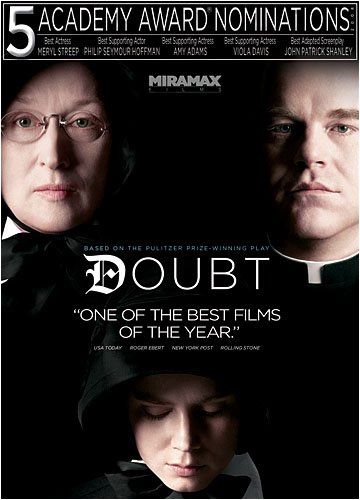
Doubt is a case of art imitating art imitating life. John Patrick Shanley based the character of Sister James on a real sister that he knew as a child. He grew up attending Catholic school, and Sister James was one of the nuns he knew during that experience. While the character was based on something real, the events were not. He took this familiar character and developed the fictional story of Doubt around her. This story became a play. W hen it came to adapting the successful play into a movie, John Patrick Shanley took on the job nearly singlehandedly. Now, I’m not a huge fan of these one man writer, director, producer affairs. The infliction of a single voice on a film often results in a movie that plays too much like an inside joke. Nothing is more tedious to watch than a person laughing at their own jokes. So, I went into Doubt expecting that recipe for disaster. Much to my surprise, I discovered that there really are rare exceptions to any rule. Doubt is that rare exception, without a doubt.

Meryl Streep is Sister Aloysius. She is a very conservative sister who can’t let go of the strict traditions of the past. She has taken a strong disliking to the new parish priest, Father Flynn. Flynn is a progressive priest who embraces the new changes the Church has undergone under the recent Second Vatican Council. The film is set in the early 1960’s shortly after the Pope John XXXIII’s proclamation. She takes exception to the fact that he writes with a ball point pen, takes sugar in his tea, and likes Frosty the Snowman, which she believes promotes such ideas as witchcraft to children. She admonishes the nuns under her supervision to watch the priest for anything suspicious. When young Sister James (Adams) calls a particular incident to her attention, she latches on to the information in an effort to bring down the priest. It appears that Father Flynn has taken a young boy under his wing. The boy, Donald Miller (Foster) is the Catholic school’s first black student and not the most welcome young lad. Father Flynn’s special attention is at first interpreted by Sister James as suspicious when Donald returns to her class from a conference with the priest acting considerably distraught. Now Sister Aloysius suspects the boy was molested. She confronts the priest and engages in a brutal campaign to have him exposed, or at least removed from the parish. All the while Sister James becomes more and more convinced she has misjudged the situation and set in motion a terrible injustice that she is now powerless to contain. Her doubt wears heavily on her soul.

John Patrick Shanley brings his thought provoking play to the big screen in 2008’s best picture, in my book, Doubt. The Academy likely shied away from the controversial content, likely because it doesn’t make it clear this priest must have done what he’s accused of doing. Many of the actors received deserved nominations, but the film was generally snubbed in the final verdict. While I enjoyed Slumdog Millionaire, for Doubt to not even get the Best Picture nomination is a crime.

“Some of the old time sheriffs never even wore a gun. Most folks find that hard to believe. Jim Scarborough never carried one, that’s the younger Jim. Gaston Boykins wouldn’t wear one up in Comanche County. I always liked to hear about the old timers. Never missed a chance to do so. You can’t help but compare yourself against old timers. Can’t help but wonder how they would have operated in these times.”

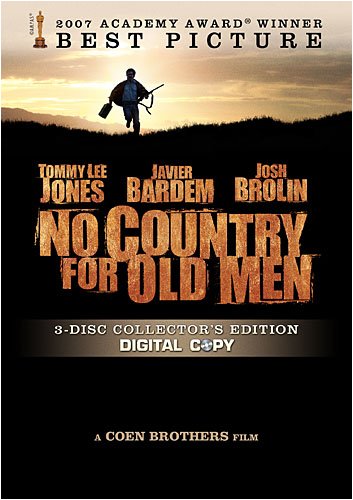
I know I’m getting old myself when a film set in the 1980’s is now considered a period piece. And No Country For Old Men is about as much of a period piece as anything else. More than any part of the story, it’s the mood and the atmosphere of this movie that makes it work on so many levels. Trouble is, no matter how many times you see the dang thing it doesn’t get any easier to categorize what exactly it is. Sure, it is set in the 1980’s, but truth be told it could have just as well been set in the 1880’s. Has West Texas even changed all that much in those 100 years? Watch this movie and you’ll be asking the same question. No Country For Old Men is as much a western as it is anything else. Some call it a “modern western”, but I don’t like that term a whole lot. I mean, when you stop and think about it, what exactly is a “modern western”? I guess you could just as easily answer, No Country For Old Men.

“The crime you see now, it’s hard to even take its measure. It’s not that I’m afraid of it. I always knew you had to be willing to die to even do this job. But, I don’t want to push my chips forward and go out and meet something that I don’t understand. A man would have to put his soul at hazard. He’d have to say, ‘OK. I’ll be a part of this world’.”

We all know by now that No Country For Old Men became last year’s “must see” Academy Awards Best Picture. Unlike this year’s more ambiguous Slumdog Millionaire, this one really was the best film I’d seen in 2007. It’s already been out on DVD for nearly a year.

In the vein of The Cincinnati Kid (1965) and a sprinkle of The Sting (1972) John Dahl brings us Rounders. Card prodigy Mike McDermott (Matt Damon) quits the game after losing everything. Once Mike’s best friend Les “Worm” Murphy (Edward Norton), gets out of jail, Worm attempts to get Mike back into the poker world. As Worm’s behavior begins to implicate Mike, Mike decides to come out of poker retirement.

The film itself is good. The on-screen chemistry between Damon and Norton is not forced. The other performances in the film do not distract from the narrative, with Martin Landau’s standing out. The film is shot very plainly without too many fancy editing techniques or wild Dutch angles. Dahl simply conveys a character piece that does what it is set out to do with little failure. David Levien and Brian Koppelman’s script has been appropriately dubbed “cool” by the poker community. Upon initial viewing most poker references will soar above the viewer’s head. However, upon multiple viewings, you tend to pick up on the language. This collector’s edition offers a plethora of bonus features which is miles away from the previous release.