Studio

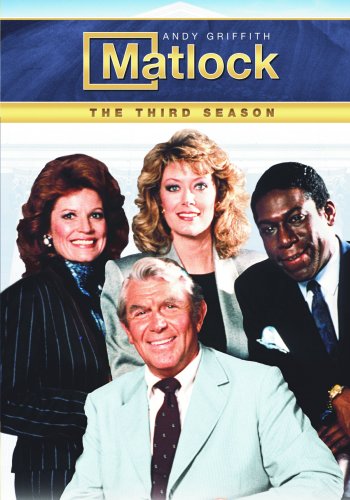
The third season of Matlock brought more of the same. If you’re a fan, that’s very good news indeed. What is that, you ask? Imagine Sheriff Andy Taylor older and now an attorney, and you pretty much have the setup for Matlock. Forget for a second that both characters were played by Andy Griffith. That’s not all they have in common. Matlock is every bit the “southern gentleman” that Taylor was. He might be a little smarter, but he walks and talks like Andy Taylor.

Matlock began life as a television movie from Dean Hargrove, who brought us Columbo. Hargrove would later work the same magic with Dick Van Dyke in Diagnosis Murder. In fact the two shows could easily have been companion pieces. Both featured sit-com stars from the 1950’s and 60’s that had become somewhat iconic characters. Both would don the role of professionals. Both shows would subscribe to the “formula” mode of storytelling. Diary Of A Perfect Murder would set up the Matlock formula. It’s simple, really. Matlock was a lawyer in Atlanta. Some wronged defendant, usually charged with murder, would show up asking for Matlock’s help. Matlock and his team would investigate the crime with an eye toward, as OJ Simpson is fond of saying, finding the real killer. His team consisted of his daughter Charlene, herself a competent lawyer, and Tyler Hudson (Holliday), his private investigator. In the pilot the Matlock character was less Andy Taylor and a little more slick at first. I’m sure that while it was intended to show Matlock’s prowess as a high priced attorney, somewhere along the line it became obvious that the show’s finest asset was Griffith himself and that southern charm he was already famous for. Whatever the reason, you can see the character soften significantly during the early episodes of the season. And that decision was a smart one, as Matlock would continue for nearly a decade.

This, the final season of the series, opens with Samantha (Elizabeth Montgomery) and Darrin (Dick Sargent) on a European tour. This means stock shots of various European landmarks before we return to rather unconvincingly dressed-up studio backlots. There are a few two-parters in the mix, including the opening episodes, where Samantha is zapped back to the court of Henry VIII, and a late-season adventure where the time travel goes the other way, and George Washington is brought forward to the present. Special note should be made of Episode 3, where the Loch Ness Monster shows up, in all his googly-eyed, man-in-a-costume glory.

There's a certain brazenness, it seems to me, for any show, even a budget-conscious one in 1972, to limit itself to the special effects technology of 1896. Indeed, there is nary a moment that couldn't have been accomplished by Georges Méliès. As for the humour, well, it's very much of its period – in other words, it creaks very badly, with the laugh track kicking in at every single line. I remember watching this show as a kid, and getting some fun out of it, though preferring the identically themed I Dream of Jeannie (for reasons now that I cannot recall). Basically, this is mildly entertaining for the nostalgic, but not much more.

As a Henry Mancini score swells with unapologetic cheese, we are swept into the world of the luxurious St. Gregory Hotel in San Francisco. Owned by aging matriarch Bette Davis (replaced, when she had to pull out due to illness, by Anne Baxter, as her sister-in-law), the Hotel's General Manager is James Brolin, who has lots of time to wander around the lobby greeting the various guest stars. In other words, he's Mr. Roarke to the St. Gregory's Fantasy Island. What follows is pure fromage of the Aaron Spelling variety, with every other guest star a fading Familiar Face, no end of improbable crises, painful comic relief, unintentional comedy gold in the dramatic moments, and much of the feel of a 1970s disaster movie minus, sadly, the disaster itself (but you can always re-watch The Towering Inferno to make yourself feel better).

The colours are strong, and the picture quality is generally what one would expect for a mid-80s television program. The grain is minimal, but the image is a bit soft – features and details tend to bleach out and disappear when in the middle distance. That said, the transfer gets the job done, and looks true to original broadcast quality.

In 1954, Coco Chanel (Shirley MacLaine) unveils her first collection in 15 years. The reception is disastrous. As she struggles to bounce back from the fiasco, she flashes back over her life. The bulk of the film then follows the young Chanel (Barbora Bobulova) and her love affairs, first with a callow playboy (Sagamore Stévenin), then with the Englishman (Olivier Sitruk) who will be the great love of her life. Along the way, we see a little bit of her development as a fashion designer.

If you're sitting down for a soap opera in period dress, then you could certainly do worse. As silly as it often is, Coco Chanel is consistently entertaining. Its desire to worship its subject does mean for some unfortunate choices, however. Setting aside the fact that there is too little time spent on what made her one of the world's most famous designers, the film decides to pretend that nothing much happened to her between 1925 and 1954, when the most cursory Wikipeida search reveals all kinds of juicy incident (shacking up with a Nazi officer during occupation, espionage games, post-WWII arrest) that would have made for wonderful storytelling. Oh well. Malcolm McDowell is rather oddly cast as the older Chanel's confidant, and perhaps the fact that he has nothing much to do is the reason why he can't seem to get rid of that sneer of contempt, even when he supposed to be genuinely moved. Still, suds and all, its 139 minutes clips by quite efficiently.

The List is adapted from a novel of the same name written by Robert Whitlow.  After returning home from his father’s funeral, Renny Jacobsen (Chuck Carrington) discovers he is the inheritor of his family’s seat in a secret society founded during the civil war.  However, Renny suspects the society’s activities are more troubling than they lead on and decides to examine them more closely.  When his inquiries are uncovered by the group’s leader (Malcolm McDowell) Renny becomes targeted by a mysterious force that has the power to destroy him and the people he holds close.


“It’s like one of those fatal attraction things, like they show on the Donahue Show, you know?”

It might not have exactly been “fatal”, but the attraction that Jack Lemmon and Walter Matthau had for each other, and we still have for them, is on perfect display in Grumpy Old Men. Then again… it might just as well have been fatal, if not fate. The two men died just months from each other. Matthau left us in July of 2000, and just under a year later in June of 2001 we lost Jack Lemmon. Chris Lemmon, Jack’s son, doesn’t think it’s entirely a coincidence. He told me in a recent interview that the men loved each other. He joked that “if Walter had played golf, he’d have married him.” Whether it was the chemistry these guys had off screen or just their natural abilities, might be hard to pin down. Whatever the reason, there have been few Hollywood duos that put out as impressive a body of work. With Lemmon, it was the fact that he was always rather a dramatic actor who found himself in hilarious roles. With Matthau, he was always the lovable buffoon whose characters almost always got in their own way. They appeared in about a dozen films together, from the enigmatic Oliver Stone JFK to The Odd Couple, perhaps their most renowned comedy. Like all of their films the main attraction, fatal or otherwise, is watching these two buddies work together. Grumpy Old Men might not be anything like their best work, but I’d take these guys on an average day over most duos on their very best.

In a mythical world, a series of apocalyptic prophecies are coming true. These events presage the awakening of a world-devouring dragon. Dragon hunters are needed more than ever, but all of the knights of yore are dead or insane. The only game in town is a couple of misfits: Lian-Chu, who still bears the trauma of the night his village was destroyed by the dragon, and his friend Gwizdo, a two-bit con artist. They are accompanied by Hector, a strange little scene-stealer who might be a rabbit or a dog. Zoe, the excitable niece of the decrepit and blind king, recruits the motley crew to defeat the evil, and off they go, journeying to the end of the world to face terrible danger.

This computer-animated effort is French, but only the English language track has been provided, and I can't help but wonder if something was lost in the translation. Forest Whitaker is top-billed as Lian-Chu, but the character has very few lines, and even less expression. Zoe and Gwizdo have the lion's share of the dialogue, and these two are overly familiar figures. The dialogue moves the story along, but doesn't particularly sparkle. What does shine, however, is the look of the film. The world is a stunningly beautiful universe of floating platforms, and the detail work is tremendous. If the story isn't anything to write home about, the eye candy most certainly is.

I tend to wince a bit when I see these films that star wrestling names and are produced in conjunction with one of the WW A-Z’s. I’ve come to believe that WW means “Won’t Wow”. Along comes John Cena and this latest cooperative film, 12 Rounds. I have to say I was somewhat surprised to find that it was a pretty good action thriller, if a bit implausible. I’m willing to overlook certain aspects of inplauability, if you take me on a thrilling enough ride and try not to totally insult my intelligence. For the most part I found that to be the case here. Cena doesn’t feel the need to work in impractical wrestling moves on his opponents. In fact most of the action is not the hand to hand tripe these movies tend to lean toward. You’ll find plenty of action sequences. There’s a pretty cool runaway rail car, plenty of car chases with the expected carnage that follows, and enough gun play to drive home the point. Renny Harlin, the director, worked on the second Die Hard film, so you know he has a good eye for this kind of action. And while no one will confuse him with John Woo, I think you’ll get enough of an adrenaline hit here to make the 2 hours worthwhile… until we get to the end. More on that later.

A sting to bring down a dangerous terrorist goes horribly awry when the fed’s informant has a sudden change of heart. The result is a lot of shooting, chasing, and dead guys on both sides of the law. Patrol officer Danny Fisher (Cena) is one of the cops drawn into the chase and eventual takedown of the chief terrorist, Miles Jackson (Gillen). In the mayhem that follows, Jackson’s wife is killed. Jackson blames Fisher for the death and vows his revenge.

“Believe me, that weren’t no shark.”

Sea Beast began life with the title Troglodyte, but I’m not sure what that had to do with anything on this movie. Perhaps someone just thought it was a clever name, but realizing they didn’t have a clever film to go with it, they decided on the more mundane Sea Beast. Whatever the reason and whatever the title, nothing can change the fact that this is one really bad horror film.

“If you look closely, you’ll find that everything has a weak spot, where it can break….”

The same can be said for Fracture. There are plenty of flaws, and if you look hard enough you can find a lot of problems with everything from the story to the performances. Thankfully these flaws are quite minor and require the kind of scrutiny that would likely ruin almost any movie experience. I taught law for about 7 years and make it a bit of a (bad?) habit to look for the errors in court and legal procedures. I found plenty here, but they aren’t all that obvious or that detrimental to the plot. You’ll find errors in such trifles as chain of custody for evidence and the admissibility of certain types of testimony. If you’re a student of the law you’ll take note, as I did, and then hopefully move on. There’s too much compelling stuff here to allow yourself to miss out because of some rather common legal mistakes.