Posted in: Disc Reviews by David Annandale on January 13th, 2009
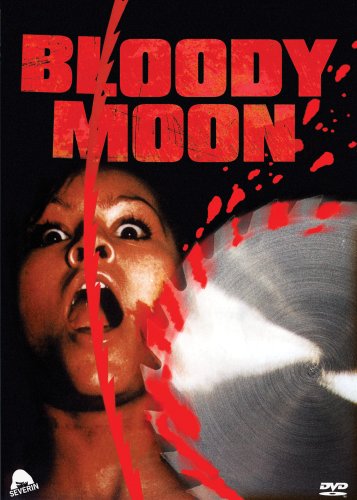
A disfigured young man with an unhealthy interest in his sister attacks and kills a woman. Five years later, he is released (by psychiatrist Jess Franco) into his sister’s care, who is helping organize a language school on property owned by her disagreeable, but very rich, aunt. In short order, the female students at the school (and there are ONLY female students, for reasons not explained) start being killed off. But no one other than heroine Olivia Pascal actually believes that anything is going on.
This was Jess Franco’s contribution to the slasher craze, though it demonstrates just how much that subgenre owes to the giallo by incorporating many of the elements of the latter (whodunit, unseen killer instead of hulking masked figure, etc). The production values are perhaps a bit higher than usual for Franco, and the gore effects are, all proportions maintained, quite good (and certainly very gruesome). But it’s obvious that this is work for hire, as the work lacks many of the more endearing eccentricities and personal obsessions that mark the films he’s more interested in. There is also some unnecessary animal cruelty involving the decapitation of a snake. The sharp-eyed will catch Lina Romay in the credits (as assistant director, under her real name of Rosa Amiral).
Posted in: Disc Reviews by David Annandale on January 12th, 2009
The giallo was never a genre that specialized in tight, coherent, logical storylines. But even by the bizarre standards of the form, In the Folds of the Flesh takes some kinda cake. Trying to summarize its plot is next to impossible, as the first two thirds of the plot are incomprehensible, and are cleared up only in the final third, which feels more like a play than a film, and where the revelations and twists pile up to such a degree that they don't induce whiplash – they torque your head clean off. So, for what it's worth, we have a castle (whose interiors look distinctly un-castle-like) where, thirteen years ago, a man was decapitated. His body was disposed of by the woman living there, and she and two children, now grown and thoroughly insane, dispose of anyone else foolish enough to come prying into their lives.

This is certainly no lost masterpiece. Its story is clumsily told, and would be offensive if it weren't so ridiculous. The murders vary from the delightfully cheesy (the decapitations) to the utterly WTF (death by cuckoo clock?? ). But the demented nature of the exercise makes it compelling in the nature of a train wreck (and speaking of trains, what's with the constant shots of one?). Lovers of the deranged will find much to feast upon here.
Posted in: Disc Reviews by David Annandale on January 11th, 2009
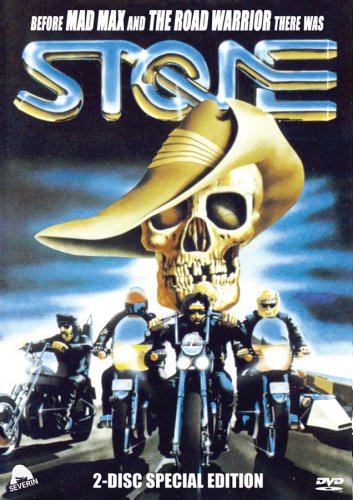
After having been present at a political assassination, the Grave Diggers biker gang starts being killed off one by one. Undercover cop Stone joins the gang (by basically saying, “Hi, I’m a cop. Can I hang out with you guys?”) in an effort to solve the murders. Plenty of shenanigans, riding around, and utterances of the word “man” ensue.
This 1974 Australian effort gets off to a bang of a start with the assassination, a scene that is largely witnessed through the eyes of a heavily stoned biker. The murders that follow are also nicely staged. But then we start getting many, many scenes of riding around and rather aimless hanging about. The eponymous hero doesn’t show up until a quarter of the way through the film, at which point he is able to find out, though his own experiences and the interviews he conducts, what a great bunch the bikers are. So there’s a fair bit of meandering about. But the action scenes are well done, and as a cultural artifact, the film is really quite fascinating.
Posted in: Disc Reviews by David Annandale on January 9th, 2009
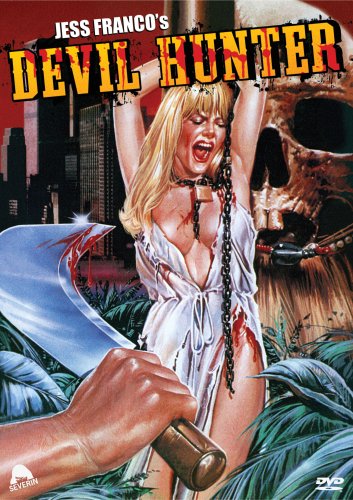
A group of low-life gangsters kidnap a starlet (Ursula Fellner) and hightail it off to a jungle island, where they subject their victim to endless indignities while waiting for the ransom money to arrive. Al Cliver is dispatched to rescue her, but his helicopter arrival draws the attention of a group of hostile natives and, more to the point, a red-eyed, cannibal zombie-god who holds them in a grip of fear.
It was 1980, and so the short-lived cannibal subgenre was in its heyday, so naturally Jess Franco was faced with directing his own contribution. Of course, he did so in his own peculiarly idiosyncratic way. Released the year prior to Severin's other recent cannibal release, Cannibal Terror, it shares that film's conceit of gangsters running afoul of dangerous locals. Also common to both films is some unintentional hilarity (“primitive” tribesmen sporting wedding rings and running shoes, a park bench visible in the background of the jungle around minute 93, or the hero climbing a “vertical” cliff face on his knees, thanks to the wonders of a tilted camera). The usual racism associated with the cannibal movie is somewhat problematized (deliberately or not) by the odd and obvious multiracial composition of the tribe. Where Franco's film steals the march on its poorer successor is a greater sense of expansiveness, even on what couldn't have been much greater means (we even get a helicopter crash), and a more lush, somewhat more convincing jungle (even though we are still pretty clearly in Spain). As well, Franco keeps the pace up with a wealth of incident, not to mention that strange mixture of elements (crime, action film, cannibal film, supernatural terror, even a little bit of King Kong). And the scenes of cannibalism, while far more simplistically mounted than in the likes of Cannibal Holocaust (an extreme close-up of a mouth showing meat and dribbling blood) are nonetheless suitably disgusting. The only shot of innards being yanked out is so brief, it feels like the contemptuous dismissal that it is. All in all, a sleazily entertaining mish-mash that could only have been made by one man, bless his twisted little heart.
Posted in: Disc Reviews by David Annandale on November 1st, 2008
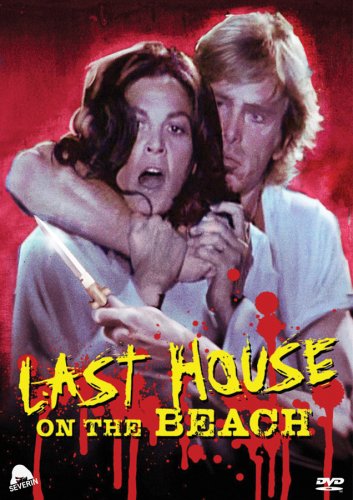
After a violent bank robbery, a trio of criminals descend upon the beach house retreat of a nun and her students. The bad guys take the women hostage, and make themselves at home, tormenting, raping and abusing to their hearts’ content, pushing their victims ever further over the edge.
At the level of plot, not a lot goes on here. The villains are ensconced at the beach house within the first ten minutes, and then story does little more than go through variations of torment until the inevitable retaliation. Nonetheless, there is a fair bit of interest here. The assaults, though very unpleasant and extremely nasty in their content, are, however, filmed with a certain restraint, with the camera concentrating on the faces of attackers and victims rather than on their bodies. Ray Lovelock’s gang leader is a deceptively pleasant pretty boy, and his character arc consistently plays out against expectations. And then there’s the climax, which turns up again almost beat for beat at the end of Quentin Tarantino’s Death Proof.
Posted in: Disc Reviews by David Annandale on October 25th, 2008
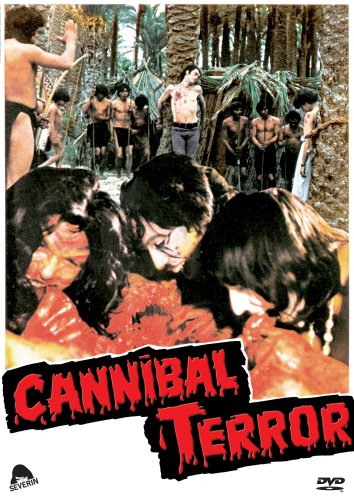
Two inept thieves and their prostitute girlfriend decide to hit the big time, crime-wise, by kidnapping the little girl (clearly and disturbingly dubbed by an adult) of an automobile tycoon. When their contact manages to get himself run over by a car while crossing the street, they have to hightail it out of town until the heat cools (or something like that – don't press me too hard for clear logic in this film). So off they head to what I suppose is the South American jungle, by my goodness there seem to be a lot of pine trees in the jungle. There they hole up at the home of a friend-of-a-friend, a middle-aged man who has the role Jess Franco would be playing if this were a Jess Franco film. He has a beautiful wife, and one of the thieves takes it in his head to rape her. So their host now has vengeance on his mind, and there are cannibals (you were wondering when I was going to get to them, weren't you?) lurking in the woods.
This is the sort of movie that makes life worth living. Sure, you could throw away your 90 minutes on something that is actually good, but in that case you would miss the following: cannibalism sequences where, once the victim has been killed, the carcass being gutted is very, very obviously that of a pig; the most pasty-skinned, European looking cannibals on record, complete with gruesome 70s hairstyles (I swear Sonny Bono is among their number); characters trudging through the brush, ignoring the road visible not three yards from them; and of course, the truck that cruises by in the background of the cannibal village, supposedly deep in the heart of darkness, but clearly a stone's throw from a highway and a beach (look for this wonderful moment at the 92 minute mark). And I haven't even said a word about the hilariously chipper, gratingly hummable Euro soundtrack.
Posted in: Disc Reviews by David Annandale on July 29th, 2008
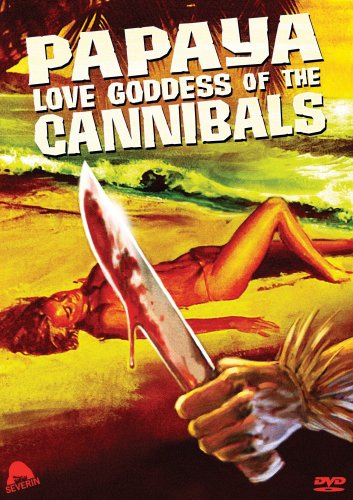
Severin continues their serious play to be the go-to company for Eurosleaze with this, one of Joe D’Amato’s better efforts. We first meet Papaya (Melissa Chimenti) as she luxuriates on the beach, makes love with a fellow in a cabana – and then orally castrates him, whereupon she walks away as two minions torch the cabana. Fantasy Island, this ain’t. The action then shifts to Sara (Sirpa Lane of The Beast fame), a journalist we first see revelling in a cock fight. She hooks up with Vincent (Maurice Poli), a nuclear power executive with whom she has had a casual fling before. The two of them are drawn into Papaya’s web of sex and blood ritual. She is, in fact, part of a political group fighting back against the power company’s expropriations and pollution by any means necessary.
Obviously, not your usual softcore romp, and a rather more interesting storyline than most of D’Amato’s Black Emanuelle series. The characters are still utterly without affect, which casts a vaguely surreal miasma over the proceedings. The sex scenes are pretty risible, but the film actually becomes quite watchable despite these scenes being its primary reason for being. D’Amato’s heightened interest turns up in the editing, in the careful creation of atmosphere, and most of all in the no-punches-pulled working out of the film’s ideas. Papaya raises, if rather clumsily, some hard questions about the nature of exoticism and the justifications for violence. Believe it or not, this is one to think about and discuss.
Posted in: Disc Reviews by David Annandale on May 19th, 2008
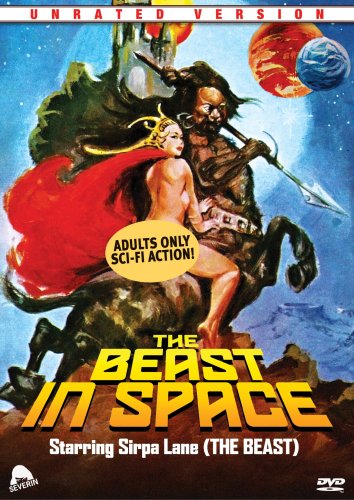
There really was nothing like the Italian film industry in full exploitative steam. The Beast in Space is a perfect example of what I mean. From where else but Italy in 1980 could there emerge a low-rent rip-off of both Walerian Borowczyk’s high-end erotic epic The Beast and Star Wars? Even the poster somehow manages to conjure thoughts of both films. And the title shamelessly implies that it is some sort of sequel to the former. So what kind of alchemy do these elements produce?
Nothing particularly enticing, beyond its considerable value as demented trash novelty. The plot is a surprisingly convoluted bit of nonsense involving and expedition to a planet that has been producing far too much of a supposedly rare mineral. Meanwhile crew member Sirpa Lane (of The Beast) is having bad dreams about being ravished by some sort of satyr-like creature. None of this ever makes any sense, nor is the combination of gruesomely bad FX and costume design with gruesomely boring sex scenes particularly entertaining. But the release is still worthwhile, if only to prove that There Are Such Things.
Posted in: Disc Reviews by David Annandale on April 15th, 2008
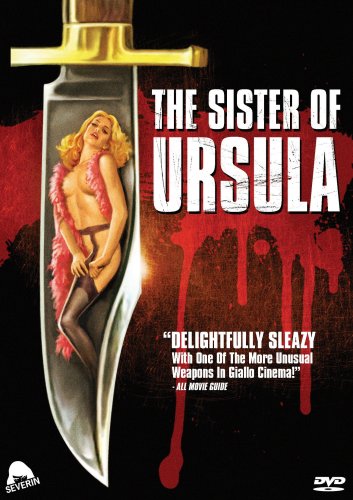
Still grieving over their father’s death, two sisters – the outgoing Dagmar (Stefania D’Amario) and the neurotic, antisocial Ursula (Barbara Magnolfi) – check into an out-of-season hotel. They are almost immediately immersed in a tangled web of relationships and betrayals involving the hotel manager, his estranged wife, a lounge singer and a drug-addicted patron. At the same time, a series of gruesome sex slayings gets underway.
Writer/director Enzo Milioni’s first film is a clumsy giallo. The elements are all there – psychosexual delerium, black-gloved killer, beautiful cast. So too is the aura of misogyny that haunts so much of the genre – the killings here all involve lethal penetration, and while the murders are generally dealt with relative restraint (a hilarious shadow of a looming erection followed by fade to black), there are, late in the film, a number of particularly tasteless shots of naked victims with bloody crotches. Charming. The ineptness of the filmmaking, however, robs these moments of much of their power: the sex scenes are dull and saddled with the same irritating score every time; the editing is rife with nonsensical cutaways (one of which unintentionally suggests that a dog has been masterminding a drug deal); and the story is so choppily told that characterization varies between the risible and the nonexistent. Add to this a resolution that even the most casual viewer of gialli will see coming a mile away, and you have a pretty weak entry. And yet, for all that, there is that delicious ineffable whiff of 70's Italian exploitation that makes even the weakest entries plenty of fun.
Posted in: Disc Reviews by David Annandale on December 14th, 2007
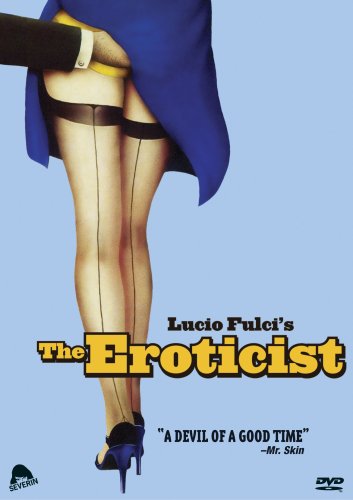
Lando Buzzanca plays Senator Puppis, a telegenic young politician on track to become Italy’s next president. He’s been groomed for the part practically from birth by the Vatican, which plans to re-exert social control over the country through its presidential puppet. But plans go badly awry as Puppis suddenly develops an uncontrollable urge to fondle women’s buttocks (Stephen Thrower has aptly described the character as a “repressed heterosexual”). Even as he seeks help for his condition, various parties around him begin to panic, as the police think Puppis is planning a coup without telling them, the military think they are being left out of the loop by the police, and the Vatican, along with its Mafia catspaws, starts whacking everyone in sight in a desperate attempt to keep everything from completely unravelling.
How’s that for a sex comedy plot? Not exactly of the been-there-done-that variety, is it now? Behind the nonsensical UK release title is one of the most interesting Lucio Fulci films to reach these shores. Fans wanting the Fulci gore will have to look elsewhere, but those open to something new will encounter a level of filmmaking absent in too much of his later work. The sex gags are rather dated (though the moment of the Puppi’s first goose is a bit of wonderful deftness I’ve never seen in Fulci), but the black political satire, which makes up the bulk of the film, while being very tied to the specific Italian context, has lost none of its bite. This is an angry film, one that builds to an utterly appalling resolution, all the more sour for its comic framing. Without going so far as to compare Fulci’s filmmaking skills to Kubrick’s, one might think of this film as Fulci’s Dr. Strangelove – a bitter, hopeless indictment that can only fully express its venom in the form of farce.