Sony Pictures

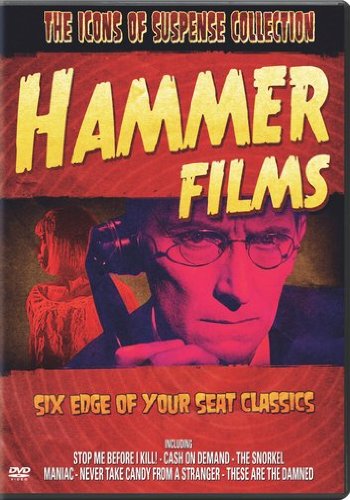
The mere mention of Hammer Studios brings to mind bloody terror to the legions of monster fans who grew up on a steady drive-in staple diet of the studio's iconic monster movies. The studio picked up where Universal left off in the 1950's and delivered a new run of the classic monsters we had been introduced to in black and white. Hammer brought these creatures to life in living ... or is that living dead … color. Dracula, Frankenstein, The Werewolf, and The Mummy were all resurrected for a new cycle of films from the British studio. The place earned its often-used nickname of The House Of Horror.

But Hammer wasn't always known as a horror factory. The company actually began in the 1930's, creating decidedly British versions of film noir. In the 1950's and 60's when the horror phase began, Hammer was also putting out other fare for a hungry public. These films often embraced some chilling elements but didn't rely on monsters for many of the scares. The films were often even crime dramas or supernatural in nature. These films often were the training grounds for some of their staple talent over the years. In this collection Sony has compiled some of these early evolving films from the House Of Horror.

If you are a regular reader here, you know I'm not much for the romantic comedy department. I tried to pass this one off on the rest of the staff but couldn't find a taker. We finally got a woman to review this stuff, but not even she was enthused enough about this title to take it on. This experience is pretty typical when it comes to Did You Hear About The Morgans. With a $58 million budget and a $30 million gross at the box office, it would seem that a lot of folks took a pass on the movie. In less than 4 weeks it dropped from nearly 3000 screens across the fruited plain to just about 500. We're not talking about an unknown cast here. The real mystery is, why did such an impressive cast take this movie on?  Hugh Grant is pretty well known, if not for his movies, then for his back seat antics with a hooker. So, his judgment should already be in question. I mean, who would give up Elizabeth Hurley for a 20 dollar hooker? Sarah Jessica Parker has been riding pretty high on her Sex In The City fame. Perhaps she was just trying to solidify a romantic comedy image here. Both made horrible choices here, and neither generated a character worth caring about. What's worse, the two share no chemistry and even a devout romantic comedy avoider like me knows enough to understand that the two most important elements in the genre are chemistry and characters that you feel something for.

Paul and Meryl (Grant & Parker) are a married couple who have been separated for three years because Paul had an affair. Both are highly successful in their chosen fields. Paul is the senior partner in a prestigious law firm and Meryl runs a very elite real estate agency. Paul wants to patch things up, but Meryl is not so sure. So the two agree to meet for a date and see if they can talk about their situation. The dinner date doesn't go very well and is completely ruined when the two witness the murder of a man who was about to turn state's evidence. Now their relationship issues are the least of their problems. The killer knows who they are (Meryl's picture is pasted everywhere from billboards to bus stations) and he's not about to let them testify against him. Enter the Witness Protection Program. The two are given new names (The Fosters) and sent to rural Ray, Wyoming where the local sheriff happens to be a Federal Marshall who has experience protecting witnesses. Marshall Clay Wheeler (Elliott) and his wife Emma (Steenburgen) are simple folk who live miles from civilization, making their home the perfect place to hide the couple. Now forced together, the two have to deal with their relationship issues to save their own lives. You know the killer's going to track them down, and through the carelessness of the couple's two personal assistants and Meryl's inability to stay off the phone, he tracks them down.

It seems like yesterday, but about a year ago; my cat of 14 years had died. Her name was Burns. She had survived through my college years and the worst period in my life during my 20’s. Sarah had come into my life at that point and I guess my cat finally realized she could let go. Burns was always a loyal companion and there to bring me up when I needed it. I never had a better pet than her, and I probably never will. Hachi, A Dog’s Tale is another story about a faithful animal, adapted from a Japanese true story.

It’s hero day at a local school. One student named Ronnie (played by Kevin DeCoste) starts to spin the tale about his hero: Hachi. Hachi is a dog that was actually owned by his grandfather, Parker (played by Richard Gere). We then start to flash back to a Japanese man shipping an Akita dog that travels cross county and ends up in Rhode Island.

It's back to the 1950's with its telltale alien invasion science fiction matinees. There's Doo Wop coming out of the radio. The cars have tail fins and plenty of color and chrome. That's right. This is 1950's Americana. Well ... almost. You see, the alien invaders are humaniacs. They turn the helpless population into mind-controlled zombies, and they eat brains for breakfast. Those sure are the classic cars, all right. But they're rounded, and instead of wheels they ride on a cushion of air. And then there's the "people". They're green. They have tentacles for hair. And they have only 4 fingers and toes on each hand or foot. Can anyone say, "Give me a high four"?

Meet Lem (Long). He's your typical 1950's teen. His biggest worry is how will he impress Neera (Biel), the girl of his dreams? He holds down a job proudly at the local museum and planetarium, where he teaches that the universe is nearly 500 miles across, containing 1000 stars. Wow! He doesn't have time for the fantastic movies and comics that depict humaniac invasions. His friend Skiff (Scott), on the other hand, reads and watches them all. He's quite well versed in the topic of alien invasion. He's convinced that "they" are coming, if they're not already here, that is. For these innocent and peaceful folks, the nightmare scenario that they've feared their entire lives is about to come true. An alien has invaded!

"There's two kinds of people in this world when you boil it all down. You've got your talkers and you've got your doers. Most people are just talkers. All they got is talk. But, when all is said and done, it's the doers who change the world. And, when they do that, they change us. And, that's why we never forget them."

And while The Boondock Saints never did bring in box office gold (heck, it didn't even bring in Box Office aluminum) like the characters in the film, they were not forgotten. There were conventions and local film festival showings that brought out untold thousands to share the movie experience. It became what we commonly call today a cult hit. But that's a term of endearment used by critics and fans to describe this kind of grass roots fan base. Unfortunately, it's a dirty word in Hollywood. No one in the studio highchairs wants to produce a cult film. Well, no one except maybe Troy Duffy.

Remember the blaxploitation films of the 1970's? These films generally played on the ghetto stereotypes that would likely not be as well tolerated today. The films were populated with fur-adorned pimps driving in purple Caddys. The street language was almost indiscernible. The black population sat around drinking from large malt liquor bottles in brown paper bags. In a day where almost every potential racist remark is pounced upon, it's hard to imagine that this kind of thing could have existed at all. But the point was that these films weren't feeding into the stereotypes for the most part. They were making fun of them. They were showing us how ridiculous they looked when taken to such extreme. What's more, the films offered the first real star vehicles for so many talented black actors. Certainly, the genre has always had its detractors, but they never seemed to cause a stir among the members of black leadership. The truth is that these films no more depicted black culture than mafia movies depict Italian culture. It's just a lot of fun to poke fun. You gotta let your hair down, or frizz out, sometimes.

The genre was important during the time and its influence began to be felt in mainstream pictures of the era. Characters like these began to show up everywhere. Starsky And Hutch was a white cop , but their streets were often populated with these characters, most notably the Huggy Bear snitch. Even James Bond suspended his international fight with global domination crooks to tackle a gang of blaxploitation drug dealers in Live And Let Die. In the 1970's you couldn't get away from it. Some of these films became huge. Shaft and Super Fly became huge hits. The recently departed Rudy Ray Moore created Dolemite, a bad Kung Fu/kick butt and take names, F Bomb droppin' bad dude. There's no question that Moore's character was a huge influence on Black Dynamite.

When the original 1987 film The Stepfather came our way, the world was a very different place. Of course, that's true with any titles that are separated by nearly 25 years of time. When reboots or remakes are attempted, as they all too frequently are today, it is often true that some allowances must be made for those inevitable changes in our world. Filmmakers attempt to make whatever adjustments they deem fit and bring the old favorite, or not so favorite, into our current collective consciousness. Like all things, sometimes it works. More often it does not work. And then there are those occasions where it simply could never work. The Stepfather was released just at the dawn of this new instant information age. In 1987 most public records weren't available at the click of a mouse. There weren't social networks and Google options that allowed any normal person to become a private investigator. Put simply, it was a time when a person could still step into a new persona and leave his past acts behind him. Certainly, the ambitious could still research someone, but that required dusty basements in newspaper offices or library microfiche. The idea so essential to the suspense and thrill of The Stepfather simply no longer exists. The only way a remake could have really been effective was to make it a period piece and set it in the 70's or 80's, if not earlier. A ten year old kid can get the goods on you now. Here David doesn't appear to be concerned at all about fingerprints and DNA.

The original film had more than a slower information age going for it. Terry O'Quinn delivered one of the creepiest performances of his career. Yeah, that's the same Lost John Locke Terry O'Quinn, so it shouldn't be that hard for you to imagine an enigmatic performance. Even in 1987 the idea wasn't terribly original. There were enough stalker films by then that the concepts were already tired and worn. What made that film work more than anything was that performance. I remember particularly a moment, badly reproduced here, when O'Quinn's character stops and looks blankly at the camera and says, "Who am I here?" O'Quinn gives us a look that totally defines the hideous pathos of his character, and in that instant we realize how dangerously deluded he really is. It wasn't the back story. It wasn't the body count leading up to that moment. It was all in that look. It sent a shiver through the stoutest spine. And it is that element that is completely absent here. Dylan Walsh is a fine enough actor, and his performance is solid, but he never truly frightened me. Without that glue, the pieces of this remake simply cannot hold together.

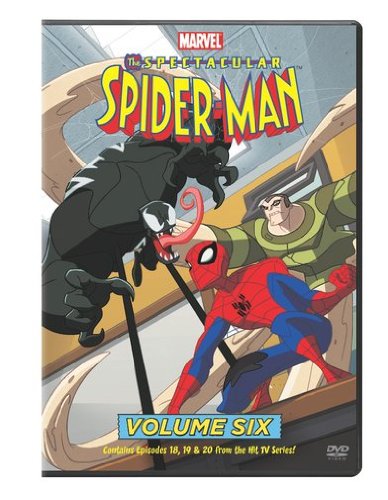
Greetings here from your favorite neighborhood reviewer and Spidey-expert: the infamous Kedrix. I certainly have a habit of appearing whenever there is a Marvel or DC superhero involved, especially if the source material happens to be animated. Needless to say, when the opportunity to review Spectacular Spider-Man both volumes 6 & 7 came available, I jumped to the task. Somehow, we missed Volume 5 (I have seen the first four), but I'm sure we can pick right back up and get to the spectacular action. (one paragraph in and we are already using bad puns, tsk tsk)

Volume Six of Spectacular Spider-Man is something short of a breather for Spidey as he is recovering from some run-ins at the hands of Mysterio & Kraven the Hunter. He even had yet another altercation with Dr. Octopus. Things are also looking up for the web slinger as he even gets invited to Flash Thompson's birthday party. Little does he know he is about to run into the Sandman who is still looking for his big score.

Brian Clough (Michael Sheen) is the manager for the Leeds United soccer team, brought in to replace Don Revie (Colm Meaney), who is off to manage the England team. Clough is young, charismatic, brash, arrogant and opinionated, and has some pretty unflattering (and publicly aired) views about his predecessor and the thuggish style of play he fostered. So begin his 44 catastrophic days in 1974 as the unwelcome manager of United, and the film flashes back to the meteoric rise that brought him to this crucial pass.

This must surely be one of the best sports-related movies I have ever seen. Every conceivable sports movie cliché goes out the window. There are no extended sequences showing the games, just some quick, impressionistic shots that tell you all you need to know. This is not the inevitable story of the Underdog Making Good. It is the reverse: a rising star who takes over the most successful team in the country and becomes a legendary disaster. And yet the film is oddly triumphant. It is very much about Clough's relationships with two men: his obsessive rivalry with Revie, who isn't even aware of him, and his deep friendship with partner Peter Taylor (Timothy Spall), a friendship that might save him from himself, did he but realize it. The performances are superb, with Meaney looking uncannily like Revie (seen in footage at the end of the film), and Sheen astounding yet again, in the wake of his performances as Tony Blair and David Frost, cementing his position as one of the great actors of this generation.

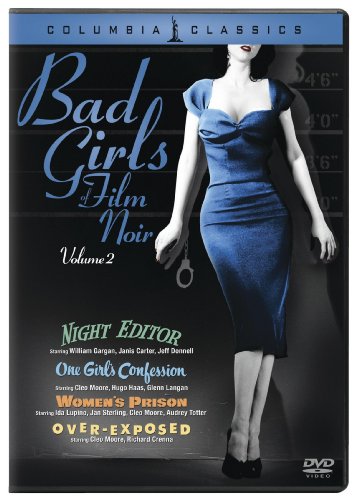
“In the 1940’s and 1950's the juiciest roles for actresses in Hollywood were often in B pictures that explored the dark side of life, staring roles as cool, calculating girls who could stick a knife in a man's back and make him like it."

And so Sony collects 8 of these films as part of what looks like is going to be an ongoing series. But what exactly is Film Noir? You hear the term used from time to time, but what does it mean?