1.85:1 Widescreen

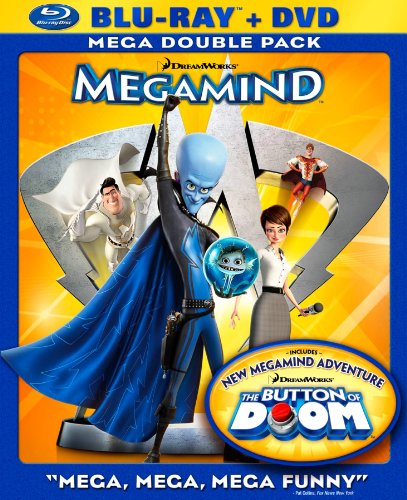
It's funny how the zeitgeist works, in that it is hardly unusual for two films with very similar high concepts to hit the screens at close to the same time. Dante's Peak and Volcano. Deep Impact and Armageddon. Hell, The Towering Inferno came about as a result of Fox and Warner cooperating in order to avoid making identical films. And this year, two animated features with super-villains as their protagonists: Despicable Me and our current subject: Megamind.

His childhood consistently ruined by the budding Metro Man (Brad Pitt), Megamind (Will Ferrell) becomes the super-villain he feels he was destined to be. But when his latest scheme actually succeeds in destroying Metro Man, he finds life curiously empty, and so sets about creating a new super-hero: Tighten (Jonah Hill). But Tighten, it turns out, is more villain than hero, while Megamind, thanks in no small part to a budding relationship with reporter Roxanne Ritchie (Tina Fey), moves ever closer to hero territory.

Charlie Babbitt (Tom Cruise) is a self-centered dealer in exotic cars. He imports high-end sports cars into the states and sells them to the highest bidder. Within the first 10 minutes, we learn that he is not above bribing the EP for the cars to pass emissions, that he treats his girlfriend poorly, and that his father has just passed away. As he goes to the reading of the will, hoping for a big payday, his father leaves him only a car. Charlie is furious to learn that more than $3 million in a trust account has gone to an anonymous person. Turns out the anonymous person is an institutionalized autistic savant named Raymond (Dustin Hoffman).

Since Raymond is a voluntary patient, Charlie organizes his discharge (for his own nefarious reasons) and the two set off on a journey to Los Angeles. Along the way, the cold and calloused Charlie warms up to Raymond, even as the autistic man has more and more difficulty in living life outside of the controlled environment of the institution. So it’s basically a road movie that tracks the change in character of Charlie from a money-hungry bastard to a caring individual. In the end, Charlie becomes less concerned with the potential money he can get from Raymond and more on the health and safety of Raymond himself. It’s a satisfying arc for Charlie. The film is widely credited as an insight into a condition (autism) that previous to 1988 wasn’t very well understood by the masses. The writing is strong, the directing excellent, and the acting top-tier.

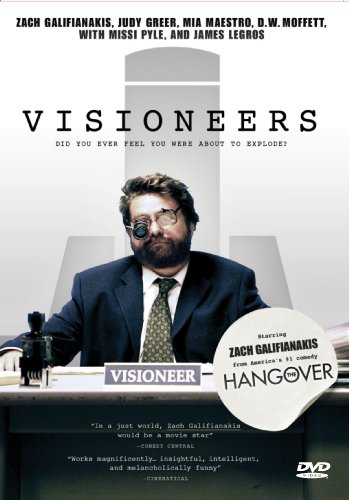
In this satire of modern life, Zach Galifianakis plays a man named George Washington Winsterhammerman who has a beautiful wife, a large house, a stable job in the world's most successful corporation, and even a boat. Despite all of this he fears he is showing symptoms (which include dreams) that he might be about to literally explode, a mysterious and unexplained epidemic that is sweeping the country.

This film is jammed very obvious messages and metaphors for how we are living artificiality through celebrity advice books, pills, corporately controlled media and other suppressants for independent thought. The most apparent in the film is when George cannot please his wife sexually she religiously follows the daily advice of her favourite talk show host, dresses and eats just like her in order to change their lives around, and eventually tries to emulate her suicide, that occurred live on her show, when all else fails.

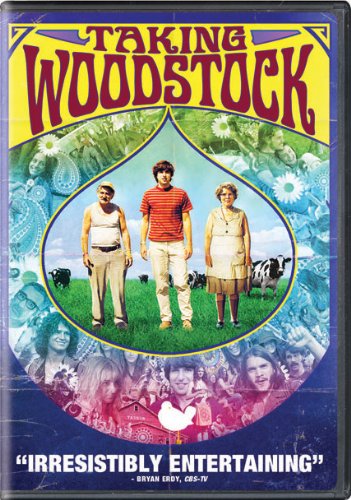
A young man wants to stimulate the economy of his tiny community, mostly for the sake of his parents struggling motel, and inadvertently welcomes what would become the original Woodstock festival into his back yard (literally).

Based on the true origins of this music festival that changed the world, we do not see the happenings of the stars onstage like other Woodstock films might. From beginning to the end, we only witness the muddy setup of the campsites and the infamously congested highway leading to the stage.

Allen Ginsberg is often regarded as one of the most important poets of the 20th century. He is seen as a symbol of the Beat Generation and contributed to the San Francisco Renaissance. His most important work, Howl has created both worldwide controversy and praise. It escalated into a 1957 obscenity trial of the poet and Lawrence Ferlinghetti who had published Howl along with other selections from Ginsberg. The film is a celebration of Ginsberg’s life as well as the results of this trial.

In 1955, an unpublished 29 year old poet presented his vision of the world as a poem in four parts. His name was Allen Ginsberg (played by James Franco) and the poem was Howl. In 1957, Allen and his work would be put on trial for obscenity. The trial would be prosecuted by Ralph McIntosh (played by David Strathaim) and defended by the prominent Jake Ehrlich (played by Jon Hamm). Judge Clayton W. Horn (played by Bob Balaban) would preside over the proceedings and render judgment.

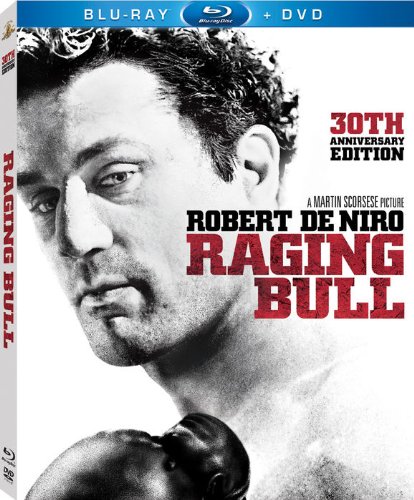
"Give me a stage where this here bull can rage."

Under normal circumstances and certainly under less skillful hands the story of Jake La Motta would not be one worth telling. His life is a story without heroes. It's a life of abusive behavior and an almost unredeemable personality. The only way he was ever capable of expressing himself was in the boxing ring. Even there he was doomed to feel inadequate most of his life. Even as he was rising toward the middleweight championship of the world, he was obsessed by his own small hands and the realization that he was fated to never test himself against the world's very best fighters. He alienated everyone around him. He was utterly and completely self-destructive, and you either left his sphere of influence or you let him drag you down in to his own dark abyss. Why in the world would anyone want to see, let alone make a film based on the life of Jake La Motta?

Philip Seymour Hoffman has become quite the acclaimed movie star by working in many well nominated flics such as Capote, Doubt, and Charlie Wilson’s War. However, Mr. Hoffman does a great deal of stage work when he is not performing in front of a camera. His recent directorial debut involved a piece of stage work that he brought to film, Jack Goes Boating. Let us see how this plays out.

Jack (played by Philip Seymour Hoffman) and Clyde (played by John Ortiz) are two limo drivers in New York City. They are both interested in moving out from the limo driving business. Clyde is attending night classes while Jack is thinking of applying at the Metropolitan Transportation Authority. They are also best friends and Clyde is currently trying to hook up Jack with a girl named Connie (played by Amy Ryan).

Most people who have read my reviews before know that I don’t particularly care for prison movies. They hardly ever have a complicated story and instead focus their time solely on fights and homosexuality. But there are examples out there that go against the grain. One such movie stars a very young Sean Penn who is a young thug on the wrong side of the law. He ends up in a juvenile detention center which is made in ever way to appear like a prison. It is simply called: Bad Boys.

Mick O’Brien (played by Sean Penn) is a troubled teen living in Chicago. He steals purses from ladies; he knocks out men and takes their wallet. During the day, he goes to school. He has a best friend named Carl (played by Alan Ruck) and a girlfriend named J.C. (played by Ally Sheedy) who he cares for very much. Life is hard for young Mick and things aren’t looking to get better any time soon.

"Did you ever notice how you let a Mexican into your home just because he's got gardening tools? I mean, no questions asked. You just let him right in. He could have, you know, a chainsaw or a machete."

The last year has been a hot year for the illegal immigration debate, between the Arizona law and the various politicians to the vigilante groups that volunteer to arm up and patrol the borders. As the debate rages on and the violence increases, it was only a matter of time before someone exploited it all for your entertainment pleasure. Who better than Robert Rodriquez and his usual cast of suspects?

The Graves:

When you first look at the title for this entry in After Dark’s 4th annual 8 Films To Die For, you probably have summoned up images of a dank and foreboding cemetery where unspeakable horrors rise from their resting places to torment the, albeit temporarily, living. This is definitely a little bit of a case of false advertising and the misleading use of a title. These Graves are sisters, Megan (Grant) and Abby (Murray), to be exact. They’re the kind of sisters who do everything together. You know the type. They almost speak in a secret language and appear to be soul mates. But Megan is a bit more outgoing and has gotten herself a job in New York, far away from the sisters’ home in Arizona. Abby is a bit more introverted and is having a hard time dealing with the inevitable loss of her sister. So the two decide to have one more blast together. It’s time for a road trip to visit the world’s largest thermometer. Oh boy. Any horror fan worth his remote knows that the girls are likely not going to make it to see the big thermometer, and they’d be correct. They get sidetracked in a small town called Unity where they are encouraged to visit the abandoned gold mine called Skull City Mine.