1.85:1 Widescreen

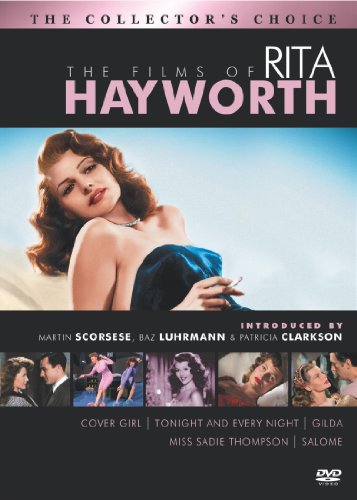
In one of Stephen King's most popular stories, at least of those translated into films, a prison inmate sits in his cell and dreams of escape. His fantasy is to escape into the welcoming arms of Rita Hayworth. While that particular element wasn't to be found in the film, it was important enough in the original story to warrant mention in the original title, which was Rita Hayworth And The Shawshank Redemption. It was a nod to the pin-up status that the actress had in early younger days. In my generation it was Farrah, but for most adolescent boys and World War II soldiers it was the red-headed come-hither smile of Rita Hayworth.

Hayworth first trained as a dancer. The instruction would certainly pay off in her film career where she would trade steps with some of the great dancers in cinema history including Fred Astaire. She was just a young teenager when she managed to be cast in Dante's Inferno and five other films that year. She left films at the peak of her popularity in a Grace Kelly-like marriage to foreign royalty. She wedded the Prince Aly Kahn, who would also die in a car accident, much as Kelly did. Fortunately for the movie-going public, Hayworth had divorced the prince 7 years earlier in 1953 and returned to the silver screen.

Written by Dave Younger

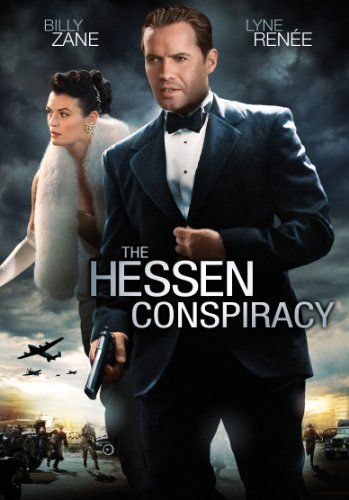
Set in 1945 Germany, WWII is winding down, and The Japanese have just surrendered.  A bunch of American officers have commandeered a castle outside of Frankfurt, Germany, and the discovery of a wine stash leads Colonel Jack Durant (Billy Zane) to thinking:  What else could Princess Sophie have hidden before she fled?  Jack is first seen flirting with Lt. Kathleen Nash (Lyne Renee), but she’s not buying. Then they discover a mother lode of jewels, enough to make them rich for the rest of their lives, and suddenly she’s hooked.  Is it love, or money?  There’s no time to wonder as many other, more vexing problems crop up: Princess Sophie discovers the theft of her jewels, a military investigation ensues, and how do they get the jewels to New York and fence them?

Written by Dave Younger

Twelve (2010, Rated R, 93 min.) stars Chace Crawford (Gossip Girl) as White Mike, drug dealer to the stars of the Upper East Side’s prep schools.  They’re young, rich, white, beautiful, and vapid: texting and whining are their main activities.  That and scoring drugs.  And then there’s Molly (Emma Roberts, Julia’s daughter (niece. Thanks Robert) who’s quite effective as the one good person here. Although they’ve been friends forever, she doesn’t know White Mike is a drug dealer.  He can’t tell her for fear of losing her friendship and, because she reminds him of his mother (who passed away recently), it would be like telling your mom you’re a dealer.


Written by Dave Younger

This is an entertaining and informative biopic of the American icon.  Starting with a $600 loan from the bank, he parlays his good fortune of coming across Marilyn Monroe pay-the-rent nudes into an I-gotta-see-this magazine.  Along the way he publishes some great fiction – Ray Bradbury says nobody wanted his Fahrenheit 451, so he sells it to Hef for $400 – and non-fiction: groundbreaking interviews with Jimmy Carter, Miles Davis and John Lennon.  His road was filled with battles, because America in the 50s was staunchly conservative. And racist, so imagine the shock of seeing blacks and whites mingle on his TV show Playboy’s Penthouse.  (Sammy Davis Jr. is given a puppy for Christmas by the eternally suave Hef – “Oh, hi, I didn’t see you come in.”)

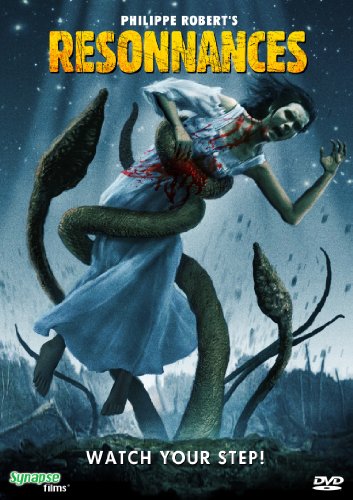
Six young men and women head off in two cars for a weekend trip in rural France. Along the way, the car with the three guys runs out of gas, fortunately within pushing distance of a filling station. There, our boys inadvisedly pick up a hitchhiker, who turns out to be an escaped psychopath. But no sooner have they started to worry about their new passenger when a mysterious fog and a ghostly vision send them careening off a cliff. Wounded and lost, they find that not only do they have a killer to contend with, but there is something monstrous and huge under the ground that is hunting all of them.

Clearly shot on a shoestring, but very ambitious in its special effects (an opening prologue featuring a meteor strike in 17th-Century France, giant tentacles reaching of the ground to grasp a helicopter), this is a film that certainly pulls out the stops. The plot is pretty packed, too, what with a ghost, a killer, AND a monster. But for all that, what the film needs is something quite inexpensive: a stronger script. The characters are set up quite well, but nothing much is done with them, and they wind up playing out in fairly conventional ways (the loser is the hero and vice versa, for instance). And for all the elements that are tossed into the mix, much of the running time still involves racing around to little effect in dark woods. Still and all, there is some fun monster work, and the just how much this little movie attempts to pull off, whether it fully manages to or not, is worthy of admiration.

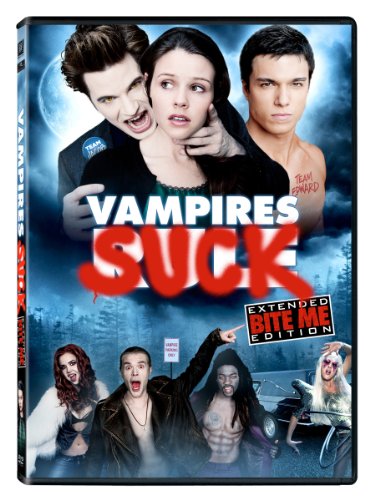
The comedy team of Jason Friedberg and Aaron Seltzer should be commended for their unwavering attempt to destroy the spoof comedy entirely. Sure, they aided the Wayans brothers in creating the first Scary Movie film (which is decent spoof film) but in 2006 they started their campaign with Date Movie and continued right through Epic Movie, Meet the Spartans, Disaster Movie, and now Vampires Suck. Did they succeed? And did it take the recent loss of Leslie Nielsen to have us be reminded that spoofs where once a glorious and enjoyable thing.

Well, while their previous efforts (I'm cringing at the idea that any “effort” was placed into making their films) where bloated with endless pop culture references that were dated before being made, Vampires Suck mostly just runs on one, the Twilight series. Yes, there is still a parade of references made, mostly to reality TV shows such as Keeping up with the Kardashians and Jersey Shore, but they mainly stick with vampire and werewolf gags that have either been done already or are simply too weak and witless to even register as a complete joke.

Bryce and Juli first meet in the second grade. Juli is convinced that Bryce is walking around with her first kiss, while Bryce is not returning any sense of being similarly infatuated with Juli. As the years pass by, Bryce manages to keep her at bay, until things “flip” (as it were) and it is Juli who may be veering away from Bryce.

This will-they won't-they (probably will) romance is told by trading the point-of-view and narrator between Bryce and Juli. This tactic makes the story more interesting to take in, despite the potential tedium of having the entire story essentially being told twice. The audience is privy to the continuous compare and contrast happening between Bryce and Juli's thoughts and feelings and so we get a more immediate understand of who they are, and what they are motivated by.

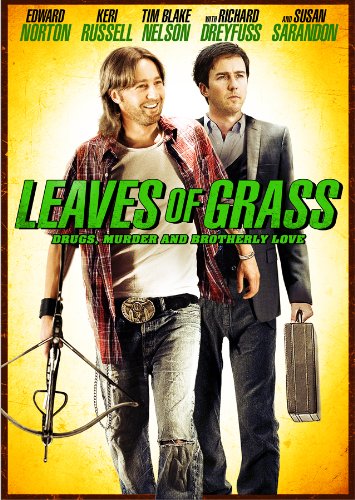
Leaves of Grass, the latest film from writer/director/actor Tim Blake Nelson, is one of those rare films that defies both description and expectation. While marketed as a violent stoner comedy along the lines of Pineapple Express, Leaves of Grass is far more difficult to categorize. Yes, there is comedy, though not as much or of the type one would expect. And yes, there is violence, but a far more realistic and less cartoony variety than you would think. But there is much more to this little film - there is thought and reflection and philosophy and poetry behind every piece of dialogue, and you get drawn into it so that, halfway through the film, it doesn’t even strike you as odd that you just watched Keri Russell recite Walt Whitman while gutting a catfish.

As the film opens, we are introduced to the lead character, Bill Kincaid (Edward Norton in the first of his two roles here), a Classical Philosophy professor at Brown. We meet him as he lectures an adoring group of students on Plato and soon afterward is fighting off the advances of a young female student. Bill is clearly a brilliant academic, and is being courted by the big schools. We also learn about his humble roots; he grew up poor in a little town near Tulsa, and earned his way into the academic elite.

"From the dawn of time, we came, moving silently down through the centuries, living many secret lives, struggling to reach the time of The Gathering, where the few who remain will battle to the last. No one has ever known we were among you ...Until now."

We all want to believe that we're special. We fantasize that one day we'll discover that we aren't the mere mortal people we thought that we were. That we are actually some hidden royalty, or better yet, that we have extraordinary powers. Connor (Lambert) makes just such a discovery in the 16th century as he goes off to war with his brothers to defend his highlander homeland against invaders. He receives what should have been fatal wounds on the field of battle. But he quickly recovers from them. His family and village turn against him, believing such powers can only come from evil. He discovers that he is an Immortal and can only be killed by having his head removed.

I'm not exactly sure what it is that audiences expected when Splice hit the box offices in June. I will have to admit that the trailers were not all that impressive. But I guess that most people didn't see what I saw when I looked at the early promotion for the film. I was fascinated by the appearance of the "creature", and the overall Frankenstein overtones were too much for me to resist. The movie compelled me from the first images and descriptions. Apparently, that wasn't the case in general. Splice tanked at the box office. It barely made $17 million. That's bad news, because the film cost $30 million to make. That figure is actually quite impressive. This was a small movie for one so ambitious. It looks like something that cost twice that to make. It didn't matter, in the end. You stayed away in droves. Back in June, you just might not have known any better. Lucky for you, my gentle reader, you have me to help to guide your home video purchases to get the most bang for your hard-earned buck. In this case, to also correct a serious miscarriage of justice. Splice is the best film you never saw.

Clive (Brody) and Elsa (Polley) are a husband-and-wife super-science team in the field of genetics. They work for a small pharmaceutical company where they develop designer life-forms in the hope of generating new drugs and compounds for the company to market. They are driven by William Barlow (Hewlett) to produce. When they do finally create a creature with drug potential, the company scraps any future gene-splicing. They want the couple to now focus on synthesizing the important compounds they can generate with the life they've already created. But the couple, particularly Elsa, wants to take their process to the next level. They want to incorporate human DNA in their experiments. Even though the company has closed them down, they continue in secret. The result of their undercover work is Dren. The specimen grows at an incredible rate, allowing the couple to study an entire life cycle in compressed time. But, the experiment gets complicated as Dren matures and evolves, making it harder to keep the creature a secret. They move her to a farm that was once part of Elsa's family home. There the couple begins to deal with the consequences of their actions.