Posted in: Disc Reviews by David Annandale on September 18th, 2010
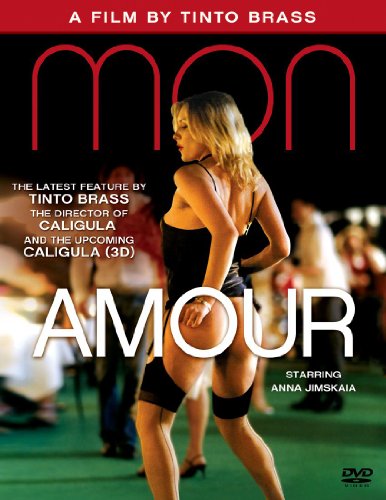
After a series of releases from erotic cinema specialist Tinto Brass's early career, Cult Epics now gives us one of his latest works. Marta (Anna Jimskaia) loves her husband Dario (Max Parodi), but he has become inattentive and selfish in bad, when he shows any interest in sex at all. Feeling lonely and unappreciated, Marta takes in the sights of Mantua, and in a museum she encounters Leon (Riccardo Marino, who is no more French than I am Martian), a sexually aggressive alpha male with whom she begins a passionate affair, with an eye (of course) to re-igniting Dario through jealousy.
As one would expect of a Tinto Brass film, this is a very handsome, lush affair, with some striking compositions and sets. There are moments at a swanky outdoor party that bring to mind the likes of Peter Greenaway. At this party, various characters (including Brass himself) get into a brief philosophical discussion on pornography and sex, and this moment encapsulates the Achilles' Heel of Brass's oeuvre. He has always struck me as a filmmaker who is nowhere near as clever as he thinks he is. His early work, especially Deadly Sweet, is, I think, the most interesting, because its self-indulgence is married to an insanely excessive cinematic frenzy. Bored with what's on screen? Wait five seconds. Here, though, the more disciplined technique is accompanied by a deeply pedestrian story. Revive your marriage through an affair? Ye godz, that's a storyline that dates back to the Triassic period. Meanwhile, Brass gives his obsession with rear ends free rein. He's certainly a filmmaker who is true to his passion, but the drooling male fantasy can get a bit embarrassing.
Posted in: Disc Reviews by Archive Authors on September 17th, 2010
Written by Diane Tillis
Only once in a blue moon will a filmmaker come along to change the way films are created…for an entire country! Kazakhstan – born director Timur Bekmambetov is best known in America as the director for Wanted (2008) and for producing 9 (2009) alongside Tim Burton, but in Russia he is known as the man who changed the film industry after the collapse of the Soviet Union. His plan was to shake up the whole Russian film world with a feature film that was unlike anything done in the country before. Night Watch was his answer: a visionary fantasy horror film with an astonishing collaboration of mind-altering visual effects, suspenseful terror, and adrenaline-fueled action.
Posted in: Disc Reviews by David Annandale on September 17th, 2010
We begin in Vietnam, where the unit of which Jacob Singer (Tim Robbins) is a member comes under attack. Jacob is bayonetted, and as he struggles with his wounds, the film flashes forward to his post-Vietnam life in New York City. He works for the post office, is divorced, is still grieving over the death of his youngest son (Macauley Culkin), and is living with his new girlfriend (Elizabeth Pena). He is also being tormented by visions of demonic figures. And then suddenly this life turns out to be a dream, and he's at home with his wife and all of his kids are alive. Or is that a dream? And what really happened in Vietnam?
I'm going to assume that most people who are interested in this film have, in fact, already seen it. But in case you haven't, spoilers follow, and should you wish to avoid them, skip to the Video evaluation. Now I'm going to waste another sentence just in case your eyes drift. You're all gone? Good. The last time I saw this film was twenty years ago, during its initial theatrical run, and I was left feeling bitterly disappointed: after all the build-up of conspiracy and mystery, we're left with the he-was-dying-all-along gambit? In other words, my sense was of a horror film that was compellingly original and frightening for most of its running time, and then squandered that good will by a hackneyed conclusion.
Posted in: Disc Reviews by Archive Authors on September 13th, 2010
“Greed is Good.”
No other cinematic phrase described the 1980’s better. And no other movie captures the financial corruption of the 80’s better than Oliver Stone’s Wall Street.
Posted in: Disc Reviews by Gino Sassani on August 31st, 2010
Back in 2001 Larry Blamire and his troupe released The Lost Skeleton Of Cadavra. Blamire was obviously a fan of the science fiction films of the 1950's and decided to take many of those standard elements and pretty much have a blast with the material. The end result was an over-the-top spoof that left you laughing, not because the material was all that funny. You laughed because they sometimes hit those ludicrous devices so perfectly that you have flashbacks to your favorite Mystery Science Theater 3000 episode. The film had all of the clichés including special effects that were anything but special. And it was all done on purpose. It was a stroke of genius, really. They did a low-budget film with all of its deficiencies and made them out to be deliberate.
Now, Blamire and his wacky group of players is back at it ... again. Shout Factory is releasing two films that the team has recently added to the Cadavra legacy. Both films utilize pretty much the same amateur cast with a few seasoned veterans sprinkled in to keep things interesting. Both films are in black & white, for the most part, to maintain the intended atmosphere.
Posted in: Disc Reviews by Gino Sassani on August 26th, 2010
"Relationships don't come cheap."
I guess I'm pretty much like most film watchers in certain areas. When I saw that $5 A Day was rated PG-13 for sexual content and brief nudity, I did what most red-blooded American guys would do. I took a look at who was in the cast. This might work. I suspected we'd be treated to a little quick peek at Amanda Peet or Sharon Stone in a little birthday suit flash. OK, now I've got a little something to look forward to. Little did I know that the brief nudity part referred to watching Christopher Walken and, to a lesser extent, Alessandro Nivola, running naked on a beach. So much for MPAA warnings. I just gotta stop reading those things. Little did I know that that cheap thrill was going to be the only thing worth looking forward to in this standard relationship/road movie. And it didn't even happen. So what did happen? I mean, beyond the aforementioned scar to my retina?
Posted in: Disc Reviews by Gino Sassani on August 25th, 2010
"The truth is, I've done dreadful things. My life has been a monstrous corruption. And there will be a price to pay."
The Picture Of Dorian Gray was actually Oscar Wilde's only full-length novel. It was quite a controversial subject when it first arrived on the scene in 1890, but not because of the horror element. The book is often sexually explicit and contains more than a flirtation with homosexuality. The main themes have survived, but much of the work itself has been forgotten. We know the work almost exclusively from the classic film from 1945 where Hurd Hatfield played the title character. The more notable members of that cast included Peter Lawford, Donna Reed, and Angela Lansbury. That film downplayed the debauchery elements and focused on the one element that appears to remain strongest in our collective memories, that of the picture aging instead of the man. It's that deal with the devil that most of us think about when we hear the name Dorian Gray, or Dick Clark for that matter.
Posted in: Disc Reviews by David Annandale on August 23rd, 2010
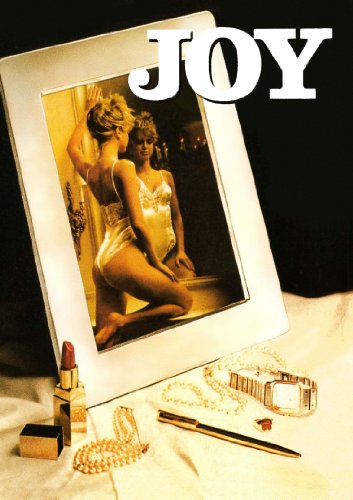
Supermodel Joy (Claudia Udy) flits from man to man, never satisfied. There's the photographer who loves her, but he, it seems, is too much of a boy. Far more intriguing for her is the older man (Gerard Antoine Huart) she falls for, and keeps returning to, moth to a flame, despite his refusal to give up the other woman in his life. The root of Joy's problem seems to be twofold: she is haunted by the memory of having caught her parents in flagrante as a young child, and she is obsessed with her father, who left her when, again, she was very young.
So yeah, nothing creepy about the older man fixation at all, now is there? At any rate, this is glossy erotica cut very much from the same cloth as Emmanuelle, complete with pointless travelogue footage to show off all the location shots and half-baked philosophical musings about sex (or, more specifically, female sexuality). There is also a minor subplot involving Joy's nude shot as part of a campaign for the liberation of the aforementioned female sexuality, though this gesture towards feminism feels rather dubious, serving only as an excuse to get the heroine naked again. Well-produced though the film is, it lacks the narrative drive of something like The Alcove, meandering gently along to a rather abrupt conclusion. It is an interesting, semi-nostalgic reminder of the lost days of theatrical soft-core, but for sheer entertainment value, a dollop of Joe D'Amato-style sleaze will get you farther.
Posted in: Disc Reviews by Gino Sassani on August 10th, 2010
"Okay, first of all, let me get something straight. This is a journal, not a diary. Yeah, I know what it says on the cover. But, when my mom went out to buy this thing, I specifically told her not to buy one that said 'diary' on it. This just proves that Mom doesn't understand anything about kids my age."
I guess I missed out on the phenomenon. Apparently in 2007 a guy named Jeff Kinney created a sort of crude comic book. The figures are little better than stick men, and the wit is something from the sixth grade. I guess that pretty much matches the book's purpose, which is to cover the life of a smart-aleck from middle school. Of course, when I was young they didn't call it that. They called it junior high. Unless you went to Catholic school where it didn't even exist. Anyway, the comic built what you'd call a cult following. It was inevitable from there that the short little features would find themselves the subject of a motion picture.

Posted in: Disc Reviews by Gino Sassani on August 4th, 2010
Johnny Handsome is based on a rather obscure and dated novel called The Three Worlds Of Johnny Handsome. Walter Hill must have found something in the dated material that attracted him to the project. Unfortunately, there wasn't much to attract audiences. The film made a very paltry $7 million at the box and has been little heard from since. In spite of a solid cast and a script that does tend to move along at a nice clip, the film has never really found an audience and is somewhat of a surprise to be found on Blu-ray.
Johnny (Rourke) is a high-level hood who goes by the name Johnny Handsome in reference to extreme deformities in his face. He looks almost like tElephant Man. His deformity even affects his speech. He's almost indecipherable when he talks. He's involved in a big takedown of a coin shop that has some valuable pieces in its collection. He and his crew take down the store, but something goes very wrong. Rafe Garrett (Henriksen) and his girl Sunny (Barkin) betray the rest of the team. They end up running off with the loot and leave the rest of the crew dead. All except for Johnny, who managed to dodge the gunfire. All of his friends are dead, and Johnny's left behind to take the fall...and the prison sentence. Still, Johnny won't rat on the two that betrayed him and got away. But Rafe's not taking any chances. He has Johnny stabbed in prison. Once again Johnny's luck holds up, and he manages to survive Rafe's wrath. In the prison hospital ward, Johnny meets Dr. Fisher (Whitaker), who has an experimental facial reconstruction procedure he'd like to try out on Johnny. It requires having his entire skull reconstructed. In return, Johnny will get a new identity to go with that new face.