DVD

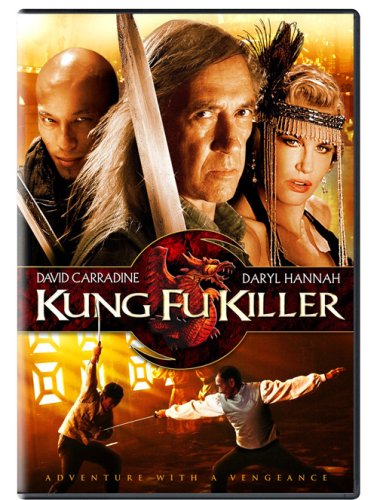
Kung Fu Killer is a sad attempt to take advantage of the two iconic roles that David Carradine has had in his life. There’s more than one reference or nod to the popular Kung Fu television show. The name of his character is Crane, instead of Caine. Here Crane is the master, and he has his own “Grasshopper” moment with his own student. There is a flute driven theme that could have easily been lifted from one of the television episodes. As if that wasn’t enough, the filmmakers wanted you to also think of Kill Bill. Carradine is reunited with his fellow Kill Bill star Daryl Hannah. Unfortunately, they share less screen time together than Pacino and DeNiro in Heat. There is also a bit of an attempt to capture the unique editing style of the Kill Bill fight scenes, but these don’t even come close. Carradine is old now and looks like he’s putting almost zero effort into the fights. He barely seems to move, and his punches are ridiculously soft. This direct to video film has almost nothing going for it. I guess Carradine fans won’t be able to resist. It’s what originally sold me on watching it. I was hoping for a revitalized return to the old days, but if Kung Fu Fighter proves nothing else, it’s that you can not go back.

The plot is a simple one of revenge. Crane (Carradine) is teaching a student when a warlord who has made a coup on the government of China attacks the monastery. Most of the inhabitants are killed, and Crane is left for dead. He does survive and plots an extremely complicated revenge on the warlord. There are moments that this appears to be a Mob film. Gary Peterman walks around the streets as Hoggins, a corrupt British representative. He struts around like Don Fanucci from The Godfather Part II. He finally gets his in much the same way. No one in this film seems to care a whole lot about playing the part. Most appear to sleepwalk through their parts. There are some fights, but no Martial Arts junkie is going to get a good fix off these poorly edited stunts.

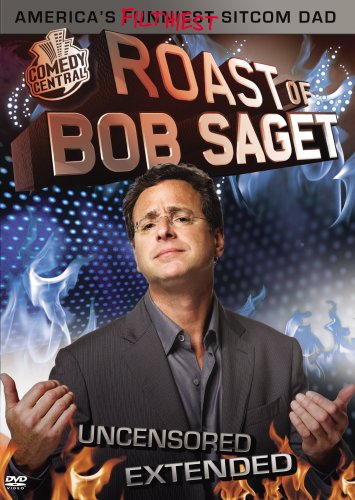
These Comedy Central Roasts are a bit of a crapshoot. I laughed my rear off during the William Shatner Roast. Unfortunately, I didn’t even crack a smile watching this one. It’s not like Saget’s a funny guy to begin with. Throw in a room full of other not-funny folks, and you get a real snore fest.

You should be warned that this is not a DVD for the kids. I’m not sure how much of this actually aired on Comedy Central, but I suspect it was edited considerably. I think they had a rule that no speaker could tell less than 3 penis or vagina jokes. Apparently jokes involving both don’t count toward that total. Look, I’m not a prude here. I don’t want to see these guys censored. But, doesn’t the material need to be funny BEFORE it’s dirty? Comedians like Richard Pryor have always used this kind of language, but Richard was a very funny guy. Somewhere along the way it must have become an axiom that bad language is funny. One of the comedians said it best. He was talking about Saget, but it was true of them all: “If bad language is a crutch, these guys are quadriplegics.” Another problem I have with this thing is the format. I always thought Roasts were about the guest of honor. These acts spent as much time sniping at each other as they did getting Saget.

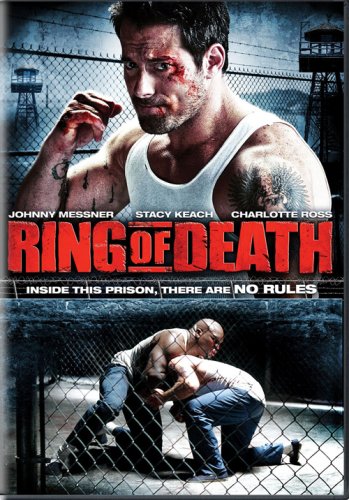
Every director has a style. Sometimes it can be a deliberate style, sometimes it can be more subtle. I received the movie Ring of Death and was a little worried since I had my fill of bad prison movies. After watching the movie, it seemed familiar but I couldn’t place why. The director’s name on the back was Bradford May. To most people, that probably does not ring a bell. To me, it was a different story: he was the director of Darkman 2 and Darkman 3. Then everything from that point became clear.

Burke Wyatt (played by Johnny Messner) is your average out of work cop. He has a loving but somewhat distrustful wife in Mary Wyatt (played by Charlotte Ross) and a son that he doesn’t get to hang out with enough in Tommy Wyatt (played by Uriah Shelton). However, Burke’s life is about to change when his former partner Steve James (played by Derek Webster) offers him an undercover gig to investigate a string of prison murders at the Cainesville State prison. The reward is simple: a large trust fund for his son and a full time job for Burke at the FBI.

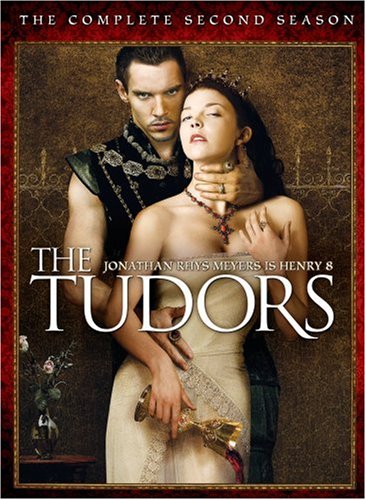
The Tudors returns for a rather triumphant second season. The series attempts to modernize the story more than a little. Henry’s attire is more akin to a rock star than a 16th century ruler. The language is also more updated, often filled with modern colloquialisms and the like. The story of Henry VIII is well known, but this is not the Henry your history teachers told you about. This Henry is a slim, energetic man. There are only hints in regard to his famous lust for food. His appetites for women are not so subtly portrayed. The series follows Henry’s alliances and break-ups with France and his growing disfavor of members of his own court. If the series is to be believed, Anne Boleyn was placed in his path by her scheming father. In any case, by the third episode his growing infatuation with Boleyn takes center stage in the series. Henry grows weary of the Church after he is constantly blocked from divorcing his Queen Catherine to marry Boleyn. This is also the story of his own rise and fall along with the Church’s influence on England’s culture. There is an almost soap opera aspect to the storytelling, which is admitted by the show’s writer, who credits shows like Dallas and Dynasty as well as Rome and The Sopranos as inspiration. Side stories like a gay musician’s coming of age populate the background, but serve merely as distractions. When The Tudors works best is when we are with Henry and his court engaging in matters of global importance.

Let’s talk about the cast. At first I must say I completely hated Jonathan Rhys Meyers as Henry. But that was last year, and by the third episode I absolutely loved his performance. He commands the screen whenever he is on it. Natalie Dormer is a relative newcomer, and she has wonderful skills. When we first meet her as Anne, she appears the naïve, lazy daughter of privilege. As her seduction of Henry takes its course, she develops many faces and emotions along the way. Now she is the doomed Queen, and she is extremely hard to read, and then all at once an open book. While she might not possess the beauty her character is said to inhabit, she more than makes up for it in a single stare. She acts wonderfully with her eyes, as so many of the great ones do. You will be seeing more from Dormer, I suspect, over the years. Nick Dunning is quite a surprise as Sir Thomas Boleyn. It is Sir Thomas who masterminds his daughter’s seduction of the King in order to destroy the influence of Cardinal Wolsey. His quiet yet assertive manner works perfectly for the character. Wolsey had his downfall in the first season, and Boleyn will show his true character in the end as well. Jeremy Northam was also a very bright spot in the second season. His character of Sir Thomas Moore has far more to do this time. Moore must consider the path of martyrdom as he finds himself in disagreement over his friend and King’s alienation of the Roman Church. His was a character I hardly noticed in the first year, but he really pops from the television screen this time around.

“Every story has a beginning. Every life has meaning and potential…”

Kyle doesn’t really know his story, and he’s beginning to understand his potential. But that was last year. This year things are about to change for our adolescent boy without a belly button. The series Kyle XY returned first to ABC Family and now returns to DVD.

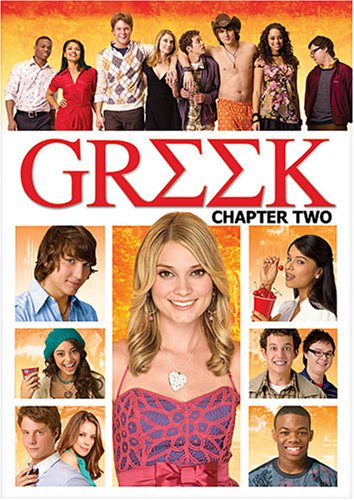
If there is a highlight of this second release, it’s the flashback episode, Freshman Daze. It’s absolutely great. We get to meet all of these characters back in high school and see how the dynamics developed. Now we know why they are the way they are to each other. I particularly enjoyed seeing how the Cappy and Evan characters were once pretty tight friends. There’s also some wonderful back story to Casey and Frannie. It’s likely the single best reason to buy the set. The only real story line that runs through this collection is the houses trying to come back from last year’s scandal. The dean has imposed some harsh restrictions. This brings us our only new major character. Lizzie (Moses), who is about as irritating for us as she is for the girls at ZBZ. She’s there from the ZBZ Nationals to bring the house back in line.

“I fear I’ve done some things in life too late… and others too early.”

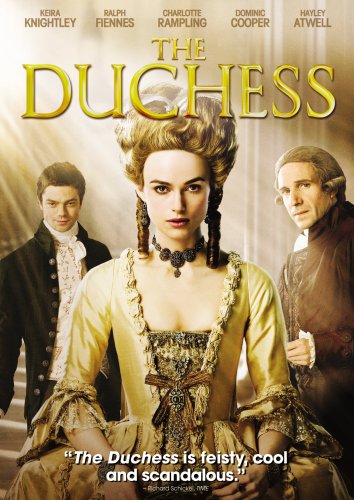
Not a creed for the growing minions of our divorced population (though it probably should be), but a remarkably summative line from the new film The Duchess starring Keira Knightley and Ralph Fiennes. Knightley is Georgiana, a spirited young girl, who starts with a fairy tale ideal of how her life as a married woman will be, but soon learns the world (and especially her husband, Fiennes) isn’t ready for her brand of feminism. Knightley does an admirable job of charming the peripheral characters, as well as viewers, but she cannot seem to win the affections of her husband. As time passes, she no longer cares, and instead seeks solace in the arms of Charles Grey (Dominic Cooper), a promising young politician.

“Gaze too long into the abyss and the abyss gazes back at you…”

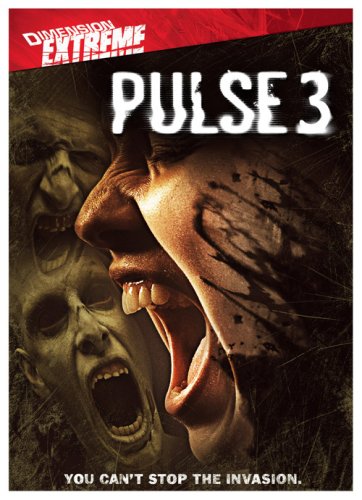
The original Pulse film was a remake of an Asian horror film, part of the recent trend of converting many of these titles into American retellings. That trend appears to also include strong warnings against technology and linking ghostly apparitions with some form of technology, from video tapes to cell phones. I’m pretty sure they’re right about the cell phones. In Pulse it was pretty much all technology that could act as a conduit for the restless dead to come to the world of the living. The internet and such access ports as laptops became the real killers. The second film brought us the complete breakdown of society, and now 7 years from that point we have Pulse 3. By now what remains of humanity lives in scattered rural areas. The cities have been abandoned, left to the dead. Technology is now the stuff of evil in the almost religious culture that has developed in the remaining people. If you haven’t seen either of the earlier films you might be a little lost, but not so much that you can’t get into this film. The problem is that this film, like its previous incarnations, isn’t good enough for you to want to get into. In case you need to know here are some basics: Ghosts can’t pass red barriers. Something in that wavelength traps them. They are all restless and drain the life force from anyone they encounter. They travel through electronic equipment. Mostly they appear to inhabit the internet.

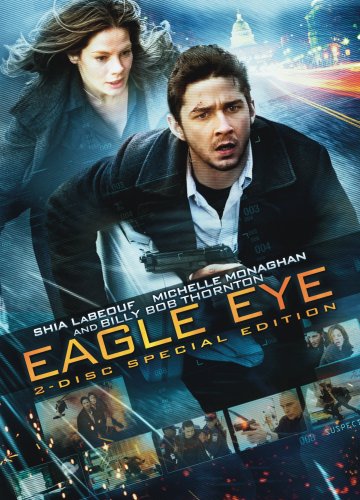
Shia LaBeouf and Michelle Monaghan are on the run from a series of carefully orchestrated catastrophes. All are ominously foretold by a rather humorless young lady that may or may not be a robot in the new thriller Eagle Eye, a film that purports to be “from Stephen Spielberg.” Spielberg-lovers, don’t get your hopes up. Authorial rights belong more to director D.J. Caruso and a smorgasbord of writers that include John Glenn, Travis Adam Wright, Hillary Seitz, and Dan McDermott. Oh yeah, and a dozen other tent-pole blockbuster action films. Sound like a hodgepodge Hollywood mess? It is.

Caruso’s direction does its best impersonation of Michael Bay’s, whooshing about from one impossible set-piece to another. His snarky heroes immediately hate each other, even before they have a clear-cut reason. We know this from the snippy dialogue peppered throughout, and their forced reluctance to accept the other’s story. The concept, while not altogether weak, feels like a worn-out retread of Enemy of the State. Sure, the technology is better, and much more precise; but it doesn’t feel as innovative, cutting-edge, or thought-provoking as it did in that first effort.

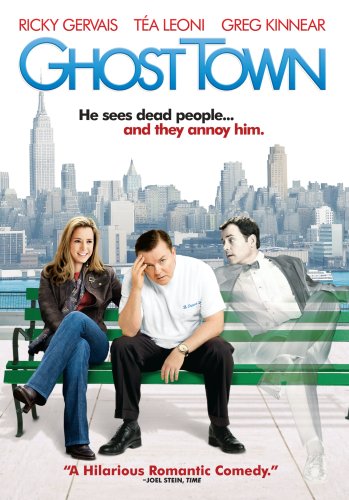
Ghost Town, the new romantic comedy from writer-director David Koepp, succeeds in not only introducing its British star Ricky Gervais to a wider audience but also in telling a simple, familiar story with an addictive charm all its own. Gervais plays Jack Nicholson in As Good As It Gets without the extreme OCD. What he lacks in this, however, he makes up for in his hatred of humanity. While Nicholson’s character was a chauvinist, Gervais is what I would call a “no”-vinist… he hates both genders equally. (Sometimes I can relate, especially around the holidays.)

Using the familiar construct of dead people needing someone to take care of their unfinished business, the script could get bogged down in all the familiar pitfalls: tug-tug moments of single moms and their children, families feuding over simple misunderstandings, and boneheaded tough-guy biker-types with hearts of gold looking out for the women they leave behind. It does venture into these areas; however, it doesn’t forget who its main characters are, and as a result comes across as something fresh and original.