DVD

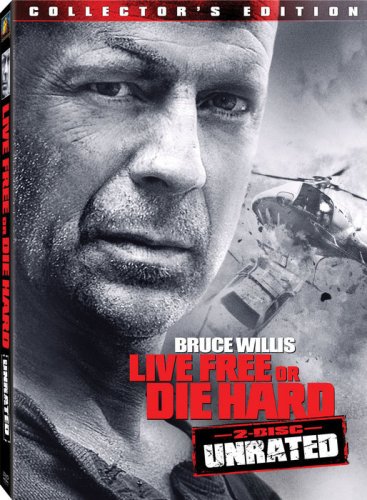
Despite its lame title, I've been excited about seeing Live Free or Die Hard since it was announced. The Bruce Willis franchise has been a favourite of mine for a long time, thanks to the original Die Hard which stands as one of the greatest action films of all time.

Willis reveals in the commentary that he and director Len Wiseman (Underworld) set out to make a Die Hard movie that surpasses the middle two in the series and is as good as the first. While Willis apparently feels they succeeded, I beg to differ. Live Free or Die Hard is certainly a good action flick, but nothing can ever surpass Die Hard in my book. Opinions of the film aside, this DVD set is sure to satisfy John McClane fans of any stripe.

You would think that after seven years, CSI would begin to show a little wear and tear around the edges. When you factor in the dilution of the two other versions of the franchise with a combined 8 years of episodes, you end up with 15 years and over 250 episodes of CSI total. Certainly even the best of shows with the most imaginative writers can’t stay fresh for that long. Still, somehow, the gang at CSI continues to crank out compelling drama, rarely repeating itself. Every year I go into a new season of CSI expecting to find it starting to show its age a bit, and every year I continue to be amazed. The fact is that season 7 just might be the best year of CSI to date. Each episode begins with The Who asking the question: Who are you? I have to say that after seven years the answer is, still a fan.


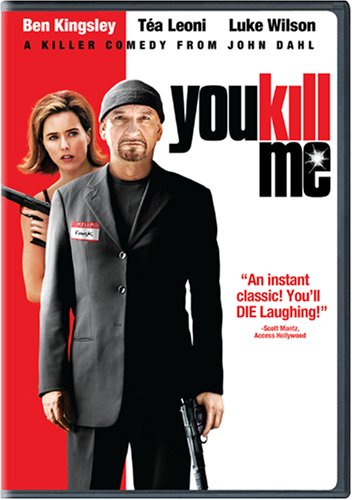
I only know Tea Leoni for a couple of things, the big thing being that she married David Duchovny (The X-Files) and grew a couple of demon seeds with him. But I guess she was bored and inexplicably took on the role of producer and actress in a film starring an Oscar winner, Sir Ben Kingsley (Gandhi), in a low budget independent film named You Kill Me, which was a script that had been kicked around Hollywood for a few years.

Written by Christopher Markus and Stephen McFeely (The Chronicles of Narnia) and directed by John Dahl (Rounders), Kingsley plays Frank, a hitman for a Polish crime family in Buffalo. He is quite the drinker, and drinking has been affecting his work lately. He sleeps through a job where he is supposed to off a rival crime boss (played by Dennis Farina, Midnight Run), so he is banished to San Francisco to dry out. A shady real estate agent named Dave (Bill Pullman, Independence Day) sets him up with an apartment and a job (dressing bodies at a funeral home), but at one of the services, he meets Laurel (Leoni), and decides to go to Alcoholics Anonymous, where he finds a sponsor named Tom (Luke Wilson, The Royal Tenenbaums) who helps him get started on the rehab process.

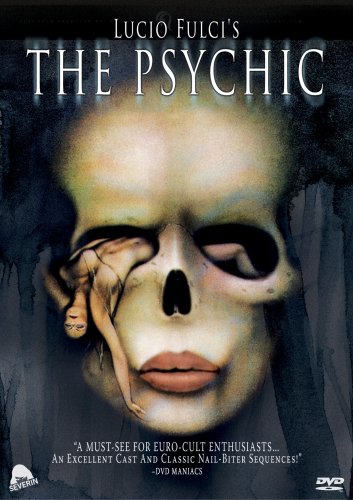
As a woman commits suicide by leaping to her death on the English seacoast, her daughter in Italy has a vision of her fall. Years later, the now-grown Virginia (Jennifer O’Neill) is married to a wealthy businessman, and is suddenly plagued by visions again. Following the evidence, she discovers the skeleton of a young woman who has been walled up in her husband’s ancestral home for years. He is immediately arrested. Virginia works to prove his innocence by investigating the other mysteries of her visions, but she is letting herself in for more than she bargained for.

Having made quite a name for itself as a purveyor of lovely editions of classic European sexploitation, Severin branches out in spectacular fashion with this 1977 effort by Lucio Fulci. Fans of the director who know him exclusively for films such as Zombie and The Beyond will no doubt be disappointed by the lack of extreme gore. (Exception: the opening suicide, which delivers a nasty jolt as we see the woman’s face smash against the rocks as she falls. Unfortunately, Fulci has to show us the effect more than once, and it loses its effectiveness as its artificiality becomes clear.) But, as clearly derivative as it is of both Nicholas Roeg’s Don’t Look Now and Dario Argento’s Deep Red, this is still evidence that Fulci was more than capable of assembling a film that is gripping at the level of narrative and suspense. Unlike Don’t Look Now, where we are kept as much in the dark as its protagonist as to what the visions mean, here Fulci makes sure we are a few steps ahead of Virginia. We realize quite early that what she saw was a vision of the future, not the past, and watch helplessly as the strands of fate wind inexorably around her. There may not be much to her character, but her plight is so clearly articulated and so unstoppable that we cannot help but feel a soul-deep dread. A excellent slice of Eurohorror.

After going all the way back to the 20s with the last entry in this series, now Cult Epics gives us a collection from 1960s, a period that marks the beginning of the end for this kind of pornographic short. Theatrical hardcore is just around the corner, and things will never be the same. In the meantime, though, things are remarkably the same. Other than some clothing styles (in those brief moments when clothes are actually on), it’s interesting to note that there is very little to distinguish these twelve entries from those of any other decade, a point driven home by the bonus short from the 1940s, which doesn’t feel very different from the rest of the offerings. Artistically, there is not much going on here (surprise, surprise), but the star rating indicates the fact that, despite this, there is some clear archival value here.

Audio

In the manner of the 1920s release, the audio track that had been standard for the rest of this series (the sound of film running through a projector) has been replaced with a music score. In this instance, it’s a series of swinging grooves, very much in keeping with the 60s, and acting as one of the only reminders of when these movies were actually made. The music is treated well by the 2.0 mix. The movies themselves are, of course, silent.

Video

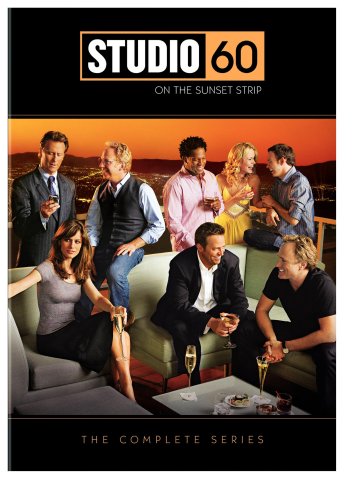
Oh, how the mighty have fallen. Five years ago, Aaron Sorkin and Thomas Schlamme were riding high with the best drama on Television, The West Wing, which is hands-down my favourite show ever. When word got out about a new Sorkin/Schlamme project set for the '06-'07 season, I was more excited than a monkey at the banana harvest. Expectations — mine and everyone else's — were sky-high for this new series, a behind-the-scenes drama about an SNL-type sketch comedy show. It would be the finest new show since The West Wing debuted in '99, Sorkin would once again raise the bar in prime-time entertainment and the collective intelligence of the human race would be elevated to the stratosphere.

Ok, not so much. While Studio 60 on the Sunset Strip premiered with much fanfare and critical praise, the series quickly slumped and never recovered. That made me angry, like a monkey whose monkey-mom made him stay home from the banana harvest. It's just not fair! So this review is about a good show killed by hype. Alas, Studio 60, you died too young.


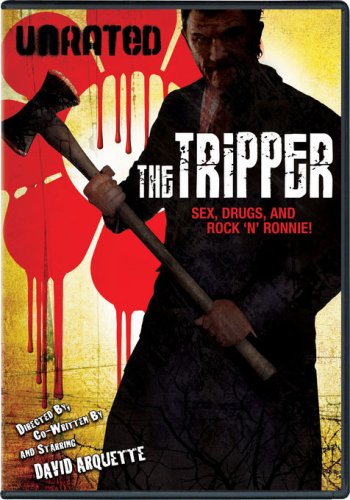
Bad horror movies are like watching a trainwreck. There are bodies all over the place and everybody is screaming in agony like a little school girl. And you can't turn your head away. So imagine my complete enjoyment when I received the Tripper to review. I screamed like a little school girl, my rabbit fainted and my girlfriend actually was able to turn her head away several times. I understand why they are the stronger sex cause I watched intently and was considering therapy when my 90 minutes was up.

The Tripper is the story of Ronald Reagan gone wrong. The back story indicates trauma to a young kid named Gus (played by Noah Maschan ) who chainsawed a tree hugger who was preventing his father, a lumberjack from performing his job. One would assume he spent the rest of his adolescence in a mental institution and then re-appeared as an axe wielding, Ronald-Reagan mask wearing psycho killer (played by Christopher Allen Nelson).

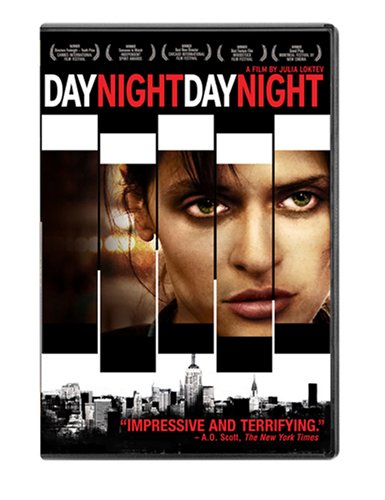
The premise of Day Night Day Night is relatively simple; a young woman decides to be a suicide bomber in Times Square. The motivations for her doing this, as in the outside forces who convince her to do it, aren’t really explained at all, so what makes it unique is that it focuses on the preparation the girl makes. She is portrayed by Luisa Williams, who appears in the film in her first role.

Written and directed by Julia Loktev (Moment of Impact), the film conveys some degree of tension and atmosphere, because you’re wondering what’s going to happen next, but the fact of the matter is that the level of activity that occurs here is almost nonexistent, and the context of the event borders on confusing. You watch the girl wait. And wait. And wait. And then her pseudo-presumably Islamic organizers who have American accents get her ready for it. Then she waits. And waits. And waits. And later on as we get closer to the actual event, she eats. And eats. And eats.

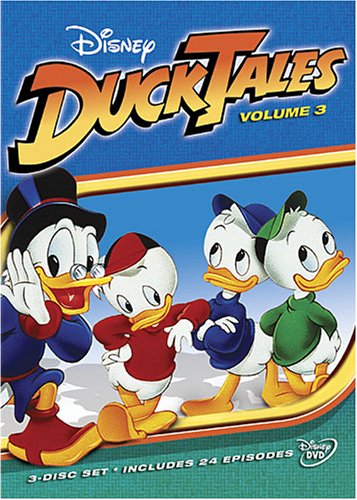
Disney Studios reinvented the afternoon cartoon when they introduced something they called Disney Afternoon. It was the brain child of studio animation head Bob Jacquemin. He saw the potential of taking famous Disney cartoons that were already beloved by millions and spinning them off into regular television cartoons. Not willing to take chances with the studio’s icon, Mickey Mouse, Michael Eisner allowed the Donald Duck universe to serve as the launching pad for this new venture. In 1987 Disney Afternoon and Duck Tales was born.


The Jungle Book was a milestone event in the history of Walt Disney’s animation history, so it shouldn’t come as too much of a surprise that the studio would tap this source for future adventures. The Disney Afternoon series has been a chance for the studio to continue many of the beloved characters. Tailspin was just such a series. The show is set in the Jungle Book world but minus little Mowgli. Now lovable bear Baloo runs an airline service with his new little friend baby bear Kit Cloudkicker. All of the other characters show up, from Shere Kahn to King Louie. This isn’t a musical, so the songs aren’t there, and there is no real mention or connection to the events in The Jungle Book. The stories are a kind of Indiana Jones affairs with plenty of tomb raiding and high flying stunts and narrow escapes. Ed Gilbert takes over the voice of Baloo, and while some of the original intonation is there, it’s clear how much the voice of Phil Harris gave Baloo so much character and charm. Obviously none of the same voice cast returns. The cost would have been prohibative for a television show, and unfortunately many of those voices are no longer with us.