AVC MPEG4

"Man, we'll die with you. Just don't ask us to do it twice."

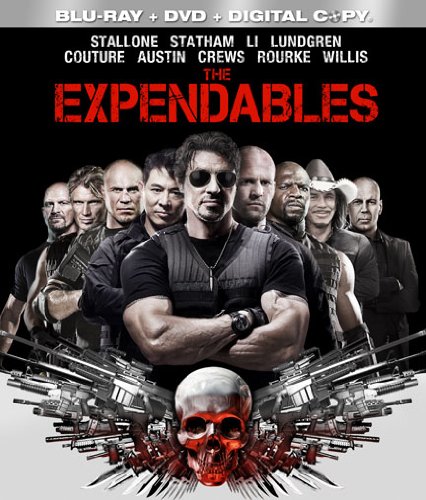
Remember the old days of the action movie? Those films where someone like Stallone or Schwarzenegger would run around and take out armies of bad guys while barely breaking a sweat. You know the kind of movie I'm talking about. The ones where the hero goes up against a hail of bullets and explosions and manages to pick off the bad guys without catching a single slug himself. These were the days when a guy like Bruce Willis could fall thirty floors, get a spike impaled in is ribcage, have a ton of concrete wall fall on his head and get run over by a truck but still manage to take out the bad guy while muttering some witty little catch phrase that we would all be repeating, because if we can deliver the line just right that meant we were tough guys too, and we didn't even have to fall out of an airplane to prove it. Well, you won't have to remember. You just have to watch Sly Stallone's love letter to the action movie fans. It's called The Expendables, and it's out right now on high definition Blu-ray from Lionsgate.

When Peter Gabriel left the band Genesis to pursue his own solo career, it was the break of a lifetime for the band's drummer, Phil Collins. He took over the front-man duties with style, and before long Genesis was enjoying the most commercial success of their lives. Collins provided the smooth, easy-to-listen-to voice that Gabriel really never had. The tunes were instantly more recognizable and stuck with you for a long time. Of course, that meant that Collins would go out and work on that solo career as well. He didn't quite abandon Genesis and managed to keep both careers on the charts for quite a long time. If anything, the two entities became more and more the same. It's hard to distinguish the band's Invisible Touch from anything Collins released under his own name. No problem, as long as the records were selling. And sell they did.

We haven't heard a ton from Collins in recent years. He's always been there. He's toured under both names a few times in recent years. But the releases became less and less successful. Much of this can be traced to Collins' wish to become a one-man band. The last few CD's were produced in his own home studio with Phil filling in for most of the instruments. The lyrics lost much of their creativity, and it seemed that the British rocker had waded deep into stagnant waters. I guess it was time to try a different approach in the hopes of getting back on top.

"You're traveling through another dimension, a dimension not only of sight and sound but of mind; a journey into a wondrous land whose boundaries are that of imagination. That's the signpost up ahead — your next stop, the Twilight Zone."

"Sometimes you just gotta let a dog do his thing."

Hey everybody. Baby back again to bring you yet another dog movie from a dog's point of view, which is the floor, in case anybody out there really wants to know. You see, Gino won't let me on the furniture in the theater. He says that just because the seats look like chew toys, and smell like chew toys, doesn't mean they actually are chew toys. I mean, really, people. You wanna talk about your special effects, which reminds me of something else I'm not supposed to do in the theater, but let's not talk about that right now.

"Millions of people around the world believe we have been visited in the past by extraterrestrial beings. What if it were true? Did ancient aliens really help to shape our history? And if so, what if there were clues left behind, something hiding in plain sight? What if we could find that evidence?"

Ever since Eric von Daniken released his speculative book and its subsequent 1970 film Chariots of the Gods, there has been an entire field of study created around something commonly called Ancient Astronaut Theory. The idea is that extraterrestrials have visited many of our ancient civilizations. The theory continues that these visitors had a hand in shaping our development whether it be through technology or even manipulation of our very DNA. These believers point to a world of evidence to support their claims. There are tons of images from earlier civilizations that could certainly be interpreted as depicting modern devices, concepts, or even spacemen. There is plenty of speculation that some of the knowledge and accomplishments of these peoples could not have been possible without some outside interference. There are even those who believe that aliens best explain our religious beliefs and that God himself was/is an extraterrestrial being. Whatever your own beliefs on the subject, there are certainly some fascinating points to be made. There is no question that the speculations and observations bring up some interesting queries that deserve our attention. This series attempts to document much of this evidence and the beliefs these findings have inspired.

Imagine a world where Winston Churchill battles deadly machines from space intent on dominating the universe, a place where Santa is a deadly menace, and a rather eccentric fellow travels about in a police call box with a rather deceptively spacious interior. To Dr. Who fans of all ages, this is all very familiar territory. I fell in love with Dr. Who as played by Tom Baker from 1974 – 1981. He was the fourth actor to portray the Doctor and arguably the most popular. With a pocket full of jelly babies and a trusty sonic screwdriver, the Doctor rather muddled his way about with a massive wool scarf around his neck, all the while solving the mysteries of the universe. It was through PBS stations in the late 70’s that Americans were first introduced to these adventures on a regular basis. Before long the Doctor would develop a cult following of sorts, particularly at college campuses. The Doctor was an alien from the planet Gallefrey. A time lord, he traveled through space and time in his TARDIS, disguised as a police call box by a chameleon device. He was accompanied by a line of companions that would serve as the representative of the audience. These women provided a place for the Doctor to bounce his ideas off of, and from time to time they would require a bit of rescuing. The show was noted for its low budget f/x and over-the-top villains. The cardboard sets often appeared as if they would collapse at any moment. All of this created more than a little bit of campy cheese. But for some reason there was a charm to the entire play that was oddly compelling. To ensure longevity, the character was able to regenerate when faced with death. The new Doctor would not only look different, but he would sport an entire new range of mannerisms. This way the series would continue through several changes in the actor playing him. It all worked, and Dr. Who became the longest running scripted science fiction show ever in the world. Of course all good things do come to an end, and so did Dr. Who, in spite of an American television film attempt to bring the character back. But what started with Peter Cushing in a couple of films finally ended for good…

…but not so fast.

In 1887, readers of the popular periodical Beeton's Christmas Annual were to receive quite a special treat. There wasn't much fanfare or hype to the event. Inside the pages of the magazine was a story called A Study In Scarlet. It was a detective story, perhaps like many published before, except for the detective himself, a certain Mr. Sherlock Holmes. Together with his faithful companion and chronicler Dr. Watson, Holmes would win the hearts of those holiday readers. It might have been an ordinary day, but the world was about to change. Sherlock Holmes would become the most famous detective in the world. His stories would remain in print nearly 130 years later. Over 100 films would be made featuring the character. There would be television shows and cartoon spoofs. No other character has appeared in more productions. When his creator dared to kill the beloved detective in order to move on to newer stories, his very life was threatened. It would seem that Doyle was on the verge of becoming a victim much like those in his stories. There was only one man who could save him from such a grim fate, and he did just that. It was Sherlock Holmes himself.

Today, Holmes has enjoyed a bit of a resurgence. There's been a stage production of Hounds Of The Baskervilles. Robert Downey, Jr. played a more modern action-figure version of Holmes in a very successful blockbuster film. A sequel is on the way. It seems that Holmes has more lives than a cat.

They’ve been called The Greatest Generation, and who are we to argue the point? Sitting here writing reviews from my comfortable seat in a state-of-the-art home theater, I’m in no position to lay claim to the title. They fought in the bloodiest conflict in modern human history. Over 20 million were killed. That’s a staggering number. If you’re like me, it’s not even real. I can honestly say that those facts have never really reached home as much as they did while watching this footage.

World War II has been a favorite topic for Hollywood films since before the war itself ended. There have been some truly remarkable efforts and some equally unremarkable disasters. Many of these films have been long forgotten. Heck, many of them deserve to be forgotten. But something that should never be forgotten is the stuff of this footage. To do so would be a sacrilege of the worst kind. But these war films, no matter how startling the scenes, no matter how real we might think they are, no matter how visceral the experience might appear, nothing can ever capture the reality like this footage has done.

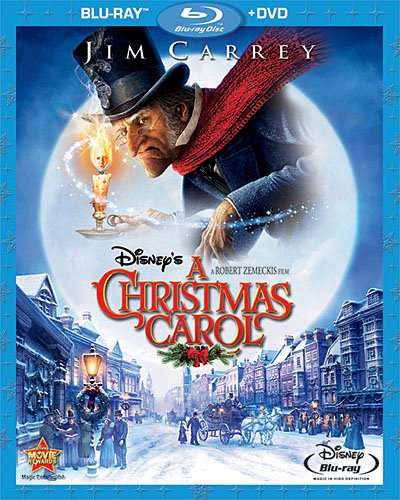
It was in 1843 that celebrated writer Charles Dickens created one of the most iconic symbols of Christmas with his publication of A Christmas Carol. It was a cautionary tale for an industrial revolution that was getting caught up in its material worship. Dickens intended the story both to entertain and to put the spotlight on what he considered already then was an over-commercialization of the Christmas season. Little did he know that his very story would become a huge part of that commercialization. While the writer gave us many memorable characters like Oliver Twist, David Copperfield, and Little Nell, perhaps none have become so well known as Scrooge and Tiny Tim. It's certainly true that no other story has been used as much in film, television and on the stage.

For most modern folks it all started in 1951, almost 100 years after the story's publication, with the definitive film staring Alastair Sim. That movie has captured the hearts of several generations. But it didn't begin nor did it stop there. The three Christmas ghosts have haunted over 100 film and television versions over the years. Even Fred Sanford was visited by the specters, resulting in at least a temporary temperance of his biting grouchiness. With such a classic tale, it was only a matter of time before the computer-animated genre and the motion-capture technology were used to deliver a new movie for the holiday masses. Thank our lucky stars, my gentle reader, that it was Walt Disney Studios that took up the task. The results could have been rather unfortunate.

"They rob, kill, and terrorize, and they've left their mark on our nation's history."