Brain Blasters

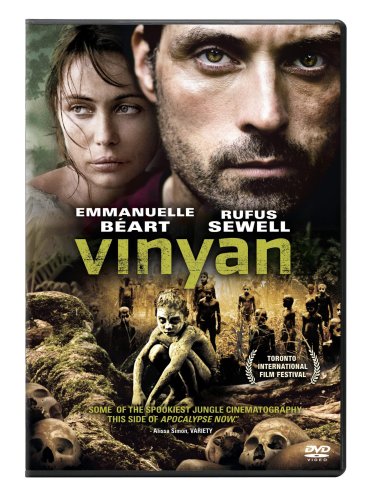
Belgian director Fabrice Du Welz burst onto the horror scene in 2004 with Calvaire, an unforgivingly black tale of a young man running afoul of a town whose exclusively male population would make Leatherface blanch and get the hell out of Dodge. A distinctly European concoction, it nevertheless paid tribute to Deliverance and The Texas Chainsaw Massacre. It was an attack on the audience as assured as it was original. Now, Du Welz has followed up with Vinyan, which is no less original, no less assured, and stakes out its own identity distinct from its predecessor, while still sharing many of Calvaire's thematic preoccupations. People, I think we have an auteur in our midst.
A vinyan is, in Thai mythology, an angry ghost, the spirit of someone who has died a bad death and cannot make its way to the afterworld, and so remains to cause trouble for the living. A bad death is certainly what the son of Emmanuelle Béart and Rufus Sewell suffered: he was swept away by the Boxing Day tsunami. His parents are still grieving, still in Thailand, and Béart in particular cannot let him go. When, at a charity function, a video of the devastation in Burma is shown, Béart sees an indistinct image of a child that she insists is her son, still alive, sold out of a hospital instead of deceased. Sewell sees nothing of the kind, but agrees, in the face of his wife's implacable obsession, to try to find the child in the film. This means contacting the Triads, as they are the only means of sneaking into Burma. So begins a long journey into Hell.
If Calvaire's touchstone was the survival horror films of the 70s, Vinyan too looks to that decade for inspiration, but its model is very different: Apocalypse Now. In fact, I dare say that it is to that film what Apocalypse Now was to Heart of Darkness: a parallel journey with transplanted events and similar tones and themes. Both films and novel share, along with a nightmare boat odyssey into the jungle, a languorous pace that effectively conveys the enervating atmosphere through which the characters move, a careful attention to the oppressiveness of the jungle, which becomes a character in and of itself. There is also an abyssal loss of hope in all three works. Vinyan even re-creates a number the Coppola film's shots of passing trees. There is also a shared sense of penetrating into a strange, surreal world where nothing is explained and everything is possible. Had Marlon Brando appeared in the midst of the feral children that populate Vinyan's last act, I wouldn't have been a bit surprised.
But this journey into another world, signaled by crossing through barriers of fog and rain, is also one of the things that links Vinyan to Calvaire. While the pace and content of the two films is very different, their horrors both occur in dark forests, and both stories concern themselves with the destructive properties of grief. In Calvaire, innkeeper Jackie Berroyer convinces himself that poor Laurent Lucas is his wife come back to him, a psychosis that the entire town shares. Similarly, Béart refuses absolutely to believe that her son is dead. When presented with a boy who is clearly not her son, there is still a moment where it is clear that is willing to believe that it is. In both films, grief and desire are one and the same. They are creative in a the most terrible sense, distorting reality in toxic ways, and therefore, in the final analysis, utterly destructive. The true name for what they really are, then, is the death drive.
Viewers will find Vinyan a challenge. Even fans of Du Welz's first film might find this too slow. But don't go in expecting a visceral roller coaster. Instead, remember Apocalypse Now, especially in its second, increasingly bizarre half, and regard the work as a doom-laden tone poem, and your patience will be richly rewarded.
Oh, and is there an angry ghost? Not in the traditional supernatural sense. But in terms of psychological effects? Definitely. And there is more than enough of the uncanny to go around in the last act.

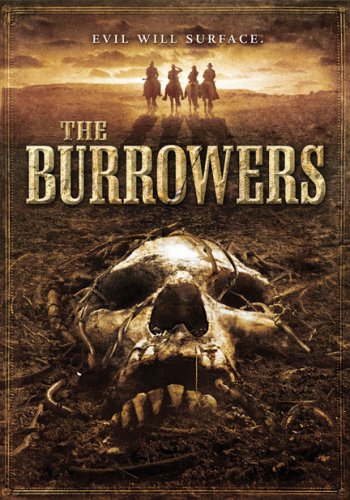
I first became aware of J. T. Petty when his Mimic: Sentinel came through for review. I popped it on, expectations very low (it always seems to be a sign of a franchise's last gasp when the digits are dropped from the titles of sequels), and was pleasantly surprised by a clever reworking of Rear Window. Soft for Digging, his feature debut, was just as interesting, and was a quietly effective little ghost story. He hasn't been very prolific as a director (though he did find gainful employ scripting the first three excellent Splinter Cell games), and I missed his S&Man, but now he's back in horror territory with a bleak western with monsters: The Burrowers.

There's a bit of an echo of The Searchers in Petty's set-up: a group of white settlers are abducted, and a posse is formed to hunt down the guilty parties and rescue the captives. While the searchers assume they are after a group of Native Americans, in fact their quarry isn't human at all. What follows has the inevitability of tragedy (and, for that matter, of history): the posse (initially led by a psychotic military commander) perpetuates no end of atrocity against innocent parties, and it is pretty clear from the ferocious racism on display that these men needed very little excuse to start torturing and killing Native Americans. At the same time, the men are very vulnerable to attack from the burrowers of the title.

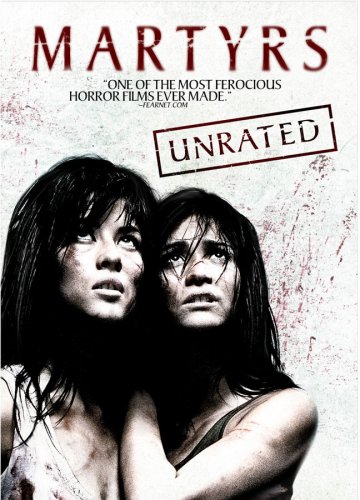
The current wave of extreme French horror marches triumphantly on. The latest wave-making entry is the Franco-Canadian production Martyrs, and it is as nasty as it is a vital piece of filmmaking. Writer/director Pascal Laugier, whose previous film was the honorable but not entirely successful House of Voices, here reveals himself as a force to be reckoned with. Horror fans, the genre is healthy and out to get your.

Pretty much every piece I've read on the film has been very circumspect about the plot, and I will not be the one to break ranks. I will summarize the set-up as have most others: a young girl escapes from a scene of horrific abuse. Years later, the now-grown woman (Mylène Jampanoï) in the company of her best friend (Morjana Alaoui, in an astonishing performance), shows up at the door of the people she believes were responsible for her torture.

So, there have been approximately a godzillion zombie movies made over the years, and a goodly number of those just in the last few years. And there have been quite a number of very creative ones (Shaun of the Dead, Fido, 28 Days Later, but no, NOT the remake of Dawn of the Dead). Likely about to disappear from a theatre near you is one of the most interesting variation of late: Pontypool.

Directed by Bruce McDonald (most recently of The Tracey Fragments), and scripted by Tony Burgess (adapting a section of his novel Pontypool Changes Everything), Pontypool takes place in the eponoymous town, somewhere in the snowy wastes of rural Ontario. Grant Mazzy (erstwhile Nite-Owl I Stephen McHattie) is a former shock jock, turfed from his big city job, and now stuck hosting the morning show out here in the middle of nowhere. After a disturbing encounter with a babbling woman on his pre-dawn drive to work, he settles in behind the microphone to start his shift. Little by little, he and the station's crew of two (Lisa Houle and Georgina Reilly) discover that something really, really bad is happening in and around the town. What that bad thing is, of course, is your basic zombie apocalypse.

Well, I might as well follow up last week’s piece with my own thoughts about Watchmen, now that I’ve seen it. Let me begin with the most important point: these musings must be understood as provisional. My feelings are mixed, and I think I will have to see the film a few more times before I can come to a definite conclusion about it.

That caveat out of the way, let me begin by saying that, all in all, Zack Snyder's interpretation is staggeringly faithful to its source material. One isn't really faced with a question of what is changed, because the answer is, other than one significant aspect of the ending, virtually nothing, and even that aforementioned change is true to the spirit of the original, and the case has been made that it is actually an improvement. It is certainly an elegant solution to one of the more problematic, much-debated elements of the comic. In any event, the question is more about what is left out, and even that is precious little, considering the task of packing the entire twelve issues into the space of a single film. Yes, there is compression, yes, there are events passed over, but there is barely a moment from the text that doesn't show up in some form or other.

I'm not even going to try to justify considering Watchmen a cult film. Not on that kind of budget and mainstream-saturation advertising. But the comic book (let's avoid the artificial marketing term “graphic novel,” shall we) is another story, a work whose brilliance is equaled only by the fanatical reverence in which it is held by its fans. Now that's cult. I won't be seeing the film for another couple of days, so whether it does a good job or not I will leave as an open question (what is beyond question, however, is that, whatever flaws it may have, it has to be better than the what the original stab at adaptation, back around 1987 would have been – I read a summary of the screenplay, and “desecration” is too weak a word). What I want to consider today is the rather strange set of conflicting emotions anticipated adaptations such as this provoke.

The basic conflict is quite simple: fans have been regarding a film version of Watchmen with both rabid impatience and all-consuming dread. The latter is easy to understand. Watchmen, with its intricate narrative structure and stately pace, defies easy transfer to film, and audiences not ready to view a deconstruction of the super-hero might well put up a (misguided) resistance. But it's the former emotion that I find puzzling, even as it is one to which I am not immune.

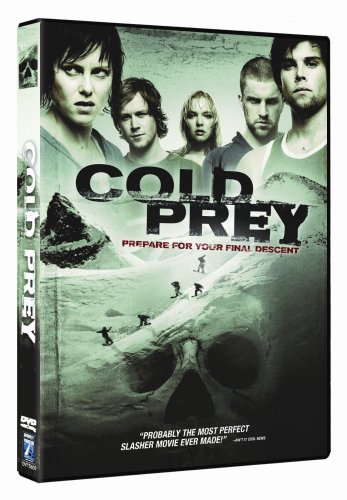
Last week, I offered my paean to King of the Hill. Today, another recent European horror film, which also has a mountain setting: the Norwegian Cold Prey. If King of the Hill was related to the slasher in terms of the idea of the characters being stalked through the countryside by a killer who could strike at any moment, Cold Prey fits far more comfortably within the slasher subgenre. It is, after all, ultimately the story of a group of young people running afoul of a giant masked maniac. Hardly original, I know. But it is how Cold Prey handles its familiar material that produces a delightful gust of fresh air.

Two couples and a fifth wheel head off to the mountains for some off-trail snowboarding. The fifth wheel breaks his leg partway down the slope, rather inconveniently in the middle of nowhere. Fortunately (or so our heroes think, since they don't know what kind of movie they're in), there's a mountain resort nearby. It turns out to be abandoned, but it's shelter, and they can make do. But then, of course, it further turns out that it is not completely abandoned, and one by one they come to gruesome ends.

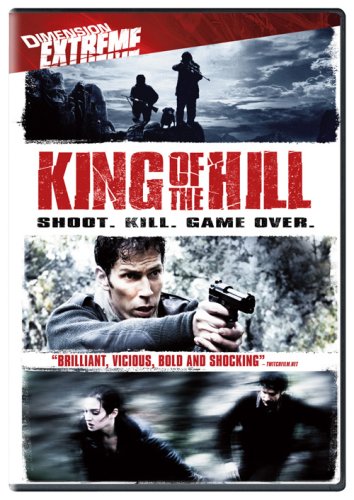
The European horror revival continues apace. Today's entry in the please-don't-remake-it category is the 2007 Spanish entry King of the Hill, directed by Gonzalo López-Gallego. It's another case of a simple premise worked out rigorously, and with great skill. Leonardo Sbaraglia plays Quim, a man on his way though the Spanish countryside. Stopping at a filling station, he has a quickie encounter with shoplifter Bea (María Valverde) in the washroom, after which he discovers that she has lifted his wallet. Catching sight of her vehicle heading up a mountain road, he takes the detour in pursuit. Then, once he is well off the beaten track, nicely far away from civilization as he knows it, he sees a glint on a mountain peak, and then a bullet hits his car.


From that moment on, things very rapidly become much more bizarre and much, much worse. Before long, he and Bea (whose car has also been disabled by the mysterious sniper) are on the run through mountains. They don't know why they are being targeted, and they cannot see their attacker, and therein lies the simple brilliance of the premise. Sure, we've seen many a rural stalking film, be it Deliverance, Rituals, Friday the 13th, or even The Edge (where the stalker is a bear instead of a person). All of these films play on the vulnerability the urbanite in particular will feel in the wilderness. All directions look the same, there are no landmarks, there is no shelter, there are no means of calling for help, the human form is dwarfed in the chaotic immensity, and danger can come from anywhere. King of the Hill takes this idea a step further in that the killer doesn't even have to be anywhere near his victims to strike them down. His reach is infinite.

A few days ago (and with my advancing age and failing memory, I cannot now recall precisely where), I read a commentator who essentially bemoaned the fact that every single piece of celluloid dreck ever to hit the grindhouse, drive-in, or VHS remainder bin is now being repackaged as a “Cult Classic” on DVD.  There is something to this criticism, but I would argue that, in the final analysis, this is no bad thing.

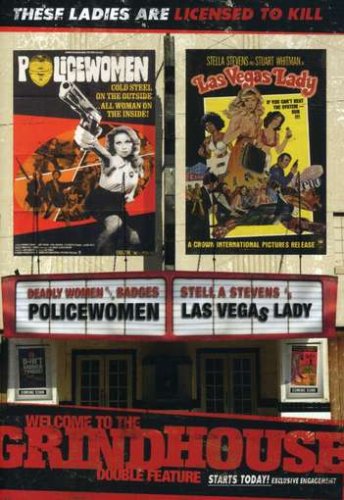
First, though, let me acknowledge the validity of the point. There is no doubt that many of the films being released with this description are certainly no classics, and just as certainly not the subject of the adoration of any cult worthy of the name. For instance, one of the Welcome to the Grindhouse double-bills is a combo of Policewomen and Las Vegas Lady. Now, maybe, maybe there is someone (or more than one someone) out there who was pining for these titles, someone for whom these were formative viewing experiences (or, which might be a teensy, eensy, weensy bit more likely, whose posters were formative viewing experiences). Maybe. But not likely. Honesty forces me to admit that I haven’t viewed the disc yet, so take my comments with a suitable amount of salt, but by all accounts, the films don’t even rank as decent sleaze, but are rather mere filler.

This past weekend, the Goya Awards were handed out. These are Spain’s equivalent to the Oscars. And during those awards, there was a moment that, for followers of mainstream film, must surely portend the End of Days, but which for fans of psychotronic or paracinema is tantamount to the Raputre itself: the lifetime achievement award was presented to Jess Franco.

Check out the YouTube video. There are no subtitles, but a longer version of the clip montage is available as “The Life and Times of Jess Franco,” and it has (somewhat dodgy) subs. Some of the highlights of the Goya footage are as follows. As the montage rolls, the audience is being told: