Godzilla has been a household name in North America almost for as long as he has been in Japan. Over the course of the last few years, most of his recent films have been appearing here in all their unedited, widescreen, subtitled glory. But the film that started it all was never properly seen here theatrically until last year, and only now is available on DVD for the first time, but it was worth the wait.

When producers Harold Ross and Richard Kay picked up Gojira (1954) for American distribution, th...y couldn’t let the original work stand as it was. The climate was not right for something quite so grim and politically pointed (more on this in a bit). So Terry Morse was brought in to direct new scenes, inserting an Raymond Burr as reporter Steve Martin to bring an American perspective to all the chaos and destruction. The result was Godzilla, King of the Monsters. Enough of the original movie was left, at least in terms of the special effects, to preserve some of the majesty and poignancy, but there is no question that director Ishiro Honda’s movie was butchered. The original ran 98 minutes. Even with half an hour of Burr footage added, the new film only ran 80.

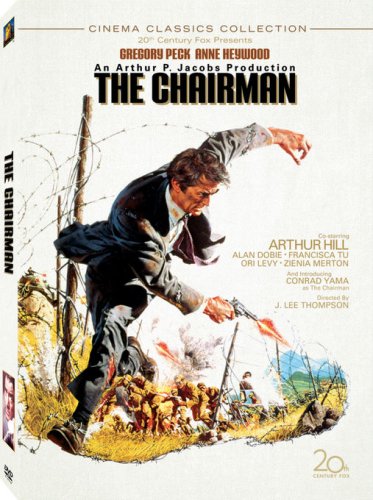
This could have been a pretty good film. I just don’t know. The advance material and the jacket suggest this is a “gripping thriller” with timely themes of terrorism and war. As soon as the film opens, it becomes immediately obvious that something entirely different is at work here. A news report suggests that a tyrant is showing his compassion and generosity when he commutes the sentence of a prisoner about to go to the guillotine. What does he commute the sentence to? Death by hanging. What a guy. I think my mood...was determined at that point. With the evident conflict, I begin to wonder just what the intent really was. Is this a satire? Do they really think this is “gripping” stuff? It’s hard to believe that the satirical nature of this script could be accidental. The entire film presents us with awkwardly comedic elements mixed with rather brutal images of death and torture. So what the heck is this film after all?

The film opens with an explanation that this undisclosed nation has been ruled by a brutal tyrant for many years. Upon the man’s suspicious death, his inept son, affectionately called Jr., takes over. The trouble is Jr. is worse than his father and is far more concerned with making bad action films than actually running the country. Campaign ads remark that you should “re-elect President for life and Things Will Be OK”. An underground revolutionary leader has been in prison for over ten years. He uses the time to write quaint words of wisdom on the walls of his cell in excrement while enticing his guard to his political beliefs. What follows is an expected coup followed by yet another brutal dictatorship. As the soldier wisely remarks, “Before the revelation it was man exploiting man; after the revelation it has reversed”. It is in this second act that the film attempts to jettison its comedic style and be the serious effort it claimed to be. More brutal images assault us at every turn, but by now it’s too late..

From the rather twisted mind of Stephen King, Pet Sematary is actually one of my favorite of his horror novels. It’s scary to think the story was never meant to be published and only offered up to finish a contract with his earlier publisher. As has been the Stephen King plague at nearly every turn, something ends up lost in the translation. In the novel, the deeper subtexts that King is so adept at take several hundred pages to set up and ultimately pay off. Unfortunately a mere couple of hours of celluloid never ...eem to scratch the graveyard surface soil. Pet Sematary is, sadly, a definitive example. While the original work taunts us with its mystic undertones that always seem far more believable than they ought to be, the film lays down a path as overgrown as the one leading to the titular graveyard. At first the two works are not so convergent, and a great deal of hope is to be had. Soon, however, the movie descends into the typical shock horror film so common in recent years. Startles and zombies begin to dominate the experience, while the story’s deeper and far more frightening elements lie as dead as the bones of the neighborhood pets.

The plot points are pretty faithful to the King work. For ages the kids in this suburban Maine neighborhood have been burying the remains of their beloved pets, often victims of a dangerous road, in the barren soil of the local Pet Sematary, misspelled by the countless kids who christened the field untold years ago. But beyond the pet graveyard is a more mysterious and foreboding place. It was here that Indians brought the dead back to life. Our unfortunate family is about to discover that perhaps “dead is better”.

Jack Black says when he’s embarrassed, he knows it’s funny. He must have been pretty confident about the success of Nacho Libre, because as Ignacio (Nacho) – the friar by day, wannabe wrestler by night – he embraced one embarrassing moment after another.

Black stars as a friar at a Mexican orphanage run by the sort of God-fearing folk who think wrestling, or Lucha Libre, is a sin. All his life, Black has longed to be a luchador (wrestler), which is a bit of a conflict. His only jobs at the orphanage are cooking duty, and dead-guy duty. The latter only serves as an amusing side joke, while the former drives the story. You see, Ignacio’s bosses don’t provide him enough money for decent ingredients, so his food sucks. When the beautiful Sister Encarnacion (Ana de la Reguera) shows up at the orphanage, Black is smitten, and inspired to impress her with better food. But for better food, he needs money for ingredients.

Vectors, PS3 Linux, and Knights not being squire - Welcome to the Sword that lost its edge a long time ago known as Dare to Play the Game.

The Break-Up tells the story of the relationship of Gary (Mr. And Mrs. Smith’s Vince Vaughn) and Brooke (Friend’s Jennifer Aniston. As the film begins, we see Gary at a baseball game as he attempts to ask Brooke out on a date by endless asking her. The film skips forward roughly two years, to a point where Gary and Brooke are now a couple who are living together in a highly desirable condo. Gary is working as a Chicago tour guide with his brothers, while Brooke works at the Marilyn Dean Art Gall...ry. Everything seems to be going fine until a dinner with their respective families. Gary, feeling that Brooke is constantly asking too much of him, yells at Brooke, who feels that Gary never wants what she wants in life, leading to them breaking up (hence the title of the film).

Now that they’re ‘broken-up’, Gary and Brooke tend to play off each other doing little things to annoy each other. Gary is beaten up by Brooke’s brother while Brooke, on the other hand, votes Gary off of her bowling team. All these events occur, as Brooke tells us, in the hopes of getting Gary to change himself so he’ll get back with her. While this plot sounds kind of stupid, the real charm of this film is Vince Vaughn.

After one year of Alfred Hitchcock Presents, television had been forever changed. Hitch proved beyond any doubt that film quality production was practical in the fledgling television format. Nothing changed as the show returned for its second season. Hitch had a remarkable eye for good stories, and he often found them in the most unlikely of places. Take two of this season’s episodes. In The Three Dreams Of Mr. Findlater, a man fantasizes about his nagging wife’s death. In A Man greatly Beloved, we find a small tow... embracing none other than the Boston Strangler. Nothing new in the macabre world of Hitchcock, except perhaps that these tales were born in the same brain that brought us Pooh Bear and Piglet. A.A. Milne provided these wickedly sinister tales. Hitch mastered the art of dark wit. In The Indestructible Mr. Weems, a lodge brotherhood tries to cash in on a dying member, but in the world of Hitch we probably already knew how this was going to end. Hitch himself directed One More Mile To Go, which would eventually provide some of his later inspiration for Psycho. We also find the only multi-episode story of the entire series in I Killed The Count, which aired over three weeks.

Hitch was also a good judge of acting talent. A great number of the show’s performers became household names in one acting medium or another. In season 2 look for Dick York, Barbara Baxley, James Gregory, Sir Cedric Hardwicke, Ralph Meeker, Rip Torn, Steve Forrest, Claude Rains, Vic Morrow, Jessica Tandy, and many more. Of course, you can count on Hitch himself to continue his tradition of introducing each episode and then wrapping things up, usually with an additional moral epilogue.

Japanese horror films are all the rage these days, with the originals hitting DVD in the States, and the remakes showing up in the theaters. Therefore, it stands to reason that even Criterion would get in on the trend, offering up a film from famed director Nobuo Nakagawa, widely regarded as the father of the Japanese horror film.

Jigoku is both strange and fascinating. The film tells the story of two friends that are involved in a hot-and-run accident. While one of the young men is cool, calm and collected, the other is wracked with guilt over their actions. While the family of the murdered man begins to close in on the guilty parties, strange things begin to happen to the man with a conscience.

Synopsis

Michael Caine plays Nicholas Urfe, a self-centred, cynical Englishman who arrives on the Greek island of Phraxos to take a teaching post. He meets Maurice Conchis (Anthony Quinn), a mysterious individual who ensnares Urfe in a complex, psychologically violent mind game, where Urfe is increasingly unable to distinguish truth from lies, reality from illusion.

In 1984 Brian De Palma dusted off his best Alfred Hitchcock imitation in the by now infamous Body Double. We all know the story by now. In fact, if you’ve seen the far superior Vertigo and Rear Window films, you knew the story already. Claustrophobic vampire actor Jake Scully is having a hard time. He’s just been fired because he can’t lie in a coffin, and getting home early, he walks in on his girlfriend in bed with another man. Out of work and homeless, things look up when a fellow actor gets him a sweet housesit...ing gig in a flying saucer shaped condo overlooking the Hollywood valley. There, he is obsessed with a neighbor he spies on with a conveniently provided telescope as she performs all sorts of sordid little things naked in the window. Looks like things are really going well now, until he believes he has witnessed a murder. His investigation into what he saw leads him to the underworld of the porn industry and into the arms of porn queen Holly Body (Griffith). Most of the film takes place at a painfully slow pace. De Palma offers up a lot of stylistic cinematography but not enough action or suspense to keep us all that interested. While the erotic nature of the film was quite shocking in 1985, it just doesn’t pack that kind of a punch today. When De Palma wants to, he can simply ooze atmosphere on film. In Body Double, he oozes something a bit less flattering.

Part of the blame for the film’s awkward pace must be taken up by Craig Wasson. He simply can’t emote beyond a typical movie of the week level. The same can be said for villain Sam (Henry). On one hand, De Palma is trying to dazzle us with the epic scope of the thing, but his two main actors limit that range significantly. Credit should be given to Melanie Griffith, who is miscast in her part, but carries it off with more credibility than one would expect. The stand out has to be Deborah Shelton, who is captivating with little to say. Dennis Franz stands out in his comedy relief portrayal of the director who fires Jake. He’s playing De Palma to a fault, including De Palma’s own clothes. Both men admit in the extras that Rubin was indeed based upon De Palma..