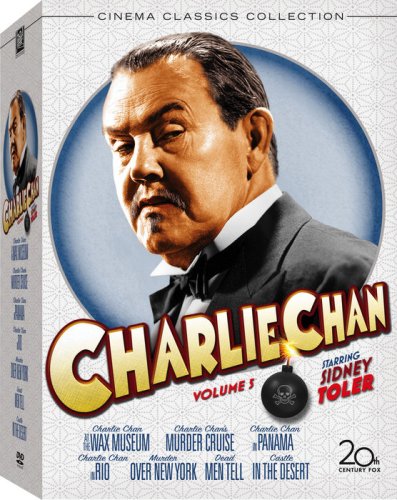
The character of Charlie Chan was created by writer Earl Derr Biggers in 1925 in the book A House Without A Key. He based the character on real life
The Charlie Chan films were very short affairs even for the times. Few ran barely longer than an hour. The films were cranked out with such frequency that there were years that saw as many as 4 films in the series released. You almost have to view a film series like this as that era’s version of a television show. These films almost always feature Chan away from home in some exotic location or another. Without fail Chan and Jimmy would end up in the middle of an unexpected murder investigation. The Chan films were famous for the traditional gathering of the suspects at the film’s end. It was there that Chan would reveal the murderer or cause the suspect to give himself away as Chan sprung his carefully crafted trap. Chan was always softspoken, never revealing too much at any one time. When he did speak it was often in philosophical parables. He was known for phrases like: “Swallow much. Digest little,” when his son asks him if he’s falling for a suspect’s story. Fortune cookie sayings like “Sweet wine often turn nice woman sour” or “Pretty girl often like lap dog. Sometimes go mad”.
The films in this collection are:
Charlie Chan In
Charlie Chan’s Murder Cruise: You can’t expect Charlie Chan to be on a vacation cruise and not stumble unto murder, can you? Lionel Atwill again stars in one of the better of the Chan films on this collection. Tarantula’s Leo G. Carroll also stars.
Murder Over
Charlie Chan At The Wax Museum: Just as a murderer is sentenced to death based on testimony from Charlie Chan, he arranges a daring escape. He fakes his death. The local wax museum of crime is owned by a disgraced doctor who uses the shop as a front to help criminals evade justice with new faces. It is here that the culprit hopes to lure Chan to his death by dangling a lead to an old crime in front of him.
Dead Men Tell: It’s a pirate’s life for Chan as he tries to unravel the mystery of an old pirate’s ghost. There are four pieces to a treasure map, and someone wants all of them.
Charlie Chan In
Castle In The Desert: Chan is called to an isolated estate where the people are considered evil by the nearby townsfolk.
Video
Each film is presented in its likely original full frame format. I was a little worried when the films each came with the following warning: “We have brought this film to DVD using the best source material surviving”. The truth is these prints are in remarkable shape for their age. The picture is usually pretty sharp. There are minimal specks and blemishes. There was obviously a good effort to present these films in as good a condition as possible. There aren’t the expected jump edits or dirty frames. The contrast varies considerably but is often incredibly sharp on these black and white presentations. I’ve watched a ton of old films in my days, and I find these to be extraordinary at times, better than average at others. Of course, they still are 70 years old and wouldn’t compare favorably to today’s standards, but I think anyone who would enjoy these kinds of films will be very happy with the results here.
Audio
The Dolby Digital Mono track is not quite as impressive as the video. There’s some scratch to some of the dialog and a wobble to some of the musical cues. It’s still fair throughout and will likely not distract you from the nostalgic experience.
Special Features
There are some picture galleries and text production notes.
Final Thoughts
My parents used to watch these things on late night television in the 70’s, and that’s about all the exposure I had to these films before. I’m not even sure I saw any of these films before in my life. I ended up running them in rather quick succession, however. I found them completely entertaining, and yes, a bit amusing as well. You can’t really take any of this seriously, and if you watch it with tongue firmly placed in cheek you’ll find them, “as the North Americans say…is ok”.