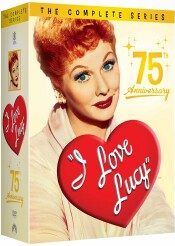
Lucille Ball was originally a radio personality starring in a popular comedy, My Favorite Husband. It was here that she began to develop the character she would continue to play for decades in television through several shows, all bearing her name in one form or another: I Love Lucy, The Lucy Show, Here’s Lucy, and Life With Lucy. See the pattern? Anyone who was a fan of the radio show would instantly recognize the red-haired actress even though they had never actually seen her on the radio. That exaggerated cry was already a staple of her physical comedy, even when she couldn’t be seen. She had also toured for many years with her real-life husband Desi Arnaz. When they could not convince a network to film a pilot of a show featuring both of them, they made it on their own dime. CBS was so impressed with the pilot that they reimbursed the couple, and in 1951 I Love Lucy hit the airwaves.
Lucy played the character she had already perfected on radio and on the stage. Desi played her husband, a Cuban bandleader who headlined at the Tropicana. Lucy was always trying to find a way to get into Ricky’s act. She had no talent, but that never stopped her, usually embarrassing Ricky along the way. The couple lived in an apartment owned by the Mertzes, Fred (Frawley) and Ethel (Vance). They were not only the Ricardos’ landlords but also their closest friends. Ethel would often find herself talked into one of Lucy’s crazy schemes. The show also found comedy fodder in Ricky’s thick Cuban accent. Sometimes his mispronunciations caused hilarious misunderstandings. William Frawley as Fred had the job of playing straight man most of the time. It was a thankless job, to be sure, but he was perfect at it. He didn’t talk as much as the others, but he had some golden moments over the show’s very successful six-year run. It was a shame that Frawley and Vance absolutely hated each other. Both were slated to return to Lucy’s second series The Lucy Show, but Vance refused to work with Frawley again, and he was written out of the second show, as Vance and Ball were very close in real life as well. During that time the series never once fell below number three for the entire year in ratings.
I Love Lucy changed the fledgling television industry in the 1950’s. This was a time when network television was less than a decade old. Most folks had never heard of television just 15 years earlier. I Love Lucy defined the concept of a sitcom. The show was driven by the very strong personalities of the cast. Desi Arnaz was considered a charismatic Latin lover by American women. Lucy played the perfect foil and found a mountain of gold to mine in strong physical comedy. So many modern shows owe their roots to this classic that it would be impossible to mention them all here.
Even if you are not a particular fan of the show, it would be a mistake to dismiss the impact the series had both on the situation comedy and the television industry itself. The show’s pioneering use of the three-camera format and shooting on film allows the material to be in a position to be restored at all. That setup has remained a staple of the television comedy since that time. Desi was also a marketing genius who was the first to take advantage of the promotional value of putting the show’s name on everything from lunchboxes to sleepwear. It’s an innovation that is exaggerated in a Red Skelton skit provided in the extras here. Desi changed the way television crew did their jobs and created the modern production methods still used today.
Lucille Ball passed away in 1989. She was the last survivor of the quartet that formed the nucleus of I Love Lucy, and her passing brought about a wave of nostalgia for the series. By 1990 CBS was still looking for ways to capitalize on the resurgence of popularity. That’s where the idea of a Christmas special was first brought up. The concept evolved into colorizing the show’s own Christmas episode and offering it up as a 1990 Christmas program. The ratings were huge, and before long the network found a way to make it an annual television tradition by adding more colorized material each year. Eventually we had 16 full episodes colorized using original props, costumes, and photographs as reference points to make the colors as authentic as possible. Still, these early attempts at colorization were crude. In the years to follow that technology improved, and using the new techniques in concert with the restored 35mm film negatives we now have relatively pristine copies of these episodes, and they were brought together in one DVD package.
Here it’s all in the original black & white, but you’ll smile to find some episodes that have gone on to be somewhat immortal. Lucy and Ethel working in a candy factory is one of the highest rated television episodes on pretty much anyone’s list. George Reeves would appear as both himself and Superman less than two years before his controversial suicide. Robert Stack played an Elliott Ness-like character, and remember that Desilu produced The Untouchables, so the episode looks and sounds like an episode. Desilu would later produce Mission Impossible and Star Trek. The show made early television history with the birth of Ricky, Jr. It was the most watched episode of television until the M*A*S*H final episode almost 30 years later. The show was times to account for Ball’s actual pregnancy with Desi Arnaz, Jr. but he never actually appeared as little Ricky on the series.
For the first three years most of the show took place in their apartment. In the fourth season Ricky gets a chance at Hollywood, and the cast go to California for several seasons. This was the very first time a television series used continuing story elements across several episodes, and it was a ratings hit that allowed Lucy to interact with many stars of the day like Montgomery Clift, John Wayne, and Harpo Marx, among others. The idea went over so well that the following season the cast went on a whirlwind tour of Europe, where Lucy’s grape-stomping bit became another classic moment. In the final year the cast visited Florida and finally Cuba where both Arnaz and Ricky were born.
The show also scored one of the best film cinematographers in the movie business to shoot the show. Karl Freund is known to anyone who grew up with the Universal monsters. He was the cinematographer on many including Karloff’s The Mummy and Lugosi’s Dracula. He worked with Fritz Lang on one of the most notable films of the silent era: Metropolis. He was instrumental in securing the shoot on 35mm or the series would likely be mostly lost today. He also made Arnaz’s idea of a three-camera system work by developing a unique lighting system that gave each of the cameras the same lighting tone so that edits between them were invisible. He was reluctant to do television, and it was only through the couple’s personal pleas and a healthy paycheck that he agreed, and it was one of the best decisions the couple made. It’s the only reason you can now see the show in such good condition on a release like this.
Extras include pieces of Ball’s radio show along with a limited number of deleted scenes and flubs. You get every episode including the unaired pilot with some casting changes. The image is quite good, and the series would look equally as good on your video shelf.
Everyone has their favorite moments and episodes. No word on if there’ll be more colorized episodes in the future. There haven’t been for some years now. You could wait for an eventually larger set, but “you shouldn’t cross your bridges before they’re hatched.”