

“My murderer was a man from our neighborhood. I took his photo once as he talked to my parents about his border flowers. I was aiming for the bushes when he got in the way. He stepped out of nowhere and ruined the shot. He ruined a lot of things. My murderer could live in one moment for a long time. He could feed off the memory, over and over again. He was animal. Faceless. Infinite. But then he would feel it, the emptiness returning, and the need would rise in him again.”
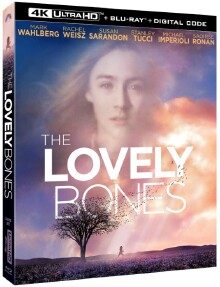
Peter Jackson was well into the nearly decade he would spend in Middle Earth bringing The Lord Of The Rings films to life. But he knew he would need to do something very unlike the fantasy world in which he was now living and working. He turned his attention to a book by Alice Sebold called The Lovely Bones. While it was published as a novel, some elements of the story were autobiographical for the author. Of course, she wasn’t murdered, or she would not have been able to write the book, but she was raped, and so she knew something of the emotional journey the book took its readers on. One of those readers was Peter Jackson, and he very much wanted to shoot the film. There was a problem. British television ITV obtained the rights and hired Lynne Ramsay to write and direct the film for Channel 4. Ramsay couldn’t find a way to soften the material enough for British broadcast, and it was never made. Jackson finally snagged the rights while he was making his King Kong remake, and the rest fell into place in 2009 and became the film The Lovely Bones, now released on UHD Blu-ray in 4K from Paramount Studios.
The film was originally made a bit infamous by the late critic icon Roger Ebert. He called it “deplorable” and called it one of his most hated movies. He acknowledged the performances and other aspects of the film, but faulted Peter Jackson for appearing to make the statement that a young girl getting raped and murdered was a pretty good thing for her. As much as I respect Ebert, he couldn’t have been more wrong. The truth is the novel is far more graphic than the film, which spares us from actually having to witness the act of brutality. He had no way to win here, and that’s part of the film’s problem. He was called too graphic by some and not graphic enough by fans of the book. It was a real no-win situation.
“When I was alive, I never hated anyone. But now hate was all that I had.”
Young Susie Salmon, pronounced “just like the fish”, played by Saoirse Ronan, is a pretty normal suburban little girl. She saved her brother’s life once when he accidentally poisoned himself by getting him to the hospital by driving a classic Ford Mustang exactly the way you’d expect of a young girl too young to drive to drive it. But she saved his life, and her somewhat wacky grandmother, played by Susan Sarandon, told her that meant that now she would live a very long time. Grandmom was wrong.
Enter Stanley Tucci as neighbor George Harvey. He’s a psychopath who hasn’t yet taken a life. We see him carefully plan out a sort of underground clubhouse he built in the middle of a cornfield the kids cut through on the way home. He saw Susie, and like a spider to a trap he used its wonder to lure her into his clutches, and he raped and murdered her. The scene is actually played out both tastefully and quite emotionally. As we watch Harvey tempt her and eventually pounce, the scene is intercut with her family having dinner, oblivious to the danger their daughter is just then facing. As she attempts to escape, there is another clever bit of filmmaking here. If you have ever read or seen An Occurrence At Owl Creek, you’ll recognize what is happening here. It’s a great story that Rod Serling considered one of his favorites. He made it into a Twilight Zone episode, but it didn’t really fit that mold. If you haven’t seen it, that’s your homework before seeing this film. All of these tragic and brutal circumstances are actually played with care and avoid going the shock route.,
Dad is played by Mark Wahlberg, who replaced Ryan Gosling the day before shooting. Both Jackson and Gosling realized he just wasn’t right for the part, and it was a mutual parting of ways. Wahlberg does a fantastic job. He’s close to his daughter. They build ships in bottles together, and he’s driven to the breaking point when she vanishes. Mom is Rachel Weisz, who is now about to return to The Mummy franchise. Her grief is both for the loss of her daughter and also her now obsessed husband. He jumps at every lead and is always in contact with the lead detective, played by The Sopranos star Michael Imperioli. One of the big clues comes from Susie’s use of her camera. She invented the selfie back in the early 1970’s and took pictures of everything. She took so many rolls of film that the family resorted to a deal where one roll gets developed each month. You young folks might have to do a Google search on film and development. It’s finally that last roll of film that puts him on the trail of Harvey. It’s a bit tenuous, but hey, it works.
“I was in the blue horizon between heaven and earth. The days were unchanging, and every night I dream the same dream. The smell of damp earth. The scream no one heard. The sound of my heart beating like a hammer against cloth, and I would hear them calling, the voices of the dead. I wanted to follow them to find a way out, but I would always come back to the same door. And I was afraid. I knew if I went in there, I would never come out.”
If the film had stuck to these dramatic beats with the clever cinematography, it would have made for a better film. But Susie is in a sort of Waiting Room to Heaven, and she’s watching all of these things happen. That’s a huge part of the novel, and it works here, except where Jackson can’t help himself from going too big with some weird otherworldly f/x going on. They distract from the truly emotional story going on here. The problem is that even Jackson considered it a supernatural film, but it really isn’t. The wild environments not only distract, but they make this film over-long at nearly two and a half hours. Of course, this is the director who took a 100-minute classic movie and made it over three hours, so nothing new there. But this choice ruins the film. It’s not the message or whatever Ebert was going on about. It just gets too weird.
“These were the lovely bones that had grown around my absence. The connections, sometimes tenuous, sometimes made at great cost, but often magnificent, that happened after I was gone. And I began to see things in a way that let me hold the world without me in it.”
Susie grows in her Heaven-like place. She starts to learn from what she sees, and it helps her to grow emotionally. Pushed by a friend she makes there named Holly (SooHoo), she has to learn to let go, but it’s years that she stays here. A cautionary note. Be careful what clothes you die in. It appears you are doomed to wear the last clothes you wore for eternity, and you might just end up in ugly mustard-colored pants. Just a little heads up. Just one of the many public service announcements we like to make here. She learns forgiveness, or at least peace.
The performances are all strong. Tucci struggled with the role in his own head because of how bad the character is. He modeled his creepy, nuanced performance on the BTK killer. Whatever he did, it works, and it was quite a performance. Truth be told, they were all good. Young Ronan really put a lot of those emotional beats on her very young shoulders, and you can’t fault any of these performances. The chemistry she shares with Wahlberg as her dad is priceless.
Video
The Lovely Bones is presented in a its original aspect ratio of 2.39:1. I did not see the film in its theatrical release, so I can’t comment so much on how faithful the release might be, but I suspect it’s pretty dang close. It’s a nice transfer from 35mm film, so it’s naturally 4K. There isn’t as much film grain here, but I’m not sure how much there was. Jackson goes for resolution and not organic here, so it could have felt warmer and more atmospheric. Colors are often bright when appropriate, and the color grading helps us to know when we’re in the afterlife or here on Earth. Black levels are enough to do the job. They mostly function in Harvey’s world were colors are also more drab and desaturated.
Audio
The DTS-HD MA 5.1 audio presentation is pretty much what was released on Blu-ray in 2010. Dialog cuts through, and that’s really a huge part of what’s needed, so I’d say it was pretty much average overall.
Special Features
There are three discs. You get a UHD Blu-ray with just the film so that it gets all the bandwidth. There are no new features. But a second Blu-ray contains the same three-hour presentation Jackson did back in 2010 complete with introduction. I have to admit Jackson gives us a lot of extra stuff. Just nothing new for this release.
Final Thoughts:
I ended up with such mixed emotions about the film. There is some truly brilliant stuff here. If Jackson hadn’t felt the need to stray so fully into the supernatural realm, he would have had a really nice crime thriller here with plenty of heart and wonderful performances. A tighter running time would have also helped. I feel time passing during the fantastical shots. Everything doesn’t have to be larger than life. The film brushed against greatness. “Almost. Not quite.”