Posted in: Brain Blasters by David Annandale on August 17th, 2007
Nacho Cerdá made his name on the underground horror circuit with Aftermath, a short feature that made everyone’s worst surmises about autopsy tables look hopeless optimistic. The question that looms around his feature debut, The Abandoned, just out on DVD, is how on earth he might top Aftermath’s taboo-busting calling card. Wisely, he attempts no such thing. Though there is one notable moment of “yeeeurrrrgggh” in the film, it otherwise marks a very different approach to horror, as well as making clear that Cerdá is the kind of talent that horror desperately needs at this juncture. It’s a criminal shame that the film received to theatrical distribution to speak of, but here’s hoping it will find the audience it deserves on DVD.
The ominous prologue is set in Russia (played by Bulgaria) in 1966. A mortally wounded woman drives a truck to a farm, where the inhabitants discover a pair of newborn twins in the seat beside her. In the present, one of those twins, Marie (Anastasia Hille), determined to learn more about her birth parents, has arrived in Russia from Los Angeles. She is given directions to her ancestral farm. Once she gets there, a malevolent supernatural trap slams shut. She meets her twin, Nicolai (Karel Roden), who is just as caught in the web as she is, a web spun by patient and merciless past.
Posted in: Disc Reviews by David Annandale on August 16th, 2007
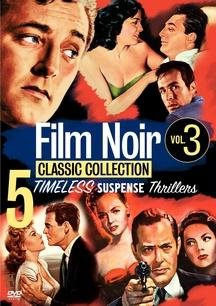
Volume 4 of Warner’s Film Noir Classic Collection series raises the bar over its wonderful predecessors by doubling the number of movies on offer: ten this time around.
Very briefly:
Posted in: Disc Reviews by David Annandale on August 13th, 2007
Mads Mikkelsen, whom we last saw taking a rope to James Bond’s family jewels, is here up to a far more praiseworthy activity: helping run a school for orphans in an impoverished region of India. The school is struggling to survive, and when a Danish businessman expresses an interest in providing stable funding, but only if Mikkelsen comes to Denmark for a meeting, the latter is reluctantly persuaded to leave India for the encounter. At said meeting, the tycoon (Rolf Lassgard) casually (it seems) invites Mikkelsen to his daughter’s wedding. Mikkelsen accepts, and at that wedding receives quite a shock. Lassgard, it turns out, has a very personal secret agenda at work.

To say more would be to spoil one among the many surprises the film unleashes upon both characters and audience. Most especially on the former, since the story also follows some twists familiar and predictable to any fan of the melodrama. And that is, essentially, what we have here, the modern inheritor of the likes of Stella Dallas and Dark Victory. That isn’t a bad thing. The big emotions are earned honestly, and Lassgard’s performance climaxes in a scene of such intensity that the word “raw” scarcely does it justice.
Posted in: Brain Blasters, Regular Columns by David Annandale on August 10th, 2007
All right, some musings on basics now. I have spilled a fair bit of verbiage over the course of this column about films that are so bad they’re good. But there are questions going unanswered, and, dare I say it, unasked: how exactly does this come to pass. How does a bad movie achieve a certain form of perverse greatness? Why do we enjoy watching these things? I could go on.
A look at the patterns that emerge from consistent viewing of Mystery Science Theater 3000 is helpful here. Wonderful as that series was (and equally wonderful its continued preservation on DVD), not every episode hit comedy gold. The shows where Joel, Mike and the ‘bots had more trouble with the material they were working with confirms, for me, a long-held theorem: that any type of film, if bad enough, turns into a comedy, with one exception: comedy. The sad fact of the matter is that no comedy, no matter how bad it is, becomes another form of comedy. It might almost approach the status of a horror film, but it remains a resolutely dismal experience, as I’m sure anyone foolish enough to line up this week for Daddy Day Camp has learned.
Posted in: Disc Reviews by David Annandale on August 9th, 2007
Logan (Malcolm Stumpf) is a lonely 13-year-old whose experience of junior high, already hellish, is made exponentially worse by his emerging homosexual identity. Smitten with Rodeo, an older rebel who is one of the only other students to spend time with him, Logan adopts the female identity of “Leah†which he uses to seduce Rodeo over the phone, hoping to make his daydream a reality. Meanwhile, he identifies strongly with the mountain lions that have begun straying onto the campus and being shot.
The film is exec-produced by Gus Van Sant, and writer/editor/producer/director Cam Archer wears the influence of his mentor on his sleeve. There is too much precious cinematographical poetry and too many preposterously literal metaphors here, getting in the way of moments that, at other times, offer the possibility of an acutely sensitive look into the torment of early adolescence. As a result, the film is merely acutely sensitive – in way that invites an atomic wedgie.
Posted in: Disc Reviews by David Annandale on August 5th, 2007
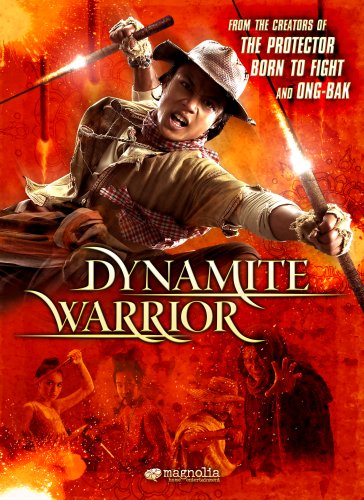
Dan Chupong plays a young warrior, armed with rockets and martial arts skills, who roams the Thai countryside in the 19th Century, searching for the man who killed his parents. His only clues are that he trades in buffalo and is a unique tattoo on his chest. He finds the man he believes is his target, but this trader, who possesses magical powers, is also in the sights of an evil local aristocrat who is trying to get rid of the local buffalo population in order to drive up sales for his tractor franchise. Said ne’er-do-well sets up our hero to do his dirty work.
The first fifteen minutes or so are a bit confusing as the plot gets all its ducks lined up, but once everything is in motion, the storyline clears up. The action, a mix of traditional stunt work and wire work, is not on the same level as Ong-Bak, but it is still exciting, and there’s plenty of it. If the lead-in to act 3 drags a bit, with an excessive use of flashbacks filling in events the audience has already figure out, the payoff makes it all worthwhile.
Posted in: Disc Reviews by David Annandale on August 3rd, 2007
One hundred years after Abraham Van Helsing and allies fail to annihilate Dracula, the vampire arrives in a small American town looking for an amulet that, if destroyed at the prescribed moment, will usher in a reign of darkness. Recruited to aid in this project are versions of the Wolfman, the Frankenstein Monster, the Mummy and the Creature from the Black Lagoon. Opposing Dracula is the titular Monster Squad, a group of monster-crazy boys and one very little (and very adorable) sister, who befriends the Monster.
I first caught this film during its original theatrical run, and enjoyed it then. Twenty years later, it looks even better. This is the kind of movie that Stephen Summers (The Mummy, Van Helsing) evidently thinks he is making, even though he is utterly unable to do so. Director Fred Dekker’s acknowledged model is Abbott and Costello Meet Frankenstein, and as in that film, the monsters are treated with respect, remaining figure of fear, not of fun. There is much humour in the film, but the stakes are real. There is a sense that the battles could have a real cost to them (and when the monsters attack, people do actually die). There are also enormously poignant, heartfelt moments (when was the last time you teared up at a Summers film?). The special effects have aged somewhat, but have accrued all the more charm for that. Dekker’s love of the classic Universal films imbues every frame, right down to replicating the out-of-place armadillos and phony-looking bats from the original Dracula. This is, from top to bottom, the dream of every classic monster fan made flesh.
Posted in: Brain Blasters, Regular Columns by David Annandale on August 3rd, 2007
Part and parcel of loving cult movies is a profound sense of nostalgia. This melancholy ache for the past is not necessarily limited to periods one has actually lived through. The shape of the nostalgia also takes on different forms, and can often wind up feeding on itself. This is a phenomenon that the bargain-basement DVD can help perpetuate. Allow me to attempt to explain myself a little more clearly.
Our starting point is the grindhouse cinema of the 1970s. As I’ve mentioned before, I was too young to actually go to any of those dubious houses, or ever see any of their offerings theatrically. But I am just old enough to remember the ads for these films in the paper. As my friends and I started going to movies on our own in the early 80s, the grand days of exploitation were drawing to a close (and we were still too young to be allowed in to many of the titles out there). So that is Stage 1 of the particular form of nostalgia I’m tracking today: the longing for a past that was witnessed from a distance.
Posted in: Disc Reviews by David Annandale on August 2nd, 2007
This is, I gather, part of a series of documentaries under the wider umbrella of “America Undercover,†and is not the first of the taxicab ones. What we have here is a collection of vignettes as various people hail a cab and, captured by the cab’s security camera, engage in revealing conversations with the driver. Most of these discussions deal with relationships and sex (the guy and his transsexual girlfriend, the guy with the big woman fetish, the guy with a thing for “crazy chicks†and so on). Over the course of the hour, this becomes a little tiresome, and one hopes for a passenger with something else on his/her mind. This moment finally comes in the form of a passenger whose former boyfriend is a firefighter who barely escaped the collapse of the World Trade Center with his life, and her narrative, moving and disturbing, is the highlight of the episode.
Audio
Posted in: Disc Reviews by David Annandale on August 1st, 2007
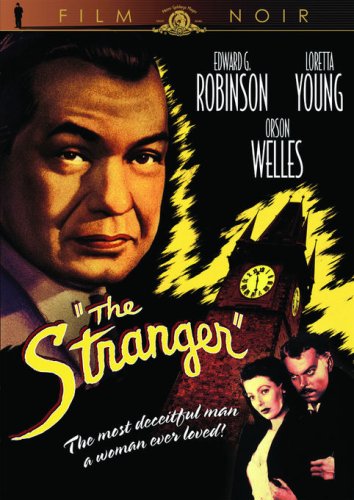
Edward G. Robinson is the war crimes investigator on the relentless hunt for the fugitive Nazi who masterminded the Final Solution. He arranges for the one man who knows his face to escape imprisonment, and follows him to a small Connecticut town. There he loses his quarry, but evidence soon points to Orson Welles, who, under the identity of Charles Rankin, is now a college professor and new husband to Loretta Young. Welles stops at nothing, including murder, to protect his secret, but little by little Young is forced to realize who her husband really is.
Welles’ third film as a director is far more conventional than Citizen Kane or The Magnificent Ambersons, and it isn’t quite up to its predecessors. Robinson is terrific as a detective who must become almost as cold-blooded as his prey, but Welles’ performance is too big: his character might as well be wearing a “NOT A NAZI WAR CRIMINAL†name tag. That said, the suspense is powerful, and the cinematography pure, gorgeous noir.