Posts by David Annandale

Apparently, someone out there really wanted to see another entry in the Species franchise, surely one of the most poorly conceived series ever. But here we go: Miranda (Helen Mattsson) is a college professor (yeah, right) who suddenly experiences a mysterious blackout, during which she transforms into monster in a rubber suit and slaughters the hospital staff. Her uncle, Ben Cross (no doubt dreaming sadly of the days when he starred in the likes of Chariots of Fire), reveals to her that the is in fact an alien/human hybrid, and the two set off to Mexico to find an ex-colleague of Cross’ who might be able to help. This unsavory sort has been making even more hybrids, which leads, in a roundabout way, to all kinds of trouble.

I say “roundabout” because this flick has one of the most infuriatingly meandering plots I’ve encountered in a quite some time. If you’re going to be a DTV B-picture, the least you could do is get to the point and stick with it, seeing things out in 90 minutes or less. But Species: The Awakening plods along for 103, first appearing to go in one direction, then another, but never mounting anything that resembles a head of steam. The inherent misogyny of the concept hasn’t been improved on, either. Colour this effort dismal, dated, depressing and dull.

Bert I. Gordon. Now there’s a man who knew no shame. Here was a director who combined the hucksterism of a low-rent William Castle (who wasn’t exactly living on the Boardwalk of Monopoly board of producer-directors, if you catch my drift), the willingness to pile on the spectacle of an even lower-rent Cecil B. De Mille, and the technical competence of a slightly (but only slightly) higher-rent Ed Wood. Here was a director who not only did his own special effects, but for some unfathomable reason thought they were good enough to show for extended periods of time. Perhaps he thought his back-projection techniques in The Amazing Colossal Man, Attack of the Puppet People and Beginning of the End (grasshoppers!) were actually impressive. They weren’t. But they had a certain goofy charm.

And goofy charm is what today’s offering is all about. Gordon’s last film, 1976's The Food of the Gods, has finally found a DVD release as part of MGM’s Midnite Movie series, and it’s about damn time. Here’s a movie that has both the honesty and nerve to claim to being based only on a portion of H. G. Wells’ source novel. I remember, in those heady, summer days of 1976, when Famous Monsters of Filmland trumpeted the film’s upcoming release, complete with plenty of FX shots that I thought were pretty cool. Of course, I was only nine. The film hit Winnipeg at the Pembina Drive-In, long since demolished to make way for highways. I didn’t see the film then, but when I at last tracked the film down decades later on VHS, it was exactly the kind of engaging nonsense I was hoping for, and it’s even better now in widescreen.

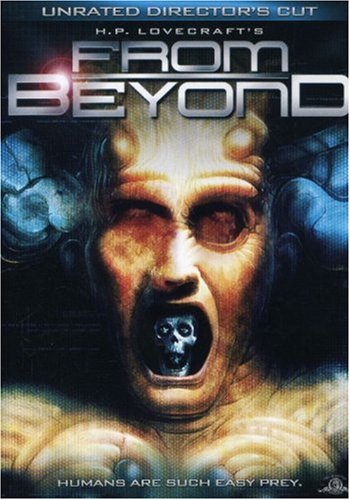
Scientists Edward Pretorious (Ted Sorel) and Crawford Tillinghast (Jeffrey Coombs) successfully construct a machine (dubbed the “Resonator”) that links our world with another, hostile dimension. Pretorious gets his head bitten off by something summoned by the machine, while Tillinghast is incarcerated in an asylum. Psychiatrist Katherine McMichaels (Barbara Crampton) believes Tillinghast’s story when she discovers his pineal gland is growing enormously, and she has him released into her custody to recreate the experiment. Baaad idea.

Director Stuart Gordon’s follow-up to Re-Animator ups the gore and mutated flesh aspect, and in this uncut version, we at last get to see Coombs sucking Carolyn Purdy-Gordon’s brain out of her eye-socket, among other gruesome delights. There are plenty of distorted monstrosities on display, too, and the film certainly benefits from an enthusiastic commitment to its material. But Gordon, despite his great love for Lovecraft’s material, has always struck me as not quite having the right temperament to really capture Lovecraft’s spirit. He comes close in Dagon, but there, as here, he coaches performances that are pitched far too broadly, and gets carried away, not just with the sex and gore (which isn’t necessarily a problem), but with the equally broad humour such that the movie never really captures the true cosmic terror of Lovecraft’s tales. (In the Mouth of Madness is much more successful in this regard.) So, while this film doesn’t quite work, it is still huge fun.

Returning to Sinister Cinema’s roster of Drive-In Double Features this year is an offering that distinguishes itself by the rarity of the two films in the pairing, and so it is my bounden duty to bring this to your attention. The two films in question are Caltiki, the Immortal Monster (1959) and The Magnetic Monster (1953).

Caltiki is another blob monster movie in the vein of The Blob and X the Unknown. It isn’t in the same league as either of those films, but is not without both interest and charm. It’s an early genre effort from Italy, coming just before the onslaught of gothics that would begin in 1960, and behind the camera are the two men most responsible for those classic horrors: Riccardo Freda as director, and Mario Bava as cinematographer (who also completed the film after Freda left). The story is bizarre. Our blob in question is discovered in an ancient temple in Mexico, and turns out to be the source of a deity’s legend. The heroic scientists describe it as a unicellular creature, an appellation that certainly doesn’t help the audience’s efforts at sustaining disbelief. But never mind. Though the creature is apparently killed by fire in the tomb, a portion of it retained for study survives and breaks free. The climax takes place in the hero’s residence, with the creature, now in several pieces, oozing all over the grounds and down hallways, closing in on the heretofore neglected wife and child. It’s all rather absurd, but well paced and nicely photographed. As well, in the hero’s troubled marriage, we see an element unusual for monster films of this type and era and, despite the Mexican setting, there’s a faint whiff of Italian social malaise from the Dolce Vita days floating about.

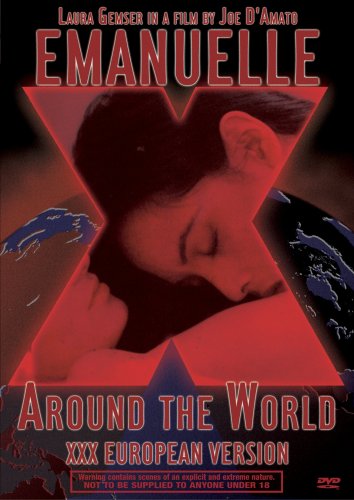
This is a second release of the film already available in Severin’s fine Black Emanuelle’s Box collection. What I said about the film in that review still holds, to whit: “Emanuelle Around the World (1977) has a bit more of a storyline, though it is still very picaresque in nature. Picturesque as well. Our heroine becomes outraged by the sex traffic of women, and so travels from location to location, exposing the evildoers. D’Amato (who also directed the previous entry) here rather unconvincingly dons a pseudo-feminist stance, but there are moments actually approaching suspense. The sex scenes of both these films are, for the most part, laughable, though occasionally well shot. Any sense of eroticism is thanks to Laura Gemser, whose ethereal beauty and grace are such that she moves through the film as an almost divine presence, above and untouched by the events around her.”

This is the “XXX European Version,” which doesn’t make a whole heck of a lot of difference. The running times are essentially identical. The only scene where I noticed any real increase in explicitness is in the creepy sequence where a captured Emanuelle is forced to watch rape by snake and dog. The scene is still, I think (and devoutly hope and keep telling myself), simulated, but most unpleasant, and makes the film’s pseudo-feminist stance even harder to buy than before.

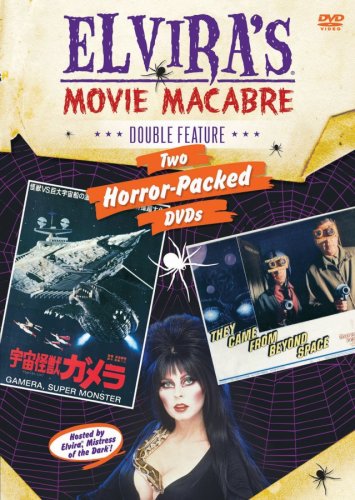
Shout Factory has begun to release DVD editions of Elvira’s Movie Macabre, the cult hit TV show from the 80s wherein our curvaceous goth host makes off-colour jokes and pokes fun, during the commercial breaks, of the movies she’s showing. Up on the chopping block in this set are Gamera, Super Monster and They Came From Beyond Space.

The former was the last Gamera film until the revival in the 90s, and is a thoroughly weak entry. An evil spaceship (suspiciously resembling a Star Destroyer, but introduced to us through the excitingly cinematic technique of ILLUSTRATIONS) is heading towards Earth. Acting in our defense is a trio of superwomen and Gamera, who battles, through the miracle of stock footage, his former foes.

My very first horror film book, acquired in Grade 3, was Denis Gifford’s A Pictorial History of Horror Movies. Among its many stills were a number for films identified by title, but with no other information provided. The result was rather tantalizing. One of those stills was for a 1969 Japanese ditty called Horror of Malformed Men. At long last, thanks to a new release from Synapse (with the title pluralized to Horrors of Malformed Men), my curiosity has been more than satisfied.

All right, seekers of the bizarre, try this plot on for size. The film opens with a man trapped in a cell with dozens of half-naked women. They’re all writhing about as if they’re performing some kind of avant-garde dance number, except for the one who is going after the guy with a knife. Eventually a guard intervenes and he hauls out the man (Teruo Yoshida), blaming him for the ruckus. Turns out the setting is an asylum, and Yoshida is an inmate, with no recollection of how or why he is there. After surviving an equally mysterious assassination attempt, Yoshida escapes. By chance (it seems), he runs into a circus performer who sings the same song that haunts Yoshida’s fragmented memories. She might have information about who he is and where he comes from, but she is killed before she can tell all. Yoshida is blamed for the murder, and he becomes a fugitive. On the run, he reads about the death of the scion of a respected family, a man who could be his twin. Yoshida takes the place of the corpse (!) and fakes a resurrection. He enters the man’s household, hoping to find out who he is, why the dead man is his exact double, and how that man really died.

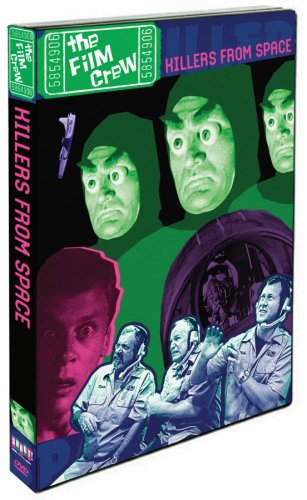
Since Mystery Science Theater 3000 came to an end, fans have been having to make do with various second-best replacements. The most obvious one has been Mike Nelson’s solo commentaries on the likes of Reefer Madness and House on Haunted Hill. Though his efforts have been amusing, they have like the lunatic fun generated when he had Tom Servo and Crow to bounce off. With The Film Crew releases, we have the closest thing yet to a return of MST3K, as Nelson is reunited with Kevin Murphy and Bill Corbett (who were the ‘bots). Playing themselves, they are a trio of working joes whose job is to provide commentary tracks to undeserving films. We don’t see their silhouettes, but we hear their exchanges over the course of the film. The result is pretty damn funny.

Killers from Space is a hilariously dismal 1954 SF opus from W. Lee Wilder (Billy’s singularly untalented younger brother). The boys give this tale of Peter Graves encountering aliens with ping-pong-ball eyes a deserved trouncing. Their work is easily on par with their MST3K days, and some of their post-film antics (which I will not spoil here) have me cackling even as I write these words. This really is the next best thing to MST3K.

If it’s 1977, this must be softcore, and so it is. Vanessa is a another lush sexual travelogue, dug up from the archives and given a rather spiffy release from Severin. Yet another product cast in the Emmanuelle mould, Vanessa has its titular heroine leave her convent home (gee, what sort of nonsense do you think we find out happened there?) after she comes into a large inheritance. Flying to Hong Kong, she finds out that this inheritance consists of a chain of high-end brothels. Cue the exotic locations and varied sexual encounters. There’s nothing hugely striking or original about any of this, but as an example its type, it’s quite handsomely mounted, makes some eyebrow-raising use of classical music, and has a couple of scenes that (almost) reach a (kind of) frenzy (all proportions maintained).

Audio

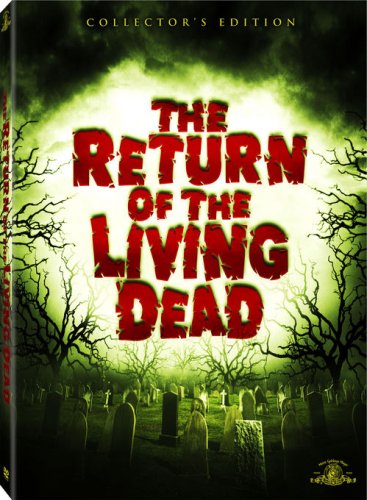
It’s back, yet again, and looking for more brains. Dan O’Bannon’s lively zombie comedy tells the tale of a toxic spill reanimating corpses who, not content with wanting to eat your brains, are going to give you lip about it at the same time. Notable for its mix of horror, punk rock, gore, humour and nudity (this is the film that established Linnea Quigley as a horror starlet), the film has since been bested in terms of wit and gore by both Dead/Alive and Shaun of the Dead, but it was there first, and remains great fun. Never having caught the film in the theatres, I haven’t noticed anything amiss with the soundtrack, but the chatter out there among the film’s fans lets it be known that some of the songs have been truncated, so be warned on that front. Otherwise, have a blast.


Audio