Posts by Gino Sassani

“Let’s be careful out there…”
The men and woman of Hill Street Station, a fictitious police precinct in Chicago, have found it rather difficult at times to live by their sergeant’s admonition. Steven Bochco’s award winning police drama changed most of the rules for a one hour television drama. Some of Hill Street’s trademark style has become rather ordinary over 20 years later. Bochco protégés now dominate the scene. Dick Wolf (Law and Order), David Kelley (The Practice), David Milch (Deadwood), Scott Brazil ...The Shield) and Ken Olin (Alias) all came from the tutelage of Bochco.

Captain Furillo (Travanti) runs one of the toughest precincts in the inner city. The streets are inundated by gang violence. Furillo also often finds himself under fire by city politics, a bitter ex-wife, and even his own girl: ADA Davenport (Hamel). The squad includes veteran sergeant Esterhaus (Conrad), scrappy biter Belker (Weitz), Redneck cop Renko (Haid), playboy detective LaRue (Martin), Gung ho SWAT leader Hunter (Sikking), Detective Goldblume (Spano), Detective Washington (Blacque). A more diverse and entertaining cast has never been assembled anywhere.

This short-lived series was based on the popular DC Comics character, The Flash. Barry Allen (Shipp) was a crime lab technician, long before CSI made the job trendy. When lightning interacted with an unknown chemical compound as only comic cosmic events can, Allen receives a powerful jolt. The injury results in a dramatic change in his metabolism. Now supercharged, his body is capable of moving at supersonic speeds. Complete with a bright crimson costume appropriately modeled after the swift Greek god Mercury, The ...lash uses his powers to combat crime in Central City. Help is provided by Julio (Desert), his capable lab assistant. Julio is apparently smart enough to tackle complex chemical formulas, but remains oblivious to his partner’s abilities. His secret is shared by scientist Tina McGee (Pays) who works with Allen to try to figure out the changes his body has been put through.

Every superhero has a weakness. Superman had kryptonite and Batman had… well… Robin. The Flash, it seems, can be done in by a junk food deficiency. It turns out that speed burns up an awful lot of sugar which, of course, must be replaced. I think they missed out on some great tie-in opportunities here. “Hey kids! Want to grow up big and strong with blinding speed just like The Flash? Then don’t forget a super sized bowl of Capn’ Crunch with extra sugar for a superhero breakfast.”

The opening titles of this film are a bit misleading. The font is a colorful, comical display played against animation more suitable for the opening of a Pink Panther film. Instead of a comedy, we are presented with a film likely to appeal to a very limited audience. To the film’s credit, it doesn’t abandon the themes and style it intends to portray in an effort to gain more mass appeal.

Antonio is a young man living in Mexico. His dreams are filled with playing music. Like most young ambitious music...ans he longs for the “big time”. When his mother dies, Antonio travels to America where his uncle has painted a picture of a golden field of dreams which turn out to be a rundown taco stand. We’re not really told if the move to America was under legal circumstances or not. Still, Antonio uses every spare moment to capture his musical career. The chance comes in a Latino band competition. The prize is $10,000 and a chance to perform with a big “mystery musician”. Suddenly we have a film with an abundance of clichés. Throw into the mix a mistaken romantic triangle and the stage is complete. It’s no real surprise how any of this turns out.

No single television show defined the 1980’s as did Miami Vice. Did Vice influence the 80’s culture, or did the 80’s culture create Miami Vice? The line appears blurred. This much is unmistakable. Miami Vice dominated the pop culture of the time. The biggest names in music, from Joe Walsh to Phil Collins, have lent their music and (sometimes pitiful) acting skills. It was suddenly cool to walk around in pastel longboats. Don’t even get me started on the car. Were Ferraris ever not cool? Don Johnson was an overnight heartthrob to millions of teen girls across the nation. The show depicted a highly stylized Miami that is not quite recognizable to those of us who really live in Florida. At least the locations were often more real than in the current CSI: Miami, which uses only establishing shots of the Beach Metropolis.

Of course, buried somewhere in all of this style and sex appeal there was a fair share of crime fighting. Crocket and Tubbs were an 80’s retread of Starsky and Hutch. While the show sported far more action than the 70’s counterpart, the partner interaction was often amazingly familiar.

When did it become mainstream to root for the bad guys? Certainly our pop culture has been propagated with colorful villains since Shakespeare, goons we love to hate or even just love. Still, the rule always seemed to be that the white hats always win and the black hats get what’s coming. Maybe it all took hold with The Sopranos. We all became enamored by this lovable teddy bear of a guy in Tony. We don’t have to spoil it by pointing out he’s a killer, adulterer, and all-star criminal sociopath. The Shield places us ...quarely in that same situation. Vic Mackey has a lot in common with Tony Soprano. He’s guilty of the entire litany just made. Even worse, Vic carries a badge. So why do we love him so much?

The answer most certainly lies in the compelling writing both of these shows share. Perhaps we’re not so much in love with Tony or Vic, but the stories that are told around them. It just might be that superior drama rivets us to our sets. We root for the bad guy because, to be frank, when they go down the ride’s over. As with The Sopranos, we don’t want our moments with The Shield to end. Therefore Vic simply has to stay just one step ahead of his just desserts.

A Dry White Season is a rather faithful adaptation of the critically acclaimed Euzhan Palcy novel. The film attempts to portray the infamous South African policy of apartheid, beginning with a massacre of peaceful demonstrators that occurred in 1976.Perhaps the point could have been made without the disturbing depiction of children being shot in such graphic detail. Such on-screen brutality seems drastic even under today’s less constrictive standards. I’m sure it can, and likely has, been argued that these events require realism, much as the opening salvo of “Saving Private Ryan” has been justified. In any case, the film certainly makes its point, leaving a lingering impression.

If anything, the film does provide a showcase for some quality performances. Donald Sutherland is most convincing as school teacher and former athletic star who finds himself compelled by conscience into the moral struggle.

Charlie was a British effort in the typical gangster style. It begins more like an A&E biography. Various characters from the film with ties to Charlie appear to be giving their insights on the man for a documentary camera. Charlie Richardson, it appears, was one of Britain’s most infamous gangsters. The film, directed by Malcolm Reeds, no relationship to a certain starship tactical officer, tries hard to be another Goodfellas. The film utilizes the same style of retrospective narration. There’s also the trademark period songs and freeze-frame on a particularly violent image. There’s enough rough language to fill a South Park feature film. In addition to the American mob clichés the film is riddled by more than bullets. Typical dry British humor abounds and appears entirely out of place in an otherwise brutal depiction of character. Although I found the film highly derivative and inconsistent, I must admit that at times it was quite entertaining. Like watching a train wreck, it was often difficult not to be drawn to the film’s exploitive portrayals.

The film has an annoying habit of abruptly switching time periods without much warning or visual clue. We find ourselves often enough in Charlie’s younger days. These transitions are seamless; in fact that is the whole problem. They are too seamless. It requires far too much attention to detail to know where you are in the timeline. The film also resorts to stylized cinematic distractions such as multi-frames during some of the trial sequences. The frames are completely unnecessary and require the viewers to again remove themselves from the flow of the action.

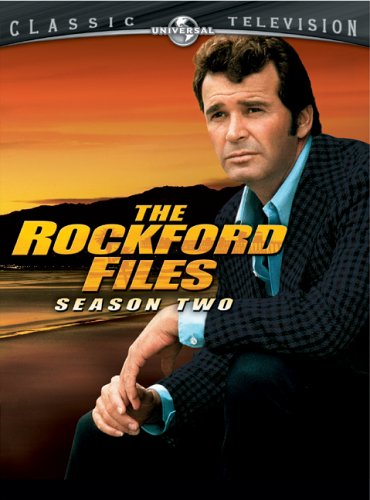
It was an excitable time for this young 13 year old boy. No matter where you were in the house, the sound came to you. No matter what you were doing, it drew you to the living room television. No matter how bad things were going, that sound brought a smile to your face. Mike Post’s opening theme for The Rockford Files has to be one of the best in television history, and it lingers in my mind as a precious anthem of days gone by.

He was every young boy’s hero. How could you resist James Rockford? He had the toughness of Dirty Harry. Yet, beneath it all, he was terribly flawed and even a little naive. Why is it that after the hundreds of TV detectives that have crossed our paths a small handful endear themselves to the pop culture? The answer is simple. Every once in a while an actor combines with strong writers and creates a character with incredible heart and soul. We can’t imagine anyone else playing the part. Peter Falk accomplished it with Columbo. In recent years Tony Shalhoub has graced us with Monk. You can’t complete such a list without James Garner and his alter ego, Rockford.

I started my review of season four by remarking how little CSI had changed over its first four years. In its fifth year the powers that be decided to muck up the works a bit. The team is split between day and night shifts and Catherine is given the supervisor position on days. This actually leads to probably the show’s largest continuity flaw. It seems that the shifts overlap not just once in a while but almost all the time. I found myself really confused about this whole shift deal. Mostly I think the change takes away from the character interactions that I have come to love so much about this show. CSI has been able to find the perfect formula. There’s enough interaction and private life to make things interesting. Still, the relationships do not devolve into casual romances that tend to bog even quality dramas down. Season 5 created some serious challenges to that wonderful system. You’ll still find the same good quality procedural drama episodes. The look of the show remains untampered with. Perhaps the changes will appear fresh to many long-time fans. We’ll see.

I do like the use of the Greg character more as he becomes a full time member of the field team. A new team member, Sofia, also helps to make up for the changes.

Greg Marcks directorial debut 11:14 is a tricky little puzzle of a film. Amazingly enough, the pieces do all fit together, despite Marcks' (who also wrote the screenplay) bewildering youth. What significance (if any) 11:14 has over other times on the clock, I don't know. In fact, why the five stories play out as they do, I wasn't sure until the final segment, which neatly ties all parts together. While it may not be the type of film that's as much fun to watch the second time around, you'll have a ball the first.

Of course, as Rachel Leigh Cook's wannabe love slave (sorry wife), I have to say the last segment is my favorite. In addition to this portion's role as crazy glue for the rest of the film, we get to see Ms. Cook's Cheri at her devilish best, and it's superb at just how naughty she can be. The joyride segment is also a winner, thanks in part to the three hot-rodders' just comeuppance, even though I did get a kick out of their antics. They're definitely the types of kids you'd wish a deadly one-car accident on during a traffic-laden Saturday night, but in the confines of this film, these characters are much more amusing than any real-life counterpart could ever be.