Dolby Digital 5.1 (English)

"When you give up your dream, you die."

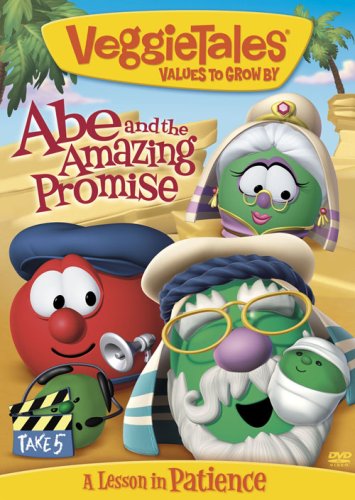
My initial reaction to most kid shows that have references to the bible are a mixture of sarcasm and skepticism. There is one exception to that rule: Veggie Tales. Veggie Tales was started in 1993 when VHS was still strong and kids were still highly impressionable under the influence of a weathered old videotape. They bring together a wonderful blend of a fun children’s show (under the guise of a bunch of talking vegetables) and have very good values to live one’s life by. So in my first title to review from the people at Big Idea, I receive a DVD about Abe and his Amazing Promise. Hopefully this Abe character has a promise about some cookies, I’m hungry.

Bob the Tomato receives a fan’s letter and decides to read it. He is joined by Junior filling in for Larry (the Cucumber). The fan’s letter is about “waiting” for something special. Bob relates his answers to the ancient biblical tale of Abraham and Sarah. This tale tells the story of how Abraham asked for a child and how it took fifteen years for them to receive that child. However, despite the hard pressures and substantial turmoil for Abe and his wife, God kept his promise and delivered them a child as a reward for their faith.

My place of birth was in Jamaica, NY in the summer of 1975. However, my parents decided to move me around a bit and where I grew up was actually a lot more south than that. Many times in my youth I visited New York to see my grandmother and wondered (often aloud) what it would be grow up in New York rather the suburbs of a southern state. My grandparents would tell me stories, my dad would tell me stories as well as people within earshot of my curiosity. Films helped in this respect too and another fine film about that experience ended up in my hands.
A Guide to Recognizing Your Saints was released in 2006 and is based on the true story of Dito Montiel.

Dito (played by Robert Downey Jr) is a successful writer and lives in California. His book speaks of his youth, living in the heart of New York. After all of these years, his mother Flori (played by Dianne Wiest) calls Dito up and tells him that his father, Monty (played by Chazz Palminteri) is ill and will not go to the hospital. After calls from friends and family, Dito decides to make the journey to New York. In the film and his mind, he really travels back to 1986 when he was just a teenager struggling to get by.

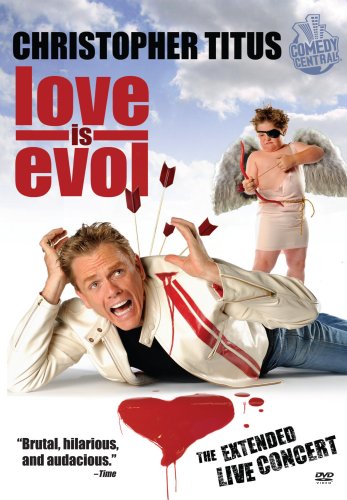
Christopher Titus lands in stores just in time for Valentine’s Day with his most recent concert tour Love Is Evol. “Tonight could fix your relationship, or end it,” he says at the opening of the performance. “Either way, you’re welcome.”After discussing the recent developments of his life with tongue planted firmly in cheek, he backs this opening promise up with nearly an hour and a half of comedy that is equal parts storytelling, punchline, and attitude.

Marvel has been pretty busy lately. Since starting their own film studio to work on their iconic characters, we’ve seen a lot of the Marvel universe of late. This past summer saw not one, but two of Marvel’s stable characters enjoy blockbuster releases on the live action front. Iron Man captured world wide attention and the hundreds of millions that go with it. While the new Hulk film didn’t bring with it the same kind of financial bounty, it was a well respected film that won over much of the character’s fan base, lost when Ang Lee put together his horrible Hulk feature some years ago. If anything, the unlikely casting of Ed Norton brought that film closer to the beloved television series than the classic comics from the 1960’s and 70’s. Now Marvel’s animation lines have been churning out full length animated adventures of many of their popular heroes. Most recently Iron Man got the predictable full length treatment. Now it’s The Hulk’s turn, but there is a bit of a twist to the formula. Instead of one longer effort, Marvel decided to go with two shorter stories, likely to bring in as many of the other Marvel franchises for the ride. In case you’ve been sleeping on another planet, Marvel is inching toward a grand Avenger film. The plans include more live action movies featuring Iron Man, Thor, Captain America, and, of course, The Hulk. There is also an aggressive slate of these direct to video animated efforts, all leading toward an Avengers project.

We all know that by himself, The Hulk can be an awkward character. He has always shone best in the comics when he had someone else to beat up on. These “Clash Of Titan” titles have been milestone events in the green monster’s legacy. It’s no great surprise that anyone who loved these moments in the comics would expect to see them as part of a new animated Hulk franchise. Enter the new Hulk vs. series. This release contains two such pairings:

Meerkat Manor is back for a fourth season on DVD. You’re invited back into the South African desert with the famous Whiskers Clan. Animal Planet has themselves a relatively big hit here with Meerkat Manor. OK, so, it’s not exactly The Sopranos or The Shield, but it does have a modestly dedicated audience. Seems that folks just can’t get enough of these fur balls. They’ve set up blogs and websites dedicated to the antics of the celebrated Whiskers. If you like them and are dying to see what these lil’ guys are up to next, wait no longer. Fast on the heels of the prequel film, The Story Begins, Meerkat Manor is here again. Of course, all of this is strictly in the interest of scientific study. Sure it is! Don’t worry, I won’t tell a soul.

Stockard Channing takes over the narration duties from Sean Astin. She’s a bit more playful and often more dramatic, but I have to admit I was partial to Astin. Expect more of the same here. Kidnapped kids to missing Commandos and, of course, the annual loss of a beloved character. It’s all par for the course on Meerkat Manor. I have to admit that as cute as these little guys are, it’s all starting to run together for me. I can’t remember which character is which or who belongs to which tribe. Maybe it’s about time to close the books on the fur balls from the African desert.

The box art promises that Red, White, & Brown won’t disappoint Russell’s die hard fans. I totally agree. This extended Comedy Central concert is pretty much standard Russell Peters. I’ve only seen his act in bits and pieces in the past, but what I saw here looks very much the same. Peters’ comedy is pretty much made up of riffing on ethnicities and various stereotypes. He gets away with what many others comics can’t by having an Indian heritage that’s not really as evident as he makes it sound. Looking at the man, I would not, as he often does, characterize him as a “brown man”. He doesn’t look even vaguely Indian to me. We’re talking Indian from India, and not the Native American variety here. Whether he actually looks the part or not, he uses the ancestry to get away with racial material. Unfortunately, if some of this stuff were coming from a white guy, there would be protests and firings.

It was a little bit of a surprise to me that the audience shots showed that young children had been allowed into the concert. The material does get sexual, and Peters even acknowledged one of the young audience members while continuing with one of those kinds of routines. The stuff isn’t offensive, just not appropriate for 7 year old kids.

In America, he is wanted. In France, he is desired. Worldwide, his films are praised for their ethereal, disturbing, and sometimes humorous qualities. But his life overshadows his accomplishments. He survived a concentration camp. His parents did not. He found Hollywood success with films such as Rosemary’s Baby, The Tenant, Repulsion, and The Fearless Vampire Killers. His marriage to wife Sharon Tate ended in a brutal homicide that took both her life and the life of their unborn child.The case would later introduce the world to Charles Manson, a crazy-eyed charismatic with a thirst for blood, and his murderous followers. It would also create a disdain in Polanski for the media, one that grew in the wake of an underage sex scandal several years later.


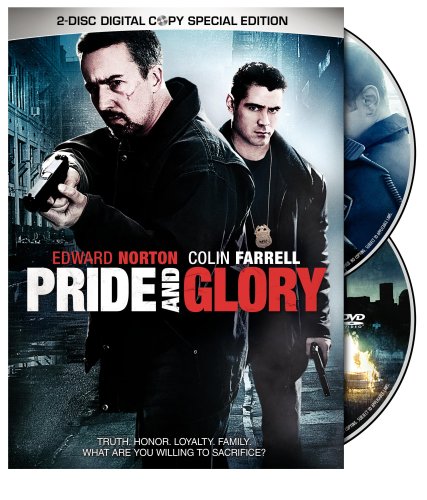
“Four cops down: two dead, two likely. An NYPD drug bust has gone horribly wrong.”

That’s how this gripping drama opens. Not since the likes of Al Pacino in Serpico has there been a movie anything at all like Pride And Glory. This film doesn’t pull punches, and it looks about as real as any police drama I’ve seen anywhere before. Filmed entirely on location in the seedy streets of New York City’s Washington Heights district, there is enough gritty realism to go around. Director Gavin O’Connor not only used these very dank and atmospheric streets, but he also employed his extras and some of the key cast members from the community. If nothing else, you can’t criticize this film for not taking us into the street and watching the action from street level.

Welcome to the neighborhood here in Lakeview Terrace. See that house next door with the zillion watt security lights? Yeah, they’re pointed right at your bedroom window, but that’s just for your own protection. Well, that’s Abel’s house, right there. He’s a cop with the LAPD. Don’t worry about crime around here. Abel performs regular patrols in the neighborhood in his off hours. If you do something against the rules here, like litter, or park somewhere you shouldn’t, don’t worry, Abel will let you know what’s what around here. Abel will keep a close eye on you. Yes, indeed. Welcome to Lakeview Terrace.

When young couple Chris (Wilson) and Lisa (Washington) buy their first home and move into the community of Lakeview Terrace, they are giddy with excitement. They have that first time homeowners feeling, at least until they meet neighborhood big dog, Abel (Jackson). First of all, Jackson doesn’t believe in interracial marriage, which is what the Mattisons happen to be. They’re used to that. Lisa’s father, played by Barney Miller’s Ron Glass, isn’t real high on the idea either. But when Abel starts to meddle in their business, they begin to get concerned. They don’t help matters themselves when they decide to “christen” the pool with a make-out session while Abel’s young son and daughter watch from their bedroom window. Abel’s the self-appointed community enforcer, and he’s decided that the Mattisons have to go. The confrontations continue to escalate, leading to the predictable, because it’s inevitable, conclusion.