Dolby Digital 5.1 (French)

For many, Saving Private Ryan has been the measure of the perfect war film in the modern era. Without question the Steven Spielberg film is a milestone in depicting battle on the screen. But I’m going to make the possibly unpopular statement that Enemy At The Gates is a better film, and the standard by which war films should now be measured. The movie is at least almost as good technically as Private Ryan. There are battle scenes that offer the same caliber of shocking reality. And even if this movie falls a little short of the technical marvel that Private Ryan was, this movie captures the human element of war time in a way I hadn’t seen before or since. Certainly all of the necessary hallmarks of the war picture formula are intact. There are plenty of battle scenes and enough ultra realistic bloodletting to satisfy the most insatiable aficionado. But Enemy At The Gates refuses to rely on such brutality to make its point. Instead the hazards of war are merely the atmosphere that allows an excellent cast, under brilliant direction, to bring to life an inspired script.

It’s the heart of World War II. Hitler and his Third Reich are marching across Europe spreading their shadow of fascism and tyranny wherever they go. They have now begun their assault on the young Soviet Union. For the Soviets, troops are weary and supplies are scarce. For the beleaguered soldiers of the Red Army, it is a matter of being shot by the enemy or by your own field commanders should you even think about a retreat. Their mission now is to defend the city of Stalingrad, which bears the name of “The Boss” and stands as a symbol of nationalism to the infant nation. But things are not going well at all. Only every other soldier is armed. The unarmed soldier is admonished to wait until the one holding the rifle is killed to take up arms himself. For these Russian men it is not a matter of if they are killed, but merely when. After a heavy day of fighting, a political officer, Danilov (Fiennes) finds himself pinned down with another young soldier, Vassili (Law). Vassili manages to take out the officers who stand in their way of escape. Danilov decides that Vassili could well be the hero that the Soviet soldiers need. He realizes that fear is not as good a motivator as inspiration. Before long he has written news articles that chronicle the exploits of Vassili as he takes his positions in the city and racks up an impressive score of German officers. Unfortunately, it is not only the Soviet soldiers who hear of these adventures. Vassili comes to the attention of the German brass who bring in their own sharpshooter, the decorated officer, Major Konig (Harris). The two play a dangerous game of cat and mouse in the ruins of Stalingrad. Vassili must also contend with his feelings for an intelligence officer, a young woman named Tania (Weisz). The three become engaged in a love triangle of sorts, causing Danilov to attempt to take down the hero he created. He also begins to doubt the figure he has become to the Soviet people. Konig and Vassili will eventually face each other, and only one of them can survive.

“I don't know who you are. I don't know what you want. If you are looking for ransom, I can tell you I don't have money. But what I do have are a very particular set of skills; skills I have acquired over a very long career. Skills that make me a nightmare for people like you. If you let my daughter go now, that'll be the end of it. I will not look for you, I will not pursue you. But if you don't, I will look for you, I will find you, and I will kill you.”

That pretty much sums things up quite nicely for you. The filmmakers must agree, because the scene figured prominently in their marketing campaign for the film. In the end it’s not really anything that we haven’t seen before with Bruce Willis, Mel Gibson, or a handful of other actors in the role. What might make the whole experience somewhat unique is that Liam Neeson isn’t usually associated with this kind of a character. You usually find him more on the cerebral side of things. He plays the part well in spite of the handicap that he never really looks quite right for the part. Give the thespian credit for making the whole idea at least somewhat believable.

“White supremist world was cancelled.”

When you talk about Wayne’s World 2 you can’t help but talk about disappointment. I mentioned in my review for the first film that over the span of nearly 20 years the skit had lost some of its luster. I certainly wasn’t nearly as entertained now as I had been when I first saw the film in the early 1990’s. That same principle appears to have been true just a year later when Wayne’s World 2 was released. It gathered in a disappointing $48 million off a $40 million budget. While there was talk of a continuing franchise at the beginning, there wasn’t any interest in a third film by the time the second film had crashed and burned. The fact is, I know many fans out there that didn’t even know a second film existed.

“Your life is defined by its opportunities... even the ones you miss.”

F. Scott Fitzgerald is one of those great American writers from the classic age. In school most of us were required to read various works from the writer. For many students those works included The Curious Case Of Benjamin Button. The original work is a mere 20 page short story. For the last 15 years Hollywood has made one attempt or another to bring the classic story to the screen. The closest anyone got was Ron Howard who expected to bring in John Travolta as Benjamin Button. The one reason or another these attempts never made it past screenplay drafts. Along comes one of the best and most diverse directors, David Fincher. Fincher’s work needs little introduction and spans the genre spectrum from Se7en to Fight Club. The original short story would be adapted by Eric Roth. That left many, myself included, to expect a remake of Forrest Gump. When you consider that Roth wrote both screen adaptations and that he was once again working with a character spanning many years of history, the concerns were not unfounded. Would Roth take Benjamin Button on a journey through the 20th Century that would find him present at crucial moments in history as he did with Gump? Fortunately, Roth resisted such temptations and delivered a story relatively faithful to the original work, where the main character was a silent witness only to the major events of his life. Of course, I say relatively faithful because Roth also turned that 20 page story into an epic 3 hour film.

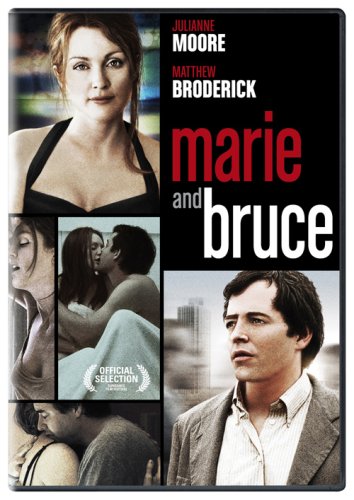
Based on a play by Wallace Shawn (who also co-wrote the screenplay), this film is a day in the life of an unhappily married couple, played by Juliane Moore and Matthew Broderick, who don't know what to do about said unhappiness. The story is simple but the paths each character take is not. After a bitter breakfast scene, they separately go about their day before meeting at a party in the evening where Marie may or may not leave Bruce once and for all.

The dialogue is very reminiscent of a meta-theatrical stage production as the characters are able to freely address the audience in narration or monologues. When speaking to each other, they are terribly open and leave no feeling hidden as they express every thought in a highly unnatural and stylized manner. This leads to some very biting humour as Marie explains her disdain without mercy towards either Bruce or anyone he associates with, while Bruce feels no qualms about detailing the state of is genitals after a one night stand he had 11 years prior. At the same time, this strange and often venomous dialogue is peppered with the persistent use of endearing terms such as “darling” when one of the two addresses the other, which turns into a nice device used by the writers to squeeze out more of a satirical view of decaying, modern couplehood.

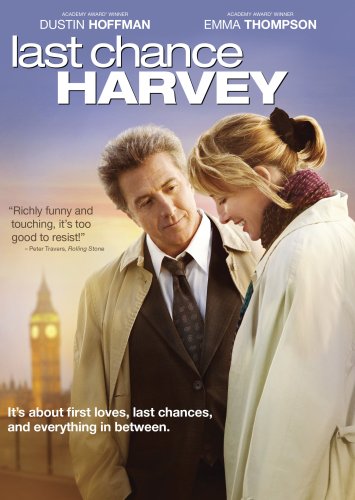
Dustin Hoffman is the titular Harvey, a morose jingle composer who, with his job hanging by a thread, arrives in London for his daughter's wedding. He is a complete outsider at the rehearsal dinner, and feels even more cut off when his daughter informs him that she wants her stepfather to give her away. Meanwhile, the scarcely more cheerful Emma Thompson spends her time being set up for disastrous blind dates and being constantly harangued on the phone by her mother. These two losers at the game of love meet, and something blossoms between them.

And that is really about it as far as plot goes. The script is so insubstantial that it threatens to waft away on the first gentle breeze. The film is quite watchable, however, and that is due to the sheer force of its leads. They make the enterprise seem considerably more substantive than it is, their pained expressions conveying worlds to us. The film is at its strongest when it sits back and lets the two banter, and the relationship that develops feels easy and natural. It is all the more disappointing, therefore, that writer/director Joel Hopkins feels it necessary to shoehorn in the obligatory Romantic Comedy Third Act Falling Out by the most contrived and Deus Ex Machina-like of means. This is a turn of events that is a poke in the eye to any viewer who thought his/her intelligence was going to be respected.

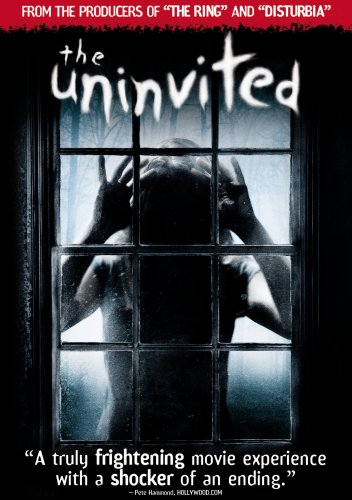
The Uninvited is yet another in a long string of Asian films that are translated and retooled for American audiences. It’s been a rather strong and long running trend that was kicked off with the wildly successful The Ring, from the Asian classic, Ringu. But, for every effective spooky thriller that comes out of this Asian pipeline, there appear to be a dozen or more complete failures. Some American directors think that all they need to do is throw fast moving creepy ghosts at us and often have them inhabit some modern electronic device. Presto! You have a horror movie for the purposes of generated cash. I’m happy to report that The Uninvited is a fresh approach that relies on almost none of these tired conventions to work. There is no morality tale about our modern conveniences here. No ghosts haunt cell phones, beepers, computers, video games, DVD’s, or even toaster ovens. The appearance of spectral creatures is actually quite limited and will disappoint the viewer who is there for the quick scare moments. This film uses the technique sparingly, and ultimately more effectively. The truth is that The Uninvited is really not so much a ghost story as a thriller in the vein of The Hand That Rocks The Cradle. It gives us one of those rare endings that you won’t easily see coming at all. Most importantly, this movie completely shatters the mold of these Asian remakes by making it all about the characters; the human characters, that is. Based on the Korean film that roughly translates to Tale Of Two Sisters, this is a refreshing take on a stale theme.

Anna (Browning) is just getting out of a mental hospital. She’s been there for some time, following the death of her mother in a terrible house fire. She had been haunted by nightmares of that tragic night. Her doctors now think she will be able to cope and return home. Her father, Steven (Strathairn) is hopeful about bringing her home. There she is confronted by a harsh reality. Her mother had been infirm at the time of the fire. Now Anna has discovered that her mother’s former nurse, the very young Rachel (Banks) has moved into the house as her father’s lover and future wife. She notices that in her absence, her mother’s presence has been erased from the home as Rachel has redecorated and removed any connections to her dead mother. She takes comfort only in the company of her sister, Alex (Kebbel) who also hates the woman they see as an intruder in their home. Anna begins to have visions that her dead mother is warning her about Rachel and suspects the fire was not an accident. The sisters investigate, only to find that Rachel’s name is not a real one. Anna is convinced that Rachel killed her mother and will now do the same to her and her sister. When a local boy who claims to have information about the night Anna’s mother died turns up dead himself, Anna decides to get help. But no one appears interested in her story, and now Rachel knows she’s on to her. The film ends in a sort of typical cat and mouse game that ends up not being so typical after all.

Citing personal history, I don’t do really well with horror films. As mentioned in other reviews, my parents let me see scary movies such as Exorcist & Poltergeist (as well as R-rated action films) when I was no more than ten years old. While, Poltergeist sits proudly in my DVD collection, I still have trouble to this day with Exorcist. Yes, I can be a scaredy cat at times. To be also perfectly honest, I was a bit worried when I received The Uninvited in the mail to review. After all, it proclaims proudly on the cover that it is made by the producers of the Ring(which I absolutely hated) & Disturbia. By the end of the movie, I was very pleasantly surprised.

Anna (played by Emily Browning) is out with her boyfriend Matt (played by Jesse Moss) at a local beach party. They start to kiss when Matt tells Anna he loves her and he has a condom. (Wow, that screams love) Upset, Anna decides to leave. She passes her sister Alex (played by Arielle Kebbel) on the way back to the house. Through the woods she goes until she encounters three filled garbage bags. She opens them and the dead body of a redheaded girl spills out. The redheaded girl’s head snaps and speaks. Anna runs again in the direction of the house.

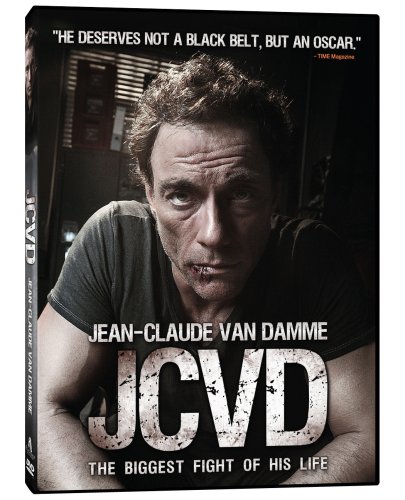
Sometimes I feel like a broken record. Once upon a time, I adored the likes of Steven Seagal and Jean Claude Van Damme. I would spend many hours watching Above the Law or Bloodsport until I had nothing else better to do. When I matured, I left many of those movies behind. However, the spirit of those movies was still within the type of movies I would typically watch. The problem is that both of these starts pretty much went from feature film to direct to DVD. But Jean-Claude has tried to change his image by taking on more serious roles. His newest, JCVD; he takes on the role of himself the actor.

Jean-Claude Van Damme (playing himself) is an aging 47 year-old action movie star. His agent can not find him anything decent. JCVD has no money and worst of all, he is fighting a losing battle in the custody of his daughter with his ex-wife. He decides to return to Brussels, his childhood home. Here, he is still considered a national icon and with that comes some sense of worth and peace.

The Last Kiss is based on the internationally acclaimed Italian movie L’ultimo bacio which was written by Gabriele Muccino and adapted for this American version by screenwriter Paul Haggis. From all reports the movie is remarkably similar to the Italian classic with only the ending modified. Haggis tells us in the extras of this release that he attempted to merely translate the original work and performed little in the way of modifications. From the looks of things, the ending was a bit of a struggle for these filmmakers, as there are three different versions available on the release. I think it’s safe to say that the more open-ended version which was ultimately used was probably the best of the choices I’ve seen.

The plot of the film is a rather difficult one to summarize. The movie is less about plot points or beats and is more about the emotional journey of many of the characters. The main story is about Michael (Braff). He’s 29 and fast approaching 30, a time when many people begin that introspective examination of their lives. He’s been with his girlfriend, Jenna (Barrett) for some time but has avoided the ultimate commitment of marriage. We quickly learn it’s a four letter word in their relationship. Now she’s pregnant, and Michael is facing fatherhood. He’s worried that his life is now set out before him with no more “surprises” or diversions left to him. While at the wedding of one of their friends, Michael meets Kim. She’s much younger and is attracted to Michael. Of course, this gives his ego a boost, and he begins to spend inappropriate time with the girl. While he resists actually having an affair until after his secret is out, it damages his relationship with Jenna. Suddenly faced with the loss of his “safe” and “predictable” life, he realizes he had it pretty good and wants it back. All of this doesn’t happen in a vacuum. Around him, Michael’s friends are also going through major life crises. One friend is married with a young child and but wants out. Another friend appears to be happy. He’s on his own and sleeps with a different chick every day. But even he’s beginning to tire of his “carefree” life. Even Jenna’s parents are struggling with the ins and outs of their own “routine” life. Strangely, each character sees another’s life as far better. It’s a perfect example of the old “grass is greener” axiom.