Dolby Digital Mono (English)

They say that it isn’t over until the Fat Lady sings. Did you ever wonder what “it” was or who the heck this Fat Lady is they keep talking about? I can’t help you there, but I do know who the Fat Man is. It’s William Conrad, who came back to television in 1987 as J.L. McCabe, better known as “the Fatman”. McCabe was one of those tough as nails district attorneys. He was actually an ex-cop, so had great criminal instincts. McCabe wasn’t above bending the law to put away the bad guy, and he wasn’t considered a very friendly type of fellow. He majored in stubbornness and plain speaking. He relied on Jake Styles, his private investigator, to do much of the leg work for the office. Jake was a bit of a flashy playboy, but he always delivered the goods for his boss. Again, Styles wasn’t against breaking a few rules to get what he needed. Styles was played by Joe Penny. McCabe also served as a mentor, of sorts, to young District Attorney Derek Mitchell, played by Alan Campbell. Mitchell was quite wet behind the ears and a little too eager sometimes. His ambition often got the better of him, and it was the gruff McCabe who kept him out of trouble. Finally, the team was completed by Gertrude, McCabe’s loyal and trusty secretary, played by Lu Leonard. While The Fatman put crooks away instead of defending innocent defendants, there could be no mistaking the parallels between Jake And The Fatman and Perry Mason. The two shows were from different times, and the styles might not have been the same, but the dynamic was very much the same. You can see a lot of Della Street in Gertrude and more than a little of the Drake/Mason relationship in the two leads. There was far more action, but that was more a reflection of the change in decades than anything else. And like Mason, the Fatman rarely lost a case.

The Fat Lady was warming up after the first season of Jake. The show did not immediately return for its second year. It was delayed until March and so only ran for 11 episodes. That’s why Paramount has issued this as an “entire” season set. The show never really found its footing and struggled for the 5 seasons that it ran. It wasn’t a terribly original program and was steeped in cliché for its entire run. It was never a ratings monster, and there were constant radical changes in attempts to retool the show over the years. In this season McCabe and his staff, excluding trusty Gertrude, moved to Hawaii in an effort to spice the show up Hawaii Five-0 style. Even that exotic location didn’t help matters, and the series returned to California by 1990. These erratic changes in location and style meant that the show never found the solid fan base it needed to survive. It was likely William Conrad that was the only thing that allowed the show to last 5 years. What made the show work at all was the unlikely pairing of the two characters. It wasn’t only their weight that separated the two. McCabe looked angry all the time and had a slower pace to his method. Jake was almost too slick; at least that’s the way they tried to portray him most of the time. In the end the pair really was too unlikely for most viewers’ tastes. While it did get 3 Emmy nominations, it never won. These nominations were for cinematography and music only. Today Jake And The Fatman wouldn’t have gotten past the mid season.

Warner nearly single-handedly invented the cartoon medium as we know it today with the advent of their various Bugs Bunny and associates cartoons. Ever since the early 1930’s these characters have become an indelible part of the American pop culture. Their images became an important part of the World War II effort and even helped to put a face on the issues of the Great Depression. They represent one of the richest histories in animation, second only to Walt Disney. There are some, I’m sure, that would argue they might even belong in front of Uncle Walt. When I was growing up in the 1970’s, I had no idea I was enjoying cartoons and characters that were already 40 years old. The truth is that my grandfather had been a fan of these same cartoons when he was a kid. Today the Warner cycle of Loony Tunes cartoons is over 70 years young. Things might have changed with the passing of Mel Blanc, who provided most of those familiar voices for much of that time, but Bugs and the gang are still out there and going strong.

Which brings us to The Looney, Looney, Looney, Bugs Bunny Movie, which arrived in theaters in 1981. While the film wasn’t a huge box office success, it was pretty cheap to make. The film was made up of bits and pieces from various Looney Tunes shorts. The featured shorts included: Knighty Knight, Bugs, Hare Trimmed, Sahara Hare, Wild And Wooly Hare, Roman Legion-Hare, Golden Yeggs, Catty Cornered, The Unmentionables, Three Little Bops, Birds Anonymous, Show Biz Bugs, and High Diving Hare. All of these shorts were from the time period between 1949 and 1957. The shorts were edited into an opening and a three act film. The cartoons are not necessarily shown in their entirety and are used to create these three separate stories. There is new material that was created more to bridge the shorts and act as a wraparound for the whole affair.

This is the second season of this prime time soap opera's fourteen season run. This show is the stories of three couples who all live in the same cul-de-sac, along the second season addition of single temptress Abby Cunnigham (played by Donna Mills), whose role inspires the packaging's amusing tag-line "Abby Cunnigham moves to Knots Landing. Do you know where your husband is?"

The show is a spinoff from the massively popular Dallas, and it contains much the same level of drama peppered with some sassy comedy, leading it to surpass Dallas in ratings for a time. This particular season kicks off with a two part story where one of our Californian cul-de-sac heroes is accused of rape and needs the aid of his lawyer neighbour. From there on we get stories involving the FBI, the mob, and an especially interesting episode where the women of the neighbourhood are held hostage at a baby shower and newcomer Abby uses her seductive powers to aid their escape.

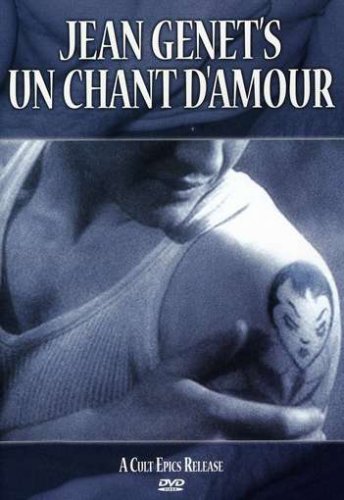
A while back, Cult Epics released a 2-disc limited edition of Un Chant D'Amour. This single-disc reissue features a number of the features (though not all) from the limited release. The actual film and transfer quality are the same, and so much of this review is likewise the same.

Long the bad boy of French novelists, Jean Genet directed this 25-minute short in 1950. Borderline pornographic, it is a silent portrayal of (literally) imprisoned desire. Two prisoners convey their longing for one another through the prison walls, while a voyeuristic guard watches, becoming aroused and frustrated to the point of violence. poetic, fetishistic, and intensely personal, it is a startling and historic piece of underground cinema.

"Space...The Final Frontier. These are the voyages of the Starship Enterprise. Its 5-year mission: to explore strange new worlds, to seek out new life and new civilizations, to boldly go where no man has gone before!"

Star Trek: The Original Series finally makes it to high definition. If you’re anything like me, you’ve been waiting for this day for what seems like centuries. They’re here. One of the best features about this set is the multi-angle option. Remember how we were promised all of this control way back when DVD’s first hit the market? We got the same promises when Blu-ray arrived, and we weren’t going to hold our breath. Hey, I still have a red, yellow, blue, and green button on my Blu-ray remote. What are they ever going to be good for? Anyway, we finally have a use for the angle button. You can use it to toggle between the new digital f/x Paramount recently created for the show, or you can watch the original f/x if you’d rather. With that button you now have the ability to toggle between the two. Through the use of branching technology you can go between them as often as you like and never stop the show. I will warn you, however, that many of these shots occur so quickly that the second delay in transition might not allow you to see the entire segment. It also does not change while the video is in pause. It’s one of the best new features out there and perhaps the best reason to upgrade your recent purchase of season one to the Blu-ray release.

Frankly, if you need any information beyond the title of this release, then it probably isn't for you. It's The Sinful Dwarf, man! But if you really must know more, be it on your head. Mind-bogglingly stupid and broke newlyweds Mary and Peter (Anne Sparrow and Tony Eades, actors of an ineptitude that passeth all understanding) check in to the boarding house of retired (and scarred) burlesque performer Lila Lash (Clara Keller) her son Olaf (children's show host Torben Bille), the titular sinful dwarf. Mary hears noises in the attic, but Peter won't listen to her. He should, as Lila and Olaf keep a harem of women up there as prostitutes, ensuring their submission through forced injections of heroin. Now they have their sights set on Mary...

Whatever you fear or hope about a film with this title, the reality will likely exceed your imagination. “Exploitation” is almost too tame a word to describe the spectacles here, whether we're talking about incessant close-ups of Bille's sweaty, greasy, drooling, leering face, or Keller's disturbing Marlene Dietrich impersonation. If you don't need a shower after watching this, you aren't human. In other words, it's sublime.

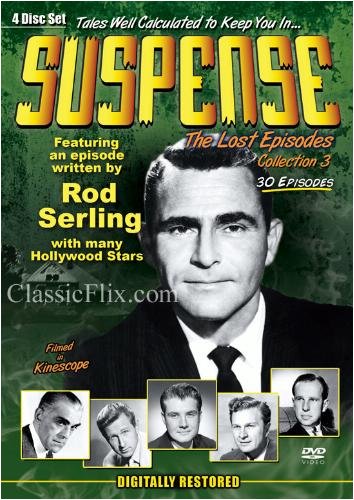
Suspense began life as a very successful radio show on the CBS Radio Network. It premiered in 1942 and lasted just over 20 years on the nation’s airwaves. When television began to make its own waves on the air in the late 1940’s, naturally many of those first shows would be programs that had already shown strong appeal to the radio audiences. Shows like Gunsmoke had been staples on the radio for years and would be a nice way to entice the first television crowds to the new medium. Suspense was one of those shows. It first broadcast in 1949 and was broadcast live from a studio playhouse in New York City. The anthology series presented stories that featured some kind of a horror or thriller theme. Public domain stories were great fodder for the series, and it certainly brought together some of the big names of that genre to the broadcasts. Names like Boris Karloff, Bela Lugosi, Peter Lorre, Nina Foch, and John Carradine would give the show instant credibility. But, the episodes were not limited to the horror field. Crime dramas that involved murders under mysterious circumstances were another favorite staple of the series. Because it was aired live there were no taped copies to be used as reruns, so that each episode was intended as a single broadcast event. For reference purposes a kinescope recording was made, but not very well preserved. These were the days when the networks were just starting, and they didn’t reach a majority of the nation yet. These simple recordings were intended so that the episodes could air in the towns and cities where the networks had not yet penetrated, a whopping 67% of the nation in 1949. It would go on to become one of television’s first hit shows and lasted 15 years. Surprisingly, the radio version would continue for almost another decade after the television series left the airwaves.

These kinescope recordings were uncovered in 2007. Since then they have been released in various sets and collections. 90 episodes in all have been found and somewhat restored. This collection 3 offers the last 30 of those 90 episodes. They feature the likes of Boris Karloff, Eddie Albert, Walter Matthau, Pat Hingle, Lloyd Bridges, Arlene Francis, Jack Warden, Jackie Cooper, James Whitmore, Vic Morrow, George Reeves, and Richard Coogan. The episodes span the entire run from 1949 – 1954, although one episode lists an airdate of 1958. I could find no record of that episode airing at all.

“When you wish upon a star. Makes no difference who you are. Anything your heart desires will come to you. If your heart is in your dream, no request is too extreme.
When you wish upon a star, as dreamers do… Like a bolt out of the blue, fate steps in and sees you through. When you wish upon a star, your dreams come true.”

The song has become a standard. Every kid knows it. Walt Disney Studios has made it their theme song. You hear it each time you load up a Disney disc. If you have been fortunate enough to have visited Walt Disney World, you’ve heard it the entire day long. We know the song, but did you know where it originated from? It was back in 1940 and the release of Walt Disney’s, in fact, the world’s, second ever feature length animated film: Pinocchio. Now Disney brings us this timeless classic on high definition and Blu-ray. What a marvel this release is.

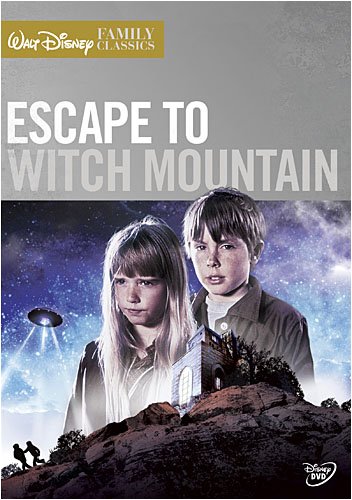
Walt Disney has always had as a main theme in its movies the idea of empowering children. It didn’t matter what circumstances the children might find themselves in, Disney always found a way to bring them out of their predicaments with an inner strength that they never really knew or believed that they had. It’s likely one of the reasons the studio has been so successful with children’s films over the decades. Escape To Witch Mountain is one such film. It’s certainly not the greatest from the Disney vaults, but you could do a lot worse. The film holds a certain element of charm that I remember from my own childhood, and it appears to still have some miles in it 30 years later.

Tony (Eisenmann) and Tia Malone (Richards) are orphans. They have no memory of their real parents or of anything that happened to them when they were much younger. Now they find themselves, yet again, transferred to a new orphanage, after their latest foster parents were killed. They may not know about their past, but they are aware they have special powers that other kids don’t have. They have the power of telepathy and molecular manipulation. Tia’s powers are a bit stronger. She can put her thoughts in Tony’s mind, and she can use her levitation powers almost limitlessly. Tony must still move his lips to send thoughts to Tia. He also relies on an external force, in this case a harmonica, to focus his powers. They make no secret of these abilities, at least to the other children. Almost at once, Tony uses his abilities to defend himself against the orphanage bully. When the kids are on a field trip, Tia exposes her ability to predict the future when she saves the life of a man about to have a tragic accident. Unfortunately, the man, Lucas Deranian (Pleasence) has been on the lookout for psychic powers. His wealthy employer and benefactor has an obsessive desire for such things. When Aristotle Bolt (Milland) hears of the encounter, he desires to possess the children. Deranian poses as their long lost uncle with forged papers in order to get the children. Once at Bolt’s mansion, they are tempted by a life of luxury and excess. But the men did not anticipate their telepathy skills. When the children learn of their plans for them, they escape with the help of an ornery horse. It appears the children can also communicate with animals telepathically. They are aided, at first unwittingly, in their escape by a kindly, but rather gruff on the outside old loner, Jason O’Day (Albert). The three bond, and eventually they work to unravel the mysteries of the children’s’ true nature, and where home really is. But to get them home, the trio must evade Bolt, Deranian, and the police.

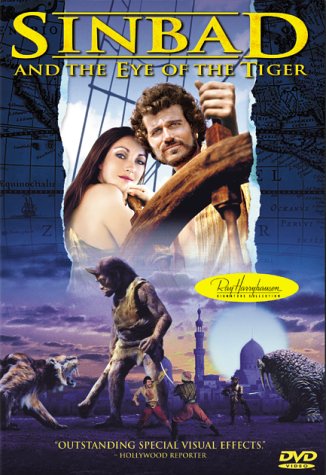
Long before the magicians of movie special effects had computers to conjure up monsters and otherworldly creatures, or even talking dogs, they relied on more physical tricks of the trade. One method, used perhaps most famously in 1933’s King Kong, is stop-motion animation. Kong inspired a young boy who would go on to master the art form and establish himself as a legend of fantasy filmmaking: Ray Harryhausen. Over a career spanning more than 40 years, Harryhausen produced some of the most delightful moments ever captured on film, wowing audiences and inspiring people to believe in movie magic.

Harryhausen’s mastery is showcased in 1977’s Sinbad and the Eye of the Tiger, the third film in a trilogy about the legendary swashbuckler. Eye of the Tiger has its flaws, but the animation is still captivating after all these years.