Posted in: Disc Reviews by Gino Sassani on June 19th, 2009
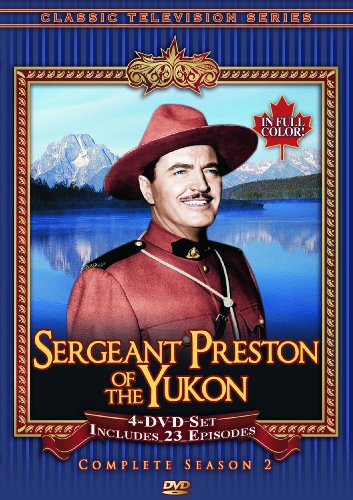
“Back to the days of the Gold Rush, as Sergeant Preston with his wonder dog, Yukon King, meets the challenges of the Yukon … A land inflamed with gold. Men who came quickly learned the heroism of sacrifice and the treachery of greed.”
These words first reached across the radio airwaves in 1947. Children and adults alike would gather around the warm glow of their large radios to hear the exploits of Canadian Mounties Sergeant Preston and his trusty companions Rex, his horse, and Yukon King, his Alaskan Malamute. When the early days of television arrived, it was no surprise that the more successful radio dramas would become some of the first television shows. Sergeant Preston was part of that transition wave of the new medium of television. Although filmed in color, the series ran in black and white, which was the only format available to the homeowner in those days. Now through the release of the series on DVD, we get to see the series for the first time in color.

Posted in: Disc Reviews by Gino Sassani on June 17th, 2009
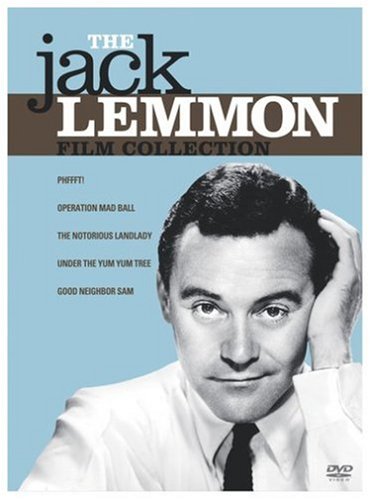
Perhaps best known and beloved for his portrayal of Felix Unger in the original Odd Couple film, Jack Lemmon has a long list of credits to his name. He’s appeared in 100 films and many stage and television productions as well. It was also a little known fact that he was an extremely accomplished musician and wrote music for a couple of his films. He was one of those actors who simply loved his job. He was known for uttering the phrase “It’s magic time” before a take on the set of almost all of his films. While primarily known for his comedy, Lemmon was actually not a bad dramatic performer and believed there was no reason the two couldn’t be combined. His role in The China Syndrome was far from a comedic one and showcased his ability to do drama.
Jack Lemmon might not be the most dramatic or even the most acclaimed actor out there. But there was something about him that defined him as an icon all the same. He was a very typically American actor. He brought to life characters that were instantly identifiable, but yet oddly eccentric enough to keep our interest. He always came off as genuine and was literally loved by the plethora of actors who always considered it an honor to work with him. He developed lifelong friendships with many of his co-stars, most notably Walter Matthau. The relationship you saw on the screen was what you got off the screen. Jack’s son Chris referred to him as Uncle Walter and claimed that if Matthau played golf, Jack would have married him. But this was just the kind of guy he was. In a day of angst-filled superstars who make more press outside of their roles, Lemmon is still a breath of fresh air. You might miss the man, but Sony and Chris Lemmon have gotten together to make sure you don’t miss some of the greater films.
Posted in: Disc Reviews by Gino Sassani on June 8th, 2009
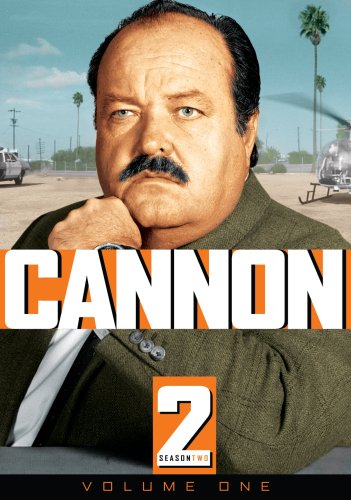
William Conrad was no stranger to audiences when Cannon joined the Quinn Martin stable of television dramas. In fact, most folks knew his voice before they got to know his trademark girth. Conrad was the original Matt Dillon when Gunsmoke was a radio drama. When the drama entered the visual medium of television, even Conrad admitted later that the audience, who thought of him as tall and handsome, would have been disappointed. His voice lent authority to any role he played, and on radio his size was never an issue. He was famous as the voice of the stern narrator in the Rocky and Bullwinkle cartoons who often crossed the laws of the trade and interacted with the title characters. He was also the voice that narrated the struggles of Dr. Richard Kimble on The Fugitive, another Quinn Martin production. He continued to narrate series intros even after his own success. He gave us the informative opening dialog in Buck Rogers In The 25th Century. As a voice, Conrad was one of the best, but when CBS approached Quinn Martin asking for a television vehicle for Conrad, it was a huge gamble. The gamble, of course, paid off… well… huge, and Cannon became an iconic figure in television. Cannon was so popular he was showing up on other shows as well. He appeared on the pilot for Barnaby Jones. The show ran 5 seasons and returned with appropriately enough The Return Of Frank Cannon tele-film in 1980. It is also interesting to note that Conrad, while greatly overweight, lived to be 74.
Frank Cannon was unlike any detective we’d ever seen on television before, or since. He was known as a high priced PI with a taste for the finer things in life, particularly fine food. His appearance was counter to all of the rules about rock-jawed handsome detectives who ran around shooting it out and beating up the bad guys. Cannon was a big man and wasn’t about to do much running and fighting. He wasn’t totally different, however. Cannon had a lead foot and could run a car chase with the best of them. He was smart and often a bit flashy in his technique if not in his appearance. It was also rare for a series to have a lone regular to carry the … um… weight. Conrad was up to the task and made the show and the character a permanent part of our pop culture.
Posted in: Disc Reviews by Michael Durr on June 3rd, 2009
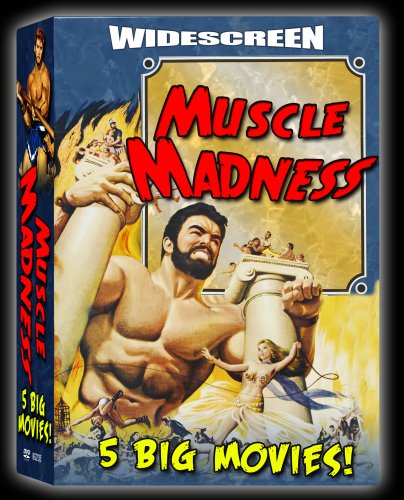
Sword and Sandal films have been around since the early 1900’s and under the broad definition, Ben Hur was the first way back in 1907. However, under the more accepted narrow definition, this referred to Italian films that were based on loose plots around Greek mythology with giant muscle men and low budgets. The popular Sword and Sandal era was a period of roughly 10 years from 1957-1964 and started with the world-wide release of Hercules in 1957.. It kinda died out once the spaghetti westerns came around (giving Italian directors something else to do). Muscle Madness provides us with five films representative of the era including the likes of Steve Reeves, Alan Steel and Mark Forest. Let the cheesefest begin!
Giant of Marathon was made in 1959 under the Italian name: La battaglia di Maratona. The setting is 490 B.C. at the times of the Medic Wars. Philippides (played by Steve Reeves) has brought home to Athens the Olympic laurel crown and joins as commander of the Sacred Guard. Philippides is truly in love with Andromeda (played by Mylene Demongeot), daughter of Creuso who rejects him at first. However, there is a conspiracy afoot who try to influence Philippides with a seductive servant as well as brute force.
Posted in: Disc Reviews by Gino Sassani on May 28th, 2009
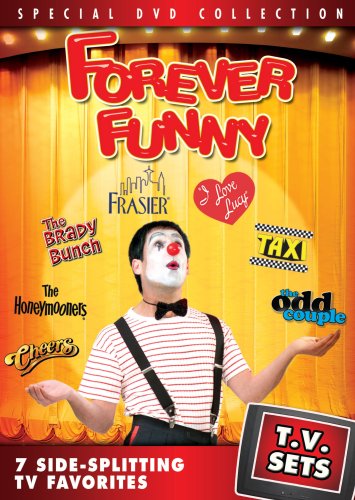
This single DVD contains the premiere episodes of 7 of CBS’s most endearing comedies. All were influential to those that came after. These weekly shows offered that much needed relief from the pressures of whatever decade they appeared in. The stars are names that everybody knows, even those that appeared 50 years or more ago. If you ever wondered how some of these shows began their historic runs, here’s your opportunity to go back in time with Forever Funny.
Posted in: Disc Reviews by Gino Sassani on May 27th, 2009
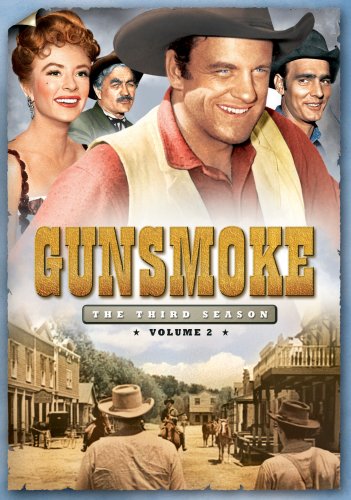
Another release, and it’s another half season of that iconic western, Gunsmoke. Among the 20 episodes found on 3 discs you’ll find Claustraphobia. Dillon has to arrest his old friend Ollie who kills a man because he killed Ollie’s hogs. In Ma Tennis, you’ll meet the ultimate Mama’s boy. When a man ends up in Dillon’s jail, his mother breaks him out. In Sunday Supplement, a couple of newspaper writers come to Dillon looking for a juicy story, even if they have to instigate one themselves. In Texas Cowboys, Dillon closes up all of the shops in town until they are willing to tell him who committed a murder. A woman comes to Dodge wanting Matt to kill her in Amy’s Good Deed. In Hanging Man, there’s a vigilante out there killing folks and making it look like suicide. Dillon’s got a serial killer on his hands now. Chester is nearly killed in a break out attempt in Chester’s Hanging. Finally, in The Gentlemen, Dillon gets caught up trying to keep the peace with a torrid love triangle brewing in Dodge.
The setting for Gunsmoke was the by now famous Dodge City, circa 1870’s. Phrases like “get out of Dodge” would enter the popular lexicon as a result of this resilient series. Marshall Dillon (Arness) was charged with keeping the peace in Dodge City. The only other character to see the entire 20 year run was kindly Doc Adams (Stone). Star Trek’s own Doc, Leonard McCoy, took many of his traits from Doc Adams. He was the humanitarian of the city, always looking to help someone. Like McCoy, he had a taste for bourbon and a soft heart underneath a rather gruff exterior and was always ready with free advice. Dillon’s love interest throughout most of the series was Miss Kitty Russell (Blake). While there were certainly a few romantic undercurrents, the romance never came to fruition. Miss Kitty was a prostitute on the radio and was likely one here as well, but CBS chose to underplay that aspect of her character as a “saloon girl”. Finally Dillon’s faithful sidekick deputy was Chester (Weaver). Chester often found himself in trouble and was the naïve son figure to Dillon.
Posted in: Disc Reviews by David Annandale on May 26th, 2009
Aging senator James Stewart and wife Vera Miles arrive in the prosperous town of Shinbone to attend the funeral of an anonymous farmer. The local newsmen want to know why. Stewart tells the story. Cue the flashback, where he arrives in a much more anarchic Shinbone as a naïve lawyer. Held up and beaten by the brutal outlaw Liberty Valance (a psychotic Lee Marvin), he is determined by bring law and justice to the town, but must come to terms with the fact that he cannot do so without the gun of John Wayne (the aforementioned farmer).
For all intents and purposes, this 1962 film was director John Ford's last western. It is an elegiac, melancholy piece (and one that makes Catlow, reviewed here a few days ago, look even more out of step with time). Like Unforgiven, it is a film whose casting is not only perfect, it is necessary. The collisions between the Wayne and Stewart characters are also the collisions between the symbols of American Myth the two icons represent. Vera Miles, as the woman torn between the two men, comes to represent the country itself, which must, for its own sake, choose the civilization and rule of law embodied by Stewart, even as it grieves over abandoning the larger-than-life figure of Wayne. He is the Old West, a figure from a more anarchic time, perhaps the light to Marvin's darkness, but in many ways not that different. He must vanish to make way for the future, but the future cannot come into being without his help and sacrifice.
Posted in: Disc Reviews by David Annandale on May 23rd, 2009
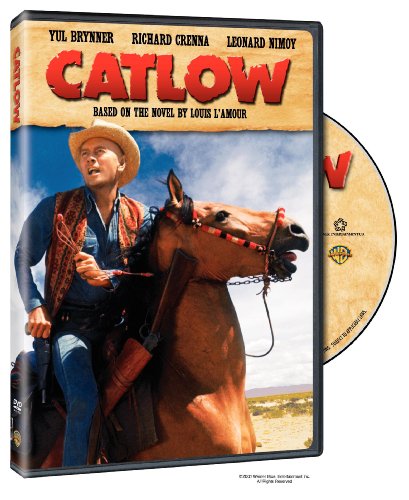
Yul Brynner is the titular Catlow, a jovial outlaw rounding up maverick cattle, much to the consternation of cattle barons who feel the strays belong to them. Richard Crenna is Ben Cowan, Catlow's best friend but also a federal Marshal, who is tasked with arresting Catlow. Leonard Nimoy is the hired gun whose task is rather more lethal. Catlow and Cowan spar good-naturedly as the former plans to steal a great deal of gold in Mexico, which will have many other people annoyed with him.
This 1971 western is a lighthearted romp, or at least it intends to be. In fact, the humour is rather forced, even though everyone is grinning madly and putting a great deal of energy into convincing us that they're having mad fun. The effect, however, is rather flat. The film also trots out unquestioningly almost every old western convention, up to and including a completely unreconstructed vision of its “Indians” as dangerous savages. In the wake of the Spaghetti Westerns and Sam Peckinpah's elegiac orgies of violence, it seems curiously old-fashioned, and in the end functions as little more than passable entertainment.
Posted in: Disc Reviews by Michael Durr on May 19th, 2009
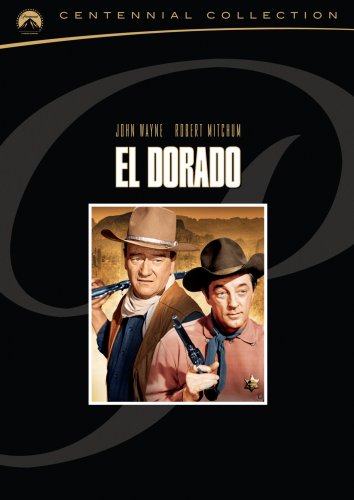
My history with Westerns isn’t exactly a vast one. I watched a bunch of Westerns with my dad growing up and I continued to watch the bigger ones of the modern era like Tombstone and Unforgiven as I progressed through my teenage years and young adulthood. John Wayne is kinda a mystery to me. He’s a huge gritty guy with a lot of patriotism and a funny way of talking. For lack of a better analogy, Sylvester Stallone is my generation’s John Wayne. Or Chuck Norris I guess. El Dorado is an interesting western flic because it was shot later in John Wayne’s career but he had still had the swagger of earlier pictures. A true classic revisited by the minds at Paramount.
Cole Thornton (played by John Wayne) is a gunslinger for hire. He’s been hired by Bart Jason (played by Ed Asner) for some help in a ranch dispute with the McDonald family. Cole rides into El Dorado and is approached by his friend: Sheriff J.P. Harrah (played by Robert Mitchum) who tells him the real tale of the ranch dispute. Cole also finds out that Jason eventually would have put him in a gunfight with the Sheriff. This is something that he didn’t want to do.
Posted in: Disc Reviews by Gino Sassani on May 7th, 2009
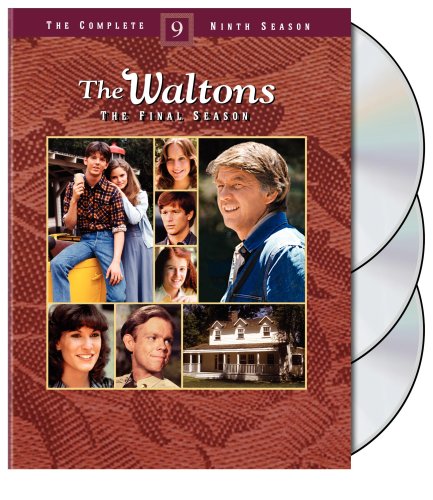
Talk about your hit show running out of steam. The Waltons is the perfect example of a show that outstayed its welcome. When it first took television audiences by storm in 1971, it became a cultural phenomenon. But by the show’s ninth and final year as a regular series it was 1980 and the country, the world, for that matter, had changed. It didn’t help matters that Richard Thomas had left the show, and his popular John Boy character, behind. The show’s core fans remained, but America’s love affair with The Waltons was clearly over. The show continued with 6 specials, often around holidays that brought the now scattered family back to Walton’s Mountain and our television screens. The last of these reunion films aired in 1997. They are not included in this final season set. I would expect they are awaiting their own release, much as the Columbo series has done.
John (Waite) and Olivia (Learned) Walton lived on the Walton land high atop Walton’s Mountain. The land had been in their family for generations. They shared their home with Grandpa (Geer) and Grandma (Corby) Walton and 8 children. At first we found the family in the heart of the Great Depression. They series had a Little House On The Prairie feel to it. The stories took place mostly in that small town where they all lived. The family would suffer one hardship or another and overcome weekly obstacles by sticking together as a family. As the years moved on, the series entered the World War II era and some of the boys would end up fighting in the conflict. By far the breakout character became John Boy, who was first played by and made famous by Richard Thomas. In the last season the character was covered as a recurring character by Robert Wrightman. It would never be the same.