Posted in: Disc Reviews by Michael Durr on November 26th, 2007
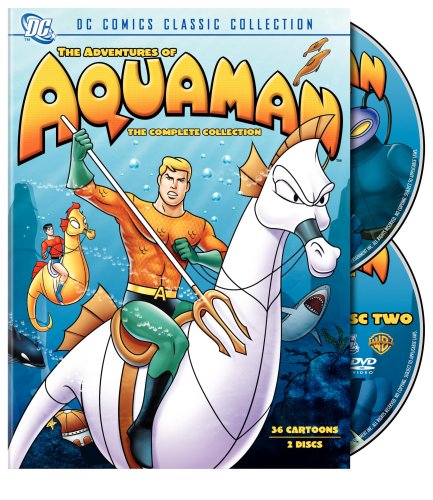
Remember Aquaman? You know, that guy who lived underwater and fought people who would dump hazardous waste in the ocean or people with big helmets named the Black Manta. No, not Charlie the Tuna. Let's try this description. He's King of Atlantis and has giant muscles and was a very popular super hero. Namor, the Sub-Mariner? *sigh* He's the one who sat behind the desk feeding the Justice League information cause simply he had nothing else better to do. Oh Aquaman, quite right. Well he had his own cartoon show in the late 60's that ran for a couple of years with the Superman/Aquaman hour of Adventure (which incidentally only ran half an hour). It featured Aquaman, Aqualad, and a vast array of exciting characters like Tusky the Walrus. I'm not making this up.
Ever sit in a cartoon show and wonder why you keep having a sense of deja vu? The series wasn't so bad, it was quirky and sported the classic 60's superhero feel. The good guys are just spending another day at the office which happens to be the ocean and the evil guys come and mess it up. Biff, bang, boom the bad guys are defeated and the world is good again. But it suffers heavily from using the same frame of animation over and over again. It's no Batfink but it's not very far off. Another thing that Aquaman did was borrow heavily from Batman, the live action show. If I hear "Holy Haddock" one more time or watch as Aqualad act as a complete copy of Robin complete with rather homo-erotic tendencies, I think I might scream. Outside of that, the stories while simple aren't so bad and it is one of those things that is fun; just in small doses.
Posted in: Disc Reviews by David Annandale on November 22nd, 2007
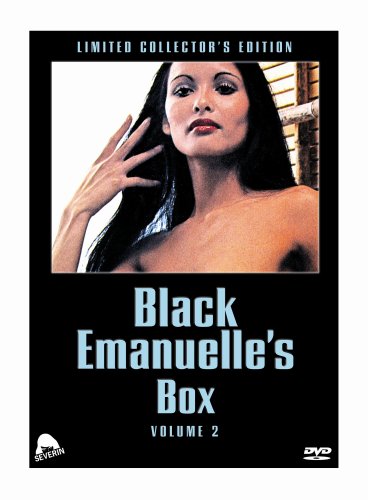
Severin unleashes three more entries from Italy’s long-running sexploitation saga, and the result is another fascinating collection. The quality of the movies themselves up and down, but the good stuff is very good, and the collective result is something that is completely fascinating. Exploitation fans should be over the moon.
I’ve already gone on at length about Black Emmanuelle/White Emmanuelle (1976) elsewhere, so I won’t rehash everything again. Briefly, though, the set-up has Laura Gemser as Emanuelle (let’s stick to the single “m” version to avoid confusion with Sylvia Kristel), here a model instead of a journalist, arriving with SOB photographer boyfriend at the palatial home of some friends in Egypt. Much aristocratic ennui ensues, until Laure (Annie Belle) arrives to tear down everyone’s comfortable illusions. The most nicely shot and intelligently scripted of the films, there is something absolutely mesmerizing about the display of decadent self-loathing proposed here. Writer/director Brunello Rondi’s effort is emphatically a high point of the series, and invites repeated viewings.
Posted in: Disc Reviews by Gino Sassani on November 21st, 2007
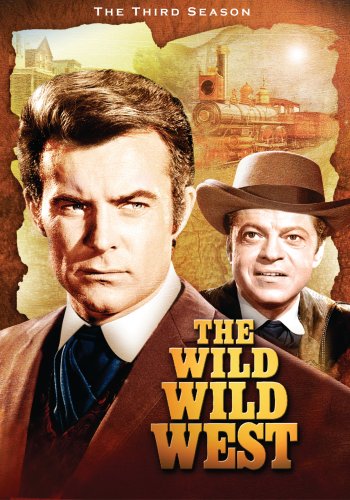
James West (Conrad) was a Union Army vet. He’s the kind of act first think about it later kind of guy. Artemus Gordon (Ross) was a typical con man. He could create the most convincing disguises and was also a master of sleight of hand. Together they worked for the Secret Service in the days of the western frontier. The two of them were the prototype of the future spy. They would use incredible inventions and Bond-like gadgets along with their own skills at trickery to investigate major Federal crimes, often plots against the
Posted in: Disc Reviews by David Annandale on November 14th, 2007
As a woman commits suicide by leaping to her death on the English seacoast, her daughter in Italy has a vision of her fall. Years later, the now-grown Virginia (Jennifer O’Neill) is married to a wealthy businessman, and is suddenly plagued by visions again. Following the evidence, she discovers the skeleton of a young woman who has been walled up in her husband’s ancestral home for years. He is immediately arrested. Virginia works to prove his innocence by investigating the other mysteries of her visions, but she is letting herself in for more than she bargained for.
Having made quite a name for itself as a purveyor of lovely editions of classic European sexploitation, Severin branches out in spectacular fashion with this 1977 effort by Lucio Fulci. Fans of the director who know him exclusively for films such as Zombie and The Beyond will no doubt be disappointed by the lack of extreme gore. (Exception: the opening suicide, which delivers a nasty jolt as we see the woman’s face smash against the rocks as she falls. Unfortunately, Fulci has to show us the effect more than once, and it loses its effectiveness as its artificiality becomes clear.) But, as clearly derivative as it is of both Nicholas Roeg’s Don’t Look Now and Dario Argento’s Deep Red, this is still evidence that Fulci was more than capable of assembling a film that is gripping at the level of narrative and suspense. Unlike Don’t Look Now, where we are kept as much in the dark as its protagonist as to what the visions mean, here Fulci makes sure we are a few steps ahead of Virginia. We realize quite early that what she saw was a vision of the future, not the past, and watch helplessly as the strands of fate wind inexorably around her. There may not be much to her character, but her plight is so clearly articulated and so unstoppable that we cannot help but feel a soul-deep dread. A excellent slice of Eurohorror.
Posted in: Disc Reviews by Archive Authors on November 12th, 2007
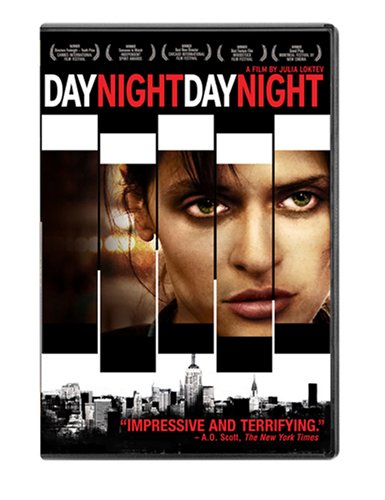
The premise of Day Night Day Night is relatively simple; a young woman decides to be a suicide bomber in Times Square. The motivations for her doing this, as in the outside forces who convince her to do it, aren’t really explained at all, so what makes it unique is that it focuses on the preparation the girl makes. She is portrayed by Luisa Williams, who appears in the film in her first role.
Written and directed by Julia Loktev (Moment of Impact), the film conveys some degree of tension and atmosphere, because you’re wondering what’s going to happen next, but the fact of the matter is that the level of activity that occurs here is almost nonexistent, and the context of the event borders on confusing. You watch the girl wait. And wait. And wait. And then her pseudo-presumably Islamic organizers who have American accents get her ready for it. Then she waits. And waits. And waits. And later on as we get closer to the actual event, she eats. And eats. And eats.
Posted in: Disc Reviews by David Annandale on November 8th, 2007
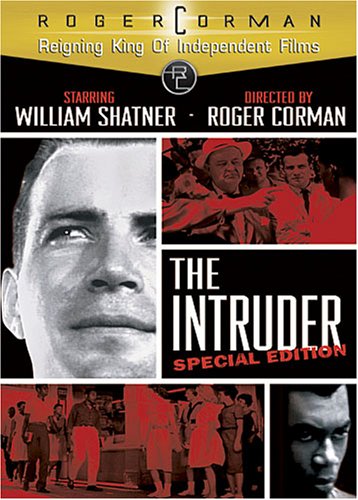
Roger Corman is fond of saying that only one of his movies ever lost money. It was this 1962 release (shot in 1961), and it is his bravest film, and still arguably his most powerful. William Shatner plays Adam Cramer, a white supremacist associated with the “Patrick Henry Society” (read: John Birch Society), who arrives in the southern town of Caxton on the eve of racial integration of the school. The demagogue whips up the hatred of the white townspeople, leading to cross-burning, church-bombing, and worse.
Corman’s film has lost none of its power to shock and appal. Nor has it lost its power to amaze. An absolutely blistering condemnation of bigotry, it makes the likes of Mississippi Burning look mealy-mouthed by comparison, and its unblinking political directness is all the more astounding for when and where it was made. As we learn from the accompanying featurette, the cast and crew operated under the constant threat of violence, and the sort of events they were depicting were actually taking place nearby. One of the first cinematic statements on the struggle for civil rights, it is still hard to find another film as raw and as uncompromised as this. And those whose only impression of William Shatner is of a shameless ham are in for a revelation. His performance is a satanic mixture of charm, smarm, self-love and seething, explosive hatred. He incarnates a textbook definition of “evil charisma.”
Posted in: Disc Reviews by David Annandale on October 30th, 2007
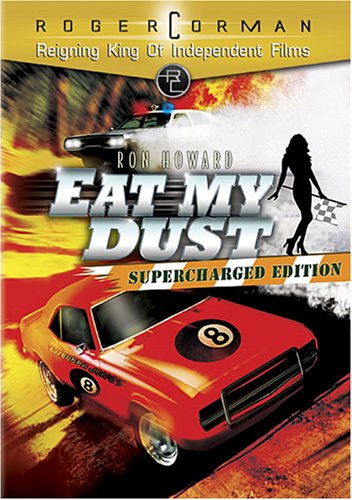
Ron Howard’s move from sitcom star to director began with playing the lead in this Roger Corman-produced car chase flick, after which he would move to behind the camera to direct Grand Theft Auto. Here he plays the son of the local sheriff. In an effort to impress the girl of his dreams (Christopher Norris, and yes, that’s a woman’s name), he steals a stock car, and he and his friends then lead the authorities on a merry chase. As is typical of Corman productions, this works hard at delivering, on a stringent budget, exactly what its audience wants. Writer/director Charles B. Griffith was responsible for some of the better scripts to come out of the Corman stable (It Conquered the World, Little Shop of Horrors, Death Race 2000), and some of his trademark wit is on display here, but without the snap of the better films. It feels much more forced and laboured. The film clips along just fine, but today is little more than a curiosity.
Audio
Posted in: Disc Reviews by Gino Sassani on October 11th, 2007
I grew up on a steady diet of horror hosts. In the
Posted in: Disc Reviews by Gino Sassani on October 3rd, 2007
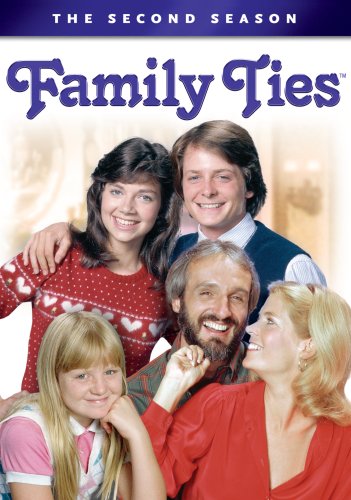
Family Ties is likely remembered most as the series that launched the career of Michael J. Fox. There’s no question that he owes a great debt to Alex Keaton. It’s almost a bit awkward now to watch him as this young, extremely conservative teenager after Fox has spent so much of his life as a liberal poster boy in the last couple of elections. Politics aside, it’s hard not to credit his performances in Family Ties and the Back To The Future films for launching him into a well deserved lucrative career. The Michael J. Fox issue, however, might hide some of the other assets the show had going for it in its time. For one of the first times parents were portrayed as humanly flawed, and families were not the perfectly functional institutions most of these shows described. Up until Family Ties, these households were either perfect little examples of American ideal or they were so dysfunctional that they could hardly be considered families at all. This show obviously went for a bit of realism.
Posted in: Disc Reviews by David Annandale on September 27th, 2007
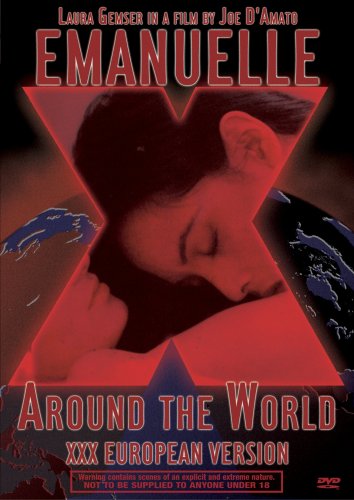
This is a second release of the film already available in Severin’s fine Black Emanuelle’s Box collection. What I said about the film in that review still holds, to whit: “Emanuelle Around the World (1977) has a bit more of a storyline, though it is still very picaresque in nature. Picturesque as well. Our heroine becomes outraged by the sex traffic of women, and so travels from location to location, exposing the evildoers. D’Amato (who also directed the previous entry) here rather unconvincingly dons a pseudo-feminist stance, but there are moments actually approaching suspense. The sex scenes of both these films are, for the most part, laughable, though occasionally well shot. Any sense of eroticism is thanks to Laura Gemser, whose ethereal beauty and grace are such that she moves through the film as an almost divine presence, above and untouched by the events around her.”

This is the “XXX European Version,” which doesn’t make a whole heck of a lot of difference. The running times are essentially identical. The only scene where I noticed any real increase in explicitness is in the creepy sequence where a captured Emanuelle is forced to watch rape by snake and dog. The scene is still, I think (and devoutly hope and keep telling myself), simulated, but most unpleasant, and makes the film’s pseudo-feminist stance even harder to buy than before.