Dolby Digital Mono (English)

A mysterious figure or organization going by the name of War on Crime is apparently engaged in just that in the streets of Soweto. Known drug dealers are being gunned down. On the case is Lt. Deel (Nigel Davenport). Caught up in the case is newspaperman Chaka (Ken Gampu), who is contacted by War on Crime and given tips as to when the next attack will take place. Deel and Chaka are friends of long standing, but their friendship is challenged by the fact that the police captain now views Chaka as a possible accomplice in the vigilante killings. The question, too, is whether there is more to these killings than meets the eye.

Now this is an interesting artifact: a South African grindhouse epic from the 70s (and thus the Apartheid era). The case boasts that this is a blaxploitation effort, and while this is only 100% accurate, as a fair amount of screen time is spent with Deel, and ditto a white killer working for War on Crime, it's certainly close enough for government work. The story is a bit meandering, given that there isn't really that much plot (and so we can take time out to watch Chaka eat lunch and feed ducks). But the moments of tedium are made up for by the over-the-top slow-motion violence, not to mention the entertainment value of the hilariously clunky post-synchronization. And the editor, it seems, was having to work while being subjected to random electrical shocks. All in all, a most fascinating oddity.

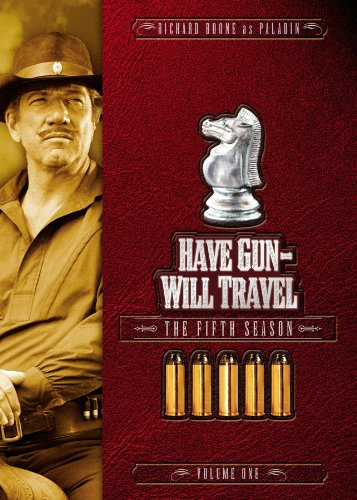
’Have gun, will travel’ reads the card of a man. A knight without armor in a savage land…”. Those words ended every episode of Have Gun Will Travel, sung by Johnny Western in a time that such words could be sung without irony. Outside of Richard Boone’s black-clad, craggy Rhett Butler gone-to-seed gunfighter, that song was all I could really recall about this venerable Western from television’s golden age. Would it, like so many revisited shows from my youth, ultimately disappoint? Or would it hold up fifty years after it was originally broadcast, viewed as it would be by the far more jaded, cynical man I’ve grown into?

The verdict? It’s pretty darn good.

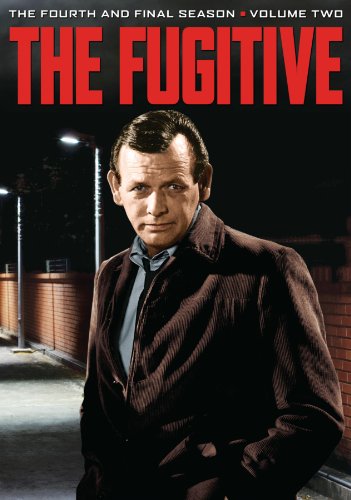
“The man is Richard Kimble and, not surprisingly, the man is tired. Tired of looking over his shoulder, the ready lie of the buses and freight trains. Richard Kimble is tired of running…”

The elusive “one-armed man” is one of the best known television icons of all time. The plight of Dr. Richard Kimball has been the subject of numerous imitations and even a feature film staring Harrison Ford as Kimball and Tommy Lee Jones as his pursuer. Tim Daly left the ranks of comedy to fill the shoes of Kimball in a very short-lived revival series. While some of these efforts managed to capture the essence of The Fugitive, none can truly compare to the real thing.

Having made it through WWII, fellow soldiers Bing Crosby and Danny Kaye are now a song-and-dance team. Kaye is worried about the lack of romance in Crosby's life, but that problem seems likely to be resolved when sister act Rosemary Clooney and Ver-Ellen show up. These two pairs of entertainers must pool their talents in order to save the inn run by former general Dean Jagger from financial ruin.

The plot is, of course, very thin, a mere excuse on which to hang the sentiment and the songs. This is, of course, not the film which originated the title track – that was the earlier Holiday Inn (1942), which Crosby was teamed up with Fred Astaire. The holiday this time is strictly the Christmas one, and White Christmas goes its predecessor one or two better in terms of spectacle, thanks to Technicolor and VistaVision. The end result is not really the classic it self-evidently wants to be, but it and its cast are extremely likable.

Written by Diane Tillis

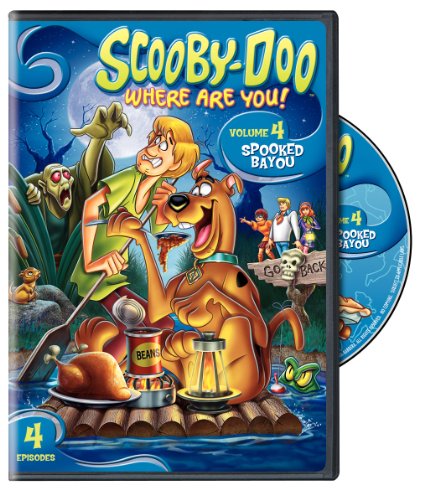
Jumping Jellybeans! Scooby Doo deserves mention in any article that discusses the best and most-loved animated television series in history.

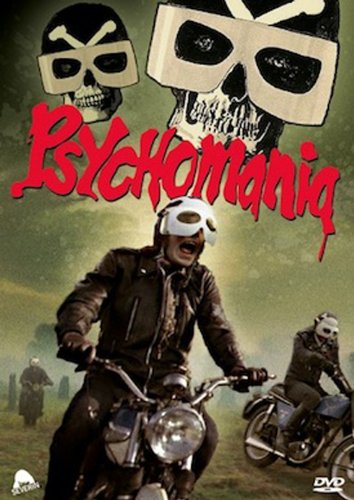
Nicky Henson plays Tom, the leader of a hellraising biker gang known as the Living Dead. His goal is to make that moniker absolutely literal, and it helps that his mother (Beryl Reid) is a medium who has made some sort of Satanic pact, and the butler (George Sanders, in his final role just before his suicide) might well be an infernal power himself (his precise nature is never made clear). At any rate, all it takes to come back from the dead, apparently, is to kill oneself while firmly believing that one will return. Tom proves this formula to be correct, and soon almost all the other gang members follow suit. The one member who might hold out is his girlfriend Abby (Mary Larkin). Meanwhile, as the Living Dead embark on a reign of terror, will anyone be able to stop them?


This is a pretty odd duck of a film, and quite delightful for precisely that reason. In the first place, the Living Dead are hardly the most threatening biker gang ever to grace the silver screen, and though they do rack up quite the body count of policemen and civilians, many of their other bits of misbehaviour are not so much atrocities, but more in the line of shenanigans (as a fellow viewer aptly put it, the gang don't become flesh-eating zombies, only unkillable twits). The precise nature of Reid's motivation is never made clear, Abby is so whiny and callow that one is hard-pressed to feel any sympathy for her, and there's this strange preoccupation with the idea of the frog as an embodiment of evil. But these very oddities contribute to, rather than detract from, the film's off-kilter entertainment value. There's a wealth of incident, so the viewer is never bored, there are  some very fun chase scenes, and (which is a good thing) there is a rather knowing sense of humour about the whole affair. Definitely one of the odder horror films to emerge from England in the 1970s, and an engaging rediscovery.

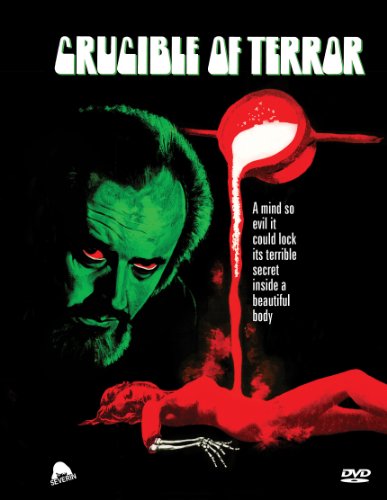
Former pirate radio DJ Mike Raven plays Victor Clare (a case where the actor has a scarier name than the character he plays), reclusive artist who, one strongly suspects, has the unpleasant House-of-Wax-y propensity to pour molten metal on his models in order to bronze them. A group of characters with varying agendas gather at his Cornwall abode: his senile wife; his sexually ambivalent model; his weak, alcoholic son (Ronald Lacey, a long way from the menacing Nazi he would later play in Raiders of the Lost Ark) and impatient daughter-in-law; a neophyte art dealer and his girlfriend, Millie (Mary Maude). Victor becomes obsessed with Millie, determined make her his artistic muse. Meanwhile, the cast is being gruesomely bumped off one after the other.

Raven comes across very much as a poor man's Christopher Lee. He has the height (more or less), he has a deep voice, and he even looks not unlike Lee. But he has none of the master's screen presence, and isn't as frightening as he clearly should be. Most of the film is a rather dull plod, with characters wandering about, flirting or sniping at each other, and repeating conversations ad nauseum. The murders come along every so often to spice things up, but given Victor's obvious villainy, one might well wonder why the film is being so coy about the killings, and refusing to show us the killer.

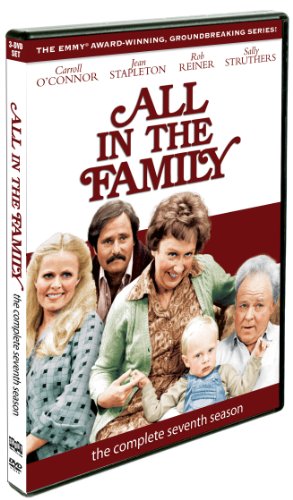
There were a lot of changes in store for the Bunkers in the seventh season. The Jeffersons, long a source of irritation for Archie and a ton of laughs for us, moved to their own show, on up to the East Side and that big de-luxe apartment in the sky. Mike and Gloria finally move out of the house, but only as far as next door in the vacated Jefferson home. Most importantly, little baby Joey joins the family. New characters would join the show in the seventh season. It's been a rough ride for the Bunkers, to be sure. The series was first released through Fox for three seasons. Sony took over the releases for the next three seasons. Finally Shout Factory has stepped up and has taken over the release chores for this classic comedy.

It’s perhaps a sad commentary on the level of political correctness that Archie Bunker could never have graced network primetime in 2010. Archie was ignorant and an incredibly vocal bigot. Archie was an equal-opportunity bigot. He didn’t just hate certain minorities … he hated everybody who wasn’t white blue-collar protestant. Carroll O’Connor, who brilliantly portrayed Archie, was without a doubt one of the best actors to grace a network sit-com. Just watch his eyes and you’ll understand. All in the Family holds a record for spin-off series. The Jeffersons, Maude, Good Times, and Archie Bunker’s Place are just a few of the highly successful shows that owe their roots to All In The Family. Rob Reiner, Meathead, has since followed in his father Carl Reiner’s footsteps as a highly-acclaimed producer.

I grew up on the Peanuts creations of Charles M. Schulz. Most of us have, in some way or another. His newspaper comic strip is one of the longest running and most successful strips of all time. The work has been translated into every language currently spoken on the planet. The images of Charlie Brown, Snoopy, Linus, and the rest of the Peanuts gang have appeared on just about any kind of product imaginable. Our pop culture contains too many references to the strip to mention briefly. For me, it was the television specials starting in the mid 1960’s that brought the gang into my life. The classics are running annually, still after nearly 50 years. A Charlie Brown Christmas and It’s The Great Pumpkin, Charlie Brown are the most mentioned and certainly beloved by generations of children and adults. I thought I never missed an airing.

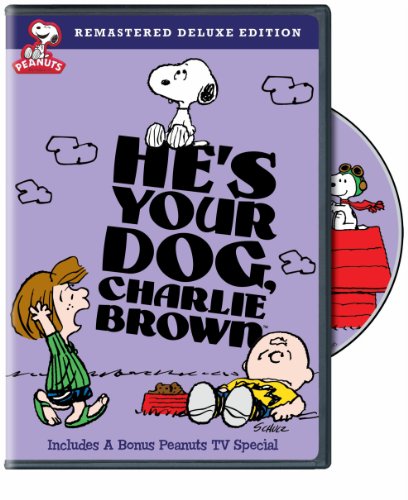
He’s Your Dog, Charlie Brown: Snoopy’s driving the neighborhood crazy, and they want Charlie Brown to do something about it. That means back to The Daisy Hill Puppy Farm for everyone’s favorite flying-ace beagle, and obedience school. But along the way to the farm Charlie Brown discovers just how much he loves Snoopy, just the way that he is.

Despite lasting over a hundred episodes, The Patty Duke Show only lasted about three years from the fall of 1963 until the late spring of 1966. However, it was often penned as one of the best shows of the 1960’s and still finds a way into syndication when networks such as TV Land need a wholesome show to fill a time slot. So, it is little surprise that Shout Factory have decided to release all three seasons of the show to DVD. But how does the final season of this show hold up after all of these years?

Prior to this dvd set, I wasn’t very familiar with the show and had only caught a few random episodes on Nick at Nite. So I’ll do the service of giving a brief layout before we continue. The show is based in Brooklyn where the Lanes family resides. The main character of the show is Patty Lane (played by Patty Duke) who is a strong willed and outgoing teenager. She has a dad named Martin (played by William Schallert) and a mother named Natalie (played by Jean Byron).