Posted in: Disc Reviews by David Annandale on June 6th, 2011
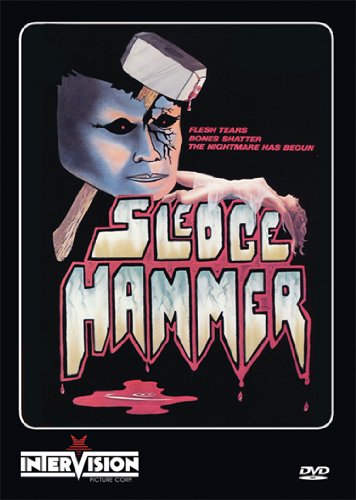
A mother locks her child in a closet so she can have an uninterrupted tryst with her lover. But the couple is rudely interrupted after all, as they are bludgeoned to death. Ten years later, a group of friends arrive at the deserted house to party down. After doing so for a fair bit of running time, they then fall prey to a hulking masked maniac, who not only has the titular hammer, but also has all sorts of supernatural powers.
This is, according to the box, “the first shot-on-tape slasher movie for the home video market.” This is a warning as much as anything else: don't be expecting John Carpenter or Dario Argento behind the camera. That the film is amateurish goes without saying, but I'll say it anyway. Viewers should be prepared, then, for lots of padding (a slow-motion scene of a couple walking that goes on for minutes), bland camera set-ups, ropey script (let's have a complete food fight sequence!) and whipped-up-in-the-kitchen gore. On the upside, once the supernatural kicks in, logic goes out the window, and all sorts of strange things start happening with no explanation whatsoever, resulting in a rather charming sort of dime store surrealism. This isn't a good film, but it is a likable one.
Posted in: Disc Reviews by William O'Donnell on April 12th, 2011
Dennis Mitchell always means well when he wants to help out his parents, or good ol' Mr. Wilson, but he also just wants to have a good time. ¼ helpful young lad but ¾ mischief, Dennis made the leap from the beloved comic strip by Hank Ketchum to the small screen for four seasons.
Compensating for when ABC took over Leave it to Beaver from CBS, Dennis the Menace was the attempt to grab some audience back for CBS. Jay North is the titular Dennis, and does well to carry the spark of this character's “menacing” namesake. Each episode sees Dennis with the best of intentions, but always managing to create more damage than his help is worth. Along for the ride are his best friends Tommy and Joey (the latter seeming to be a strange mute boy), his rival Margaret, his parents played by Herbert Anderson and Gloria (who could not look closer to the original characters) and Joseph Kearns as the ever-frustrated Mr. Wilson.
Posted in: Disc Reviews by David Annandale on March 3rd, 2011
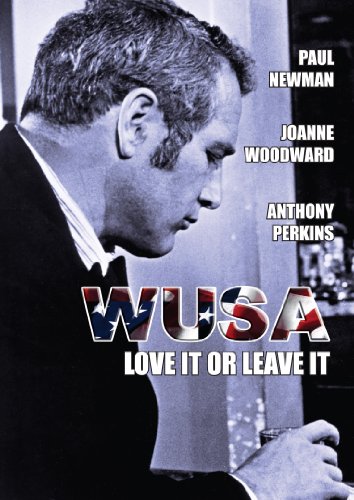
Cynical, alcoholic ex-musician Paul Newman arrives in New Orleans with barely a cent to his name. Following a tip from scam-artist preacher Laurence Harvey, Newman lands a job as a DJ for WUSA, an extreme right wing/white power propaganda radio station. Newman has no patience for his employers' message, but he's happy to take the money and drink himself into an apathetic stupor. Acting as the unwelcome voice of his conscience are the scarred hard-luck woman he has taken up with (Joanne Woodward) and the twitchy, anxious liberal (Anthony Perkins) who is about to discover that the survey work he has been doing in the city's ghetto is, in fact, in the service of Newman's dark masters.
Very much a reflection of, and commentary on, its turbulent times (1970), this is a film that is messy in its construction but ferocious in its convictions. The plot meanders more than is good for it, the script takes some rather pretentious flights into poetry, and Newman's character changes too little to be very interesting, with the result that the final scene lacks the kick that it clearly wants to have. Perkins, however, is magnificent in his painful, tortured sincerity, and the climax – a WUSA rally that becomes a hellish riot – is a knockout.
Posted in: Disc Reviews by David Annandale on January 15th, 2011
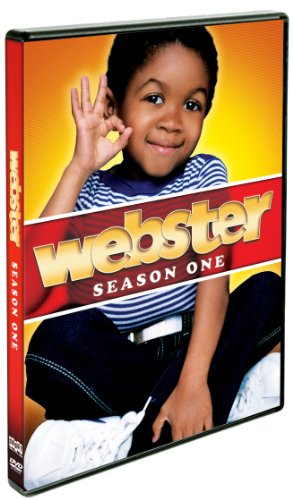
George Papdapolis (Alex Karras) and Katherine Calder-Young (Susan Clark) meet on a Greek cruise, and, after a whirlwind romance, return to Chicago. They're a bit of an odd couple – she's a blue-blood, complete with male secretary, and he's an ex-football player. The cross-class romance is barely underway, however, when they suddenly find themselves the guardians of the unspeakably adorable seven-year-old Webster (played by twelve-year-old Emmanuel Lewis) after his parents die (George had agreed to be his godfather back in the day). All sorts of cute misunderstandings, cute heart-warming lessons and cute sentimentality then ensues.
There is no denying diabetic-shock-inducing cuteness of Lewis, though there is also something a little bit creepy about the way the camera presents him, shamelessly exploiting that cuteness for all its worth, offering up Lewis for the audience to cluck over as if he were some kind of ambulatory teddy bear. The humour, meanwhile, is typical of an 80s sitcom – banal jokes in tandem with a Serious Message. And some of the gags are, to put mildly, antediluvian. Oh, look! Katherine is a woman who can't cook! Hilarious! For those with fond memories of the show, however, none of this will matter. But those who have no such memories are probably better off not forming them.
Posted in: Disc Reviews by David Annandale on January 15th, 2011
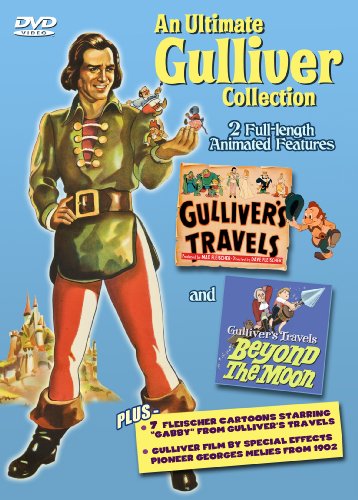
Johnathan Swift's Gulliver's Travels was never meant to be a children's tale. It is one of the most corrosive satires in the English language, one that has lost none of its brilliant venom over the passage of centuries. But endless bowdlerizations have given its first two sections (the voyages to Lilliput and Brobdingag) the reputation for being children's classics. Obviously, references to people being “the most pernicious race of little odious vermin that nature ever suffered to crawl upon the surface of the earth” are usually left out. At any rate, said bowdlerizations inevitably resulted in various anodyne film adaptations. And so, as Jack Black galumphs across the screen to box office disaster, here is a collection of animated takes on Swift's work.
Gulliver's Travels: (76 mins.) This 1939 effort is the main attraction here, the second feature-length animated film ever made. It limits itself to Gulliver's journey to Lilliput, where, in this version, he must bring about the end of a war between Lilliput and Blefuscu so that bland princess and prince of the respective nations can marry. The Fleischer brothers are best remembered for Betty Boop and their excellent Superman cartoons. Gulliver's Travels, on the other hand, is far from their best work. The animation is fluid, though the backgrounds are lifeless and still, a far cry from what Disney had just done with Snow White. The pace is slack, meandering along through rather tired slapstick. The cartoonish Lilliputians are charming enough, but the more realistic characters are expressionless waxworks, or, in the case of the rotoscoped Gulliver, dip alarmingly toward the uncanny valley. The piece is a historical curiosity, but is no classic. Still, it's much, much better than...
Posted in: Disc Reviews by Gino Sassani on December 6th, 2010
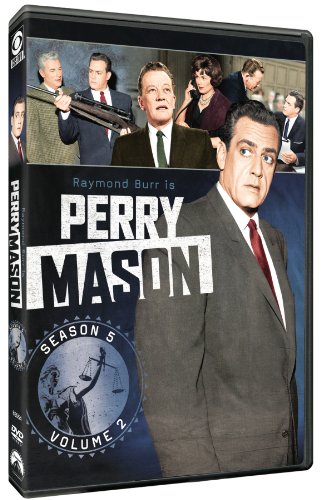
Erle Stanley Gardner wrote crime fiction, and while many of his 100 or so works are unknown to most of us, he created a character that has become as identified with criminal lawyers as any other in fiction. It was in these crime novels that Perry Mason first faced a courtroom. He developed a style where he would investigate these terrible crimes his clients were on trial for. He would find the real killer, and in what has become a Hollywood cliché, reveal his findings in a crucial moment during the trial. While we may not remember the novels, we all remember the man in the persona of Raymond Burr. Burr had a commanding presence on our screens and enjoyed a well deserved 11-year run as the clever lawyer. What makes this run so amazing is that the show followed pretty much the same pattern the entire time. We always know what’s going to happen, but we wait eagerly for that gotcha moment when Perry faces the witness on the stand. We know when he’s got the guy squarely in his sights, and we can’t sit still waiting for him to pull the trigger. OK, so maybe that’s a little over the top, but so was Perry Mason. From the moment you heard that distinctive theme, the stage was set. To say that Perry Mason defined the lawyer show for decades would be an understatement. Folks like Matlock and shows like The Practice are strikingly similar to Perry Mason. If you haven’t checked this show out, this is your chance. See where it all began.
At this rate, it’s going to be quite some time before you complete your collection. I’m not even sure that DVD will still be a viable format before the end of the series on DVD. It’s another half season, and the episodes continue to fly at us at a snail’s pace. But slow and steady wins the race, and as long as the quality episodes continue to deliver that classic Mason charm and style, I guess folks like us will continue to come back for more.
Posted in: Disc Reviews by David Annandale on November 3rd, 2010
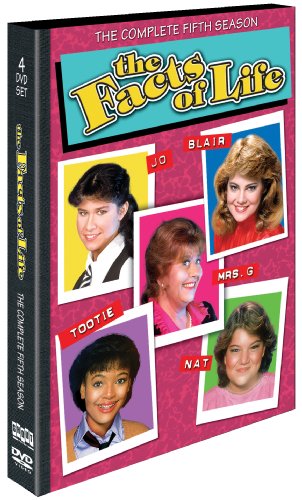
Season 5 of this most well-meaning of sitcoms finds a major change. With the cast now having aged to the point that not all the girls could reasonably be in high school together, Mrs. Garrett (Charlotte Rae) opens Edna's Edibles, a bakery-slash-coffee-shop, and the opening two-parter establishes the new status quo (essentially doing whatever is necessary to keep the main characters together). Otherwise, things proceed as they always have, with each story combining standard sitcom hijinks with Important Life Lessons and forays into weighty subjects. So, for example, the friendship between Natalie (Mindy Cohn) and Tootie (Kim Fields) hits a rough patch when Natalie's reaction to being asked out by Tootie's cousin is perceived, by Tootie, to be racist.

The series' flaws and strengths are much as they always were. On the one hand, the commitment to deal with serious issues is commendable, and the actual integration of these themes into the structure of the stories is fairly smooth. On the other, the performances are thuddingly broad, and the dialogue (and its attendant jokes) is both chronically and acutely awful. In the final analysis, only viewers who have retained a devotion to the show will really be able to get much out of this.
Posted in: Disc Reviews by William O'Donnell on October 15th, 2010
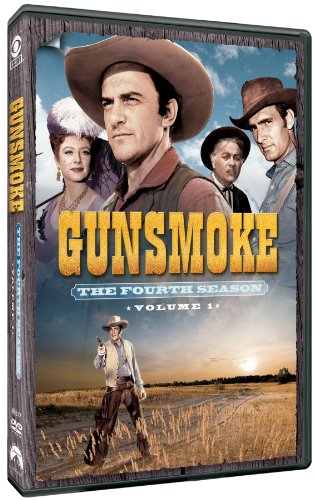
Gunsmoke, in all of its 20 seasons, making it the longest running prime-time drama of all time, has such a strong legacy that it feels odd to review it. Thankfully the challenge is an enjoyable one as the show is at a full head of steam in its fourth season (it was ranked #1 at this time) and each episode is still as engrossing today as it was over 4 decades ago.
James Arness plays Marchall Matt Dillon, and is the law of Dodge City. Both him and the local doctor have rather stony demeanors when it comes to death, and death seems plenty common in 1800s Kansas. More often than not the criminal behind each episodes story is shot dead by the quick draw of Dillon before they could ever see a trial. I suppose that just makes the opening narration all the more suiting as many episodes start with a stock scene of Dillon wandering through a graveyard as Dillon narrates his musings on those that have made one too many mistakes and earned themselves a spot in that yard.
Posted in: Disc Reviews by David Annandale on September 20th, 2010
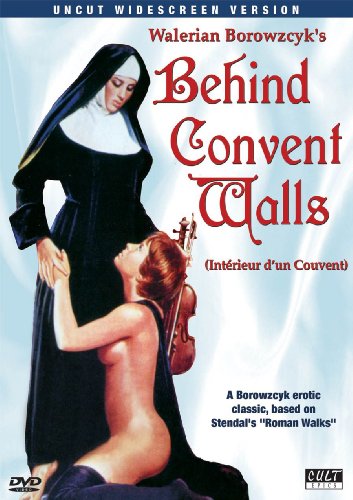
A nunsploitation box set was always an inevitability, and here the good people at Cult Epics chime in with just such a collection, one limited to 2500 copies. There are only two films here, but they are two good ones, the works of strong directors. One is a distinctively idiosyncratic work, showing the unmistakable hand of its filmmaker. The other will quite simply knock you out the back wall.
Behind Convent Walls is Walerian Borowczyk's contribution to the subgenre. A repressive abbess rules her convent with an iron fist (not to mention the blade concealed in her cane), but the sexuality of the nuns will not be repressed, and it will make its presence known, whether through rebellion or madness. The film defies any linear summary, given that it is almost impossible to tell the nuns apart, and the various incidents are not only disconnected, they take place with very little motivation or logic. Instead, we have a strikingly beautiful exercise in pure cinema. The Aurum Film Encyclopedia: Horror, on the subject of Borowczyk's Docteur Jekyll et les Femmes, notes, “Borowczyk's imagery, here fed by his fetishistic fascination with all things antiquarian, is often stunning and the film becomes a sort of still life in which familiar yet alien objects … seem imbued with a secret significance all their own.” Exactly the same is true for Behind Convent Walls. While nowhere near as powerful a film as The Beast, it is nonetheless well worth one's full attention.
Posted in: Disc Reviews by Archive Authors on August 7th, 2010
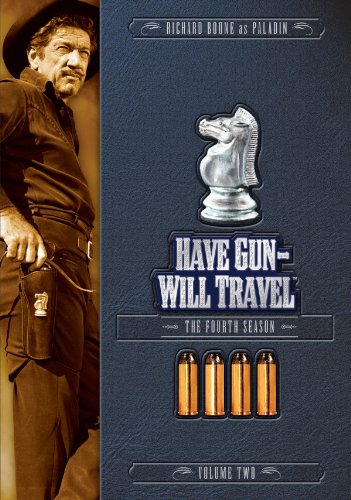
“Have gun, will travel reads the card of a man. A knight without armor in a savage land…”. Those words ended every episode of Have Gun Will Travel, sung by Johnny Western in a time that such words could be sung without irony. Outside of Richard Boone’s black-clad, craggy Rhett Butler gone-to-seed gunfighter, that song was all I could really recall about this venerable Western from television’s golden age. Would it, like so many revisited shows from my youth, ultimately disappoint? Or would it hold up fifty years after it was originally broadcast, viewed as it would be by the far more jaded, cynical man I’ve grown into?
The verdict? It’s pretty darn good.