Comedy

One of the first books I read about the restaurant business was a title called Kitchen Confidential by Anthony Bourdain. He describes the people who work at restaurants to be a band of misfits, those who are probably only there because of an irrational dedication to cooking. That would certainly describe the people who work at the Slammin Salmon, the latest comedy from Broken Lizard group.

Rich Ferente (played by Kevin Heffernan) is a down on his luck waiter. After a bout with some very disrespectful customers, he comes to the back with a tuna patty forcefully stuck in his mouth. He gets yelled at by the floor manager Carl (played by Nat Faxon) which causes Rich to quit on the spot. However Rich has to tell the Champ that he has quit and you know what happened to the last guy who did that? Ultimately Rich chickens out and runs away. Fast forward a year.

Bud Abbott and Lou Costello began their career completely by accident. Bud Abbott had tried his hand at doing the straight man bit with limited success. One night in 1931 he was working as a cashier for a vaudeville company when Lou Costello's partner came down with an illness. The performer needed a stand-in, and Bud Abbott filled in for the night. It was a temporary gig, to be sure. A temporary gig that happened to last 25 years. The two continued to work together on stage. While the team certainly reused a ton of the classic routines of the era, there was something unique and clever about the duo. The natural way in which they fell into each other's lines was a rare sight, indeed. They eventually stood out for their ingenious word play, culminating in one of the most famous comic routines in history, Who's On First.

The pair next took their act to the airwaves -- radio airwaves, that is. They became a staple in the medium and eventually the highest paid performers in that industry. Films weren't really much of an option at first. They were still mostly silent, and while comedy thrived in that era, Abbott and Costello's brand of humor just would not have worked. But when sound became more economical and standard, the boys were thrown into the pictures. In 1940 they would star in a film called One Night In The Tropics. They would continue to make films for the next 14 years at an incredible pace. They made several films a year and were soon financing Universal studios with their output and box office income. Perhaps their most famous films were the monsters movies where Universal teamed their new moneymaker with the one before. In Abbott And Costello Meet Frankenstein, Bela Lugosi and Lon Chaney, Jr. would both reprise their famous Dracula and Wolf Man characters to the delight of fans of both franchises. Boris Karloff considered himself too old to don the heavy boots of the titular monster, which was played by Glenn Strange, who had performed the role in both House films. So he was still a legitimate part of the horror film cycle. The boys would get their chance to face Karloff later, not once, but twice.

Holy crap, this movie made a boat load of money for Fox when it came out around Christmas 2006, making $250 million and running second only to the Pirates of the Caribbean sequel for box office money. And to see Ben Stiller finally appear in a film that could be considered a blockbuster success was nice too. And in Night at the Museum, he gets to play Larry, night security guard in the New York Museum of Natural History.

Based on a book by Milan Trenc, the story contains man… of the same qualities of a Jumanji or even a Zathura. Larry takes over for a trio of retiring night guards (played by longtime veterans Dick Van Dyke, Mickey Rooney and Bill Cobbs) at the Museum. What he doesn’t know is that the inhabitants of the museum come to life at night, and he has to make sure that the inhabitants stay in said museum from sunset to sunrise, or else they turn into dust.

"We're back..."

The Chipmunks began life oddly enough as a singing group, of sorts. They were the brainchild of struggling songwriter Ross Bagdasarian and were named after the three chief executives at Liberty records. His own alter ego David Seville’s name came from his World War II Army station in Spain. The Chipmunks first appeared in a 1958 record called The Witch Doctor, but wouldn’t officially become The Chipmunks until later that year when The Chipmunks Christmas Song was released. It is for that Christmas music that I most remember the group. They first appeared as puppets on The Ed Sullivan Show. Alvin and the boys got their own television show in 1961. When Ross died in 1972, the Chipmunks would continue on under the guidance of his son. In 1983 The Chipmunks had yet another popular cartoon show and had appeared in countless specials and films. Today they are pretty much a hallmark at the holidays, and a Christmas song collection just wouldn’t be complete without them.

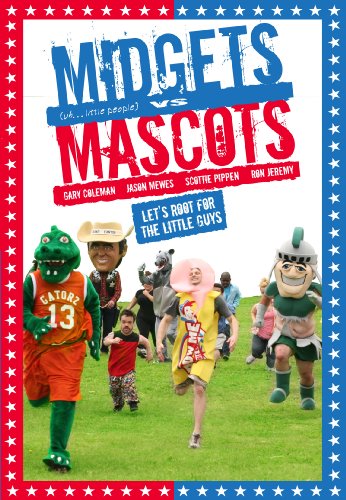
We're into the serious world of high concept now, people. Remember all those struggles D.W. Griffith and Sergei Eisenstein went through to establish cinema as a legitimate art form? Well, this here flick sure makes all those struggles worthwhile. Big Red – midget, former mascot, porn star – dies, and leaves his millions to be fought over by midget-hating son and gold-digging wife. The terms of the battle: each must coach one of the titular teams through a series of ridiculous contests and pranks.

What we have, then, is a mixture of story with would-be outrageous stunts, some real, some staged. In other words, not unlike the work of Sacha Baron Cohen. That is, if you removed every semblance of wit, intelligence and satirical bite from his work, and tossed in Ron Jeremy and Gary Coleman.  The film is sophomoric and puerile, which is exactly what it wants to be, but it also works far too hard to get reach those goals. Depressing.

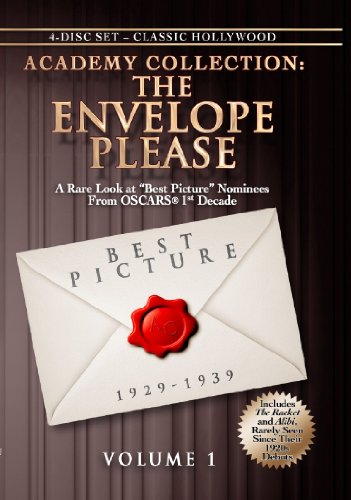
Infinity Entertainment's latest themed grouping of public domain movies deserves some props for originality: eight features that were up for Best Picture during the first decade of the Oscars. Not a single one actually won the prize, but as we all know, that doesn't mean they weren't worthy of doing so.

In chronological order, then, here are the nominees:

"More of this is true than you would believe."

What was intended as a somewhat thought-provoking quirky comedy looks a lot like something you would expect to see on a late night rerun of The X-Files. All of the subject matter has been covered there, just not quite in this way. It all started with a non-fiction book written by Jon Ronson. He claimed to have researched various government studies in human behavior that entered into the world of the paranormal. It was part of an ideology of waging non-lethal war. It was a strange combination of 1980's new age mysticism and actual studies that showed that soldiers in World War II were, in fact, quite reluctant to kill or even harm the enemy. The study claimed that almost 80% of the soldiers deliberately looked for excuses not to fire or merely aimed inaccurately to avoid killing. The study went further and claimed that of the minority that did shoot with deadly results, most of them suffered terrible guilt over the experience, often making them unable to remain effective soldiers. The study regards the remainder of the study group, the ones who did fire accurately and did not suffer guilt as psychopaths. In short, the book gathered a lot of speculative ideas and put them into a rather oddball collection of "facts".

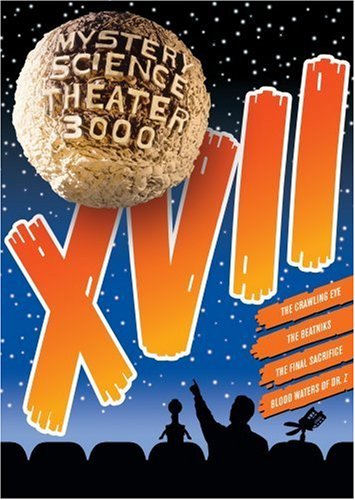
This series from Comedy Central began as a low budget film hosting show in a small television station in Minnesota. It was the brainchild of Joel Hodgson. It ended up running for 11 years and a feature film version.

Mystery Science Theatre is an acquired taste. For me, I’ve really got to be in that certain mood to watch it. That’s the beauty of these DVDs. You pop them in when you’re ready. The idea is pretty whacked. Depending on the season you’ve got, Joel or Mike is trapped in space on the “Satellite of Love”. Doomed to spend his life watching very bad films, our hero makes the best of a bad situation. He uses his resources to construct a couple of robot pals. There's Crow T. Robot (Beaulieu), Tom Servo (Murphy), and Gypsy (Mallon). Part of an experiment together, they watch the films from the front row, constantly ranting throughout. If you’re like me, you’ve invited a few friends over to watch a schlock festival. The movies weren’t as important as the banter you created while watching. That’s exactly what you see here. The silhouettes of our host and his robots dominate the lower portion of the screen, where they provide alternative dialog and sometimes witty commentary on the action. The two evil station owners/mad scientists send them a new bad film each week to observe their reactions to the bombs. The films are broken up by off-the-wall skits and fake commercials to alleviate the tedium. This DVD collection is better than some because it includes films from four different seasons to give you a good sample of the overall series.

If you are a regular reader here, you know I'm not much for the romantic comedy department. I tried to pass this one off on the rest of the staff but couldn't find a taker. We finally got a woman to review this stuff, but not even she was enthused enough about this title to take it on. This experience is pretty typical when it comes to Did You Hear About The Morgans. With a $58 million budget and a $30 million gross at the box office, it would seem that a lot of folks took a pass on the movie. In less than 4 weeks it dropped from nearly 3000 screens across the fruited plain to just about 500. We're not talking about an unknown cast here. The real mystery is, why did such an impressive cast take this movie on?  Hugh Grant is pretty well known, if not for his movies, then for his back seat antics with a hooker. So, his judgment should already be in question. I mean, who would give up Elizabeth Hurley for a 20 dollar hooker? Sarah Jessica Parker has been riding pretty high on her Sex In The City fame. Perhaps she was just trying to solidify a romantic comedy image here. Both made horrible choices here, and neither generated a character worth caring about. What's worse, the two share no chemistry and even a devout romantic comedy avoider like me knows enough to understand that the two most important elements in the genre are chemistry and characters that you feel something for.

Paul and Meryl (Grant & Parker) are a married couple who have been separated for three years because Paul had an affair. Both are highly successful in their chosen fields. Paul is the senior partner in a prestigious law firm and Meryl runs a very elite real estate agency. Paul wants to patch things up, but Meryl is not so sure. So the two agree to meet for a date and see if they can talk about their situation. The dinner date doesn't go very well and is completely ruined when the two witness the murder of a man who was about to turn state's evidence. Now their relationship issues are the least of their problems. The killer knows who they are (Meryl's picture is pasted everywhere from billboards to bus stations) and he's not about to let them testify against him. Enter the Witness Protection Program. The two are given new names (The Fosters) and sent to rural Ray, Wyoming where the local sheriff happens to be a Federal Marshall who has experience protecting witnesses. Marshall Clay Wheeler (Elliott) and his wife Emma (Steenburgen) are simple folk who live miles from civilization, making their home the perfect place to hide the couple. Now forced together, the two have to deal with their relationship issues to save their own lives. You know the killer's going to track them down, and through the carelessness of the couple's two personal assistants and Meryl's inability to stay off the phone, he tracks them down.

"If the glass is half empty, at least you can't drown."

When I looked at the title and description of this film I couldn't help but think of that Jimmy Stewart classic It's A Wonderful Life. I'm not sure if it is the close title or the idea of a cynical man finding some kind of epiphany about his life and how he interacts with others. So, maybe it was that connection and inevitable comparison and expectation that caused me to dislike this film as much as I did. It's not fair, you might say, but it is the filmmakers themselves who invite this comparison and apparently welcome it. I'm sure the idea was that it would bring in that particularly large audience of viewers. Unfortunately, it was more of an anchor providing a standard that Wonderful World simply can't meet. But let's forget the comparisons for a moment. This is still a pretty bad film. It made its run of the film festival circuit for a time and even managed a very limited American box office run which barely grossed nine grand in total.