Drama

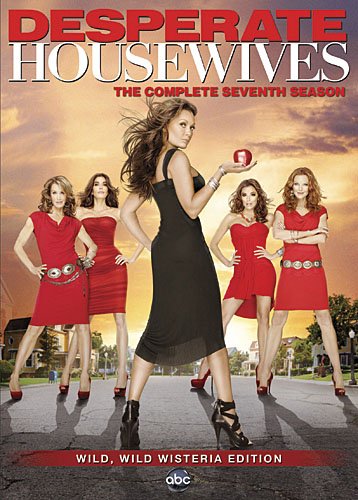
The residents of Wisteria Lane have become household staples in the last four years. Even after watching the show, I’m still not sure I understand what it’s about, but I’ll try to give my take on it anyway. It would appear to this reviewer that the show owes at least part of its genesis to the HBO hit Sex And The City. There is the same narrative angle, this time by a deceased member of the group. Still, that narrative contains many of the same kinds of observations as the HBO show and appears to imitate it as often as not. The show also deals with the exploits, often sexual, of a group of women. This time they are married, but that doesn’t seem to stop the flings, or at least the fantasies any. Finally, the best correlation between the two shows is how much both depended almost entirely on the personalities of the women themselves instead of any particular element of story or concept. Here the women are the concept. In the first season it appears young housewife Mary Alice (Strong) commits suicide. She now looks down (or up, I guess) on her neighbors, offering the commentary that is the show’s narration. At the end of each episode she offers some tidy little wrap-up, adding comments on how the lives of these women are evolving.

The plot is pretty much standard soap-opera fare. There are love triangles, diseases, and the typical complications you can find on any given weekday during the networks’ afternoon programs. Of course, here we have prime-time production values and a decidedly A cast of actors. It’s very likely that Desperate Housewives might have actually benefited from the writers’ strike, which reduced the run of episodes down to 17. The writers spent more time dealing with the characters and less trying to pretend they were creating compelling drama. Where the show works is in these quirky, almost black-comedy moments between the characters. Since there is no “story” to really speak of, I guess it’s more important that you meet the residents of Wisteria Lane. Susan (Hatcher) is married to Mike (Denton). She’s kind of an airhead and is the housewife most likely to be on the outside of a joke or reference. Her husband might or might not be a murderer. Perhaps denizens of the show have a better grasp of the 411 on that situation than I got. Susan was raising her daughter Julie (Bowen) on her own before she married Mike. Lynette (Huffman) was once a big-time corporate executive who is now raising four kids and is married to Tom (Savant) who also left corporate America and runs a pizza shop. They are also raising Tom’s daughter from a previous affair, who absolutely hates Lynette. Katherine (Delany) is the local “perfect housewife”; she’s a cooking champion and is a bit of a snob, refusing to share her lemon meringue pie recipe with anyone. She and gynecologist husband Adam (Fillion) are the newest residents of Wisteria Lane. Bree (Cross) is a rival to Katherine in all of this homemaking stuff, but it appears they learn to work together before the season ends. Bree is married to Orson (MacLachlan), who has had more than one ex-wife turn up dead. Unfortunately for Orson, it is the husbands that are expendable in this show. Last but certainly not least is Gabrielle (Parker). She’s obviously the best-looking of the group and acts like she knows it. Her husband is the town’s mayor, but she spends far more time with lover Carlos (Chavira). She has expensive tastes and wants to be pampered. Together these ladies go through guys and catfights like they were pitches at the All Star Game.

Alan Ball was pretty much an unknown to anyone but a few Hollywood insiders and fans of such television shows as Grace Under Fire and Cybill, where he wrote a mere total 10 episodes combined. When he began to shop the idea for American Beauty, he had originally conceived it as a stage production. Truth be told, he wasn't sure that there was a studio out there that would touch the awkward dark idea. But Dreamworks was still a young company with big ideas. If there was a studio out there that was going to take a flyer on a young talent with an oddball script, it was Dreamworks. Of course, they weren't going to take a very large flyer. The budget for the film was set at about $15 million. Not much even for 1999. The guys were willing to gamble. The gamble paid off.

The film didn't attract any of the established directors in the industry. I'm sure the budget had as much to do with that than anything else. Sam Mendes hadn't directed a feature film to this point. Actually, he hasn't directed all that many films in the decade since. With the small money and young, inexperienced director, this was looking more and more like an independent or festival film. But then something began to happen.

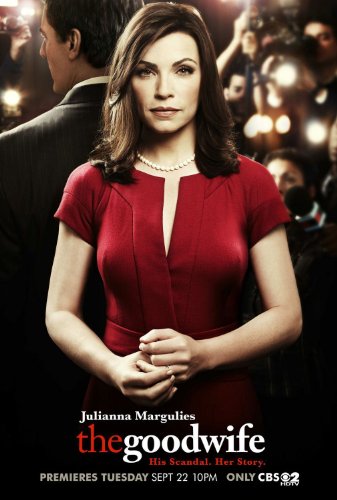
I've seen a ton of lawyer shows over the years. Pretty much any variation that's been tried, I've likely seen at least an episode. I generally like lawyer shows. I thought I'd seen pretty much everything in the genre until The Good Wife came to me from CBS Home Video. I was surprised that the series had somehow escaped my notice the last television season. I couldn't really find anyone who had seen even an episode of the freshman drama. It was time to give it a try. Turns out that there are still a few new tricks out there in the field, and The Good Wife has done a pretty good job of grabbing my attention, as it should yours.

The series is not really a lawyer procedural, at least not on the surface. The first images of the pilot lead us to believe we aren't getting a legal drama at all, but a political one. Chicago's State's Attorney Peter Florrick (Noth) is walking to a podium with a large anxious crowd of press with microphones and cameras flashing. He's clutching the hand of his wife Alicia (Margulies) as he approaches the buzzing audience. The event turns into a scene we've seen quite frequently of late. A politician must apologize for a sex scandal with his bewildered wife standing beside him trying to hide all of those feelings of anger and betrayal that you know she must be feeling. Florrick is resigning his office, admitting to indiscretions but denying reports of corruption that have apparently been looming over his administration. At first you are sure, in spite of the show's title, that this is Peter Florrick's story. It's not. From this point on the focus will be almost entirely upon Alicia.

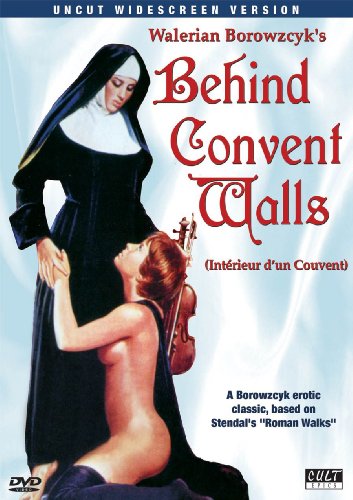
A nunsploitation box set was always an inevitability, and here the good people at Cult Epics chime in with just such a collection, one limited to 2500 copies. There are only two films here, but they are two good ones, the works of strong directors. One is a distinctively idiosyncratic work, showing the unmistakable hand of its filmmaker. The other will quite simply knock you out the back wall.

Behind Convent Walls is Walerian Borowczyk's contribution to the subgenre. A repressive abbess rules her convent with an iron fist (not to mention the blade concealed in her cane), but the sexuality of the nuns will not be repressed, and it will make its presence known, whether through rebellion or madness. The film defies any linear summary, given that it is almost impossible to tell the nuns apart, and the various incidents are not only disconnected, they take place with very little motivation or logic. Instead, we have a strikingly beautiful exercise in pure cinema. The Aurum Film Encyclopedia: Horror, on the subject of Borowczyk's Docteur Jekyll et les Femmes, notes, “Borowczyk's imagery, here fed by his fetishistic fascination with all things antiquarian, is often stunning and the film becomes a sort of still life in which familiar yet alien objects … seem imbued with a secret significance all their own.” Exactly the same is true for Behind Convent Walls. While nowhere near as powerful a film as The Beast, it is nonetheless well worth one's full attention.

Tennessee Williams was both a prolific writer and celebrated personality in his day. His plays are still making the rounds of community theaters and even more than a few higher- end performance halls around the country. Songs have been written about the guy, and he's quite honestly become a bit of a mythic legend over the years. A lot of that owes, in no small part, to his huge hit A Streetcar Named Desire. The 1947 play was a huge hit on its own. The thing even snagged a Pulitzer. There hadn't been a bigger play before it, and few have reached the popularity and classic status since. Then director Elia Kazan got his hands on the material. And while another writer worked on the screen adaptation, Kazan was smart enough to have Williams himself write the screenplay. A couple of things happened with that 1951 film. While this was actually his second screenplay, it would catapult him into the film and television side of life. His career ... and our screens … would never be the same.

A Streetcar Named Desire is still huge today. But is it the material from Williams or the amazing performances of Marlon Brando, Karl Malden, Kim Hunter, and Vivian Leigh that stand out after all of those years? Isn't it Kazan's inspired direction and his unique eye for cinematography that make the film so memorable? I guess the argument could be made for any of those things. Likely, it was the fortunate combination of these elements that made that film what it remains today. There's been a kind of rediscovery of Williams of late. There's also Hollywood's penchant for "lost" material. All of these things combined to bring actress and first-time feature director Jodie Markell and one of Williams' "lost" screenplays together for the 2010 Loss Of A Teardrop Diamond.

Shonda Rhimes had a big hit on her hands with Grey’s Anatomy, so after five years she did what comes naturally in her situation. You spin the success off in the hope that the fans can’t get enough in just one night. At first it appeared to me she had chosen the wrong character to put out on her own. I mean, I never considered Kate Walsh as Addison to be one of the show’s more compelling characters. The show was presented as what the business calls an imbedded episode on Grey’s. What that means is that the situation is set up during one of the original show’s episodes. In this case a two parter called The Other Side Of Life. The idea is that you want to be sure that your existing show’s fans at least watch the pilot in the hope that they will consider it a part of their beloved series. I got to watch that episode when I was called upon to review the fifth season of Grey’s.

Dr. Addison Montgomery (Walsh) is looking for a change. She’s feeling a little burned out in Seattle at Grace Memorial Hospital, where she carries a ton of baggage. She heads down to L.A. to visit a friend who has his own clinic in the sunny city. The clinic practices something called co-op medicine. Specialists from various fields come together to treat their patients in a more holistic manner. Dr. Naomi Bennett (McDonald), specializing in fertility, and her ex-husband Dr. Sam Bennett (Diggs) run the place. Dr. Violet Turner (Brennemen) is the clinic’s shrink. I guess you could call her a shrinking violet. Dr. Cooper Freedman (Adelstein) is the pediatrician. Dr. Peter Wilder (Daley) is the herbal medicine specialist. He’s also got a rep for sleeping with all of the other women and even running some out of the clinic. Dr. Charlotte King (Strickland) is a troubled soul who can’t sleep and has an apparent addiction to pills. Finally there is Dell (Lowell),the office assistant and “pretty boy”.

Grey’s Anatomy follows the life and tribulations of a group of doctors and interns at Seattle Grace Hospital. There’s certainly nothing original about the premise, except that the story is told by one of the more unlikely characters, Dr. Meredith Grey (Pompeo). As a lead she’s really not all that remarkable, but the show doesn’t put everything on her narrow shoulders. The series is populated by a solid supporting cast, giving it all a far more ensemble feel despite the title. James Pickens, Jr. is perhaps the most extraordinary actor in the show. He’s underused, but steals every scene he’s in. His Dr. Webber is a powerfully serious voice in an otherwise often frivolous world. Chandra Wilson as the intern teacher Dr. Baily is another standout performance, offering tremendous range. Her character, often referred to as a Nazi by her interns, is capable of outstanding empathy just when it’s required. Too many of the characters serve as eye candy, but I can’t say that any of them don’t have some good acting chops.

The 6th season at Seattle Grace is filled with the type of drama and stories you've come to expect. Jessica Capshaw becomes a regular as Arizona Robbins. T.R. Knight leaves the show, and it is a huge loss. As much as I was getting sick of the on-and-off-again relationship between his George character and Katherine Heigl's Izzie, they were both wonderful characters that I'm sure most of the fans will miss. Izzie is also gone but makes a few appearances throughout the season. The season begins with the two-hour event Good Mourning. It's the show's chance to deal with the loss of the George character. Perhaps the biggest change in the show isn't in the cast. Seattle Grace merges with long-time rival Mercy West, and it will bring a shake-up to how the hospital operates, if you'll excuse the pun. The staffs of the two hospitals will still be fierce rivals, only now they are working out of the same building. They'll be a lot of jockeying for position and to keep their jobs. There's another cross-over with Private Practice, bringing Addison back to Seattle Grace for another traumatic visit. Of course, it all ends with a two-hour finale that places yet another tragedy on the staff of the hospital. The show ends with a lot of action and destruction. We'll just have to wait for season 7 to see how it all plays out.

“Greed is Good.”

No other cinematic phrase described the 1980’s better. And no other movie captures the financial corruption of the 80’s better than Oliver Stone’s Wall Street.

When I saw the title for this movie my immediate thoughts went to that old Neil Diamond song of the same name. I don't know why, but I absolutely expected to hear it at some point in the film. So I actually found myself smiling a bit when the first guitar chords for the song began during the opening credits. I was a little disappointed to hear the song, but performed by the Man In Black, Johnny Cash. Not that I dislike Johnny. I just was expected something else. You know the feeling. Did you ever pick up someone else's drink by mistake and sip it, expecting it to be yours? It doesn't matter how much you might actually like what that someone was drinking. It completely throws you and tastes bad for a split second. Well, that's what happened with Solitary Man, the song and the film.

You see, the box art and studio buzz calls this film a sophisticated comedy. It's neither. It's actually quite good for what it is, but the studio's misrepresentation means that I was ready for something entirely different than what I got. That makes it so much harder to give a film a chance. I was all set to laugh. Instead I got a very moody and often dark character study. It took me a bit of a readjustment to finally begin to appreciate the movie for what it was. Michael Douglas can still deliver a solid character study. Here he takes a character that's almost impossible to like, and makes you enjoy it all the way.

“Ride into this world all alone. God takes your soul. You're on your own.
The crow flies straight, a perfect line on the devil's back until you die.
Gotta look this life in the eye”.

When these guys send a message, they don’t use Western Union. Not only will they blow up your warehouse, but they’ll catch one of your guys and plant a stick of dynamite in his butt cheeks to set off the explosion. That’s the world of the motorcycle club, the Sons Of Anarchy. In the wake of The Shield, FX stays true to form with the latest from that show’s alumni Kurt Sutter. Sons Of Anarchy has a familiar tone and quality to it for fans of that now gone cop drama. There’s a lot of handheld camera stuff, and you have very similar themes.