Drama

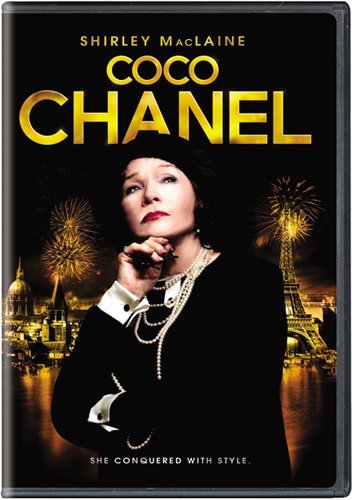
In 1954, Coco Chanel (Shirley MacLaine) unveils her first collection in 15 years. The reception is disastrous. As she struggles to bounce back from the fiasco, she flashes back over her life. The bulk of the film then follows the young Chanel (Barbora Bobulova) and her love affairs, first with a callow playboy (Sagamore Stévenin), then with the Englishman (Olivier Sitruk) who will be the great love of her life. Along the way, we see a little bit of her development as a fashion designer.

If you're sitting down for a soap opera in period dress, then you could certainly do worse. As silly as it often is, Coco Chanel is consistently entertaining. Its desire to worship its subject does mean for some unfortunate choices, however. Setting aside the fact that there is too little time spent on what made her one of the world's most famous designers, the film decides to pretend that nothing much happened to her between 1925 and 1954, when the most cursory Wikipeida search reveals all kinds of juicy incident (shacking up with a Nazi officer during occupation, espionage games, post-WWII arrest) that would have made for wonderful storytelling. Oh well. Malcolm McDowell is rather oddly cast as the older Chanel's confidant, and perhaps the fact that he has nothing much to do is the reason why he can't seem to get rid of that sneer of contempt, even when he supposed to be genuinely moved. Still, suds and all, its 139 minutes clips by quite efficiently.

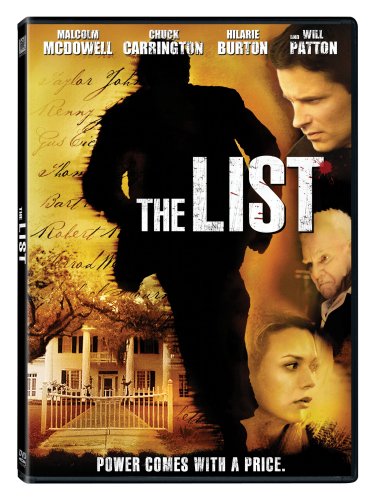
The List is adapted from a novel of the same name written by Robert Whitlow.  After returning home from his father’s funeral, Renny Jacobsen (Chuck Carrington) discovers he is the inheritor of his family’s seat in a secret society founded during the civil war.  However, Renny suspects the society’s activities are more troubling than they lead on and decides to examine them more closely.  When his inquiries are uncovered by the group’s leader (Malcolm McDowell) Renny becomes targeted by a mysterious force that has the power to destroy him and the people he holds close.


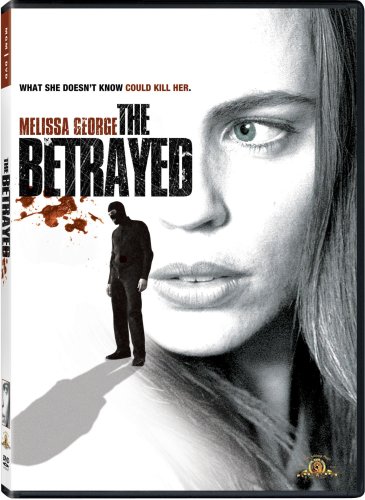
Jamie (George) has just been in a violent car accident that was really not an accident at all. She awakes to find herself prisoner in a dirty warehouse room. She discovers that she and her young son have been kidnapped, but her captors are not looking for ransom. Her husband has been secretly working for some pretty bad dudes, and he has squirreled away 44 million dollars of the bad guys’ money. Now they want it back. Jamie is given boxes of audio recordings that were made at her home and asked to break a code her hubby was using that might help identify where the money is. The promise is that she and her son will go free if the money is recovered. Unfortunately there is a deadline. Someone named Falco (Krige) is coming soon and will kill all of them if the money is not recovered.

The film is quite claustrophobic. It pretty much all takes place in the same small room. The entire film depends too much on the performances of the two leads. Melissa George does about as much as she can with the role. Her movements and range of emotions is pretty limited. Oded Fehr plays the kidnapper who interacts the most with Jamie. For some reason he does not list the credit on his official resume. It is also not included on his IMDB profile. I’m not sure if he was unhappy with the finished result or if it is merely an oversight. He does a pretty good job here, but half the time his face is covered, giving him even less to work with than George has. There are some good tension moments, to be sure. Still, I found the film didn’t move fast enough or supply enough stimulation to keep it from getting very tedious. It was a brave choice, to be sure, but never carried off as effectively as was needed to keep the film engaging.

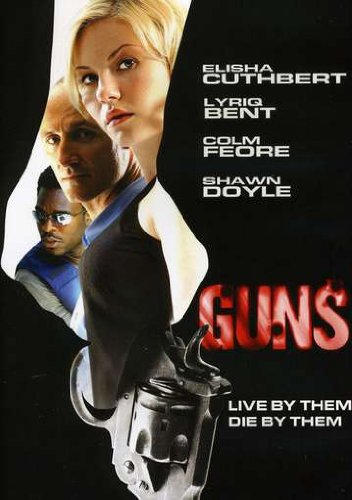
Guns is a Canadian TV mini-series that came to fruition in late 2008. The premise of the series is slightly convoluted.  Paul Duguid (Colm Feore) is a legitimate arms dealer that sells to governments around the world. However, Duguid also sells illegal weapons to gangs around Toronto as well. Duguid comes under police scrutiny when his son Bobby (Gregory Smith) goes to a street level gun dealer’s house that is under police surveillance.  Bobby also becomes implicated in the murder of the father of a U.S. Senator.  During all of these events, Bobby’s girlfriend Frances (Elisha Cuthbert) volunteers to smuggle guns across the border.  The multiple storylines on display here work well in a TV mini series.  However, when shown in 180 minutes on a DVD, they are difficult to appreciate.

“If you look closely, you’ll find that everything has a weak spot, where it can break….”

The same can be said for Fracture. There are plenty of flaws, and if you look hard enough you can find a lot of problems with everything from the story to the performances. Thankfully these flaws are quite minor and require the kind of scrutiny that would likely ruin almost any movie experience. I taught law for about 7 years and make it a bit of a (bad?) habit to look for the errors in court and legal procedures. I found plenty here, but they aren’t all that obvious or that detrimental to the plot. You’ll find errors in such trifles as chain of custody for evidence and the admissibility of certain types of testimony. If you’re a student of the law you’ll take note, as I did, and then hopefully move on. There’s too much compelling stuff here to allow yourself to miss out because of some rather common legal mistakes.

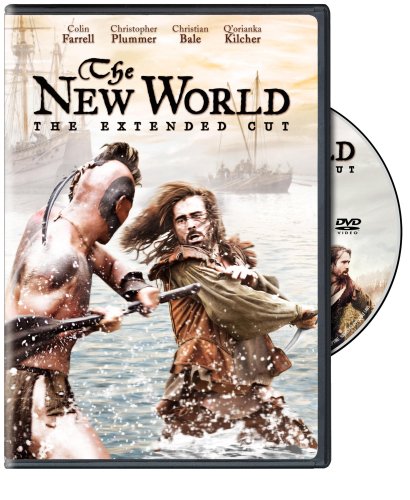
When Terence Malick's latest effort hit the theatres, he had trimmed it down to 135 minutes. Early critics had seen a version running 150 minutes. This version is longer yet, clocking it at 172 minutes. Most of what I said about the previous DVD release holds, and so I'm reproducing it here, with additional comments as necessary.

Virginia, 1607. English ships arrive and a colony is set up, but with considerable difficulty. Famine and disease take their toll. Captain John Smith (Colin Farrell) heads off to seek help from the Powhatan. He is captured, sentenced to death, but waved by Pocahontas (Q'orianka Kilcher, whose character is never actually given that name). So begins a fateful relationship.

How do you like your eggs? Scrambled or easy over? Hitchcock despised eggs and thought they were absolutely disgusting, to the point of intentionally mutilating a plate in many of his films. What about Easter Eggs? No, I’m not talking about hidden features in your latest DVD or Blu-ray release. I’m talking those colored hardboiled variety left by a furry bunny during the Easter season. When I was a kid they came in all sizes and varieties, and even though I really don’t like hardboiled eggs all that much I was a whiz at finding the things, and I’d hoard them as if I suspected an approaching Armageddon and these babies might be the only food left for thousands of miles. Now the Russians. They knew a little something about their eggs, particularly the last two reigning monarchs in the famed Romanov Dynasty. They had consigned Easter Eggs from the world renowned jeweler Carl Faberge. These eggs were extraordinary examples of luxury and excess. They were adorned in precious metals and rare gems and stones. Two of these eggs play a vital role in the latest release from Revolution and First Look Studio’s The Code.

Gabriel Martin (Banderas) is a thief. In the middle of his latest job he is approached by Keith Ripley (Freeman), yet another world renowned thief. Ripley needs a partner for his latest heist. He has a buyer for two Faberge Eggs that are previously unknown and worth an estimated $40 million. The eggs are kept in a high end security vault by the appropriately named Romanov Company. Gabriel is reluctant to do the job but is eventually persuaded to join the effort. He’s helped in no small part to join by meeting Ripley’s goddaughter, Alex (Mitchell). They have an immediate attraction, much to the displeasure of the all business Ripley. Together they mastermind the heist.

Released just in time for the global financial meltdown, this hymn to designer products features Isla Fisher, who demonstrated her comedic talent by stealing Wedding Crashers from both Vince Vaughn and Owen Wilson – no small achievement. Here she plays Rebecca Bloomwood, a compulsive shopper who, while hoping to land a job working at a fashion magazine, accidentally finds herself hired on a columnist at the sister publication, a rather less glamorous financial mag. Her columns, couching financial advice in shopping metaphors, become a surprising hit, and sparks begin to fly with her editor (Hugh Dancy). Meanwhile, a relentless debt collector is dogging her heels.


Combining Sex and the City voice-overs and clothes with Bridget Jones insecurities, the film sets out to be, I suppose, some sort of female fantasy. And sure, just as we are expected to buy Seth Rogen as a babe magnet in the male POV rom-coms, one can be fairly asked to do some heavy suspension of disbelief exercises when it comes to the match here, too. But why, as seems to be so often the case, are the female characters presented as ADD idiots? It becomes very hard to like Rebecca when, with her career (and quite possibly that of the man who is giving her a shot at the journalistic brass ring) hanging in the balance, she would rather rampage at a sample sale then do her work. Fisher throws herself into the part with enormous energy, but she is working with empty, predictable, numbing material.

“Do you believe in miracles?”

Al Michaels’ famous coda to the 1980 Olympic Hockey Championship Game provides the title of this Walt Disney film based on the incredible feat. I have to admit that I’ve never been a big fan of the Olympic games. I’ve more times than not been annoyed at how much television time is preempted, and it dominates the headlines for over 2 weeks each time the games are played. Still, it was hard not to feel a little excited about this particular game. As Americans, we love those underdog stories. Just look at our most popular sports films and you’ll find characters like Rocky Balboa crawling up from nothing to take on the world. The story gets even better when we, the Americans, are the underdogs. It’s a role we seldom really see ourselves in. Call it arrogance. Call it nationalism. Whatever name you give it, it’s a position we don’t consider to apply to us whether deservedly or not. Finally, the traditional kind of story is all the more powerful when it’s based on a true event, and one that many of us can still recall. Put the Disney imprint on such a tale and you have the makings of a truly remarkable film…except when you don’t.

When the second season of Lost hit the airwaves, expectations were very high. The show enjoyed a very successful first year in the ratings, and many of us were looking to see if the show would suffer the all too common sophomore slump. Lost exceeded our expectations. The show changed dramatically, yet managed to keep us hooked with the same blend of mystery and solid storytelling that made the show such a huge hit to begin with.