Horror

The Haunting of Sorority Row has one of those titles that, when you first hear it, you immediately make assumptions about. My initial assumption was that the movie might very well feature a house full of hot young girls in various stages of undress, acting all catty between pillow fights and being menaced by a supernatural entity of some kind. And then I looked down to the bottom of the dvd case and noted that this was produced by Lifetime. Wait, I thought, isn’t a horror movie by the Lifetime Network akin to Spike TV producing a Jane Austen film festival? Or Comedy Central hosting a David Cronenberg retrospective? Or Arts & Entertainment producing a reality show about a guy who traps raccoons….? Oh. Wait.

Never mind.

"Nobody thinks of it from the whale's point of you."

I think this is the very first film I've ever seen that was made in Iceland. Of course, Iceland isn't one of those movie-making meccas known throughout the world for their movie magic. The truth is, there haven't been too many films set in Iceland and even fewer shot on location there. Now that Harpoon has come along, I don't expect that is going to change any time soon.

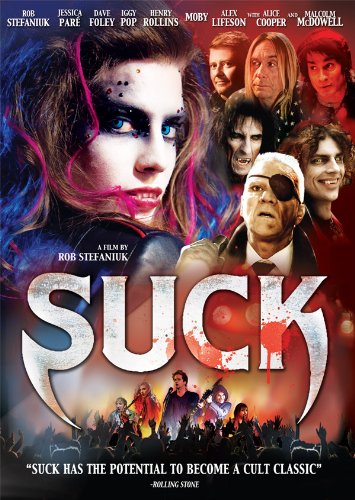
The Winners are anything but, being an undistinguished rock band playing to tiny, apathetic audiences in nowhere bars. Their time has not only passed, it never arrived. But just as they seem headed for the scrapheap, their bass player (Jessica Paré) is bitten by a vampire. Though her newly acquired taste for blood is a bit of an inconvenience, leading to some extremely messy murders to clean up, she now mesmerizes audiences, and the band catches fire. Leader Rob Stefaniuk is so desperate to catch a break that he is willing to turn a blind eye to just about anything. But complications loom, not least of which is Malcolm McDowell in full Van Helsing mode, heavily armed and sporting an eye patch.

Suck has the potential to become a cult classic,” reads the blurb from Rolling Stone, and that might well turn out to be the case. But Suck also rather desperately wants to be a cult classic, and that desire can stand in the way of its becoming the genuine article. It pulls all the right moves – black humour, full musical numbers, rock star cameos, outrageous gore, Malcolm McDowell – but those moves feel just a bit too self-conscious. The songs are rather bland, and the humour is hit and miss – though to its credit, when the film is funny, it is very funny (Iggy Pop's deadpan turn is one highlight). The flashback scenes of McDowell's traumatic first vampire encounter are very well done, cleverly incorporating repurposed footage of a young McDowell. In the end, while not everything works here, what does work, works well enough to make this worth a rental.

Written by Diane Tillis

Sociopathic serial killer James Bennett (played by Silas Weir Mitchell of Prison Break) has escaped a maximum security mental hospital after being incarcerated for nine years. Two FBI agents team up with a Federal Marshall to figure out where Bennett is heading next by investigating clues left behind in Bennett’s cell. They also turn to the mental hospital’s director Dr. Green (played by Gail O’Grady of Boston Legal) for insight into Bennett’s mind. What they don’t know is that Bennett’s first order of business is to return to his childhood home. Meanwhile six graduate students are traveling to Bennett’s childhood home for inspiration to finish their thesis. When Bennett arrives, the students begin to disappear one by one.

When Wes Craven delivered his first Nightmare On Elm Street film back in 1984, there wasn't much expectation for the film to do anything but deliver a little profit for the new independent studio New Line Cinema. The film did quite a bit better than that. It made the small studio into a player in the industry with the budget to make mainstream films that would have never been possible if not for Craven's little Nightmare. You could say that The Lord Of The Rings owes its very existence, at least in the form of the Peter Jackson films, to Freddy Krueger. Of course, the studio just couldn't help itself, and they continued to cash in on the franchise time after time. After the 7th film, it appeared that even the fans were about done with Freddy Krueger. A misguided attempt to pit Freddy against Friday The 13th's Jason might have pulled in good money at first. But the film ultimately disappointed, and a follow-up became very unlikely, indeed. But, like all good cinema monsters, you can't keep a good fiend down. A Nightmare On Elm Street joined the increasingly long line of horror films that received the remake/reboot/reimagining/regurgitation treatment.

A lot of the 70's and 80's slasher films have been remade by now. All of the big franchise names have been reborn. Michael Myers, Jason, Leatherface, and now Freddy Krueger have all been given the reanimation treatment. With most of these bad guys, there was little problem with replacing the man behind the mask. No one actor had played any of these characters exclusively throughout the franchise run. While Kane Hodder came closest with both Freddy and Leatherface, he was not the only performer under the hood for either monster. Freddy Krueger was different, however. In all of the Nightmare films of the original run, Robert Englund had been the only actor to play Freddy. There was an attempt to replace him in the early goings of the second film, but the filmmakers discovered rather quickly that you can't just put a stuntman in the makeup and turn him loose. Freddy had a personality that had become quite intermingled with that of Englund. So the very first question that had to be answered when the subject of a do-over came up was who was it going to be in the red and green sweater wielding that knife glove. Could anyone but Robert Englund make the part work?

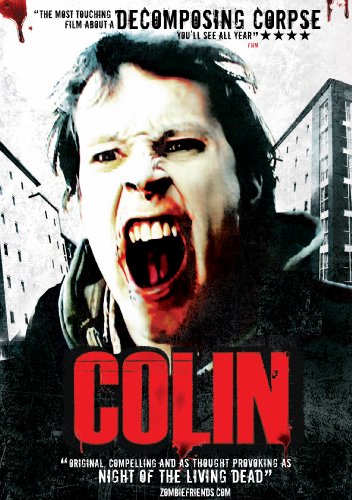
For me, I’ve never understood the fascination behind zombies unless it involves Milla Jovovich (See Resident Evil). They are undead, lumber around, make strange noises and have a primal urge to eat brains. So, admittedly I saw Colin in my review pile and mostly shrugged. Another zombie movie, *twirl finger*. However, after reading the back jacket, I realized this one had something more: it was told from the zombie’s point of view.

Colin (played by Alastair Kirton) walks into his house and closes the door. He calls for Damien, presumably his roommate. We hear gunshots in the background and a general ruckus. Colin walks over to the sink and starts to wash his hands. He notices a steady flow of blood down his arm. That’s when he pulls back his sleeve to reveal a massive wound.

Written by Diane Tillis

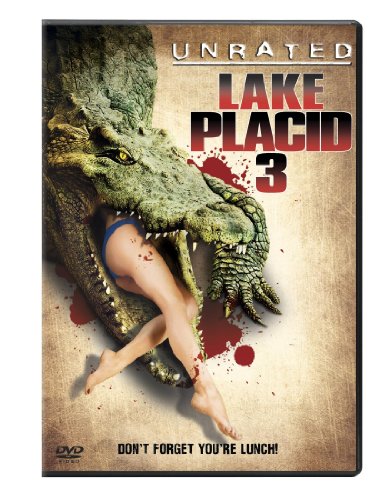
Lake Placid (1999) was a humorous film which played on our fears of animal attacks. It depicted a gigantic man-eating crocodile living in a lake near a rural town in Maine. The idea of crocodiles in Maine was a creative parallel to the alien-invasion scenario. The humans (park rangers, anthropologists, and wildlife experts) had to defeat the murderous alien (giant crocodile) before it destroyed the world (Maine). This concept continued in two direct-to-DVD films, Lake Placid 2 and Lake Placid 3.

Nicky Henson plays Tom, the leader of a hellraising biker gang known as the Living Dead. His goal is to make that moniker absolutely literal, and it helps that his mother (Beryl Reid) is a medium who has made some sort of Satanic pact, and the butler (George Sanders, in his final role just before his suicide) might well be an infernal power himself (his precise nature is never made clear). At any rate, all it takes to come back from the dead, apparently, is to kill oneself while firmly believing that one will return. Tom proves this formula to be correct, and soon almost all the other gang members follow suit. The one member who might hold out is his girlfriend Abby (Mary Larkin). Meanwhile, as the Living Dead embark on a reign of terror, will anyone be able to stop them?

This is a pretty odd duck of a film, and quite delightful for precisely that reason. In the first place, the Living Dead are hardly the most threatening biker gang ever to grace the silver screen, and though they do rack up quite the body count of policemen and civilians, many of their other bits of misbehaviour are not so much atrocities, but more in the line of shenanigans (as a fellow viewer aptly put it, the gang don't become flesh-eating zombies, only unkillable twits). The precise nature of Reid's motivation is never made clear, Abby is so whiny and callow that one is hard-pressed to feel any sympathy for her, and there's this strange preoccupation with the idea of the frog as an embodiment of evil. But these very oddities contribute to, rather than detract from, the film's off-kilter entertainment value. There's a wealth of incident, so the viewer is never bored, there are  some very fun chase scenes, and (which is a good thing) there is a rather knowing sense of humour about the whole affair. Definitely one of the odder horror films to emerge from England in the 1970s, and an engaging rediscovery.

Anyone who is looking for a direct sequel to the 2008 sleeper hit with Kiefer Sutherland or even a connection to the original Asian ghost film might tend to be disappointed in the direct-to-video Mirrors 2. This is absolutely one of those films where the name is used merely because of its franchise value, and the film's associations are mostly just a few familiar names. Add the same basic idea of a haunted mirror at the center of it all, and you pretty much have all of the connections this movie makes to either of the original projects. With that said, there is a bit more to like about Mirrors 2 than you might suspect on the surface.

This time it's Nick Stahl who plays a down-on-his-luck security guard at another branch of the Mayflower Department Store. He is Max, who has been dealing with a great deal of guilt of late. His fiancée was killed in an auto accident by a drunk driver. But Max was driving and wasn't paying attention to the road. He was playing a game of "find the ring" with his girlfriend when the tragedy occurred. As it turns out, Max's father (Katt) is the owner of the Mayflower Department Store, which is about to reopen its doors in New Orleans. The previous night watchman cut himself quite severely and quit his job, apparently going crazy during a night shift. Of course, we saw what really happened. It was an image in the main mirror that caused his injuries. The grand opening has been plagued with mishaps. Eleanor Reigns (Honore) has been missing for several weeks. Max discovers her spirit in the store mirror on his first night on the job. He also sees a vision of the store's executive buyer, Jenna (Romano) lose her head, literally. Later that night, he discovers that the woman really was decapitated by a shower door. He begins to see other prophetic images and decides something is seriously wrong here.

In June of 1987 many of us took to our local theaters to watch two future state governors tackle an alien creature in the jungles of southeast Asia. Director John McTiernan had combined the Rambo mercenary-styled film with that of a creature feature. The result was an impressive $60 million on a mere $15 million budget, and a franchise was born. From its first reveal in those Asian jungles, the Predator was an impressive sight. The creature was highly intelligent, to be sure, but it possessed those baser instincts of hunting and survival. It was a monster, but one who utilized advanced technological weaponry to accent its own fearsome brutal nature. It was the stuff that new nightmares would be made of. A sequel featuring Danny Glover and placing the creature in an urban setting soon followed. While that film is widely disregarded, I found it to be a rather good film. I still think it's an underrated monster movie.

It didn't take very long before the fan boys in Hollywood started getting their imaginations running wild. The inevitable question, since Frankenstein's Monster met up with The Wolfman -- who would win if we put the Predator against the Alien. It was a heavyweight fight just itching to play itself out at the box office. And, it did ... twice. The result might have destroyed both franchises. It seemed that these creatures had finally met their match, and it wasn't each other. Bad writing and wayward filmmaking brought down both creatures. It appeared as if they were both gone, forever.