Mature

Frankly, if you need any information beyond the title of this release, then it probably isn't for you. It's The Sinful Dwarf, man! But if you really must know more, be it on your head. Mind-bogglingly stupid and broke newlyweds Mary and Peter (Anne Sparrow and Tony Eades, actors of an ineptitude that passeth all understanding) check in to the boarding house of retired (and scarred) burlesque performer Lila Lash (Clara Keller) her son Olaf (children's show host Torben Bille), the titular sinful dwarf. Mary hears noises in the attic, but Peter won't listen to her. He should, as Lila and Olaf keep a harem of women up there as prostitutes, ensuring their submission through forced injections of heroin. Now they have their sights set on Mary...


Whatever you fear or hope about a film with this title, the reality will likely exceed your imagination. “Exploitation” is almost too tame a word to describe the spectacles here, whether we're talking about incessant close-ups of Bille's sweaty, greasy, drooling, leering face, or Keller's disturbing Marlene Dietrich impersonation. If you don't need a shower after watching this, you aren't human. In other words, it's sublime.

Welcome to 1972, when the sexual revolution is simultaneously in full swing, yet also showing signs of exhaustion (all that swinging can wear a body down, don’t you know). Barbi (Anna Biller) is a model housewife who is awakening to the feeling that there is a world outside her four walls. When she and her husband have a falling out, she hooks up with her more extroverted neighbour Sheila (Bridget Brno), who is also in the midst of a marriage crisis, and the two of them seek new love by taking work at an escort agency. What follows is a picaresque series of encounters, with nary a sexploitation angle ignored.

This film is a textbook definition of “labour of love.” Anna Biller no only stars, she directed, scripted, co-produced, edited, and took care of production and costume design. The latter took ages, since she wanted the costumes to match the decor, but the result was worth it – no small part of the film’s humour comes from its rigorous fidelity to the worst of seventies’ sense of aesthetics. Biller has recreated the classic sexploitation film down to the smallest detail. There are just enough winks to the audience to acknowledge the passage of time (and there is one address to the camera, describing the era as a fleeting utopia for the male of the species, that is as incisive as it is hilarious). The performances perfectly nail their models, capturing stilted, unnatural expressions and their forced enthusiasm. But no matter how much fun is poked at those bygone films, Viva also radiates an enormous love for them. As funny as the movie is, though, at 120 minutes, it is simply too long, and the pace is too measured. Lost of fun, all the same.

So there's this group of flight attendants, and we follow their swinging adventures and affairs on and off planes. One, for instance, hopes to be an actress, and hooks up with an advertising executive. And if you care what the plot of “the first 3D sex film” is, you need your head examined. Much of the what goes on  is mind-numbingly banal (SEE  Wine being poured  SEE  Drinks being mixed  HEAR  Dull conversations ), though the acid trip that leads one woman to make out with a lamp in the form of a greco-roman head is something you don't see every day.

The film is an object lesson on how far mere novelty can take a film – it was a huge success at the time, and 3D was, in 1969, a rarity again after its initial craze in the 50s. So there are numerous shots of legs and pool cues (and feet) jabbing at the camera, enough, presumably, to have kept audiences entertained while everything else remained mundane beyond words. Or, so the situation is for most of the running time. But the last act takes a sudden turn into the starkly dramatic, and becomes very dark indeed. It is also rather more imaginatively shot than most of the rest of the film. The ending is a vicious sucker punch that must be seen to be believed, and suggests that the filmmakers were storing all of their creative juices for the cruel finale. In fact, as the accompanying featurettes reveal, the dramatic plot was added to the film after the rest of it was completed, and indeed, after it had already been released in some markets. In the final analysis, this is a vital piece of low culture.

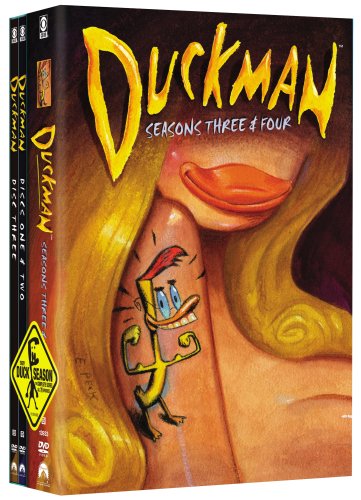
The series known as Duckman can be explained in one phrase. Guilty pleasure. The series ran on USA during the 90’s before they decided to re-brand themselves as something more serious. Though for some reason they still tend to show the dog show every year. Anyhow, as I remember it came on right before another guilty pleasure of mine from the 90’s, Rhonda Shear and Up All Night. I miss Rhonda deeply, plastic never looked so good. Heck Tupperware was jealous. Duckman was a series like no other; full of debauchery and indecency just like Grandma intended. Grandpa will never be the same. Paramount has brought us forty-eight episodes over seven discs to compose season 3 & season 4. One has to wonder if it will hold up after all of these years.

(*BTW, this review is written in inspiration to Duckman, so if you are easily offended by suggestive commentary and terrible jokes at the expense of others, then perhaps you might want to skip to a recent review of Petticoat Junction. However, if you read my weekly gaming column and are actually entertained enough to read my reviews, then you will be right at home. Enjoy!)

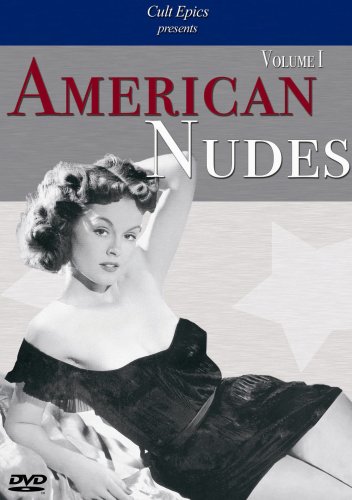
Cult Epics continues its erotic archival work with these two collections of short films. Volume 1 consists of pieces from the 1940s (with at least one from 1938 thrown in), while Volume 2 deals with the 50s. The former has such amusing “documentary” shorts as “They Wear No Clothes” (*gasp*) and various comedy routines. The latter has the inevitable Irving Klaw shorts. None of these films are by any definition “good,” but they are fascinating records of the state of American sexuality at that time. Watching all of these at one sitting would be quite the chore, but then, when was the last time you read an encyclopaedia straight through? There is a similar documentary value here.

Audio

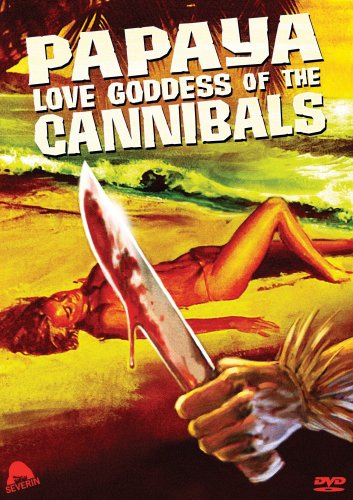
Severin continues their serious play to be the go-to company for Eurosleaze with this, one of Joe D’Amato’s better efforts. We first meet Papaya (Melissa Chimenti) as she luxuriates on the beach, makes love with a fellow in a cabana – and then orally castrates him, whereupon she walks away as two minions torch the cabana. Fantasy Island, this ain’t. The action then shifts to Sara (Sirpa Lane of The Beast fame), a journalist we first see revelling in a cock fight. She hooks up with Vincent (Maurice Poli), a nuclear power executive with whom she has had a casual fling before. The two of them are drawn into Papaya’s web of sex and blood ritual. She is, in fact, part of a political group fighting back against the power company’s expropriations and pollution by any means necessary.

Obviously, not your usual softcore romp, and a rather more interesting storyline than most of D’Amato’s Black Emanuelle series. The characters are still utterly without affect, which casts a vaguely surreal miasma over the proceedings. The sex scenes are pretty risible, but the film actually becomes quite watchable despite these scenes being its primary reason for being. D’Amato’s heightened interest turns up in the editing, in the careful creation of atmosphere, and most of all in the no-punches-pulled working out of the film’s ideas. Papaya raises, if rather clumsily, some hard questions about the nature of exoticism and the justifications for violence. Believe it or not, this is one to think about and discuss.

When The Ruins opens, it doesn’t look quite so promising. We’ve got two American couples sharing a vacation in Mexico. They’re reaching the end of their stay and are getting a tad bored with the sun and surf. Enter the foreign stranger who happens to have access to a secret archeological dig and invites the foursome along. Immediately I begin to suspect I’ve seen it all before. I figure the guy’s going to lead them to some isolated torture garden where sadistic maniacs will have their way with the tourists. As the stranger leads them further and further into the isolated jungles, my suspicions are getting that much stronger. When they arrive to find a Mayan pyramid, I’m starting to think that this just might be something different, after all. The group is greeted by some locals who don’t exactly roll out the welcome wagon. They kill the “red shirt” in the group, who we never really got to meet, and herd the group up to the plateau atop the temple. The locals surround the structure and appear unwilling to allow them to leave. At the top they discover the stranger’s brother, who was the one working the site, dead. They discover a shaft that goes deep into the heart of the structure, where they hear what sounds like a cell phone ringing. Attempts to reach the phone don’t go very well, and before long two of them are wounded. That’s when the fun starts. The vine is attracted to the blood and begins to invade the wounds. Before long it becomes clear that the locals weren’t herding them to attack them, but to quarantine them because they had touched the vine. The film allows for some clever moments as the survivors contend with the ancient creature.


There really was nothing like the Italian film industry in full exploitative steam. The Beast in Space is a perfect example of what I mean. From where else but Italy in 1980 could there emerge a low-rent rip-off of both Walerian Borowczyk’s high-end erotic epic The Beast and Star Wars? Even the poster somehow manages to conjure thoughts of both films. And the title shamelessly implies that it is some sort of sequel to the former. So what kind of alchemy do these elements produce?

Nothing particularly enticing, beyond its considerable value as demented trash novelty. The plot is a surprisingly convoluted bit of nonsense involving and expedition to a planet that has been producing far too much of a supposedly rare mineral. Meanwhile crew member Sirpa Lane (of The Beast) is having bad dreams about being ravished by some sort of satyr-like creature. None of this ever makes any sense, nor is the combination of gruesomely bad FX and costume design with gruesomely boring sex scenes particularly entertaining. But the release is still worthwhile, if only to prove that There Are Such Things.

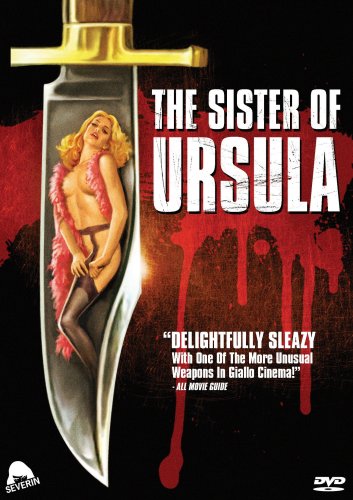
Still grieving over their father’s death, two sisters – the outgoing Dagmar (Stefania D’Amario) and the neurotic, antisocial Ursula (Barbara Magnolfi) – check into an out-of-season hotel. They are almost immediately immersed in a tangled web of relationships and betrayals involving the hotel manager, his estranged wife, a lounge singer and a drug-addicted patron. At the same time, a series of gruesome sex slayings gets underway.

Writer/director Enzo Milioni’s first film is a clumsy giallo. The elements are all there – psychosexual delerium, black-gloved killer, beautiful cast. So too is the aura of misogyny that haunts so much of the genre – the killings here all involve lethal penetration, and while the murders are generally dealt with relative restraint (a hilarious shadow of a looming erection followed by fade to black), there are, late in the film, a number of particularly tasteless shots of naked victims with bloody crotches. Charming. The ineptness of the filmmaking, however, robs these moments of much of their power: the sex scenes are dull and saddled with the same irritating score every time; the editing is rife with nonsensical cutaways (one of which unintentionally suggests that a dog has been masterminding a drug deal); and the story is so choppily told that characterization varies between the risible and the nonexistent. Add to this a resolution that even the most casual viewer of gialli will see coming a mile away, and you have a pretty weak entry. And yet, for all that, there is that delicious ineffable whiff of 70's Italian exploitation that makes even the weakest entries plenty of fun.

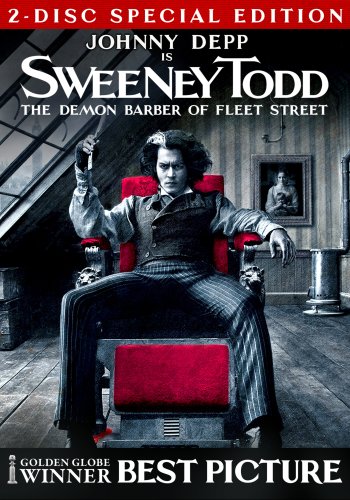
Tim Burton, Johnny Depp, Helena Bohnam Carter, and a 1970’s Broadway musical by Stephen Sondheim about a barber with a penchant for truly close, and rather bloody, shaves. With these kinds of ingredients you have a can’t miss recipe for Sweeney Todd, The Demon Barber Of Fleet Street. The finished product is a wickedly clever and most unusual movie experience. Tim Burton’s style blends so seamlessly with the dark humor of the original production. If I had any reservations going into the film it was the casting of Burton’s go to actors Depp and Carter. I had no doubt that either of them could pull off the roles. Depp particularly has become one of the finest actors of our time. His ability to own a part so completely never ceases to amaze me. I was more worried about the rather heavy singing load that the film required. Imagine my surprise to find that Depp was not only up to the task of providing the musical voice of Sweeney Todd, but he managed it with a remarkable amount of skill. His performance provided unexpected vocal nuance to the musical numbers, none of which are particularly easy melodies to sing. To a lesser extent Carter was also quite good in her singing performances. The Sondheim songs take on new life in the hands of Burton. His depiction of London in gothic splendor is vintage Burton. The foggy darkness of the night surrounds a cityscape utterly gritty and atmospheric. There is an almost Charles Dickens reality to the entire film that creates just enough believability to allow the artistic license that is so identified with Burton to become a wonderful playground for a talented group of performers.