Genre

"Do you believe in Sin?"

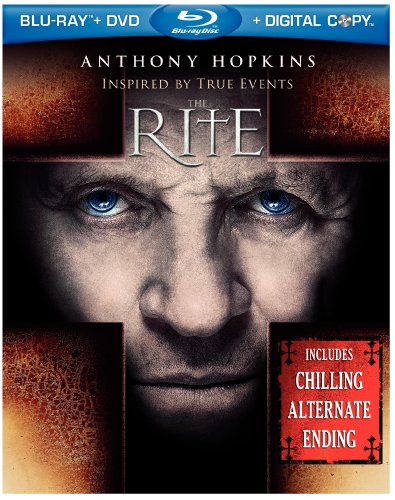
The Exorcist was one of the most chilling films ever made. William Friedkin used subliminal images as well as those quite famous scenes of Linda Blair being taken over by Satan himself. Ever since that time filmmakers have been trying to cash in on the phenomenon. Exorcism movies have become almost a sub-genre in the horror field. There have been everything from no-budget to mega-budget attempts. There have been both sequels and prequels to the original film. Some of these efforts have been truly worthy films with effective moments and compelling plots and performances. None have come close to the original film. The Rite is another attempt to create a modern version of The Exorcist. It's not a bad film at all, but it's not even close.

"The machines rose from the ashes of a nuclear fire. Their war to exterminate mankind had raged for decades, but the final battle would not be fought in the future. It would be fought here in our present... Tonight."

Where were you on Judgment Day?

The Usual Suspects is a most unusual movie, and in this case, that is a good thing. The Usual Suspects keeps you interested throughout its entirety by making you think and trying to figure out what will happen next. If only today's movies did the same thing!! As this has been one of my favorite movies of all time, the excitement I felt when I received this in the mail today could only be compared to a young child on Christmas morning.

A boat, thought to have $91 million in cocaine on board, is docked at a pier in San Pedro, near Los Angeles. Within seconds a thunderous explosion takes place. Soon after twenty-seven dead bodies are found at the scene. Miraculously, there are two survivors: a Hungarian gangster who clings to life in a local hospital and Roger “Verbal” Kint, a crippled con man from New York. As U.S. Customs Special Agent David Kujan conducts his grueling inquisition, Kint weaves a tale that begins six weeks earlier, at a police lock-up in New York. Five felons, accused of hijacking a truckload of gun parts in Queens, are brought in for a lineup. They are suspects. Strangers. With one thing in common: Keyser Soze — a criminal so feared and fabled. While an FBI sketch artist struggles to complete his rendering of Soze before the witness dies, Verbal Kint sits in the District Attorney's office, taking Kujan through the steps that led him there. The questioning is extensive. Agent Kujan is relentless and questions Kint for hours. In the end the surprise of all surprises takes place.

"The heat is on..."

Precocious teenage girls are movie mainstays for a few reasons. They tend to be cute, for starters. They give young audiences someone to identify with and perhaps envy, because the movie girls get to say and do things that would get their real-life admirers grounded at best, imprisoned at worst. We have our favorites, of course, going all the back to The Bad Seed, The Children’s Hour and the original Lolita. More recently, we’ve been perversely charmed by sexually manipulative antiheroines such as Christina Ricci in The Opposite of Sex, Maggie Gyllenhaal in Happy Endings, Mina Suvari in American Beauty and Ellen Page in Juno. These characters have little in common except that they were captivating on screen and well treated by their screenplays.

As often as not, the genre requires the young woman to be a fish out of water, perhaps relocated from a big town she likes to a small one she despises. Her story, like that of male counterparts in similar youth-market efforts, is designed to put the “coming” in “coming of age.” You know the bit: Sexual awakening is an awkward, confusing process fraught with physical and emotional peril. But there’s a fine line between useful familiarity and plain old cliché. Unfortunately, Daydream Nation can’t decide whether it wants to be radical, routine or ridiculous.

During the Korean War, a platoon led by Laurence Harvey and Frank Sinatra is captured and sent off to Manchuria. Here the men are brainwashed into believing that Harvey saved them all in an incredible feat of heroism (which he did not) and that he’s a loveable guy (which he isn’t).The unfortunate Harvey is programmed to become a remote-control assassin. Back in the States, Sinatra is plagued by nightmare memories of the experience, and gradually comes to believe that something … really did happen. The question is whether he and Harvey can solve the mystery and discover the target before Harvey is triggered.

The Manchurian Candidate accomplishes a spectacular balancing act. It is simultaneously one of the most intense suspense thrillers ever to emerge from Hollywood, and an absolutely corrosive satire. Said satire is all the more brilliant for savaging both the extreme right and the extreme left of the political spectrum. Also of note is Angela Lansbury’s ferocious performance as Harvey’s gorgon mother. Only 37, and but three years older than the man playing her son, she is utterly convincing, and a villain for the ages. Unquestionably, this is director John Frankenheimer’s masterpiece.

When I got to college, I had no idea what I wanted to be. I had signed up for computer science so I could go on to be a video game programmer. The truth is, I placed that as my major because I did not know what else to put. As luck would find it, five years later would get me a degree in Finance which I have never used in the professional world. But there was one thing in college I knew for sure. I wanted nothing to do with any fraternity and I am guessing Brotherhood is not going to change this opinion.

We start off the story with four frat guys in a van (if that van was down by a river, I’m out of here). Frank (played by Jon Foster), the pledge leader puts on a mask and runs out to rob a convenience store and comes back. He demonstrates that he wouldn’t ask the pledges to do anything he wouldn’t first. The other three are noticeably frightened because they think they will be arrested. Eventually one of the pledges decides to do it and when they hit the next store, he completes his task quickly.

"The two most infamous mass murderers battle for the top spot."

"You unlock this door with the key of imagination. Beyond it is another dimension— a dimension of sound, a dimension of sight, a dimension of mind. You're moving into a land of both shadow and substance, of things and ideas. You've just crossed over into the Twilight Zone."

In 1972 he made us an offer we couldn't refuse. A couple of years later he followed it up with one of the finest sequels in Hollywood's history. Of course, I'm talking about Francis Ford Coppola. His movies are often considered epics. When Coppola paints, he tends to paint big. But it wasn't always like that for the once young director. He learned his trade, oddly enough, from the master of the B movie, Roger Corman. It was there that he learned to do more with less. It was there under the tutelage of Corman that Coppola and Jack Hill gave us one of the most atmospheric films to come out of the B movie machine: Dementia 13. It was another one of Corman's attempts to squeeze everything he could out of his resources. Coppola was working, mostly as a sound designer, on Corman's The Wild Racers. He offered Coppola the remaining resources to crank out one of his quick specials. Coppola put together a quick script that was intended to capitalize on the Psycho craze of the time.  The result was a creepy film that might have been better than the feature the funds came from, at least horror fans think so.

Louise (Haloran) is arguing with her husband in a row boat when he has an inconvenient heart attack and dies. The inconvenience for him is quite obvious. For Louise it means she won't be getting her hands on any of his family's money when Mother (Dunne) finally kicks the bucket. So Louise develops a quick plan. She dumps hubby in the lake and arranges things so it looks like he had to leave suddenly for business in New York. Meanwhile, she'll stay with his family at their castle and estate in Ireland. But, things don't go as planned. The family is still mourning the death of Kathleen (Dowling) many years ago in a drowning incident. Each year they have a private little ceremony, and the event has shaped their very existence at Castle Haloran. There's also someone with an axe to grind, preferably in the heads of unlucky victims. Good old family Dr. Caleb (Magee) plays detective and has the pond where Kathleen died drained, revealing an even deeper mystery. Who killed Kathleen and now members of the Haloran clan and anyone else unlucky enough to be in the wrong place at the wrong time?