Posted in: Disc Reviews by David Annandale on April 5th, 2011
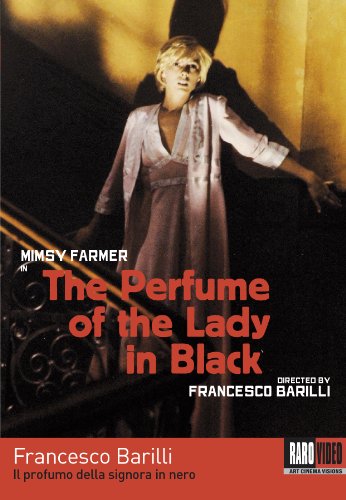
Three years after her unsettling turn in Dario Argento's Four Flies on Grey Velvet (1971), Mimsy Farmer headlined this giallo-related effort by director/co-writer Francesco Barilli. She plays a successful chemist on the verge of a psychotic break. She has been haunted since her childhood by the death of her father, and she has recurring memories (or are they fantasies?) of her mother in the arms of a sinister man. Her sense of reality crumbles as objects and people from her past appear and vanish. She retreats deeper and deeper into a paranoid shell. But just because you're paranoid doesn't mean they aren't out to get you, and there are signs that she may be the victim of a sinister conspiracy.
By the time Barilli's film reaches its admittedly chilling finale, it has ceased to make a lick of sense. This isn't necessarily a bad thing: many gialli (and related Italian horror films) follow a logic that belongs to dreams rather than the real world. But even as Barilli adopts a stately pace (all of the violence in the film is reserved for the last fifteen minutes), he also tries to do too much, as if he were trying to fuse Repulsion with The Wicker Man. The film's head-scratching aspects get in the way of the fist-in-the-gut denouement, or at least prevent it from having quite the impact it deserves. However, the film is handsomely shot, and the ending is sufficiently powerful that it will linger in the mind.
Posted in: Disc Reviews by Michael Durr on April 4th, 2011
I have been reviewing various discs for plenty of years now. As a rule, I’ve stayed away from most documentaries as I know that unless they involve video games, I will probably use them for a sleep aid. That is not to say I can’t enjoy them, I just know my track record. Then, I received the grand mother of all documentaries, The Civil War by Ken Burns with an anniversary edition to boot. Yep, this is going to be a long and bumpy ride, let’s hold on shall we?
“To understand our history is to understand the Civil War”, Shelby Foote (Writer and Historian).
Posted in: Disc Reviews by William O'Donnell on April 1st, 2011
Our Planet is a merging of a large handful of documentaries that originally aired on the History Channel. Here they are packaged together to thematically display the “Past, Present, and Future of Earth.”
HOW THE EARTH WAS MADE
Posted in: Disc Reviews by David Annandale on April 1st, 2011
One of the (many) reasons that Scream 3 was such a weak entry is that it tried to riff on the rules of trilogies, when, at the time of its release, there really weren't any horror film trilogies, with notable exception of the Omen series (and the not-so-notable exception of the trio kicked off by Captive Wild Woman in 1943). But the last few years have seen the completion of two horror trilogies, whose third parts were a very long time in coming. Dario Argento wrapped up his Three Mothers trilogy with the disappointing Mother of Tears in 2007. And now, hitting home video, is a primal roar that also happens to be José Mojica Marins' 2008 conclusion to his Coffin Joe saga.
Despite his enormous list of crimes and his total lack of repentance, Coffin Joe (Marins) is released from prison after serving a mere 40 years. Administrative bungling appears to lie behind his freedom – a hint of the vein of mordant humour that runs through the film. Met outside prison by his hunchbacked assistant Bruno (Rui Rezende), Joe is at first thrown by the 21st-Century metropolis he finds himself in, and Marins has some fun with the Gothic and wildly out-of-place Joe and Bruno stumbling along through the traffic. But things take a darker turn very quickly, once Joe is back in the slums, and embarks once more on his quest for the superior woman who will bear his son, and ensure the immortal continuity of his blood.
Posted in: Disc Reviews by Michael Durr on March 31st, 2011
There is a place in London of the United Kingdom that is down in the Royal Borough of Kensington and Chelsea that used to be the first Church of Christ. However, throughout the years the populace decreased that flowed into the church and it became a shell of its former self. Still a goregous location, in 2001 it became home to the Royal Philharmonic Orchestra. That building is called Cadogan Hall. Fast forward to 2009, a band called Marillion decided to play there which led to this 2011 release.
Marillion is classified as neo-progressive rock music. If you are not in the know, you might ask yourself, what the heck is neo-progressive rock music? Well according to what I could find, it is deeply emotional music with dramatic lyrics and an almost theater like quality on stage. One really won't see guitar and drum solos on the spur of a moment. They will be carefully staged with help from other instruments such as keyboards and percussion. If you are thinking of influences such as Genesis or Yes, you would be in the right area.
Posted in: Disc Reviews by Bob Ross on March 30th, 2011
A newspaper article infuriates the White House, which retaliates with all its political might to discredit the story, crush its author and cover up its own internal corruption. Sound familiar, like maybe All the President’s Men? If that’s among your favorite docudramas, then make room on the shelf for Fair Game, a real-life paranoid trip that unfolds across continents but finds its emotional center in a quiet suburban home.
There are striking similarities between the 1976 Redford-Hoffman classic and the inexplicably overlooked Fair Game. There are also major differences: The ’76 film exudes the idealism of its era, while the new one is steeped in the cynicism of modern media. The older movie is told from the viewpoint of hustling young reporters, while the one released this week on video comes through the eyes of a married couple -- respected officials whose careers collide in a cataclysm of government disinformation. Yeah, there’s another huge difference to point out: This time, the good guys don’t win.
Posted in: Disc Reviews by William O'Donnell on March 30th, 2011
The Nazis have been the subject of countless documentaries and films. On this occasion, The History Channel has decided to place the focus on the people of Germany, with a time line that starts at approximetaly the First World War and leads to the end of the Second World War. With the aid of newly discovered home videos gathered from Germany & Russia, we see a combination of German life during this time, as well as public and private views of Nazi discourse and planning.
There is one film hobbyist in particular who's home movies become the basis for a story within the story. This one family are typical of the German people, and their lives are documented as they, like many others, go from joy, to desperation, to a sense of empowerment, to denial, to horror as their nation is seized by Hitler and his enforcers. There have been many written accounts of what the people felt and experienced, in fact many biographies are quoted and/or use as narration script in this film, but it is all the more rare to have visual records outside of propaganda films or some news reels, especially of Nazi Germany. It is such rare glimpses that makes this film so special to behold and the history of it feel all the more real.
Posted in: Disc Reviews by Archive Authors on March 30th, 2011
Phoenix is having a rough night. Her scumbag ex boyfriend has just shown up in her apartment with a gunshot wound and a sack of stolen cocaine and her psychotic HIV positive prostitute sister has also shown up, having just shot a john in the face. Plus there are gangsters after the cocaine who will stop at nothing to get it back. Plus there’s her lesbian friend downstairs whose brother is involved on multiple levels and wants to drag her into a plot to steal and sell the cocaine. Plus it’s her birthday.
Phoenix is the central character in A Kiss of Chaos, the unfortunately titled offering from Maya Entertainment. She is played with sullen competence by Judy Marte and surrounded by a cast of “where do I know that dude from?” Latino actors in a basic drug/gangster/crime movie that is clearly aspiring to be more. For one, the character of Phoenix is supposed to be an artist of some kind. We know this because there are a couple of flashes of her on a stage in some kind of coffee shop, apparently reading entries from her diary, which, as her lesbian friend tells her, “sound like poems”. We must, however, take this on faith, since the only tidbit we hear is the enticing entry, “November seventh; I’m in love with the wind”. I’m serious.
Posted in: Disc Reviews by Gino Sassani on March 29th, 2011
All eyes are on Angelina Jolie; okay, so that's not much of a surprise, is it? But, I'm talking about the opening scenes of Jolie's partnership with Johnny Depp in the remake of the French spy thriller Anthony Zimmer, retitled for the American audience, The Tourist. Her character Elise is attracting a lot of attention from men hidden away in vans with surveillance equipment trained on her every move and from every angle. No, it's not the paparazzi this time. Elise is being followed because the intelligence community believes she will lead them to their real target, an elusive master criminal named Alex. Instead Elise merely receives a letter which she proceeds to burn and walk away. The agents swarm on the smoldering paper, convinced it's a message from Alex and a clue to his whereabouts. It seems he's gotten away with a ton of money, and sources say he has used some of those riches to alter his appearance, and Elise is the only clue they have left.
The note has instructed her to take a specific train and locate a random person that approximates his size. The idea is to convince the agents that the rube is Alex, thus distracting them from their true quarry whom she is to meet in Venice. On the train, Elise chooses math teacher Frank Tupelo (Depp) for the ruse. She develops an odd attraction for the man and invites him to stay with her in her lavish hotel suite. A series of mistaken identity gags gives Depp a chance to shine in the role, while Jolie offers the window dressing and emotional attachment for the team. Expect plenty of misdirection and red herrings.
Posted in: Disc Reviews by Gino Sassani on March 29th, 2011
"Jellystone Park, one of the nation's oldest and most beautiful stretches of wilderness. For years, families have headed out from the busy city eager to enjoy a little camping, fishing, and, of course, observing the park's natural wildlife..."
He's smarter than the average bear. Children and adults alike have been watching his adventures since 1959. Yogi and his young sidekick Boo Boo were one of the most popular of the Hanna-Barbera stable of talking animal characters that reached a peak of popularity on the Saturday morning cartoon shows of the 1960's and 1970's. The two brown bears lived in the fictional Jellystone Park, which is often considered to be intended as Yellowstone Park. Such real-life fixtures as Old Faithful appeared in the original cartoons. The park was kept in order by Ranger Smith, who was always frustrated by the plots and exploits of Yogi, particularly his obsession with acquiring pic-a-nic baskets. It sure beat foraging, and Yogi would go to incredible lengths just to snatch an unsuspecting camper’s lunch.