Posted in: Disc Reviews by Gino Sassani on February 12th, 2011
Character studies. They might be the most misunderstood movies in the business. Those who do understand them love them when they're done right. When the perfect balance of performance and direction create dynamic moments through character and to a lesser extent the story, we get pretty excited. I watched Stone recently, and I got pretty excited. But that's not the experience a lot of folks had. Perhaps because the film had a limited release in just over 100 theaters nationwide, the idea that it was an art-house or festival film might have put the mainstream folks off a bit. I would have thought that a cast that featured both Robert De Niro and Edward Norton would have more than compensated for the perception. Still, the film has not been treated very kindly by moviegoers and many critics. Again, I think that's because there are still a lot of people out there, critics included, who still don't understand the nature of a character study.
Jack (De Niro) works at a prison. He's a probation officer who must evaluate potential parolees for the parole board. His job is to sit with them and hold conversations akin to counseling sessions to get a feel for where their head is at. He makes his recommendation, and it carries a lot of weight, so he literally has these men's future in his hands. His wife (Conroy) is deeply religious, and the couple read from the Bible each night. The film's opening vignette reveals that Jack was a violent and unstable man in his youth and has obviously settled down. But now he appears to go through life numb. He's about to retire, and he's searching rather desperately for some meaning in his life. His worldview is about to be shaken with his final case.
Posted in: Disc Reviews by David Annandale on February 11th, 2011
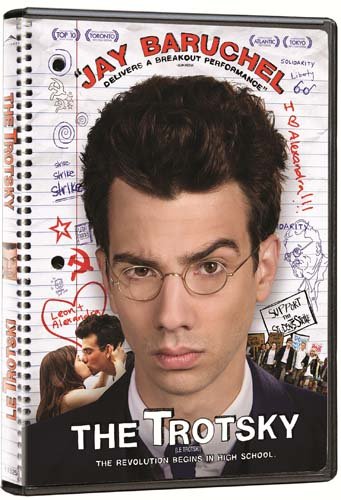
Leon Bronstein (Jay Baruchel, in a knockout performance) is convinced that he is the reincarnation of Leon Trotsky, and is determined to live out his life in the same way, right down to getting himself assassinated (“hopefully somewhere warm” his note appends). He also has only three years left to find Lenin, but in the meantime, his attempts to kick-start the revolution are meeting with little success. His struggle to unionize his father's factory manages only to embarrass and anger his father, who retaliates by removing him from private school and packing him off to a public one run by the tyrannical Colm Feore. Delighted to have worth enemy, Leon sets about mobilizing the student body, while trying to romance Alexandra (Emily Hampshire). Not only does she bear the name of Trotsky's first wife, the age gap between the two (she is almost ten years older) is the same. It must be destiny
This is enormous fun. Baruchel's Leon could easily be a figure of ridicule, and though he is funny, he is also possessed of such indomitable will and the desire to change the world for the better, not to mention a complete imperviousness to social humiliation, that it is impossible not to get behind him. Writer/director Jacob Tierney makes good use of his Montreal setting, adding the city's quirks to his characters', and the cast is engaging mix of new faces and veteran Canadian actors (Feore, Geneviève Bujold, Saul Rubinek). Sharp, witty, and unapologetically optimistic, this is about as feel-good as feel-good gets. And, as an added bonus, the film features the most hilarious riff on the Odessa Steps sequence from Battleship Potemkin I have ever seen.
Posted in: Disc Reviews by David Annandale on February 11th, 2011
Roger Greenberg (Ben Stiller) once was a musician, but now he is a carpenter and an inveterate writer of letters of complaint (to pet taxis, for instance, for not having a soft carpet for the paws of their passengers). After a stay at a mental institution, he arrives in LA to look after his brother's house and dog while the family is away in Vietnam. He reconnects with an old friend from his band days (Rhys Ifans, a long way from his manic energy in Notting Hill), and circles around a stop-start romance with personal aid and professional doormat Florence (Greta Gerwig).
Stiller's performance here reminds me of Adam Sandler's in Punch-Drunk Love. In both cases, we have actors known for embodying a particular comic type: Sandler is the raging man-child, while Stiller is the sensitive soul prone to social catastrophe. And in both films, we see the actors working with a distinctive auteur (P.T. Anderson, Noah Baumbach) on a low-key comedy that is very much a film of personal expression (to borrow a term from William Bayer). Finally, the borderline art-house trappings and new gravitas notwithstanding, they are still playing recognizable versions of what they've always done. It's just that what is a type of clown perfect for one form of comedy becomes a psychotic in the more realist version. At any rate, I find Stiller's same-yet-different performance very interesting, and very good, and that goes for the other performers too, especially Gerwig, who nails Florence's insecurities, naivete and strength. However, though I found the performances interesting, I didn't find the characters that interesting. Greenberg is thoroughly repellent, and that's fine, but he isn't compelling. I found myself unable to care about what he would do or say next (partly because I had a pretty good idea of what that would be), and wished that Florence were the protagonist instead. Though her self-destructive crush on Greenberg is as inexplicable as it is nonsensical, and so she too tries our patience, she has enough off-beat quirks and surprising resilience to make her worth following around. This is, then, a film that is finely wrought, written and acted, but that is also rather static and distancing.
Posted in: Disc Reviews by Archive Authors on February 10th, 2011
Charlie Babbitt (Tom Cruise) is a self-centered dealer in exotic cars. He imports high-end sports cars into the states and sells them to the highest bidder. Within the first 10 minutes, we learn that he is not above bribing the EP for the cars to pass emissions, that he treats his girlfriend poorly, and that his father has just passed away. As he goes to the reading of the will, hoping for a big payday, his father leaves him only a car. Charlie is furious to learn that more than $3 million in a trust account has gone to an anonymous person. Turns out the anonymous person is an institutionalized autistic savant named Raymond (Dustin Hoffman).
Since Raymond is a voluntary patient, Charlie organizes his discharge (for his own nefarious reasons) and the two set off on a journey to Los Angeles. Along the way, the cold and calloused Charlie warms up to Raymond, even as the autistic man has more and more difficulty in living life outside of the controlled environment of the institution. So it’s basically a road movie that tracks the change in character of Charlie from a money-hungry bastard to a caring individual. In the end, Charlie becomes less concerned with the potential money he can get from Raymond and more on the health and safety of Raymond himself. It’s a satisfying arc for Charlie. The film is widely credited as an insight into a condition (autism) that previous to 1988 wasn’t very well understood by the masses. The writing is strong, the directing excellent, and the acting top-tier.
Posted in: Disc Reviews by Michael Durr on February 9th, 2011
One of the most underappreciated films in my opinion in the last ten years is Undercover Brother. Stop looking at me strangely! Seriously, it was a very funny movie. It was because of one man and I don’t mean Neil Patrick Harris (though he was hilarious). That man would be Eddie Griffin. Eddie Griffin has starred in almost fifty different films but he also makes a respectable living doing stand up comedy. One such concert is new to dvd and we get the chance to talk about it my brother.
Live from Oakland, California, we have the star of Malcolm & Eddie, Deuce Bigelow, and Meteor Man (okay, some more than others), the one, the only Eddie Griffin. *waits for crowd applause*. Let’s find out what he has to talk about, shall we? The first thing out of Eddie Griffin’s mouth? Well, it would appear he wants to have his way with Michelle Obama, the president’s first lady.
Posted in: Disc Reviews by William O'Donnell on February 9th, 2011
In this satire of modern life, Zach Galifianakis plays a man named George Washington Winsterhammerman who has a beautiful wife, a large house, a stable job in the world's most successful corporation, and even a boat. Despite all of this he fears he is showing symptoms (which include dreams) that he might be about to literally explode, a mysterious and unexplained epidemic that is sweeping the country.
This film is jammed very obvious messages and metaphors for how we are living artificiality through celebrity advice books, pills, corporately controlled media and other suppressants for independent thought. The most apparent in the film is when George cannot please his wife sexually she religiously follows the daily advice of her favourite talk show host, dresses and eats just like her in order to change their lives around, and eventually tries to emulate her suicide, that occurred live on her show, when all else fails.
Posted in: Disc Reviews by Archive Authors on February 8th, 2011
Written by Diane Tillis
Posted in: Disc Reviews by Archive Authors on February 7th, 2011
Written by Diane Tillis
Posted in: Disc Reviews by Michael Durr on February 7th, 2011
Westerns are typically fun movies to review because they usually don’t deviate much from a basic formula. There is usually a criminal, and there is usually a good guy out there to shoot that varmint. Technically, that is all there is to it. Furthermore, the budget (unless big stars are involved) is small, making for some creative storytelling. Today, we get to review an Australian western: Red Hill. Let’s see if it differs from the typical American one.
We overlook a lush Australian landscape (aren’t they all this way?) and pause to look at some horses. Suddenly, there is a disturbance in the distance and the horses run. Dun dun dun. Scene shift. Shane Cooper (played by Ryan Kwanten) is up and getting ready for first day of work. His wife, Alice (yes…Alice Cooper, played by Claire van der Boom) who apparently got her Frankenstein fed, is very pregnant. They talk about his first day, and soon he goes off to work.
Posted in: Disc Reviews by Gino Sassani on February 7th, 2011
Simon Baker is riding high these days. Last year his new series, The Mentalist, was the highest ranked new drama of the year. That accomplishment got the show paired with CSI in that enviable Thursday night time slot. I’m amazed when I hear folks tell me how the actor appeared to come out of nowhere. A few film roles and he’s Mr. Television. Well, count me in with the small group that isn’t so surprised and saw him coming as far away as 2001 with a sleeper CBS series called The Guardian.
Baker played Nick Fallin, a talented young lawyer who just got busted for cocaine. Nick won’t see the inside of prison, however. His father, Burton (Coleman) is the senior partner at one of Pittsburgh’s most influential corporate law firms. Instead of jail, Nick is given five years probation and ordered to serve 1500 hours of community service. His court ordered assignment is Legal Services Of Pittsburgh, formally Children’s Legal Services. He’s placed under the charge of Alvin Masterson (Rosenberg), an idealist who set up the law clinic originally to speak for children who have no one else to do so. He’s resentful of Nick’s pampered lifestyle and at first wants to make the gig hard enough on him that he might ask to be assigned elsewhere. Eventually they warm to each other as Nick becomes more vested in the job than he thought he would be. Much of the show’s conflict is derived from Nick juggling these two worlds. He still has a duty as a shark attorney for his father’s firm, yet must find time to help these indigents and children that have come to the clinic for help.