Genre

One of the first books I read about the restaurant business was a title called Kitchen Confidential by Anthony Bourdain. He describes the people who work at restaurants to be a band of misfits, those who are probably only there because of an irrational dedication to cooking. That would certainly describe the people who work at the Slammin Salmon, the latest comedy from Broken Lizard group.

Rich Ferente (played by Kevin Heffernan) is a down on his luck waiter. After a bout with some very disrespectful customers, he comes to the back with a tuna patty forcefully stuck in his mouth. He gets yelled at by the floor manager Carl (played by Nat Faxon) which causes Rich to quit on the spot. However Rich has to tell the Champ that he has quit and you know what happened to the last guy who did that? Ultimately Rich chickens out and runs away. Fast forward a year.

Remakes are a fact of life. It might seem now more than ever that we are plagued with this reality, but it's been true for a very long time. It's not so new, as you might expect. Even the lauded Cecil B. Demille The Ten Commandments was a remake of his own silent 1923 film. They've existed almost as long as the movies themselves and will continue to exist for the foreseeable future. So, the question should be: Why should a particular film be remade? Often technology catches up with the content in a film. The ability to create on the screen something that was simply impossible originally is a legitimate reason to tackle an older film. Sometimes the movie is so powerful that it bears retelling for a new generation.

But then there are the reasons why a film should not be remade. There are some classics that simply should be off limits forever. Would anyone even dare attempt to remake The Godfather? There are those films that are just not worth being remade. How many versions of Piranha do we really need? Then there are the films that are remade in title only, like the 1999 version of The Thomas Crown Affair.

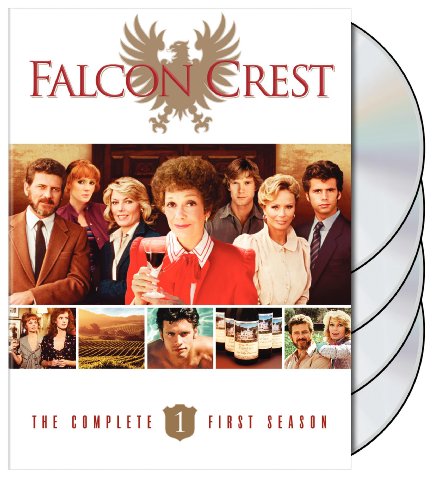
The Falcon Crest series ran 227 episodes from December of 1981 to May of 1990. The show’s creator, Earl Hamner actually worked on the Waltons and wanted to make a show about a family in the wine industry. However, when CBS got a hold of the series they wanted to make it more like rival show, Dallas. Translation: we want more smut and backstabbing. The show, Falcon Crest was born. I think John Boy would have been shot in the first season had he lived in Tuscany Valley. Good night indeed.

Emma Channing (played by Margaret Ladd) and her boyfriend, Turner Bates (played by Robert F. Lyons) are fooling around in the Falcon Crest winery. Apparently, Emma has never been with a man before, so there is much laughter and screaming. Her Uncle Jason (played by Harry Townes) overhears the racket and comes to investigate what is going on.

Nearly 10 years before Ben Stiller spent his first Night At The Museum with that eclectic cast of characters, The Relic brought us a much different kind of night at a museum. What comes to life here is anything but playful. There's nothing amusing about this nightmare in a museum. Peter Hyams might be more famous for several other action science fiction films, but none of his works before or since The Relic could claim to be quite so atmospheric. Together with the truly genius invention of creature creator extraordinaire Stan Winston, this is a movie that never quite took its earned spot in the tradition of effective horror or monster movies ... until now. For the first time in high definition thanks to this new Blu-ray release, I feel like I've seen The Relic for the first time. And, you know what? It's a pretty good film.

A cargo ship is found afloat in the middle of Lake Michigan shortly after a scientist has stowed aboard to prevent the delivery of a series of crates. The crates were the result of a Brazilian anthropology expedition for the Museum Of Natural History in Chicago. Now the ship appears deserted until Detective Vincent D'Agosta (Sizemore) boards her to investigate the disappearance of the crew and the bloody signs of a massacre throughout the ship. He makes a gruesome discovery. The crew was all mutilated by someone or something. D'Agosta believes this can only be the work of merciless drug cartel folks. That is, until a decapitation at the museum appears to have parallels to the attacks on the ship. His drug-smuggling theory will be put to the test in his search for the killer, apparently still trapped somewhere in the museum. The investigation is brought to a premature conclusion as city officials pressure him to allow a black tie fundraiser to go on that night. Anyone who's anyone will be there. He reluctantly agrees to green-light the affair, while he and his team attempt to find the killer and keep the patrons safe throughout the night.

Bud Abbott and Lou Costello began their career completely by accident. Bud Abbott had tried his hand at doing the straight man bit with limited success. One night in 1931 he was working as a cashier for a vaudeville company when Lou Costello's partner came down with an illness. The performer needed a stand-in, and Bud Abbott filled in for the night. It was a temporary gig, to be sure. A temporary gig that happened to last 25 years. The two continued to work together on stage. While the team certainly reused a ton of the classic routines of the era, there was something unique and clever about the duo. The natural way in which they fell into each other's lines was a rare sight, indeed. They eventually stood out for their ingenious word play, culminating in one of the most famous comic routines in history, Who's On First.

The pair next took their act to the airwaves -- radio airwaves, that is. They became a staple in the medium and eventually the highest paid performers in that industry. Films weren't really much of an option at first. They were still mostly silent, and while comedy thrived in that era, Abbott and Costello's brand of humor just would not have worked. But when sound became more economical and standard, the boys were thrown into the pictures. In 1940 they would star in a film called One Night In The Tropics. They would continue to make films for the next 14 years at an incredible pace. They made several films a year and were soon financing Universal studios with their output and box office income. Perhaps their most famous films were the monsters movies where Universal teamed their new moneymaker with the one before. In Abbott And Costello Meet Frankenstein, Bela Lugosi and Lon Chaney, Jr. would both reprise their famous Dracula and Wolf Man characters to the delight of fans of both franchises. Boris Karloff considered himself too old to don the heavy boots of the titular monster, which was played by Glenn Strange, who had performed the role in both House films. So he was still a legitimate part of the horror film cycle. The boys would get their chance to face Karloff later, not once, but twice.

Holy crap, this movie made a boat load of money for Fox when it came out around Christmas 2006, making $250 million and running second only to the Pirates of the Caribbean sequel for box office money. And to see Ben Stiller finally appear in a film that could be considered a blockbuster success was nice too. And in Night at the Museum, he gets to play Larry, night security guard in the New York Museum of Natural History.

Based on a book by Milan Trenc, the story contains man… of the same qualities of a Jumanji or even a Zathura. Larry takes over for a trio of retiring night guards (played by longtime veterans Dick Van Dyke, Mickey Rooney and Bill Cobbs) at the Museum. What he doesn’t know is that the inhabitants of the museum come to life at night, and he has to make sure that the inhabitants stay in said museum from sunset to sunrise, or else they turn into dust.

Ice Age – The Meltdown is a  funny, well-animated sequel that offers up a new adventure for the memorable characters from the original Ice Age film. As a great bonus, it’s nicely balanced for audiences young and old.

20th Century Fox Animation is still a poor second cousin to Disney’s Pixar Animation Studios, but for sheer entertainment value, Ice Age – The Meltdown doesn’t get knocked completely out of the water by top-shelf blockbusters like The Incredibles. Sure, the animation is weaker, and story is less inspired, but the voice work is excellent, with the talent of Ray Romano, John Leguizamo, Queen Latifah, Denis Leary, Jay Leno, and the list goes on.

"One … two… Freddy’s coming for you, three… four… better lock the door, five… six… grab your crucifix..."

Freddy might have been born in the mind of Wes Craven, but he grew and developed in the knife-wielding hands of Robert Englund. Granted, not all of these films are equal in quality, but the first was everything you could ask for in a horror/slasher film of the era. Freddy himself is by far the most colorful and animated of the slashers. His burned face, fedora, striped sweater, and knife-blade glove were all integral parts of the wise-cracking maniac.

I’ve often spent a lot of time talking about how Pixar has dominated computer animation, at least as far as full-length features go. With few exceptions, there isn’t anything out there that even comes close. Most films rely on toilet humor and crude innuendo to get a few laughs. A lot of the kids and adults might suck that stuff up, but they can’t hold a candle to Pixar. There are, as I’ve mentioned, some quite notable exceptions. The Fox Blue Sky Studios has had enormous success with their Ice Age films, and when you take a look at the third and latest entry in that franchise, you’ll understand why.

Ice Age came out in 2002 and took the box office like a blizzard piling up a drift of cash that amounted to almost $180 million before it was over. Not bad for a $50 million dollar film. Add in another $200 million in foreign receipts, and a sequel was an absolute forgone conclusion. The film introduced us to some memorable characters. Manny (Romano) was a lovable woolly mammoth. Diego (Leary) was a kind and wise saber-toothed tiger. Sid (Leguizamo) was their tagalong friend with not much going on in the noggin. A side story involved a prehistoric squirrel named Scrat who loved his acorns. He had a Wile E. Coyote/Roadrunner relationship with acorns and took a lot of punishment to get one. Together they tried to return a lost human infant to his tribe. In retrospect of two sequels, it's neat to look back to before these original core characters met for the first time.

"Imagine a world of incredible color and beauty. Of crabs wearing jellyfish for hats. Of fish disguised as frogs, stones, and shag carpets. Of a kaleidoscope of underwater life. Now go explore it."

Jim Carrey narrates this IMAX experience that takes you deep under the ocean. The film focuses on five particular locations: New Britain and Milne Bay (both in New Guinea), South Australia, the Great Barrier Reef, and Indonesia. Because this was filmed with IMAX equipment and presented here in high definition, you can expect a pretty spectacular ride on this one. Most of the animals shown here are obscure and rare, including plenty of cuttlefish segments and some really bizarre but striking sea dragons. The coral reef settings are extremely beautiful. It was originally presented in 3D during its IMAX run, but that version is not included here.