Posted in: Disc Reviews by Gino Sassani on June 14th, 2011
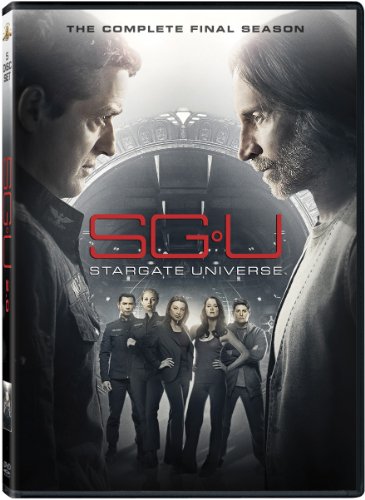
For ten years we watched Jack O'Neil, Samantha Carter, Dr. Daniel Jackson, and the Jaff'a Tealc' enter the Stargate. Others would join the team over the years. Each week we would follow their adventures, first on Showtime and finally on the Sci-Fi (now Sy Fy) Channel. We watched with awe as they stepped through a portal that was in reality a wormhole transporting them instantly to another world, brought online by dialing the device like an old-fashioned telephone. For another five years we traveled not only to another planet, but to the Pegasus Galaxy itself to the Atlantis Base, a bright floating city left behind by the ancients, the people who created the Stargate system millions of years before. On this show we met new friends, new bad guys, and had new adventures. The location might have changed. The faces might have, at first, been unfamiliar, but the missions and the entertainment value didn't let us down. For 15 seasons we enjoyed a spectacular tale to rival the myths of the Greeks and Romans themselves.
I'm told that all good things must come to an end. When Atlantis was finally cancelled, I was made almost immediately aware of the plans to continue the franchise. First reports started coming out that the show was going to be called Stargate Universe. Soon my inside contacts started giving me tidbits about the story. Details began to emerge about the Destiny, an ancient ship abandoned in another universe far away. The ship was on some kind of predetermined course and would sport an unsuspecting crew of humans that would be left stranded on the ship for an indeterminate amount of time. It was starting to sound a lot like Star Trek: Voyager to me. Of course, this is Stargate, so there has to be some gate travel, one would assume. The ship would come with a gate, and the vessel would come out of faster-than-light travel from time to time and dial up a local planet for exploration. The ship was ancient not only in its origin but in its duration in space. There were going to be a lot of system failures, as the equipment was long past its expiration date. The ship itself would know what resources it needed to continue to operate. Searching its vast planetary database, the ship would locate planets with the essential resources, allowing away teams to get such vital raw materials. Unfortunately, the ship didn't always give a good indication of what to find or where on the planet it might happen to be. Oh, and did I mention the countdown? The ship would decide how much time it would allot for each mission, instituting a countdown. When the clock reaches zero, the ship goes back to FTL, and whoever's not back in time gets left behind.
Posted in: Disc Reviews by Gino Sassani on June 8th, 2011
"Since the birth of time, humanity has endeavored to restrict evil men in prisons. But since Cain fled the murder of his brother, evil men have fled the walls of punishment. So it doesn't matter if you're a badass mother on the run because you think you're better than everyone else and somehow entitled to do what you gotta do. No, because you see, badass mothers are never fast enough. In the end, they will be accounted for."
People have been breaking out of Hell since the days of Dante. In recent years we've had two very good television shows on the subject. Brimstone suffered an early death but was a wonderful character piece with John Glover as the Devil and Peter Horton as a cop and resident of Hell he uses to track down his escapees. Reaper took a more comedic route and had Ray Wise as Satan utilizing the efforts of Jack Black clone Tyler Labine helping out damned soul Bret Harrison to bring in the escaped. Enter Nicolas Cage in the underachieving action film Drive Angry.
Posted in: Disc Reviews by Gino Sassani on June 8th, 2011
One of the best signs that a film is a disaster is when the movie's own star can't seem to stop telling the world just how terrible it really is. Mickey Rourke at first had nice things to say about the film and particularly Megan Fox, calling her the best young actress he knew. Later he backtracked and qualified the statement about Fox. But his rantings about the film Passion Play have not been softened at all. He calls the film "Terrible" and a "Train wreck" while trying to assure us that he still loves director Mitch Glazer. We'd ask Mickey himself to write the review for the film here at Upcomingdiscs, but we tend to try and remain family friendly, and he's not above dropping a few F bombs to make his point. I guess the job of evaluating this rather strange film falls to me, %$@(&.
Okay, I guess we'll start with one of the most ridiculous stories I've ever seen made into a movie. Meet Nate (Rourke). He's a washed-up trumpet player who used to be pretty well known. Now he plays in nightclubs owned by mobsters for small change, small change he likely as not turns into booze. Unfortunately, Nate couldn't help but sleep with the boss's wife. Now Happy (Murray) wants him dead. A couple of his thugs take him out to the middle of the desert for an old-school hit. Nate is miraculously saved by a strange group of white ninjas. He wanders the desert and stumbles into a sideshow where he sees Lily (Fox), a woman with bird's wings. When he finds out they're real, he breaks her out of the control of the abusive carnie and falls in love with her. But not before he sells her out to Happy in an attempt to trade her for his own life. Of course, he regrets the decision and wants to save Lily from Happy's clutches, but she doesn't necessarily want his help. You know, because of the whole betrayal thing. The ending leaves a few questions, but I'm not sure the answers are worth thinking much about. Mickey's right. This is a train wreck. Couldn't have said it better myself.
Posted in: Disc Reviews by Gino Sassani on May 20th, 2011
"The machines rose from the ashes of a nuclear fire. Their war to exterminate mankind had raged for decades, but the final battle would not be fought in the future. It would be fought here in our present... Tonight."
Where were you on Judgment Day?
Posted in: Disc Reviews by Gino Sassani on May 17th, 2011
"You unlock this door with the key of imagination. Beyond it is another dimension— a dimension of sound, a dimension of sight, a dimension of mind. You're moving into a land of both shadow and substance, of things and ideas. You've just crossed over into the Twilight Zone."
Posted in: Disc Reviews by William O'Donnell on May 11th, 2011
Lesser know than the Loch Ness Monster, Chupacabra and many other crypotzoilogical monsters is the Mongolian Death Worm. This SyFy production gives the mythological beast the Tremors “graboid” treatment and makes them desert prowling beasts with extending tongues/second mouths. Being compared to Tremors is a high summit to reach., as this film is outclassed by that film in all aspects.
Things are shaky right off the hop. The opening title has the same size and font as the text used to detail the characters' location, making it seem as if Mongolian Death Worm is the name of the setting. Such things are not monumental problems, but there are enough of these lofty mistake to mark sloppy composition and lack of care by the filmmakers.
Posted in: Disc Reviews by Gino Sassani on April 20th, 2011
"So far every person I've met in this strange place suffers from the most florid delusions, chasing green mists and looking for lost lords. I can only assume that this is the result of poor diet, or they're all just barking mad."
C.S. Lewis created an incredibly imaginative world when he wrote his Chronicles Of Narnia. The stories were an escape, of sorts, from a war-torn Europe. They integrated elements of Christianity in an effort to provide a semblance of hope in the form of a children’s fairy tale. And like all such tales, the world of Narnia was first and foremost a place of magic and bewilderment. It was a place where fantastic creatures of both good and evil thrived, living out epic lives of adventure. It was also a world where only children could enter. The stories became hugely popular, first in England, and eventually around the globe. Since that time we live in a different planet than the one Lewis was attempting to offer a respite from. Still, the images and ideals are remarkably relevant today. With such sweeping grand adventures and marvelous creatures, it’s no surprise that the franchise has found its way into films. The only real mystery is why it took so long. Perhaps it was necessary for the technology to finally catch up, providing a far more realistic and captivating experience. Some credit must also go to the enormous success of the Harry Potter and even the Lord Of The Rings films. With the investment of time and money required to bring such a world into existence on celluloid, there must be some reasonable assurance that, if done correctly, there was a large enough profit to be found. These earlier, and continuing, franchises have overwhelmingly proven that point. It was only a matter of time before the studio that practically invented movie magic would find such a place as Narnia and claim it for their own. When you combine these extraordinary histories together, can there be any question as to the results?
Posted in: Disc Reviews by Gino Sassani on April 6th, 2011
"We all know the story. Virginal girl, pure and sweet, trapped in the body of a swan. She desires freedom, but only true love can break the spell. Her wish is nearly granted in the form of a prince, but before he can declare his love, her lustful twin, the Black Swan, tricks and seduces him. Devastated, the White Swan leaps off a cliff, killing herself, and in death finds freedom."
Darren Aronofsky made a huge name for himself with The Wrestler. That film was a great comeback for Mickey Rourke, who was ripped off at that year's Oscars by the more politically correct Sean Penn. Aronofsky considers The Black Swan to be a companion piece to that film. You will certainly be able to see what he's talking about, but he's missing one important element in this film. He doesn't get near the powerful performance out of Natalie Portman that he did from Rourke. She was also nominated for an Oscar, but unlike Rourke, she didn't deserve to win it. She didn't.
Posted in: Disc Reviews by Gino Sassani on April 6th, 2011
If you are old enough to have seen the original Tron back in 1982, you know how much things have changed in the digital world since then. The block graphics of the film and subsequent game might have been state-of-the-art at the time, but it looks like something very primitive to the younger generation. Like all good science fiction, many of the incredible elements of the film have become quite commonplace. The idea that a person can be scanned by a laser and transported into a virtual world might still be out of reach, but it turns out that using lasers to scan objects is exactly how we get three-dimensional images of real-world items into the virtual world. When Flynn is communicating with his program, the program is represented by an image of Flynn himself. Today we'd call Clu an avatar, and it's become quite common for people to socialize in environments like Second Life, where their avatar representatives engage in the same kinds of activities we do in the real world.
Tron wasn't quite the huge box office film you might have expected. It did pull in about $5 million on its opening weekend, which was pretty respectable in 1982. The film ended its box office run with just under $40 million from a $17 million budget. That's not where Tron found its biggest success. The film became more popular as the years went by and some of the content was getting more and more like reality. The game became a classic and is still found in the occasional arcade. That was another trend started by the film. It was one of the first films to spawn a video game, something almost every big-budget genre film does as a matter of course today. The movie was a milestone in computer-generated images combined with animation. It took nearly 30 years, but it really isn't a surprise that Tron has finally gotten a sequel. It's been a commanding presence for years at ComicCon. It's the little big movie that wouldn't die.
Posted in: Disc Reviews by Archive Authors on March 9th, 2011
I must admit, I came at The Storm Warriors with very little knowledge of its creators, the Pang brothers, but as someone who appreciates Asian cinema, I felt that I had the sensibilities to enjoy the film. The movie deals with a Japanese invasion of China by a dread warlord named Lord Godless. As the film opens, we learn from an almost impossible to follow title sequence, he has captured China’s mightiest heroes and is preparing to execute them. Being invincible, Lord Godless is almost assured of victory, unless two of the aforementioned Chinese heroes, Wind and Cloud, can combine their power to defeat him and his army.
We learn all this and much more in the first two minutes of the movie.