Special Edition

Synopsis

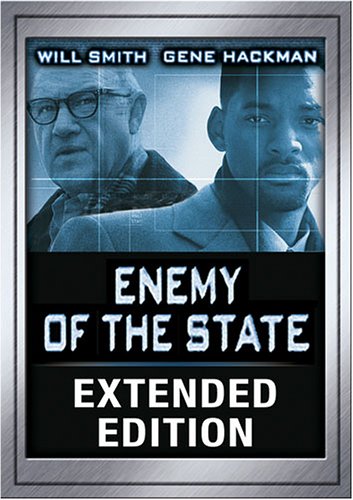
Jon Voight is a rogue director in the National Security Agency. When politician Jason Robards stands in the way of dangerous bill that would give the NSA almost unlimited powers, Voight has him killed. The murder is captured on tape, and a disc containing the incriminating evidence winds up in the hands of attorney Will Smith. The next thing he knows, his life is turned upside down as Voight sends high-tech minions after him. He seeks the help of retired surveillance whiz Gene Hackman.

While V For Vendetta certainly met with some backlash when it was released in theaters earlier this year, having now seen the film myself, I am shocked that it didn't meet with even more opposition; especially from the White House. Of course, if the White House had come out against the film, it would not only have spurred greater ticket sales, but it also would have placed the government in the position of the film's villain. To speak out against this film would be to be to speak out against basic American values.

Set in the near future, this film tells the story of V, a terrorist that rallies against an unjust government. He is something of a modern-day Che Guevara, except he bases himself on a 17th century activist named Guy Fawkes, who was foiled in an attempt to destroy the English Parliament. Among other acts of terror, V plans to succeed where Fawkes failed.

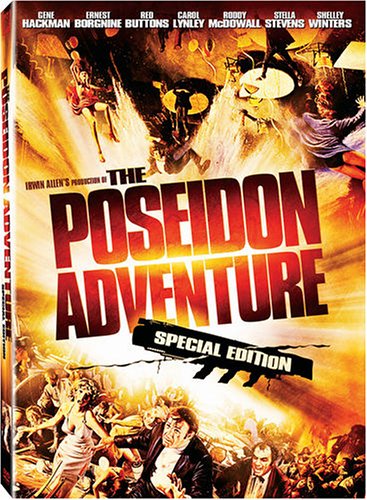
God bless producer Irwin Allen for aiming high in just about everything he did. He would make large scale productions, some focused on disasters (like his next film after this, The Towering Inferno), but he also produced Lost in Space for TV and made other contributions like Voyage to the Bottom of the Sea and an incarnation of The Lost World. He may not have had a DeMille-like grip on his project because the studios had so much control still in the early '70s, but he sure dreamt big, which is always a good thing.

In The Poseidon Adventure, based on the novel from Paul Gallico, the S.S. Poseidon has set sail and its cast and crew will be celebrating New Year's Eve on the water. When captain Leslie Nielsen (Airplane!) receives a notice about a tidal wave from an earthquake, he prepares for the worst. The wave hits the ship and turns it over, and it leaves a handful of passengers left to try and reach the water's surface before the ship sinks. Among those are Reverend Frank Scott (Gene Hackman, fresh off The French Connection), Mike and Linda Rongo (Ernest Borgnine (From Here to Eternity) and Stella Stevens (The Ballad of Cable Hogue), respectively), Belle and Manny Rosen (Shelly Winters, (Lolita) and Jack Albertson (Willy Wonka and the Chocolate Factory), respectively, Acres (Roddy MacDowall, Planet of the Apes) James Martin (Red Buttons, The Longest Day) and Susan Shelby (Pamela Sue Martin, Dynasty).

Sometimes, I get a bit of an impulse buying urge. And a while back, I went and got a spiffy Philips 727 DVD player (which I've since replaced with a Toshiba upconverting unit). Sure, it's not a higher end player or anything, but for $80 and a hack using the remote control, it's now become a decent multi-region player. So after testing out a friends borrowed Region 2 disc to see if the hack worked, I picked up a couple of movies from eBay and Amazon.UK, so I'll do the occasional Region 2 review.

For whatever reason, there are instances where the US gets yanked by the shorthairs with the occasional DVD release. If you were going to buy this movie, would you want the release that just has an anamorphic transfer and 5.1 soundtrack? Or would you want the one that has the anamorphic transfer and 5.1, along with two commentaries, as well as a 2nd disc of short films, deleted scenes and documentaries? So that's what I did. And my wife, bless her heart, is patient with me through all of this. She even watched this with me over the weekend and liked it. I've still got the bruises on my arm from where she squeezed hard.

Synopsis

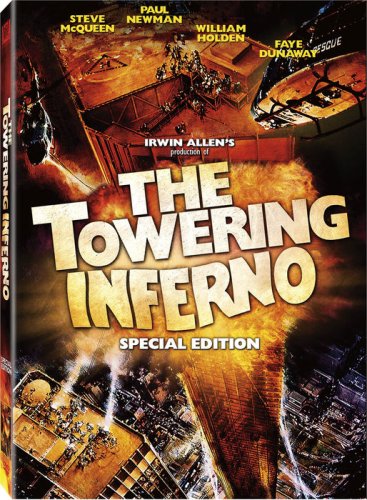
The Who’s Who of San Francisco is gathering for the grand opening of the Glass Tower, the world’s tallest building. The architect, Paul Newman, is disturbed by what appear to be corners cut in the electrical installations by Richard Chamberlain, and sure enough, a fire starts on the 81st floor. Fire Chief Steve McQueen is soon on the scene, but the situation deteriorates rapidly, and hundreds of celebrants on the top floor are at risk of fiery death.

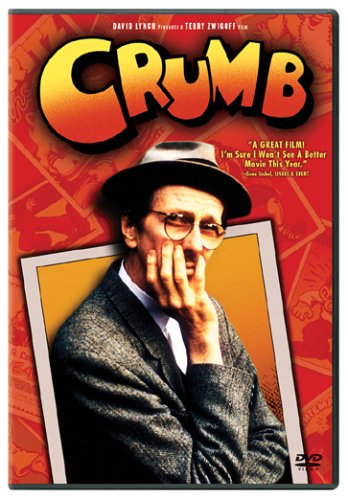
Say what you want about Robert Crumb, and his controversial cartoon funnies, but at least he’s found a healthy way of expressing not-so-healthy ideas – more than what can be said for his brothers, Maxon and Charles. Sony’s classic documentary Crumb (directed by Terry Zwigoff) demonstrates this in a beautifully ugly piece of filmmaking, now available in a new special edition to celebrate (albeit, a bit late) the film’s tenth anniversary. Maxon is the “molester” of the Crumb kids, and I say that hoping it’s an e...aggeration, but knowing somehow, deep-down, he’s probably been on his share of sex offender lists. Charles, if not for his appearance in this documentary (and role in Robert’s life), might as well not exist. He sits at home and bathes sporadically (but never often enough – you can almost smell the guy as he sits there with a pompous grin and green teeth), and he never leaves the house to get a job, seek out a slice of personal happiness, or add any value to society. The brothers of Robert Crumb are, indeed, losers, and the only things preventing Robert from sharing their fate is his talent for drawing, and for using said talent to carve out a better niche in life. Still, he, too, is guilty of hypocrisy, not necessarily in his work, but in his personal thoughts and opinions. He bemoans the commercial aspects of our society. He makes rushes to judgment about large groups of people, based solely on the kind of clothes they wear, yet his own views do little else besides espousing hostility towards women and presenting other races in unflattering lights (even if that isn’t his intended purpose). He can lay claim to all the liberal social ideas he wants, but if an African-American read his strip “Angelfood,” and had immediate access to Crumb’s throat, he or she would be ringing it emphatically (and would be just in so doing).

I am unsure of Zwigoff’s intentions in his presentation of Crumb – is this guy supposed to be a visionary artistic hero, or a mealy-mouthed little pervert with better ways of expressing it than Max? What I managed to draw from Crumb is that the case can be made for both. Make no mistake – I did not like this man. I’m more inclined to believe the pervert aspect of him than the hero. Still, I find his artistic style pleasing to the eye, and I enjoyed this examination of his work very much. He may not be a model citizen, and his move to France, which takes center stage in the final act, can only mean good things for our country, but he’s an interesting chap, and he makes for interesting viewing during the solid two-hour running time. I also found the extensive discussions among the three brothers very fitting to the film’s overall purpose – to dissect a legendary artist and his work. See, the brothers play such a huge part in shaping what this central figure becomes that, without them, there is no film – and subsequently, no Robert Crumb. Overall, this is a great piece of documentary filmmaking, which represents the difference between those that dream, and those that make their dreams come true. But the more obvious message – at least, to me – through the dichotomy of the Crumb siblings’ personalities, is how a degenerate doesn’t have to be a human slug, too. And that’s how Robert differs from his brothers.

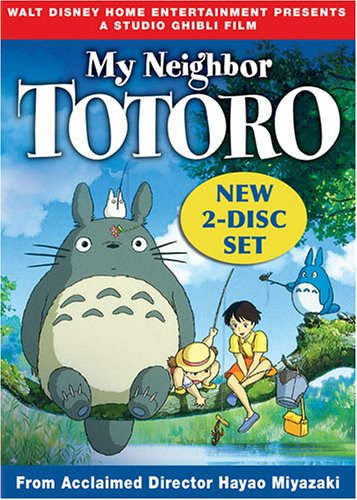
It’s rather stunning to discover that My Neighbor Totoro was made way back in 1988, long before the days of CG and all automatic illustration. And perhaps that animation does detract from the overall experience from the film, but if that’s the only reason that it would be a problem, then people simply need to get their taste in order.

In another film from legendary Japanese film director Hayao Miyazaki (who made the Oscar-winning film Spirited Away), the film follows sisters Mei and Satsuki, w...o move with their father to the countryside, to spend more time with their mother. They do some exploring and encounter Totoro, a mystical being in the woods that can only be seen by children. Totoro helps the children experience a world of wonder that they never would have previously seen.

Synopsis

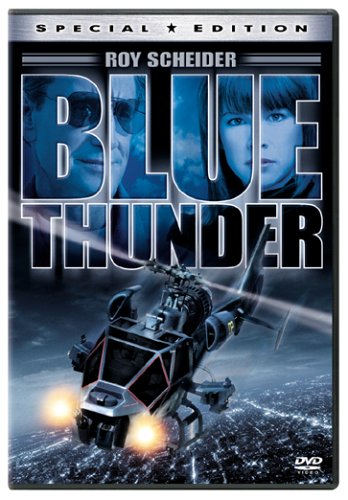
Roy Scheider is the police helicopter pilot and Vietnam war vet (cue flashbacks) who is tapped to test Blue Thunder, a new helicopter equipped with every conceivable weapon and means of surveillance. He discovers that the machine is at the heart of a conspiracy to undermine all that is good and free, and chief bad guy here is Malcolm McDowell, for whom Scheider has a more than cordial dislike thanks to what happened back in 'Nam. The stage is set for high-tech showdown in the skies over LA..../p>

Synopsis

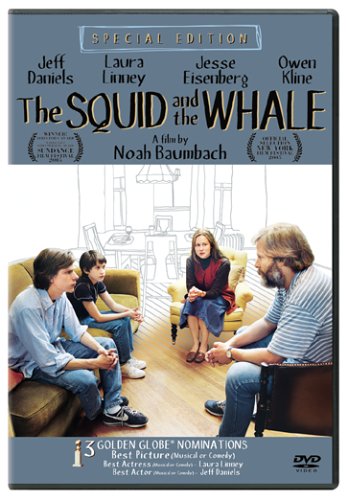
We begin with an ending: the final collapse of the marriage between Jeff Daniels and Laura Linney. He is a formerly renowned author who now can’t get himself arrested, let alone published. She is suddenly coming in to her own as a writer. He is pathologically self-obsessed. She is deeply insecure. Together, they spell bad news for their two sons, 16-year-old Jesse Eisenberg and 12-year-old Owen Kline. Both parents are a bit of a mess, but daddy is easily the worst offender, and is an absolut...ly poisonous influence on Eisenberg, who worships his father and viciously blames his mother for the split-up. What follows is primarily Eisenberg’s coming of age, where he must learn to see both of his parents (and, for that matter, himself) with real honesty.

Synopsis

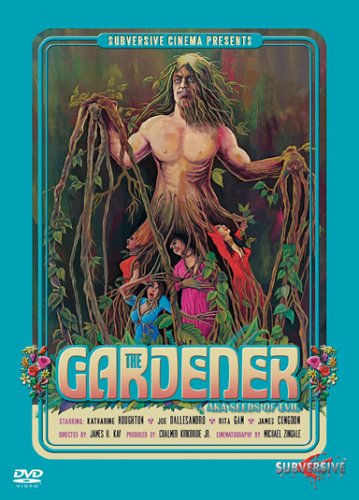
After the mysterious death of his former employer, perpetually shirtless gardener Joe Dallesandro is taken on by the rich and rather twitty Katherine Houghton. He works wonders with her garden, wonders so miraculous, in fact, that the rest of her staff becomes very suspicious. Unfortunately, Houghton is falling more and more deeply under the gardener’s mesmeric spell, and anyone who stands in his way runs into strange botanical fates.