Special Category

Synopsis

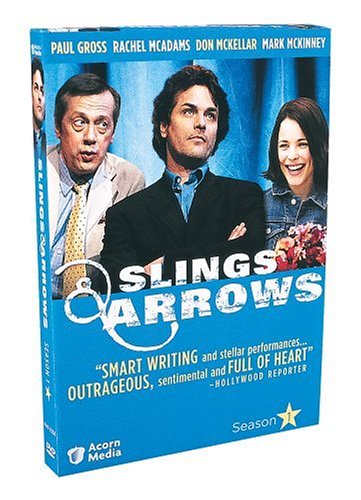
Paul Gross plays Geoffrey Tennant, a once celebrated actor who had a meltdown during a performance of Hamlet. Now he’s trying to mount The Tempest at the head of a broke company about to be evicted from its premises. Meanwhile, his former mentor, Oliver Welles, has just mounted a dispiriting version of A Midsummer Night’s Dream at the New Burbage Theatre, and very shortly thereafter dies. Tennant is brought in as the new artistic director, and his attempts to stage Ha...let are troubled by the ghost of Tennant, a lunatic director, scheming suits and difficult actors.

Synopsis

Paul Gross plays Geoffrey Tennant, a once celebrated actor who had a meltdown during a performance of Hamlet. Now he’s trying to mount The Tempest at the head of a broke company about to be evicted from its premises. Meanwhile, his former mentor, Oliver Welles, has just mounted a dispiriting version of A Midsummer Night’s Dream at the New Burbage Theatre, and very shortly thereafter dies. Tennant is brought in as the new artistic director, and his attempts to stage Ha...let are troubled by the ghost of Tennant, a lunatic director, scheming suits and difficult actors.

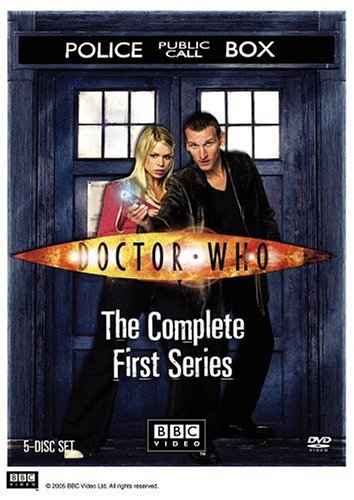
Doctor Who is much more of a cultural phenomenon in the UK than it is here in the States. In fact, the series about a time traveler who fights evil is very much on par with the Star Trek series in North America in terms of its rabid cult following. The original series ran for a staggering 26-seasons on the BBC before finally fading away. The show has become one of the most popular Science Fiction programs of all time.

In 2003, the dead show was brought back as a new series, following the same ba...ic storyline as the original. The Doctor in question is actually an alien who fights evil with the aid of his rickety and unreliable time machine, which is cleverly disguised as a British police box. Though such boxes have become a bit rare in today's society (in much the same way as the common pay telephone has disappeared in the U.S.), the boxes are still fairly inconspicuous, which allows the good Doctor to leave the machine sitting about without too much interference from the general public.

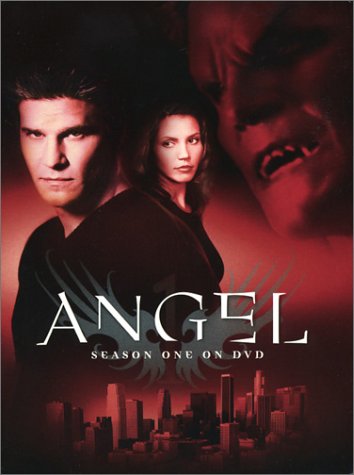
David Boreanaz is better known as the guy who played Sarah Michelle Gellar�s love interest in Buffy the Vampire Slayer for the first three seasons of its existence. Being used sparingly in some parts and shining in his occasional showcase episodes, helped convince Buffy creator Joss Whedon and producer David Greenwalt to give the guy his own spin-off series. And by having the Buffy writers and directors pull some double duty in the beginning before gently phasing in some new creative influences, it's grown into a spin-off show that, in its fourth season now, arguably gives Buffy a run for its dramatic money. Since Angel was a semi-regular on Buffy but was mysterious, it was safe to assume that more things have to be explained for the show to work. The supporting characters had to be given some more depth as well. Buffy cast regulars were brought in for the occasional show, even two, depending on the storyline. Even Faith was brought in as part of two very episodes late in the season that finally gave Buffy and Angel some long-awaited closure.

Initially, the only character that went straight from Buffy to Angel was Cordelia (Charisma Carpenter), but Wesley (Alexis Denisof) became a mid-season addition who was later included in the regular cast. A couple of new characters were introduced in the mix. Kate Lockley (Elisabeth Rohm) was brought in as a Los Angeles detective who really didn't provide much in substance outside from showing up to provide Angel information for cases he was pursuing. Although she did find out about Angel's vampire past which was a nice twist on things.There were a couple of episodes that were done to give her some depth also, and her main conflict was with her father who was also a recently retired LA cop, and the hot and cold relationship the two shared, until his killing by a demon late in the season. Another character named Gunn (J. August Richards) was added in the last 3 episodes of the season, and subsequently became part of the permanent cast just in time for the start of Season 2. Alan Francis Doyle (the late Glenn Quinn) started on the first episode as a half-demon that received visions of people in assistance, which helped Angel in helping people out each week. He was a bit of a mystery in the beginning, until we later find out more about his past (he was married briefly) and his feelings for Cordelia, while having reservations about telling her about his demon side. Sadly, Doyle was killed off of the show in the middle part of the first season, and transferred the power of the visions to Cordelia for future episodes. The recurring protagonist in the show is a legal firm named Wolfram and Hart, a firm that even "Johnnie Cochran wouldn't join", and with mind readers, shamans, and other forces helping them in their pursuit of evil in LA, they seem like the perfect group to have hatred for.

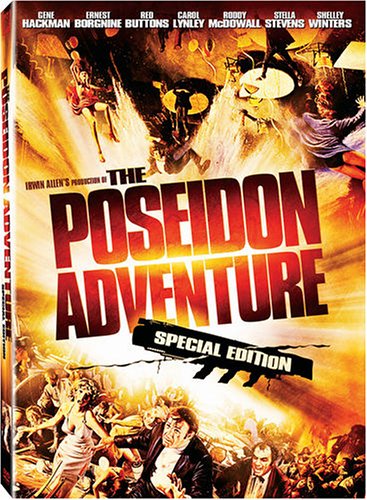
God bless producer Irwin Allen for aiming high in just about everything he did. He would make large scale productions, some focused on disasters (like his next film after this, The Towering Inferno), but he also produced Lost in Space for TV and made other contributions like Voyage to the Bottom of the Sea and an incarnation of The Lost World. He may not have had a DeMille-like grip on his project because the studios had so much control still in the early '70s, but he sure dreamt big, which is always a good thing.

In The Poseidon Adventure, based on the novel from Paul Gallico, the S.S. Poseidon has set sail and its cast and crew will be celebrating New Year's Eve on the water. When captain Leslie Nielsen (Airplane!) receives a notice about a tidal wave from an earthquake, he prepares for the worst. The wave hits the ship and turns it over, and it leaves a handful of passengers left to try and reach the water's surface before the ship sinks. Among those are Reverend Frank Scott (Gene Hackman, fresh off The French Connection), Mike and Linda Rongo (Ernest Borgnine (From Here to Eternity) and Stella Stevens (The Ballad of Cable Hogue), respectively), Belle and Manny Rosen (Shelly Winters, (Lolita) and Jack Albertson (Willy Wonka and the Chocolate Factory), respectively, Acres (Roddy MacDowall, Planet of the Apes) James Martin (Red Buttons, The Longest Day) and Susan Shelby (Pamela Sue Martin, Dynasty).

Synopsis

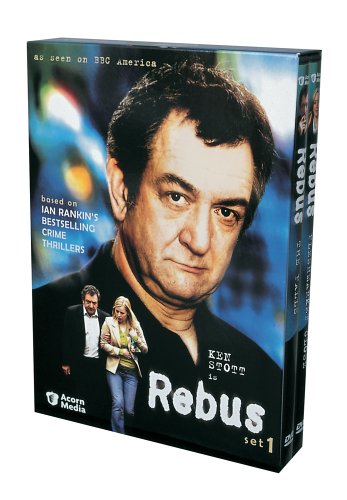
Ken Stott plays Inspector John Rebus. Working in Edinburgh, Rebus is dogged in his pursuit of the truth, no matter how many years it might be buried. He’s not one to stand on ceremony, doesn’t suffer fools at all, never mind gladly, and is curiously successful in romancing younger women. The two mysteries here, The Falls and Fleshmarket Close take place in very different settings: the former delves into the secrets of the very wealthy, the latter takes place in a high-rise proj...ct.

Synopsis

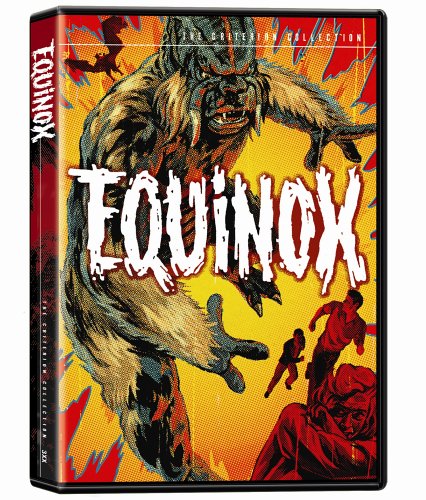
Four teens hit the wilderness, looking for a Professor Waterman (celebrated SF/fantasy/horror writer Fritz Leiber in a non-speaking role). The professor is missing, but they find an ancient time that turns out to provide the secrets of life, death, and the demons beyond. Said demons want the book back, and our heroes are attacked by one monster after another.

I’m a lucky guy. I was able to witness the game of baseball before we all became so jaded. While I wasn’t born early enough to have enjoyed Mantle, The Babe, or Joltin’ Joe, I was fortunate enough to watch the likes of Mike Schmidt. Mike stayed 18 years with one team. He never held out and was always responsible in his public persona. Oh, and he ended up being considered the best 3rd baseman of all time in nearly every millennium poll conducted. It is this experience growing up with Schmitty and his like that make these stories feel much closer to home than younger kids are likely to feel. Now we live in the days of juiced hitters, felony convictions, contract holdouts, and almost no player continuity with any team. These films bring hope. After the Black Sox scandal that nearly ruined America’s Pastime, it took players like these to return the game to the glory and most of all the honor from which it had fallen so far. These films make me long for the next generation of greatness. I can tell you they aren’t playing on any field today, but I grew up rooting for the Phillies. In the 1970’s there was a team blitz of the slogan “I believe”. If I learned anything at all it was how to hold on to hope. “Maybe next year.”

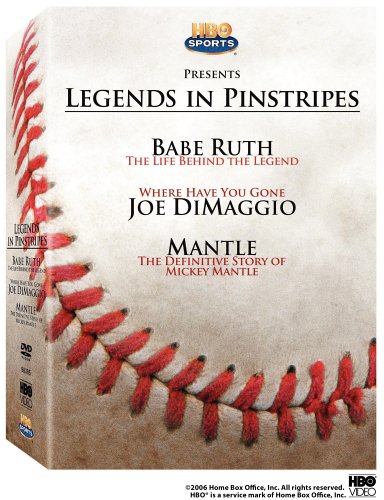
First up to the plate is Mickey Mantle. “Mantle: The Definitive Story Of Mickey Mantle” is no fluff piece. The story is candid and at times even harsh on the man. Mantle’s success is so much more amazing when you consider the number and severity of the injuries he suffered in his career. I believe his most impressive stat to be hitting over .300 for ten years. Few players today can string two years together now. A long parade of celebrities both in and out of sports give their insights into “The Mick”. These testimonials are a stunning example of the number of people’s lives he touched. Mantle was considered quite the party animal, but believe me when I say he couldn’t hold a candle to the kids of today in that department. Still, his actions on the field haven’t been approached by more than a few players since his time. He was certainly one of the most vulnerable of these Yankee legends. His career took quite a shaky start as unrealistic expectations dogged him from his first day with the team. The Yankee fans reacted quite harshly to his less than stellar beginnings, earning Mantle a crushing demotion to the minors where he considered quitting baseball. Lucky for the game he didn’t quit. Instead he found the heart to rise above his early setbacks and become truly one of the greats. His retirement years were plagued by alcoholism and finally a failed liver. Suspicions arose when Mantle appeared to be unfairly ushered to the top of the transplant list, a charge other celebrities like David Crosby have had to contend with. Whatever the truth, Mantle used his final days to champion organ donation and to speak out on alcohol abuse. Even in death, he set an example to follow and a challenge to all he left behind.

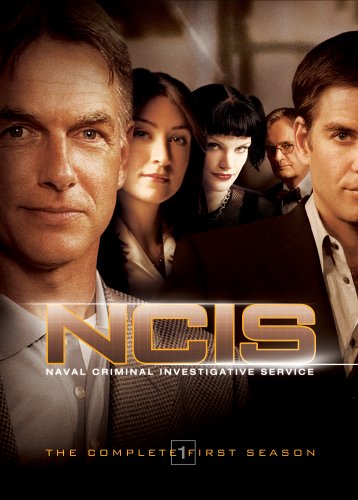
The Naval Criminal Investigative Service is, it seems, the poor cousin to the likes of the FBI and the Secret Service. It doesn't have all the toys of these other organizations, and appears to have a staff of four (five by the end of the first episode). Mark Harmon heads up the investigative team that delves into mysteries that invariably have a military tone (and thus the stories frequently deal with terrorism and the like).

This is a series that wears its pop-culture influences on its sleeve. Too much so. Everyone watching this will compare it to CSI, and so, naturally, we get a jokey reference to that acronym. But the bigger problem is that though the shows wants to appear as it is Ripped From Today's Headlines, it is instead Ripped Off From Works Ripped From Today's Headlines. Thus, in the pilot episode, we are expected to believe not only in an al-Qaida that is presented in such an insultingly simplistic and fairy-tale that its leader is less Osama bin Laden, more Professor Moriarty, but an al-Qaida that shapes its plans by basing them on Harrison Ford movies. Pretty cheesy stuff, then, though entertaining enough.

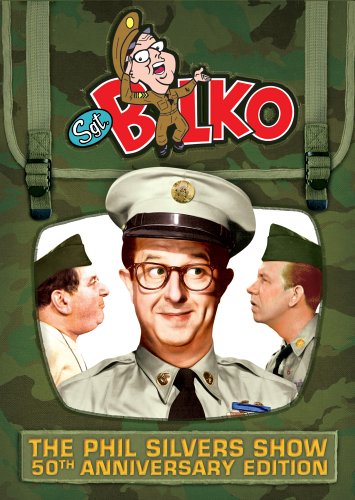
The Phil Silvers Show was groundbreaking for several reasons, but to look at the list of those who appeared on the show during its four season run is to look at a "Who's Who" of television ancestry and history. Allen Melvin played Sam the Butcher on The Brady Bunch, Harvey Lembeck previously appeared in Stalag 17 and his son Michael became an accomplished television director. Joe Ross played one half of the cop team in Car 54, Where Are You? next to a guest star of the show, a guy named Fred Gwynne, who also appeared in a show called The Munsters. Billy Sands went on to appear in McHale's Navy with a friend (and other Silvers show guest star named George Kennedy). Dick Van Dyke even showed up once in a blue moon.

Sometimes with projects like that, the stars in space seem to last longer than the television planet they orbit. But with The Phil Silvers Show and its star of the same name, there was an irreverent comic talent that not only was hilarious in his own right but helped to complement other members of the cast and giving them their chances to shine. Based around the fictional Ernie Bilko and the soldiers stationed on Fort Baxter, Bilko was sharp and a bit of a schemer, and his schemes involving other soldiers were the perfect vehicle to help Silvers offload some prime comedic moments to other actors. With Silvers and his co-creator Nat Hiken, the two managed to put together a show based on their sensibilities and wrote it the way they wanted to.