Fox

Get Shorty was one of the best films of the mid 90’s. I have seen it about five or six times and it is one of those rare movies that you see something new every time you watch it. It had amazing dialog, good action and this style to the whole movie was just uncanny. The movie was a film where one had to think but at the same time could enjoy themselves. So, when the sequel Be Cool dropped on blu-ray, would I be able to enjoy it as much as the original?

Chili Palmer (played by John Travolta) and Tommy Athens (played by James Woods) are riding along in the car talking about the movie business. Chili has been a producer for a few years now and is starting to think that he needs out. Tommy is half owner of NTL Records and pitches an idea about a movie involving his story as a music producer. They pass by a Get Lost movie poster with Martin Weir (played by Danny DeVito).

Sometimes I wonder what would have happened if I wised up at the altar of my first wedding and walked away. Sure, I would have been spared a terrible marriage and some financial woe but fate has a weird way of canceling out the good things in life too. How long would I have been single? Who would I end up with? Would I even know the love of my life, Sarah? Scary when you start thinking about it. Well, today I review A Guy Thing which explores a marriage to be that shouldn’t be. What will happen?

A pair of shots are poured. Jim (played by Shawn Hatosy) says there are three rings in a man’s life: the Engagement Ring, the Wedding Ring and suffering. *rim shot*. Heyooooooo. Jim is the best man for Paul Coleman (played by Jason Lee) who is set to be married in just a week’s time. The bachelor party is at the Hula Lounge and the bar is a hopping. But Paul just does not want to be recognized as the groom of this bachelor party.

Hockey is one of my favorite sports. Unfortunately, figure skating is not. This actually paints an interesting parallel. How can two sports that both share skating on the ice cause love on one side and distaste in the other? It most likely stems from upbringing and society's mainstream views on the two subjects. But what would happen if a hockey player came to the world of figure skating, would I feel different about the sport? Perhaps, but I would be more interested to see a film about it. Enter: The Cutting Edge.

The alarm sounds, Doug Dorsey (played by D.B. Sweeney) wakes up in a panic along side a girl with a heavy foreign accent named Lita or Rita or perhaps Anita (it is actually Gita, played by Nahanni Johnstone). Doug is #9 on the American Olympic Hockey team and is to be the next big thing in the NHL. However, at this point he is four hours late and must get dressed and off to the finals with the West Germans.

"Obviously, I miscalculated a few things. Why is it that the moment your life exceeds your wildest dreams the knife appears at your back?"

You've heard the myth that we only use about 10% of our brains so often that most people actually believe it's true. It's one of those old wives' tails that has been around long enough to become an axiom. We actually do use considerably more than 10% of our brains, or should I say, most of us do. But it is true that we don't utilize anywhere near all of it. So what might happen if we could? How might that improve our lives? After spending almost a couple of hours watching Limitless, I might have to become a tad more content with whatever percentage I'm using right now. In fact, maybe it might be a good idea to lower it a little.

When it comes to westerns, I certainly have a love hate relationship. For most westerns, especially anything with Clint Eastwood or spaghetti in the description, I have an extreme loathing and it is honestly hard for me to sit through. But then there is Tombstone which I think is one of the best movies of all time. This summer, I am even excited to go see Cowboys & Aliens. Maybe I just need a western that is out of the ordinary. However, I received Posse to review and by the looks of the cover, this might be a very conventional western or perhaps not.

An old black man (I don't normally get into race, but it is important here) (played by Woody Strode) spins us a story about black cowboys. He tells us to forget about the past and truth. One out of every three cowboys was black. He then goes into a few more facts before telling the tale of Jesse Lee and his posse. It all started long ago during the Spanish-American War, more specifically in Cuba around the year 1898.

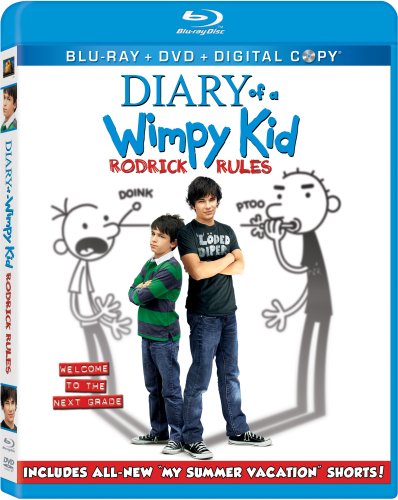
One of my favorite books growing up was Dear Mr. Henshaw by Beverly Clearly. It was a charming book that told the story of a child who would write letters to his favorite author. But somewhere in the middle of the book, it turns from letters to a journal of his life in the second grade. The book series, Diary of a Wimpy Kid focus on the experiences of Greg Heffley and told through the pages of a journal. Today, I get to review the second movie adaptation subtitled: Rodrick Rules.

Like the pages of a drawing book, we join the Rocket Rollers Roller Rink (say that five times fast) where they are welcoming back Westmore 7th graders. A car pulls up and some drawings get out? Oh I get it. By the way, the sign has now changed to, More Lame 7th Graders courtesy of two 8th or 9th graders I assume. As the drawings come out, they dissolve to a family of four.

“The first rule of Fight Club is: you do not talk about Fight Club. The second rule of Fight Club is: you DO NOT talk about Fight Club!”

Now, let me be the millionth critic to break those rules… Back in 1997, David Fincher received a call from his agent, Josh Donen, who’d just finished Chuck Palahniuk's novel Fight Club and tried to talk Fincher into reading it. Even at a brisk 208 pages, Fincher passed on it, protesting being too busy to read books. So Donen read the Raymond K. Hessel scene over the phone, the one where Tyler puts the gun to the convenience store clerk’s head and tells him, "I know who you are. I know where you live. I'm keeping your license, and I'm going to check on you, Mister Raymond K. Hessel. In three months, and then in six months, and then in a year, and if you aren't in school on your way to being a veterinarian, you will be dead."

Even though I have found my soulmate, I often consider myself to be a loner at heart. If I was born in another time, perhaps I would be roaming the earth searching for a purpose. In some ways, I could consider myself to be like the lead actor in Warrior’s Way. A warrior who is the best swordsman in the land but empty in his heart. That however would change when one day I found my purpose. Will it change in his?

Yang’s (played by Jang Dong-gun) only purpose in his life is to become the greatest swordsman in the entire world. As a member of the Sad Flutes clan, he eventually accomplishes this goal by killing the former greatest swordsman in the land and every one in the opposing clan. However, there is a wrinkle in his future ambitions when he decides to take pity on a small baby who was daughter to one of the members. In deciding to watch over her, he incurs the wrath of his fellow members and he has take refuge.

"In the winter of 1348 a knight of the Crusades returned to his homeland. He was tired in body and soul and hoped to live in peace the remainder of his days. But this was not to be."

The city of Villach has a problem. The plague has spread to its borders, and the affliction is spreading fast. The disease's arrival is timed to the arrival of a young girl (Foy) who was found to be wondering about the village. After some interrogation she confesses to being a witch and bringing the illness to the village. She must now be brought to the abbey where a holy book contains the words necessary to deal with the witch. Now they just have to get her to the abbey which is several days away from the village.

World War II has just ended, and the recently discharged Robert De Niro hits New York on the prowl for sex. He runs up against WAC Liza Minnelli, and the more she resists his advances, the more determined he becomes. There is more: he is a saxophonist, and she (of course) is a singer). So begins a tempestuous relationship between two artists whose enormous talents and equally enormous personalities mean they can neither live with nor without each other.

The idea of Martin Scorsese taking on the form of the classic musical is so bizarre that it had to happen, and here it is. Scorsese’s conceit is ingenious: all the conventions are there (the meet cute, the songs, the artificial sets and colors), but they collide with the naturalism of the performances and the emotions. A perfect case in point: wandering the streets at night, De Niro sees a sailor and his girl perform a dance together. It is a classic musical moment, but the only sound is that of a train passing. It is a scene of extraordinary beauty, grit, and cinematic truth. And it belongs in an extraordinary film.