Fox

“When one starts to perceive one’s own reflection as a completely separate being, one is suddenly confronted with two entirely separate egos, two entirely separate worlds that can surface at any given moment. A feeling of self hatred usually triggered by a psychological shock can split the personality in two, hence creating two or more personalities with distinct memories and distinct behavior patterns within the same individual. The patient has the false perception of the existence of two distinct worlds, the real world and the world inside the mirror.”

Or maybe not so false, at least according to the 20th Century Fox thriller, Mirrors.

Posted by Ken Spivey

In a box, the men of importance placed a secret. They then created an underground city capable of complete autonomy, isolated from the outside world in hopes of shielding them from the trials of time. The box was given to the first mayor of “Ember City” and passed on to each successive mayor. After two hundred years the box was to open, revealing to the mayor's descendant the way out of Ember City. Yet, somewhere along the way the box was lost. Meanwhile, the city has fallen into a major state of disrepair. Houses are crumbling, pipes are corroding, and the household robots are malfunctioning. The current mayor seems unconcerned with the welfare of the city, while its residents are terrified of the impending failure of the city's power reactor and the end to their civilization. Ember City's only hope lies in the hands of a plucky young girl, Leena, who has found the box left by “the builders.” Leena is now in a race against time to figure out the mystery of the box before the reactor fails. The fate of “The City of Ember” lies in the box and the hands of young Leena.

When I was young I used to love to eat oranges, but it wasn’t only the taste or the benefits of some good old fashioned vitamin C I was necessarily after. I would cut the fruit in half and then carefully peel the rind, attempting to keep the halves in one piece. I’d cut one of those pieces in half again. I would then place them around my mouth and there you’d have it… instant Apes makeup. Then I would twitch my face muscles to imitate Roddy McDowall’s clever facial movements intended to make the foam prosthetic pieces come alive.Talking through those orange rinds, I’d imagine I was one of those intrepid apes from the films or television series and have all sorts of ape adventures. My playtime had the extra unintended benefit of protecting me from colds. Of course, as an adult I have long since abandoned such childish ways and no longer fill my face with orange peels, at least while anyone else is looking. But the Apes films and shows have never lost their -- I guess you could call it appeal, for the 10 year old I still carry around inside. When Tim Burton went to work on his remake of the franchise, a little bit of that kid emerged, and I might have picked up an extra orange or two at the grocery, just in case. Unfortunately, while I am a fan of almost everything Burton has done, his version of The Planet Of The Apes was a severe disappointment, and more importantly might have killed the possibility of future visits to that wonderful world. While his make-up f/x might have been more realistic, it was dismissive of the groundbreaking work done by John Chambers on the original films.


Up to now we have not cared how you solved your petty squabbles. But if you threaten to extend your violence, this Earth of yours will be reduced to a burned out cinder. Your choice is simple. Join us and live in peace. Or pursue your present course and face obliteration. We will await your decision.

“Klaatu Berada Nikto…”

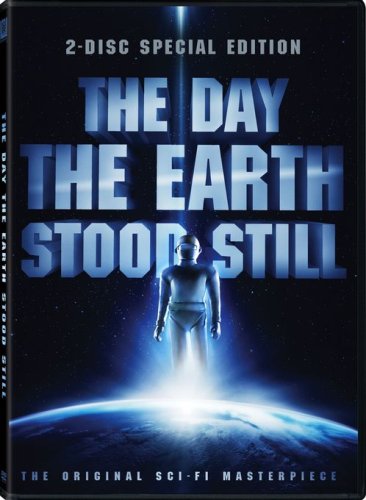
As a fan of Sam Raimi’s Army of Darkness, I just had to do that. But Raimi’s masterpiece is not the subject of this article; rather a concerned alien visitor in the classic science fiction film The Day the Earth Stood Still, now available on 2-disc special edition DVD from Twentieth Century Fox. No doubt the spawn of a marketing machine looking to cash in on the remake starring Keanu Reeves, this release should still be a welcome addition to the shelf of any classic cinema fan.

Welcome to an all-new way of presenting even more review titles to you.

From time to time we’re given a kind of disc called a “screener”. It’s sometimes the industry’s way of getting review copies without spending a lot of money. Instead of final product, we get a paper slipcase with just a disc. Even the disc is far from final product, the one you would buy in a store. There are often no extras, and the A/V isn’t necessarily the way it will look on the ultimate release. For years we here at Upcomingdiscs have often avoided reviewing those titles because we can’t really comment on the many factors we like to include in our reviews.

No, this isn't the Patrick Swayze vehicle. Instead, it's another golden opportunity for Richard Widmark to unleash his patented psycho act. Here he plays Jefty, playboy owner of the titular establishment. His right-hand man is Pete (Cornel Wilde), who is the serious-minded half of the partnership. Said partnership is strained when Jefty brings back the latest singer for the club, one Lily (Ida Lupino, in superb hard-boiled form). Pete thinks she's bad news, and she is, only not in the way any of the three suspect. Jefty decides he's in love with her, but she only has eyes for Pete, and he, despite misgivings, reciprocates. Jefty doesn't take rejection well. Not well at all...


The cast is terrific, bouncing cynical zingers off each other with aplomb. Wilde does well as the world-weary Pete, but Lupino and Widmark own the field, and their final confrontation is one for the books. Enormous fun for noir fans, and especially for lovers of Widmark as a terrifying nutjob.

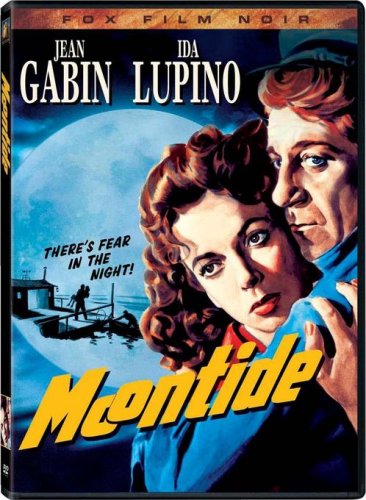
Jean Gabin, in his American debut, plays Bobo, a French sailor who has been knocking around the States for quite some time in the company of Tiny (Thomas Mitchell). Their wandering comes to a stop when, the day after a night of drunken excess that he cannot remember, Bobo sees Anna (Ida Lupino) wading into the waves to commit suicide. He rescues her, and before long the two are living together on the bait barge where he is working, and fall in love. Dark clouds are on the horizon, however. A local man was murdered, and Tiny, resentful that his meal ticket has been taken from him, darkly hints to Anna that Bobo might be responsible, even though he doesn't know it himself.

Moontide was originally a Fritz Lang project, and as the accompanying documentary demonstrates, his influence is still felt in the finished project, notably during the climactic stalking sequence. Gabin, though a masterful presence, nonetheless seems almost as much a fish out of water as his character, and it doesn't really come as a surprise that neither he nor Hollywood wound up caring much for the other, and he would return to the greener pastures of France. Claude Rains is on hand as a wisdom-dispensing night watchman – hardly a stretch for him, but it's always a pleasure to hear his mellifluous tones. The real stretch, and indeed revelation here, is Thomas Mitchell – the man whose speciality was the cuddly, avuncular Irishman here becomes a twisted monster of childish, violent rage, giving us a real nail-biter of a denouement.

Small town Connecticut. A beloved priest is gunned down in the middle of a busy street, and the pressure is on for the police to find the killer. The new regime at city hall needs a conviction, and doesn't care too much about the niceties. When a suspect (Arthur Kennedy) is at last found, police chief Lee J. Cobb isn't entirely happy with the case, but he passes it on to DA Dana Andrews, who is under even more political pressure. At first pleased with the case, Andrews becomes uncertain the more he looks into it, and startles everyone (not least the defence attorney) by entering a plea of innocent at the beginning of the trial. Politicians and lynch mobs are soon baying at his door.

Elia Kazan's 1947 thriller is, as commentators Alain Silver and James Ursini point out, very much in the vein of the docu-noir. There is lots of procedural action going on here, and the voice-of-god narrator is frequently on hand to explain things to us. What is perhaps most interesting about the film, though, is that the case itself becomes of secondary importance to the political machinations. This isn't so much about the possible conviction of an innocent man, so much as it is about the mechanisms that make such a thing possible in the first place. Given what the future would hold for Kazan and his involvement with the HUAC hearings, the witch hunt scenes here take on additional, troubling, resonance.

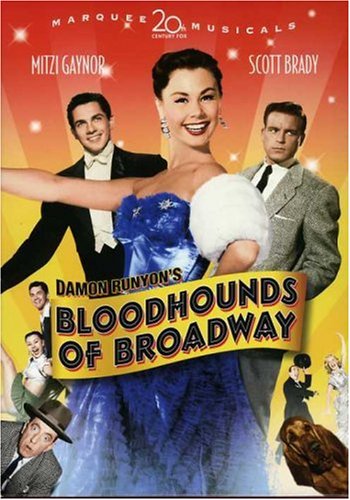
Damon Runyon’s stories would most famously make it into musical form in 1955 with Guys and Dolls. But in the meantime, this 1952 effort featured many of the same sorts of characters – wise-cracking-but-harmless gangsters and their glamorous molls. Here, Numbers Foster (Scott Brady) hightails it out of town to avoid a Congressional hearing, and on the way back, he picks up country songbird Emily Ann Stackerlee (Mitzi Gaynor), much to the displeasure of New York girlfriend Yvonne (Marguerite Chapman). Heavier on plot and lighter on numbers than some other musicals of the period, this is a jovial effort, but understandably in the shadow of its more famous cousin.

Audio