MGM

I remember when I first heard that Dead Man Walking was coming out. The first news was that it was a death penalty film that involved Tim Robbins, Sean Penn and Susan Sarandon. I was not very keen to see the movie at that time. All three of these actors are known for their over-the-top liberal antics, and I just knew this was going to be nothing but a rant against the death penalty in the United States. But you see, that's why you just have to watch the movie sometimes. I'm not sure why I ended up going to see the film, but I did. I was very surprised to find that while it certainly was anti-death penalty, the movie showed both sides and didn't hit you on the head with its morality.

The film was based on the autobiography of Sister Helen Prejean (Sarandon). She had been asked to provide some conversation and possibly a little comfort to a death row inmate who was reaching out to the church. She went to meet Matthew Poncelet (Penn) and ended up his spiritual advisor during his final days. She helped to organize a legal team headed by Hilton Barber (Prosky) and tried to get him to take responsibility for what he had done so that he could die with some dignity. Along the way she was shaken by encounters with the parents of the couple that was brutally murdered by Poncelet and his partner. Their pain causes conflicts within her, but she continues to fight for the condemned man.

"I don't remember if I started drinking because my wife left me or my wife left me because I started drinking."

Nicolas Cage has played quite an array of oddball characters in what has to be one of Hollywood's most eclectic careers. But whatever your favorite might be, this is the one that earned him an Oscar. The movie also earned Elisabeth Shue her only nomination for an Oscar. While those were not the only nominations for this cult favorite film, that's really where the money is. The film is a character study of two people on a downward spiral. The film was also nominated for two additional Oscars, but it is the acting that makes this movie somewhat exceptional.

I’m kicking myself. Martin Scorcese’s The Color of Money has long been a favorite of mine, but for some reason I never knew it was a sequel to The Hustler, a film 25 years older and three times better.

Starring a young Paul Newman (Road to Perdition) in a role that earned him his second Oscar nomination, The Hustler is about a cocky pool player hustling his way to the top. When “Fast Eddie” Felson (Newman) challenges undefeated straight-pool champ Minnesota Fats (Jackie Gleason,…Requiem for a Heavyweight) to a high stakes game, the talented young hustler shows he has the skills to be the best, but self-destructs toward the end of the 25-hour marathon match. Left near-penniless and without the managing partner who helped him get started in the seedy world of pool hustling, Eddie faces an uphill struggle to regain his confidence. Shacking up with smart, attractive and similarly self-destructive Sarah (Piper Laurie, Carrie) proves to be a decent diversion while Eddie wallows in misery, but while he uses her as a crutch, he becomes the cause of her destruction when he agrees to play for Bert Gordon (George C. Scott, Patton), a ruthless, greedy manager, and brings her along when they hit the road.

"The machines rose from the ashes of a nuclear fire. Their war to exterminate mankind had raged for decades, but the final battle would not be fought in the future. It would be fought here in our present... Tonight."

Where were you on Judgment Day?

The Usual Suspects is a most unusual movie, and in this case, that is a good thing. The Usual Suspects keeps you interested throughout its entirety by making you think and trying to figure out what will happen next. If only today's movies did the same thing!! As this has been one of my favorite movies of all time, the excitement I felt when I received this in the mail today could only be compared to a young child on Christmas morning.

A boat, thought to have $91 million in cocaine on board, is docked at a pier in San Pedro, near Los Angeles. Within seconds a thunderous explosion takes place. Soon after twenty-seven dead bodies are found at the scene. Miraculously, there are two survivors: a Hungarian gangster who clings to life in a local hospital and Roger “Verbal” Kint, a crippled con man from New York. As U.S. Customs Special Agent David Kujan conducts his grueling inquisition, Kint weaves a tale that begins six weeks earlier, at a police lock-up in New York. Five felons, accused of hijacking a truckload of gun parts in Queens, are brought in for a lineup. They are suspects. Strangers. With one thing in common: Keyser Soze — a criminal so feared and fabled. While an FBI sketch artist struggles to complete his rendering of Soze before the witness dies, Verbal Kint sits in the District Attorney's office, taking Kujan through the steps that led him there. The questioning is extensive. Agent Kujan is relentless and questions Kint for hours. In the end the surprise of all surprises takes place.

During the Korean War, a platoon led by Laurence Harvey and Frank Sinatra is captured and sent off to Manchuria. Here the men are brainwashed into believing that Harvey saved them all in an incredible feat of heroism (which he did not) and that he’s a loveable guy (which he isn’t).The unfortunate Harvey is programmed to become a remote-control assassin. Back in the States, Sinatra is plagued by nightmare memories of the experience, and gradually comes to believe that something … really did happen. The question is whether he and Harvey can solve the mystery and discover the target before Harvey is triggered.

The Manchurian Candidate accomplishes a spectacular balancing act. It is simultaneously one of the most intense suspense thrillers ever to emerge from Hollywood, and an absolutely corrosive satire. Said satire is all the more brilliant for savaging both the extreme right and the extreme left of the political spectrum. Also of note is Angela Lansbury’s ferocious performance as Harvey’s gorgon mother. Only 37, and but three years older than the man playing her son, she is utterly convincing, and a villain for the ages. Unquestionably, this is director John Frankenheimer’s masterpiece.

"In the beginning was the word, and the Word was with God, and the Word was God. I am He. He was in the beginning with God. All things were made through Him, and without Him, was made nothing that has been made. In Him was life, and the life was the light of man. And the light shines on in the darkness, and the darkness grasped it not. The greatest story ever told..."

Every spring around the time of Easter you could count on several annual films to make their way to televisions across the country for special family presentations. For Easter you had The Greatest Story Ever Told and King Of Kings. For Passover there was always The Ten Commandments. And so it is an appropriate time to see all three of these films make their way unto high definition and Blu-ray for the very first time. We've already reported on the excellent release of The Ten Commandments and King Of Kings. Our review of The Greatest Story Ever Told concludes this Holy Trinity of movies to review.

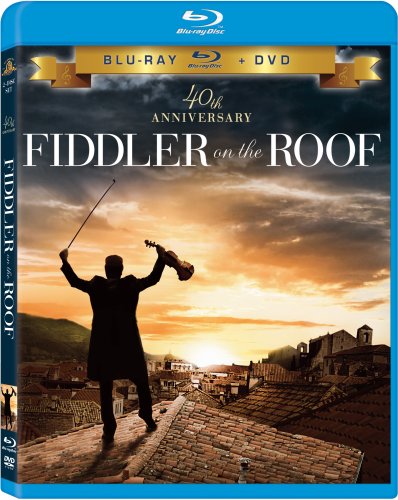
Adapted from the hit stage musical, Norman Jewison’s film version of Fiddler on the Roof has established itself as a classic over and over again since its release in 1971.

“He loves her. Love, it’s a new style… On the other hand, our old ways were once new, weren’t they?” I’ll hardly be the first to write it, but the reason Fiddler on the Roof, a story about Jewish people and their culture, is so popular, is that its themes have universal appeal. In fact, in a way it hardly matters that the characters are Jewish. As we learn from a famous anecdote, when the first Japanese production of the stage musical opened, the show’s creators traveled to Japan to meet the producer. He said to them, “I don’t understand, I don’t know how this piece can work so well in New York. It’s so Japanese!”

"Jonathan Brisby was killed today. It is four years since our departure from NIMH, and our world is changing. We can not stay here much longer. Jonathan was a dear friend. I am lost in knowing how to deal with his widow. She knows nothing of us or the plan."

When Don Bluth left Walt Disney, he led an exodus of some of the studio's top talent. They were becoming disenchanted with the product Disney was producing at the time, and it is generally accepted that this was the dark ages of the studio. The group of animators joined Bluth and formed their own company, and the first film to come out of that collaboration was The Secret Of NIMH.

"You can't keep a good dog down."

Baby here again. Yeah, that's right. I'm the German Shepherd/Chow mix that runs security here at Upcomingdiscs. I make sure only the best movies get through my complicated security system. And that spells F A N G S. Okay, I made that last part up. I try to keep them all out, but let's not talk about that right now.