Posted in: Disc Reviews by Gino Sassani on May 10th, 2010
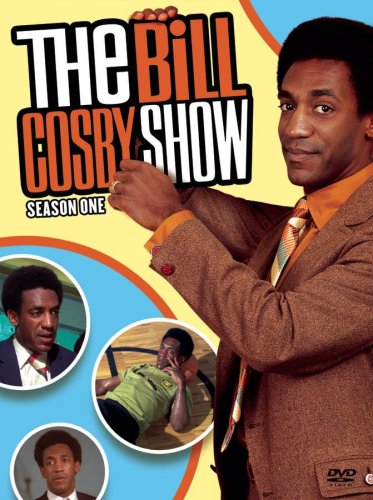
I grew up on Bill Cosby. He was everywhere when I was a kid. Fat Albert And The Cosby Kids were on my television every Saturday morning. My parents had all of his records, and I can remember borrowing them when I finally got a player of my own. I played Chicken Heart so often I think I wore away the grooves on the track. Of course, you youngsters out there have no idea what I'm talking about when I mention grooves and wearing them out. That also means that you remember a very different Bill Cosby show. Most of us think about that huge hit in the 80's. Cosby played a doctor, and he was married to a lawyer and this wealthy family had a ton of kids. The show was an instant hit. But it wasn't the first attempt at situation comedy from Bill Cosby. Back in 1968 he was the star of a very different comedy series on television. It was The Bill Cosby Show.
In this series Cos played Chet Kincaid, a high school gym teacher and athletic coach. It wasn't really a stretch, you see, because The Cos actually studied PE at Temple University with his eye toward just such a possible career. Of course, stardom interfered with those plans, and I don't think anyone has been complaining too much. The series is too eclectic for its own good. While Chet's career should be the focus, many of the episode take him out of the school and place him in oddball situations. Episodes deal with his aunt's will and a missing Abe Lincoln letter, a flood while Chet deals with a neighbor in labor, and Chet leading a group of inner-city kids on a failed attempt to get out and camp in nature. From the start, you can see that Cos is trying to bring a more intimate approach to his comedy, but it usually misses the mark completely. His natural charm and demeanor carry the day, but there's a reason why the series only lasted three seasons. He would hone those skills later to deliver one of the biggest shows in television history.
Posted in: Disc Reviews by Gino Sassani on May 10th, 2010
Pulse:
Plenty of Japanese horror films have storylines that vary from the oblique to the opaque. Pulse is no exception, so forgive me if this synopsis is a bit confusing (or confused). An internet website offers visitors the chance to see actual ghosts. Viewing the footage seems to make one vulnerable to an actual visitation, and when someone encounters a ghost, that person withdraws from others, shunning all society, and becomes consumed by loneliness to the point of suicide or something even more bizarre. All of this is slowly being uncovered by two groups of friends, even as the plague of ghostly encounters spreads far and wide.
Posted in: Disc Reviews by David Annandale on May 9th, 2010
During the chaos of a mutiny, three British officers in India get their hands on a great treasure. They do not do so honorably, however, and, mistrustful of each other, make a blood pact, which cannot be broken without suffering a terrible curse. Decades later, the three have experienced very different fortunes, and vengeance has come to call. Irene (Susannah Harker), the daughter of one of these men, seeks the help of Sherlock Holmes (Charlton Heston!) and Dr. Watson (Richard Johnson). There are many dark deeds to unravel, and along the way, Watson and Irene fall in love.
The reason for this obscurity's arrival on home video is obvious, what with the Guy Ritchie movie doing the same. While this effort is far less problematically revisionist than Ritchie's, it still presents much for the Holmes fan to struggle past. Apart from the squirm-inducing age difference between Johnson and Harker, there is, of course, the supremely odd casting of Heston as Holmes. In fact, Heston had played the part in the stage version of this story, and to his credit, he does have a solid grasp on the character, and his English accent is serviceable. His angular features are also right for the part, though there is also a muscular physicality to Heston that makes his Holmes seem just as likely to punch through a wall as solve a mystery. And Heston is one of those stars who never disappears into a role, and so one is always conscious of watching Heston, not Holmes, on the screen. As for the film itself, its stage origins remain obvious, despite the many locations. This is an entertaining enough oddity, but no more.
Posted in: Disc Reviews by David Annandale on May 9th, 2010
Having accidentally blinded a singer during a contract killing, hit man extraordinaire Chow Yun-Fat, consumed with guilt, becomes the woman's protector, and seeks redemption by finding some way to restore her sight. Meanwhile, Danny Lee is the plays-by-his-own-rules cop on his trail, and inevitably the two men will find themselves as unlikely allies in gigantically operatic gunfights.
I can remember when John Woo was still a name whispered with reverence by cult film fans, and his films were only available on grey market VHS or import laser disc. In fact, I first saw The Killer on one such disc, in Cantonese with Mandarin subtitles, reading a transcription of a translation, desperately trying to grasp the gist of the action. It was worth the effort, though, for I had never seen action sequences like these. Today, of course, the situation is very different. Woo's films are readily available, Hard-Boiled's sequel is a video game (Stranglehold), and his stylistic characteristics have become clichés. The passage of time and over-familiarity have arguably robbed the film of some of its power, while making the OTT sentimentality harder to take, but the fact remains that this is still a seminal moment in action filmmaking.
Posted in: Disc Reviews by David Annandale on May 9th, 2010
We are in the midst of the Great War. Michael Dunne (Paul Gross) is a Canadian solider recovering from physical and psychological wounds. He falls in love with his nurse (Carline Dhavernas), and when her asthmatic brother enlists, Dunne heads back to the trenches to protect him, and the two men wind up at the gigantic, murderous battle that gives the film its name.
Writer/director/star Gross has an almost messianic commitment to Canadian film and Canadian history, and here he combines his obsessions in a 20-million-dollar effort that is, by the standards of the Canadian film industry, nothing short of gargantuan. And to his credit, the battle scenes are impressive. The editing is frequently startling and brutal, in keeping with the events themselves. On the other hand, the romance is painfully hackneyed, and the naked appeals to national pride can be rather wince-inducing.
Posted in: Disc Reviews by Michael Durr on May 8th, 2010
Volume Five of the Animated Series known as X-Men is now upon us. Included here are the last fourteen episodes that haven't been put on disc for the masses. There is a lot going on in these twenty one minute chunks. There are some good things, bad things, funny things and more confusing things than probably should be in a children's animated show. So let us spend some time, the final time with our beloved mutant friendly superhero group.
The fourth season had left us on a climatic showdown. The four parter: Beyond Good and Evil had showed us some strange alliances as well as X-Men fighting together to save the day. Apocalypse was put away for another day as he could not defeat the mutant superheroes. Peace had come to the planet Earth even though we all the knew that it could not last. So we dive right into the final Volume of the X-Men.
Posted in: Disc Reviews by Gino Sassani on May 6th, 2010
Most people don't know or remember that Andy Griffith had a career before his television classic reached the airwaves. He had a pretty distinctive stand-up routine going for many years that included recordings like most stand-ups of the day. He had quite a famous bit about a country farm boy seeing his very first football game. It was called “I Think They Call It Football”, and it's a priceless classic. Andy also found his way into a couple of movies in the days before he became Sheriff Andy Taylor. One of those movies was No Time For Sergeants. It wasn't a stretch for this country boy, and fans of the rural years of Andy Griffith will find about everything they're looking for here.
Will Stockdale (Griffith) is down on the farm with his Pop enjoying the slow life when they are visited by an officer from the draft board. It appears that Will has been getting draft letters, but his Pop keeps throwing them away. Now Will is considered a draft dodger and is taken away in cuffs to be inducted into the Air Force. Along the way he befriends Ben Whitledge (Adams) who comes from six generations of infantry. His mother has sent a letter asking that the military honor the tradition by giving Ben a transfer to the infantry in the Army. Will, a naive rural boy, just wants to help. So he goes directly to the company leader, Sergeant King (McCormick) and tries to help out his new pal. What he ends up with is the assignment as PLO, Permanent Latrine Orderly, a post Will thinks is intended as an honor. But when the Captain discovers the "honor", he puts King in charge of Will's classification. If Will isn't classified in one week, King will be the next PLO. The film follows the antics of getting Will classified before the three (King, Will, and Ben) are assigned to gunnery training. With Ben and Will on a training flight, their plane ends up in the middle of Yucca Flats during a nuclear test. Presumed dead, the "heroes" are to receive posthumous medals at a gathering in their honor. It's all a nice fitting tribute until the boys show up at their own memorial service.
Posted in: Disc Reviews by Gino Sassani on May 6th, 2010
"Most of the world's population has been wiped out by a virus. Civilization, as we know it, has come to an end. For the few survivors, every day is a fight for life. But sinister forces threaten their future."
Right from the opening credits, you can see that a lot has changed since 1975 and the original series. I'm guessing that my watching them back to back allows for even more dramatic notice of the changes. Everything is cleaner here. The production values are light-years away from what they were. Even the disc menus reflect the higher-tech edge of the 21st century production values. The credits claim that this series is not really based on the original show, but more on Terry Nation's novel. I never read the novel, but it appears there is some truth to that statement. The episode titles no longer have individual titles. They are merely listed as Episode One, Two... and so on. Once you begin to watch the show, you will find that you recognize many of the characters by name and, at times, circumstance, but these are not the same people at all. More on that later.
Posted in: Disc Reviews by Michael Durr on May 6th, 2010
Iron Man 2 comes out this week and is set to do fantastic business. Usually I’m a person who waits for movies to hit dvd and blu-ray and I’m already planning to when I can go see this movie. But one of the things I’ve come to appreciate over the years is when a big movie such as Iron Man 2 comes out, there are disc releases that dip into yesteryear and help to get you in the mood. Imagine my surprise when I was asked to review Iron Man: The Complete 1994 Animated Series.
To do this correctly, I really have to break up this synopsis into two parts. There is the first season and the second season. Trust me, they are so different from each other, I’m surprised they were released together. Everything from drawing style to the characters to the way they craft stories is different. It’s a fun ride either way but you’ll certainly prefer one over the other.
Posted in: Disc Reviews by Gino Sassani on May 5th, 2010
"You know, I never thought what happens to a city ... well ... if it breaks down, all at the same time. There's no power. There's no lighting, or cooking. And food, even if you can get it into the city, you can't distribute it. Then there's water and sewage, things like that. You know, it just never occurred to me when I lived in London. The city's like a great big pampered baby, with thousands of people feeding it and cleaning it, making sure it's all right."