Posted in: Disc Reviews by Gino Sassani on May 28th, 2009
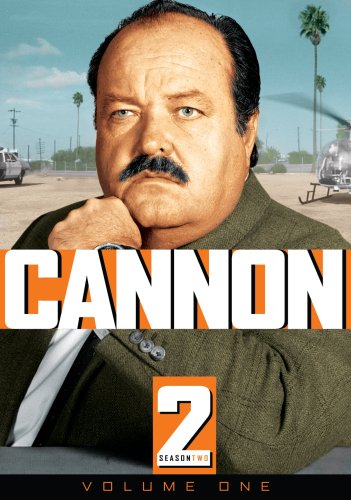
It’s a disc loaded with pilots. No, you won’t find any daring men and their flying machines here. These pilots owe more to Philo T. Farnsworth than The Wright Brothers. Farnsworth transmitted the first televised image in 1927. In case you’re wondering, that image was a dollar bill. These pilots follow in those footsteps; that’s because these pilots are television shows. They’re the first episodes of some of the best action series to appear on CBS over the last few decades. Going back as far as the 1960’s, these shows represent a nice cross section of television action entertainment.
Posted in: Disc Reviews by Gino Sassani on May 28th, 2009
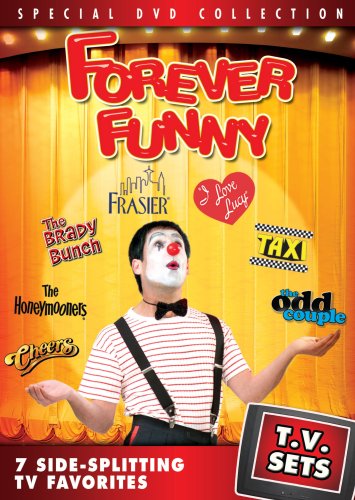
This single DVD contains the premiere episodes of 7 of CBS’s most endearing comedies. All were influential to those that came after. These weekly shows offered that much needed relief from the pressures of whatever decade they appeared in. The stars are names that everybody knows, even those that appeared 50 years or more ago. If you ever wondered how some of these shows began their historic runs, here’s your opportunity to go back in time with Forever Funny.
Posted in: Disc Reviews by Gino Sassani on May 27th, 2009
“It’s time to wake up and get a life. We live in a three-dimensional world. Until now, the world of computing has been a flat world consisting of two-dimensional imagery. Now through the use of exclusive breakthrough technology, ARC has made it possible for you to get a life. A-Life, where we can work and play in a lifelike world of three-dimensional reality. A-Life… the living monitor. Impressed?”
You should be. From the mind, or more accurately the pen or typewriter, of science fiction legend Philip K. Dick comes another big budget Hollywood film, Paycheck. The works of Dick have become impressive films in the past. From Do Androids Dream Of Electric Sheep we get Ridley Scott’s masterpiece, Blade Runner. Dick also penned the Steven Spielberg budget buster, Minority Report. But Paycheck is actually much more like the Arnold Schwarzenegger blockbuster Total Recall. Once again, Dick deals with his popular subject of downloading, or in this case removing memories. Combine that element with the seeing into the future concept of Minority Report and you have what should be a Philip K. Dick greatest hits film, with the added adrenaline rush of John Woo in the director’s chair.
Posted in: Disc Reviews by Archive Authors on May 26th, 2009
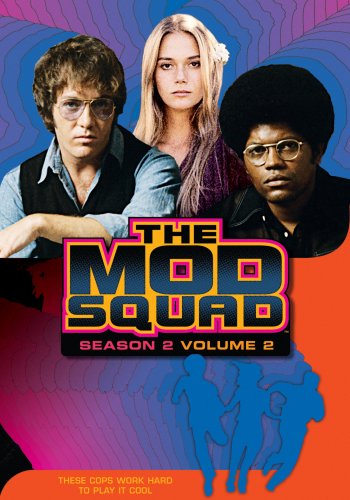
The danger in revisiting a show you used to love as a kid is that it will almost always disappoint, especially, it seems to me, if the show was made in the 70s. I have had this experience several times in my life, sitting there with a dull expression in my eyes, gazing at the screen and wondering why I ever thought Welcome Back Kotter was funny. And did I really thrill to the exploits of Starbuck and Apollo without noticing how awful Battlestar Galactica was?
Posted in: Disc Reviews by David Annandale on May 26th, 2009
Aging senator James Stewart and wife Vera Miles arrive in the prosperous town of Shinbone to attend the funeral of an anonymous farmer. The local newsmen want to know why. Stewart tells the story. Cue the flashback, where he arrives in a much more anarchic Shinbone as a naïve lawyer. Held up and beaten by the brutal outlaw Liberty Valance (a psychotic Lee Marvin), he is determined by bring law and justice to the town, but must come to terms with the fact that he cannot do so without the gun of John Wayne (the aforementioned farmer).
For all intents and purposes, this 1962 film was director John Ford's last western. It is an elegiac, melancholy piece (and one that makes Catlow, reviewed here a few days ago, look even more out of step with time). Like Unforgiven, it is a film whose casting is not only perfect, it is necessary. The collisions between the Wayne and Stewart characters are also the collisions between the symbols of American Myth the two icons represent. Vera Miles, as the woman torn between the two men, comes to represent the country itself, which must, for its own sake, choose the civilization and rule of law embodied by Stewart, even as it grieves over abandoning the larger-than-life figure of Wayne. He is the Old West, a figure from a more anarchic time, perhaps the light to Marvin's darkness, but in many ways not that different. He must vanish to make way for the future, but the future cannot come into being without his help and sacrifice.
Posted in: Disc Reviews by Michael Durr on May 25th, 2009
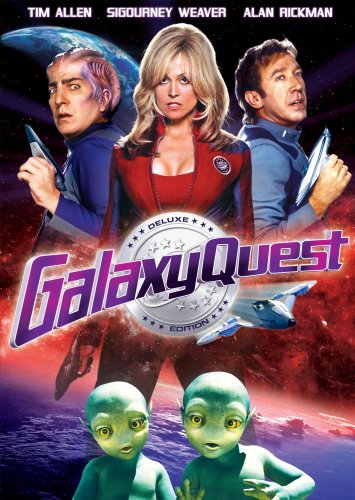
Galaxy Quest is an odd movie. It opened on Christmas Day of 1999 and did alright in the box office gathering roughly 71 million and some change. It was one of those movies that you went to go see and would laugh a lot but wouldn’t tell anybody in fear of people making fun of you. So it did respectable sales, but nobody knew the full potential of the movie until it hit the video format. The movie found a considerable audience and after many years, the movie holds up. Possibly better than it ever did nine years ago in a tiny theater. Now, with the release of a deluxe edition many years later, the movie can reach new audiences. Hopefully, they will be able to appreciate it as much as I did.
Once upon a time, Galaxy Quest was an entertaining space drama. It lasted only four seasons but found an audience that lasted many years later. The cast however has for the most part not been able to find reasonable work, reduced to conventions and lowly promotional work. There is Gwen DeMarco (played by Sigourney Weaver in a blonde wig) who played Tawny, the Computer Officer of the Protector and served as the beauty on the ship. Alexander Dane (played by Alan Rickman) plays Dr. Lazarus serves as the resident Spock/intelligent alien and is positively sick of his catchphrase (By Grabthar's hammer, by the suns of Warvan, you shall be avenged!).
Posted in: Disc Reviews by Gino Sassani on May 22nd, 2009
“Life is a tightrope. You’ve got to learn to dance.”
We’ve all had bad days. Everyone can relate to that. We’ve all had moments when we weren’t at our best, when we’ve said or done something in the heat of the moment that wasn’t exactly our most shining moment. We can only hope that these momentary lapses of reason don’t cause permanent harm to ourselves or to others. We can only plead our case that we aren’t ultimately defined by these brief acts of frustration brought about by mitigating circumstances. Most of the time we get lucky. Sometimes that fleeting moment isn’t so fleeting. Some times you have a bad day, all of it. That’s the premise behind this Samuel L. Jackson and Ben Affleck vehicle.
Posted in: Disc Reviews by Gino Sassani on May 22nd, 2009
Director Brad Anderson and writer Scott Kosar were unable to find backing or support from any of the American studios when they were shopping this movie. Apparently there were worries that it wasn’t very commercially viable. It turns out they were correct. The film made just over $1 million in domestic box office. That’s not a mistake. I meant $1 million. Even the foreign market came up short, coughing up only an additional $7 million total. Because of the lack of interest here in the States, the duo went to the Spanish government and received a grant. The grant required the film to be made in Spain and include Spanish cast members. But the movie kept its California setting and shot Barcelona for California, and not very effectively either. The truth is, there’s a lot more wrong with this film than just the lack of studio interest and its forced European locations. The team missed a grand opportunity here. They got to shoot in a rather exotic location but never took advantage of the wonderful surroundings. Instead they insisted on keeping the film urban, and in the end rather generic. The only solid set piece is the machine shop, which was filmed in a working plant.
Trevor Reznik (Bale) is a very odd man. We find him a year into a rather dramatic and steady decline. He hasn’t slept in over a year. He is losing weight to the point of emaciation. He works as a machinist for National Machine, where his bosses think he’s taking drugs and his coworkers don’t like him either. None of that is helped when his inability to focus causes another man, Miller (Ironside) to lose his arm in a machine. The only companionship he has is a hooker, Stevie (Leigh) who he pays a hundred bucks a pop and his café waitress, Marie (Sanchez-Gijon) who serves him coffee and pie. His decline appears to accelerate when he meets an apparent new employee at National. Ivan (Sharian) is a monster of a man with whom Trevor becomes obsessed. He leaves little post-it notes to remind him to do everyday things, but these notes usually disappear, replaced instead with cryptic messages and a hangman game. As his mind and body deteriorate, he becomes increasingly paranoid. His mind is pushing him to accept a reality that is not going to be pleasant.
Posted in: Disc Reviews by Gino Sassani on May 21st, 2009
For many, Saving Private Ryan has been the measure of the perfect war film in the modern era. Without question the Steven Spielberg film is a milestone in depicting battle on the screen. But I’m going to make the possibly unpopular statement that Enemy At The Gates is a better film, and the standard by which war films should now be measured. The movie is at least almost as good technically as Private Ryan. There are battle scenes that offer the same caliber of shocking reality. And even if this movie falls a little short of the technical marvel that Private Ryan was, this movie captures the human element of war time in a way I hadn’t seen before or since. Certainly all of the necessary hallmarks of the war picture formula are intact. There are plenty of battle scenes and enough ultra realistic bloodletting to satisfy the most insatiable aficionado. But Enemy At The Gates refuses to rely on such brutality to make its point. Instead the hazards of war are merely the atmosphere that allows an excellent cast, under brilliant direction, to bring to life an inspired script.
It’s the heart of World War II. Hitler and his Third Reich are marching across Europe spreading their shadow of fascism and tyranny wherever they go. They have now begun their assault on the young Soviet Union. For the Soviets, troops are weary and supplies are scarce. For the beleaguered soldiers of the Red Army, it is a matter of being shot by the enemy or by your own field commanders should you even think about a retreat. Their mission now is to defend the city of Stalingrad, which bears the name of “The Boss” and stands as a symbol of nationalism to the infant nation. But things are not going well at all. Only every other soldier is armed. The unarmed soldier is admonished to wait until the one holding the rifle is killed to take up arms himself. For these Russian men it is not a matter of if they are killed, but merely when. After a heavy day of fighting, a political officer, Danilov (Fiennes) finds himself pinned down with another young soldier, Vassili (Law). Vassili manages to take out the officers who stand in their way of escape. Danilov decides that Vassili could well be the hero that the Soviet soldiers need. He realizes that fear is not as good a motivator as inspiration. Before long he has written news articles that chronicle the exploits of Vassili as he takes his positions in the city and racks up an impressive score of German officers. Unfortunately, it is not only the Soviet soldiers who hear of these adventures. Vassili comes to the attention of the German brass who bring in their own sharpshooter, the decorated officer, Major Konig (Harris). The two play a dangerous game of cat and mouse in the ruins of Stalingrad. Vassili must also contend with his feelings for an intelligence officer, a young woman named Tania (Weisz). The three become engaged in a love triangle of sorts, causing Danilov to attempt to take down the hero he created. He also begins to doubt the figure he has become to the Soviet people. Konig and Vassili will eventually face each other, and only one of them can survive.
Posted in: Disc Reviews by Gino Sassani on May 21st, 2009
“Don’t expect too many mistakes from this man. After all he does seem rather more interesting than just another reader researcher. For example; has he gone into business for himself? Was he turned around? Does someone operate him? Is he homosexual? Broke? Vulnerable? Could he be a soldier of fortune? Did he arrange the hit? Is that why he’s still in flight? Still, he may be innocent. But why didn’t he come in gently?”
Sydney Pollack might have been channeling the essence of Alfred Hitchcock when he directed 3 Days Of The Condor. It’s hard not to see the similarities to some of Hitch’s work. But he might also have been having a bit of precognition at the same time. The later novels and films about Jason Bourne bear a striking resemblance to this 1975 thriller. Whatever connection Pollack might have been making, he managed to direct a film that was timeless while being very much a product of its time. We are reminded of that long gone era of the 1970’s with generous shots of the just built World Trade Center towers. Ads and shots of Eastern Airlines planes bring back some memories. These images securely place the action in a specific time. Still, it works maybe even more today than it did in 1975.