Paramount

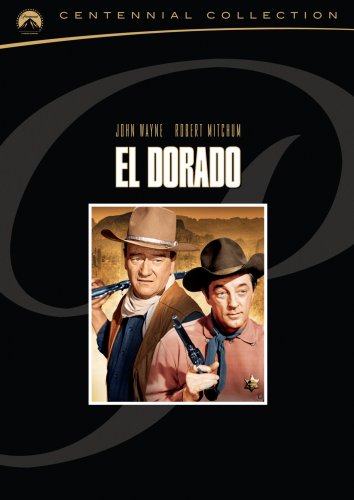
My history with Westerns isn’t exactly a vast one. I watched a bunch of Westerns with my dad growing up and I continued to watch the bigger ones of the modern era like Tombstone and Unforgiven as I progressed through my teenage years and young adulthood. John Wayne is kinda a mystery to me. He’s a huge gritty guy with a lot of patriotism and a funny way of talking. For lack of a better analogy, Sylvester Stallone is my generation’s John Wayne. Or Chuck Norris I guess. El Dorado is an interesting western flic because it was shot later in John Wayne’s career but he had still had the swagger of earlier pictures. A true classic revisited by the minds at Paramount.

Cole Thornton (played by John Wayne) is a gunslinger for hire. He’s been hired by Bart Jason (played by Ed Asner) for some help in a ranch dispute with the McDonald family. Cole rides into El Dorado and is approached by his friend: Sheriff J.P. Harrah (played by Robert Mitchum) who tells him the real tale of the ranch dispute. Cole also finds out that Jason eventually would have put him in a gunfight with the Sheriff. This is something that he didn’t want to do.

“So you think you can stone me and spit in my eye. So you think you can love me and leave me to die. Oh Baby, just can’t do this to me baby. Just gotta get out, just gotta get right outta here… Nothing really matters. Anyone cane see. Nothing really matters, nothing really matters to me.”

I don’t think I can ever listen to Bohemian Rhapsody without conjuring up the image of the gang in the Mirth Mobile bobbing their heads up and down and singing to the Queen classic song. It’s one of those iconic moments in cinematic history that will be with us long after Wayne’s World is forgotten. Too bad the rest of the film hasn’t aged as well.

“White supremist world was cancelled.”

When you talk about Wayne’s World 2 you can’t help but talk about disappointment. I mentioned in my review for the first film that over the span of nearly 20 years the skit had lost some of its luster. I certainly wasn’t nearly as entertained now as I had been when I first saw the film in the early 1990’s. That same principle appears to have been true just a year later when Wayne’s World 2 was released. It gathered in a disappointing $48 million off a $40 million budget. While there was talk of a continuing franchise at the beginning, there wasn’t any interest in a third film by the time the second film had crashed and burned. The fact is, I know many fans out there that didn’t even know a second film existed.

Have you seen the Chris Farley/David Spade film Tommy Boy? If you have, then you’ve also seen Black Sheep. The circumstances might have changed, but the general idea is still there. Farley plays the mentally challenged family member, yet again. This time he’s Mike Donnelly, and his brother Al (Matheson) is running for Governor of Washington state. Spade once again plays the faithful employee who is charged with babysitting Farley’s character and trying to keep him out of trouble. Here he’s Steve Dodds, an overlooked campaign assistant who hopes to parley the assignment into a full time job on Donnelly’s staff if he’s elected. Just like in Tommy Boy, there is the rival who is using Farley to hurt the cause. This time it’s sitting Governor Tracy (Eborsole) and her slimy campaign manager Neauschwander (McGill). They set Mike up as an arsonist, among other things. Of course, the Farley and Spade team discover some voting irregularities and take a road trip to the state capital to save the day. They’re aided in their attempt by a Vietnam vet who isn’t dealing with a full deck and is played quite hilariously by Gary Busy.

There are a ton of parallels between the Chris Farley/David Spade comedy team and that of John Belushi/Dan Aykroyd. Both teams began in the Saturday Night Live arena. It was that physical big/little guy combination that has its roots with Laurel and Hardy, and Abbott and Costello. Both teams were at the height of their careers when a drug overdose would claim the wilder member of the team. Both of the deceased comedians left behind at least one successful brother to carry on the name in show business. Tommy Boy was by far the best of the films this duo made before Farley’s tragic overdose in 1997. Black Sheep is a pale imitation.

It was the best of times. It was the worst of times. No, I’m not having a Charles Dickens flashback or reliving Star Trek II. I’m talking about the new Trek release The Best Of Star Trek: The Next Generation. It does feature one of the best Trek episodes of any of the shows, the Borg extravaganza The Best Of Both Worlds. In fact this really does contain 4 of the show’s best episodes. The problem is that there are only 4. With the fan collectives already taking up Yesterday’s Enterprise, it’s not that great a bargain for the real Trek fan.

With the original series I see no reason at all to buy into a 4 episode release. This stuff has already appeared countless times in the last 5 years or so. The episodes appeared in double episode discs originally. Then there were the complete seasons. There was the remastered DVD season sets. Finally, the best news yet, the release of these episodes in high definition on Blu-ray. So, why is Paramount releasing these single disc DVD’s now? There’s no question that they picked 4 of the best episodes, and they are the remastered versions.

“Your life is defined by its opportunities... even the ones you miss.”

F. Scott Fitzgerald is one of those great American writers from the classic age. In school most of us were required to read various works from the writer. For many students those works included The Curious Case Of Benjamin Button. The original work is a mere 20 page short story. For the last 15 years Hollywood has made one attempt or another to bring the classic story to the screen. The closest anyone got was Ron Howard who expected to bring in John Travolta as Benjamin Button. The one reason or another these attempts never made it past screenplay drafts. Along comes one of the best and most diverse directors, David Fincher. Fincher’s work needs little introduction and spans the genre spectrum from Se7en to Fight Club. The original short story would be adapted by Eric Roth. That left many, myself included, to expect a remake of Forrest Gump. When you consider that Roth wrote both screen adaptations and that he was once again working with a character spanning many years of history, the concerns were not unfounded. Would Roth take Benjamin Button on a journey through the 20th Century that would find him present at crucial moments in history as he did with Gump? Fortunately, Roth resisted such temptations and delivered a story relatively faithful to the original work, where the main character was a silent witness only to the major events of his life. Of course, I say relatively faithful because Roth also turned that 20 page story into an epic 3 hour film.

They say that it isn’t over until the Fat Lady sings. Did you ever wonder what “it” was or who the heck this Fat Lady is they keep talking about? I can’t help you there, but I do know who the Fat Man is. It’s William Conrad, who came back to television in 1987 as J.L. McCabe, better known as “the Fatman”. McCabe was one of those tough as nails district attorneys. He was actually an ex-cop, so had great criminal instincts. McCabe wasn’t above bending the law to put away the bad guy, and he wasn’t considered a very friendly type of fellow. He majored in stubbornness and plain speaking. He relied on Jake Styles, his private investigator, to do much of the leg work for the office. Jake was a bit of a flashy playboy, but he always delivered the goods for his boss. Again, Styles wasn’t against breaking a few rules to get what he needed. Styles was played by Joe Penny. McCabe also served as a mentor, of sorts, to young District Attorney Derek Mitchell, played by Alan Campbell. Mitchell was quite wet behind the ears and a little too eager sometimes. His ambition often got the better of him, and it was the gruff McCabe who kept him out of trouble. Finally, the team was completed by Gertrude, McCabe’s loyal and trusty secretary, played by Lu Leonard. While The Fatman put crooks away instead of defending innocent defendants, there could be no mistaking the parallels between Jake And The Fatman and Perry Mason. The two shows were from different times, and the styles might not have been the same, but the dynamic was very much the same. You can see a lot of Della Street in Gertrude and more than a little of the Drake/Mason relationship in the two leads. There was far more action, but that was more a reflection of the change in decades than anything else. And like Mason, the Fatman rarely lost a case.

The Fat Lady was warming up after the first season of Jake. The show did not immediately return for its second year. It was delayed until March and so only ran for 11 episodes. That’s why Paramount has issued this as an “entire” season set. The show never really found its footing and struggled for the 5 seasons that it ran. It wasn’t a terribly original program and was steeped in cliché for its entire run. It was never a ratings monster, and there were constant radical changes in attempts to retool the show over the years. In this season McCabe and his staff, excluding trusty Gertrude, moved to Hawaii in an effort to spice the show up Hawaii Five-0 style. Even that exotic location didn’t help matters, and the series returned to California by 1990. These erratic changes in location and style meant that the show never found the solid fan base it needed to survive. It was likely William Conrad that was the only thing that allowed the show to last 5 years. What made the show work at all was the unlikely pairing of the two characters. It wasn’t only their weight that separated the two. McCabe looked angry all the time and had a slower pace to his method. Jake was almost too slick; at least that’s the way they tried to portray him most of the time. In the end the pair really was too unlikely for most viewers’ tastes. While it did get 3 Emmy nominations, it never won. These nominations were for cinematography and music only. Today Jake And The Fatman wouldn’t have gotten past the mid season.

Dexter continues his jump to the world of high definition as the second season finally makes its way to Blu-ray. The show is killer, if you’ll pardon the expression. In the first season, Dexter pointed out the contradiction of a crime scene in sunny Miami. The aftermath of brutality appears somewhat surreal in such a colorful and bright surroundings. On Blu-ray you really get to understand what he was talking about. It almost feels like the show shouldn’t look so clean, so crisp, so bright. But, of course, it should, and it does in this release.

As we begin the second season, Dexter’s run-in with his brother, as well as its ultimate solution, has again taken his confidence. He’s unable to kill. He must find a way to set his life straight. Rita thinks he’s an addict and makes him go to NA meetings where he meets Lila (Murray) who is as messed up as Dexter. While she might not be a killer, she’s obsessive and is drawn to Dexter’s dark nature. Her antics to keep Dexter are straight out of the Fatal Attraction Handbook. Doakes is also getting closer to finding out what Dexter really is, and that’s going to end badly for at least one of them. Dexter’s oceanic burial ground is discovered, and now he’s on the task force to bring in The Bay Harbor Butcher. Is this finally the end of the line for Dexter? You really need to take the ride and see for yourself. I guarantee you that these dozen episodes will just fly by. Jaime Murray is the best of the newcomers, and she’s simply fascinating to watch, as she appears more self destructive than even Dexter himself. Their relationship ends in one of the most chilling scenes of the series, so far. Keith Carrradine also joins the cast this season as FBI agent Lundy who is brought in to head the Bay Harbor Butcher task force. He’s also smitten with little sis Debra, making for some very awkward moments for everybody’s favorite serial killer. The Code Of Harry takes some hits this season as Dexter uncovers some secrets of both his and Harry’s past lives. The series continues to evolve and never ceases to amaze. This is the best cable series since The Sopranos.

With so many cast changes, it didn’t really come as too much of a surprise to fans that the series was winding down. Only one more season would follow, and this year never clicked in quite the same way previous seasons had. By now the team was so significantly different that there was little of the cast chemistry that made this one such a winner. With its glory years behind and only one more struggling year to come, we reach the end of our journey with the IM Force.

Jim Phelps (Graves) led his team in a sixth season of Mission Impossible starting in 1971. The show continued its trademark traditions. Jim would receive a mission from the “self destructing” tape and would gather his IMF (Impossible Mission Force) team. The team was necessarily eclectic in nature, and it changed significantly in the sixth season. Gone were Leonard Nimoy, Leslie Ann Warren, and Sam Elliott in his signature role of Dr. Robert. Still in the team we had Barney Collier, the gadget man, played by Greg Morris. The muscle was still supplied by Willy Armitage, played by brute Peter Lupus. Together they took on missions that the government could not be officially a part of. They were always admonished that should they be caught “the secretary would disavow any knowledge” of them. Usually they were sent somewhere to put some evil mastermind out of business. Their tactics ranged from scams to outright theft. Sometimes they were a rescue team, while other times they would infiltrate a group of bad guys. There were certainly cold war elements to the whole thing. Each week the team concocted some convoluted con to play on their mark, walking away at the end of each episode often without getting any credit or congratulations.