Sony Pictures

“When someone dies in the grip of a powerful rage, a curse is born. It never forgives. It never forgets. The curse gathers in that place of death. Those who encounter it will be consumed by its fury.”

Here we go again with the American remake of the Asian classic. To be fair, The Grudge was one of the first after the great success of The Ring. There are some significant differences between this effort and the countless remakes we’ve encountered over the last decade or so. This film retained its Japanese location, which does provide for a more exotic atmosphere. The location shoots are actually pretty well done. The film was also directed by the same man who directed the Asian original, Takashi Shimizu. He’s become quite prolific in the genre, having now directed both versions and the sequels to both versions. The Grudge also doesn’t figure into the technology aspect that many of these Asian ghost stories appear to populate. The most high tech haunt here is a stainless steel bathtub. I bet that gets cold in the winter. Sarah Michelle Gellar brings in the core American audience thirsting for more Buffy. But, if you’re turning on to this film to see Buffy kick some supernatural rear, you’re better off with the Scooby Doo films. And that’s bad.

“Symbols are a language that helps us to understand our past. As the saying goes, a picture says a thousand words, but which words? Understanding our past determines actively our ability to understand the present. So, how do we sift truth from belief? How do we write our own histories, personally and culturally, and thereby define ourselves? How do we penetrate years, centuries of historical distortion to find the original truth? Tonight, that will be our quest.”

Conspiracies can be fun. We all buy into them to one degree or another. I’m not talking about the paranoid nutjob who sees a conspiracy behind every closed door, and even a few open ones. Of course, there is something to the old axiom that just because you’re paranoid doesn’t mean they’re not really out to get you. Of course, we’re not talking about the persecution complex style conspiracy here. We’re talking about the old fashioned cover-up. It’s what made The X-Files so famous for so many years. It’s why JFK’s death is so much more interesting than anything he did in his remarkable life. There are still some crazy people out there that believe George W. Bush orchestrated the 9/11 attacks, or at the very least was complacent in them. Everywhere from Super Bowl outcomes to manned missions to the moon, someone somewhere thinks it was all a big lie. So, you might as well cop to it now. We all love a good conspiracy theory. In his second Robert Langdon novel, The Da Vinci Code, Dan Brown writes about what would be the mother of all cover-ups. As one character put it so well in both the novel and film, “What if the greatest story ever told was a lie?”

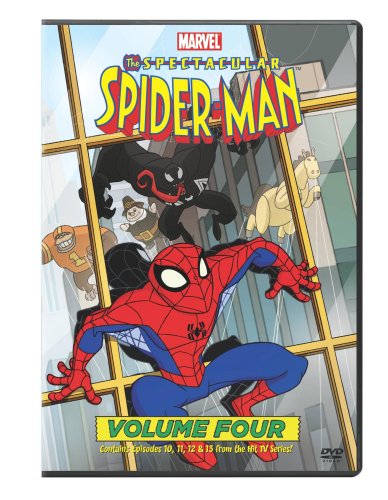
The title of Spectacular Spider-Man was once used to refer to a second-rate line of comics about the web-crawler. The Amazing Spiderman always led the way in sales but the Spectacular production always had its line of fans too. As well as the critics. The critics were often on the books because they had a more casual tone and sometimes didn’t even go along with the original book in terms of plot development. The comic eventually died off and in 2008, the Kids WB decided to use the name for their new animated show. Two seasons and 26 episodes later, this show has done quite well. Volume Four is now released and includes episodes 10-13.

Episode Ten starts out with Dr. Conners and his crew being allowed to study an alien symbiote. However, that symbiote is lost when the Black Cat & Spiderman have an altercation in the lab when Black Cat was trying to steal the life-form. It is soon found that the symbiote has actually affixed itself to the Spider-Man costume thus changing his powers and his personality.

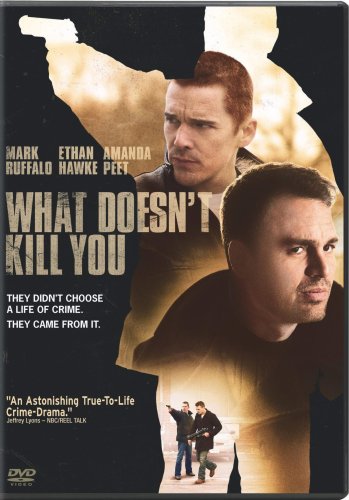
Every once in a while a movie comes along that has a very strong social message, but never comes across as heavy handed or preachy. What Doesn’t Kill You is one of the best of those movies that I’ve seen in some time. It’s based upon the real life struggles of Brian Goodman, who wrote the screenplay while he was in prison. Goodman was a lifelong criminal who was also addicted to booze and drugs. With the inspiration he gained from his two young sons, Goodman turned his life around. He got himself sober and avoided the temptations that would lead him back into a life of crime and ultimately prison. Another danger sign in these kinds of films is when you have one man who wrote, directed, and stars in a movie. These “one man band” types of films more than not fail on almost every level. Again, I have to say that What Doesn’t Kill You manages to rise above these trappings. Goodman manages an almost impossible feat here. He tells a socially powerful story, from his own personal experience, and never forgets that ultimately the end result must entertain above anything else. The most important of messages falls completely ineffective if ultimately no one ever sees the movie. And, trust me, when I tell you. More people need to see this movie.

Brian Reilly (Ruffalo) (Goodman’s character) and Paulie McDougan (Hawke) are practically brothers. They grew up together in the same south Boston Irish neighborhood and were inseparable since they were in elementary school. They admire the local crime boss and neighborhood protector Pat Kelly, played here by Brian Goodman. Kelly runs the local criminal activities out of a corner bar. He gets a piece of anything that goes on in the hood. The boys start out as kids running envelopes and other errands for Pat. Fifteen years later, they’re still doing small jobs for the boss. They’re beginning to get frustrated that they haven’t graduated to better things and more money. They soon break the cardinal rule and start to go on their own. Mostly it’s small time stuff. They roust drug dealers and take down a few trucks. But their cowboy antics are about to get them in trouble. They risk making an enemy out of the still powerful Pat, but more importantly they have brazenly taken down quite a few punks. Brian is also beginning to drink too much and is eventually introduced to crack cocaine. He’s messing up. His wife is getting frustrated with him, and he’s making mistakes “on the job”. Those mistakes end up getting him shot. Miraculously, he survives, even though he leaves the hospital against medical advice to get high. The mistakes eventually lead the two friends to get busted and do five years in prison. Brian gets out first. He makes an attempt to stay sober and away from criminal activity. He’s helped by an AA mentor he befriended in prison, named Sully (Lyman). But when Paulie gets out, his need for money and his frustration at playing it straight threaten to bring him right back into those activities that put him in prison. What will he do? Will he repeat the mistakes of the past, or will he be strong for his wife and sons, who waited for him for five years of prison?

“I found out that if you wanna know the purpose of a thing, you can’t ask the thing to tell you. A car doesn’t know why it’s a car; only the manufacturer knows what it was meant to do. And I guess that’s the same way it is with God.”

Not Easily Broken was written by a minister, Bishop T.D. Jakes. So you should expect a very spiritual message when you watch this movie. If that’s not your cup of tea, as they say, this really isn’t going to be the film for you. The message is quite clear throughout the film: Life will throw everything it’s got at you. It will try you. It will test you. The movie proposes that only through a spiritual connection with God can you overcome these obstacles. The story uses the example of marriage, but it’s obviously intended to apply to every aspect of life.

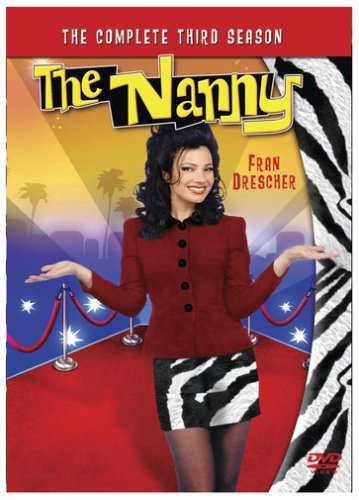
"She was working in a bridal shop in Flushing, Queens 'Til her boyfriend kicked her out in one of those crushing scenes. What was she to do? Where was she to go? She was out on her fanny... So over the bridge from Flushing to the Sheffield's door. She was there to sell makeup, but father saw more. She had style! She had flair! She was there. That's how she became the Nanny! Who would have guessed that the girl we've described Was just exactly what the doctor prescribed? Now the father finds her beguiling. And the kids are actually smiling. She's the lady in red when everybody else is wearing tan... The flashy girl from Flushing, the Nanny named Fran!"

Not exactly Mary Poppins.

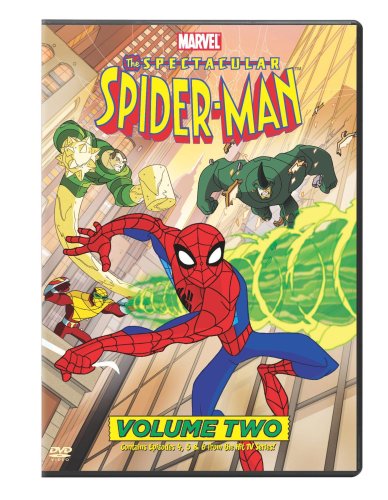
This is not your Friendly Neighborhood Spider-Man. If you’re at all like me, you grew up on the 1960’s cartoon series and, of course, the Marvel comic. A lot has changed since those early days of the web slinger. There’s been a not too successful television live action attempt. The comics themselves have changed significantly. You can’t discount the enormously profitable Sam Raimi films, that have given new legs to an old superhero. It stands to reason that a new cartoon series was in order. Enter The Spectacular Spider-Man, the 10th series based on the Marvel character. This recent cartoon series updates the world of Spidey. The shows take from both the original comics and the film series to create a new fusion of the hero. Like in the comics, Parker is the loner high school kid teased constantly by bullies like Flash Thompson. He has a few girls on his radar like Gwen Stacey and Mary Jane Watson. He still lives with his kind old Aunt May. Unlike the film, Spider-Man was not endowed with his web slinging ability by the radioactive spider. He developed the shooters and the chemical mixture that makes them work. That means he can run out of fluid and lose his ability to shoot webs. The Osborne relationship from the movies exists here. It’s also likely no coincidence that the villains featured in the film have prominence here. Doc Ock, Sand Man, The Goblin, and even Venom are hinted at in the last episode of this collection.

These cartoons are actually pretty good. The animation is pretty solid. Some of the characters look rather strange. Aunt May looks like she’s a 20 year old with white hair. Character jaw lines have a distinctive angular style that makes everyone look like they’re posing for some tough guy magazine cover. MJ looks like a matchstick and says “tiger” way too often. They are not really standalone episodes. Unlike the 1960’s series there is a story arc that connects the episodes into a longer form. The character’s mythology is also played with quite a bit. The cartoons work in a few origin stories and connect them together as a master plan plot devised by OsCorp and spearheaded by Dr. Octavius. The only real complaint I have is that each disc, sold separately, contains a mere 3 episodes. While this is great for bit rate and picture quality, it’s not much of a bargain material wise. The total running time for each disc is just 69 minutes. (That’s about 23 minutes an episode.) Because the stories are continuous, you never really reach the end of the plot. I think Sony would have done much better to wait and release season sets of the cartoon. I wouldn’t be surprised if that comes, making these discs unnecessary in the long run, except to add more money in the Sony cash registers.

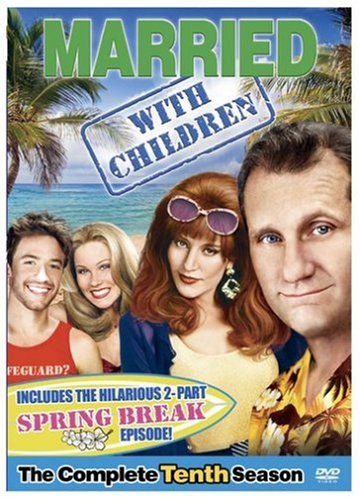
On October 9th 1986 the network television landscape did something that hadn’t been done successfully in its 40 year history. A fourth network broke on the airwaves. It was called FOX and wasn’t even going to broadcast 7 days a week. Most pundits in the television industry never gave it a chance. Most of the channels were in the double digit UHF range. This had long been considered the independent station area, and a lot of televisions didn’t pick up this band as well as the established VHF band. And for a while it looked like the network was going to disappear almost as quickly as it appeared. But by 1987 the network suddenly had two big hits on its hands. The first was a silly cartoon, originally aired as a throwaway segment on a variety show. The cartoon featured the most unlikely of television families, The Simpsons. That show is still with us nearly 25 years later. The second hit was a live action series, also based on a very unlikely and this time seemingly unlovable family, the Bundys. Right from the start there was criticism that the name itself was a death knell. At the time America was still dealing with the pending execution of a far more infamous Bundy. Married With Children, however, would become an almost instant break-out hit.

Al Bundy (O’Neill) was a working stiff. He had seen his high school glory years evaporate into the rearview mirror of his ancient Dodge when he married his childhood sweatheart (no, I did not misspell), Peggy (Segal). The red-headed woman would soon become his curse. She was lazy. Peggy wouldn’t know what a stove looked like if it fell on her. She was content to sit around all day while Al worked for minimum wage at a mall shoe store. Tying Al to his meager existence were two children. Bud (Faustino) was a frustrated teen who couldn’t seem to find his cool. Girls scorned him, and he appeared to be headed to the life of his father. Daughter Kelly (Applegate) was a teen slut. She slept around and used her looks to make her way in life, which was likely good, because she was dumber than rocks. Al was also plagued by neighbor Marcy (Bearse) who was a feminist and usually a thorn in Al’s behind. Her second husband, Jefferson (McGinley) was often Al’s accomplice in trouble. Most of the material involved Al’s suffering and the apathy of his family to his lowly station in life.

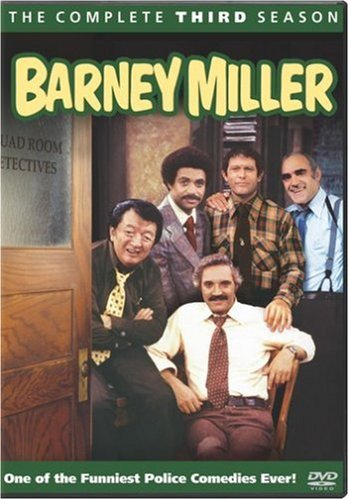
In 1976 a New York media group conducted a survey of the NYPD detectives. The question was: “Of all the TV cop shows, which most accurately portrays life as a detective?” The overwhelming response was the comedy Barney Miller. Seems real cops related to the daily grind and weekly wackos of Barney Miller. Let’s not put aside that this was also one of the most consistently funny shows on television. I remember it took me a while to accept Abe Vigoda in such a light role as Fish. My first exposure to Vigoda was the ruthless mobster in The Godfather. Barney Miller always managed to be funny while still telling a good short story. The characters were always wonderful.

Captain Barney Miller (Linden) was in charge of the detective squad at New York’s 12th Precinct. Among his detectives were a colorful group of odd individuals. Detective Ron Harris (Glass) was writing a book that detailed his life as a New York detective. It was called Blood On The Badge and was far more fiction than fact. He prided himself on his stylish clothes and culture. Arthur Dietrich (Landesberg) was a know-it-all. He had an almost encyclopedic base knowledge on everything and anything. He would bore his colleagues with his endless drone of facts. Stan “Wojo” Wojciehowics (Gail) was the typical New Yorker everyman. He might not have been the brightest tool in the box, but he more than made up for it in heart. At times his desire to show initiative would end up getting the squad in trouble. Fish (Vigoda) was past his prime and spent more time in the men’s room than actually fighting crime. He was always suffering from one old age ailment after another. His bulky frame made him look intimidating, however. Nick Yamana (Soo) was a lovable Japanese guy who wasn’t always the first to understand. He had a literal way of interpreting speech which led to some very classic misinterpretations. He was also a gambling junkie, often on the phone with his bookie. From time to time the squad would be visited by the clueless Inspector Luger (Gregory). He often reminisced about his glory days and often expressed regret that he didn’t go down in a blaze of glory like his old friends had. He was usually intruding upon the squad’s time with long pointless stories. Finally, patrolman Levitt (Carey) was an ambitious uniformed officer who wanted to be a part of the squad, which he eventually did.

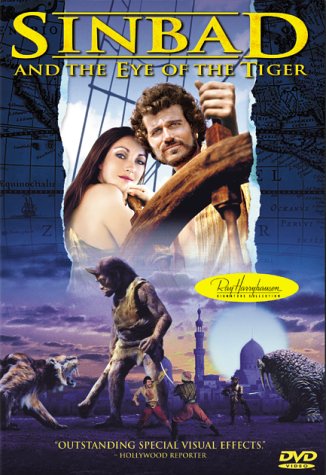
Long before the magicians of movie special effects had computers to conjure up monsters and otherworldly creatures, or even talking dogs, they relied on more physical tricks of the trade. One method, used perhaps most famously in 1933’s King Kong, is stop-motion animation. Kong inspired a young boy who would go on to master the art form and establish himself as a legend of fantasy filmmaking: Ray Harryhausen. Over a career spanning more than 40 years, Harryhausen produced some of the most delightful moments ever captured on film, wowing audiences and inspiring people to believe in movie magic.

Harryhausen’s mastery is showcased in 1977’s Sinbad and the Eye of the Tiger, the third film in a trilogy about the legendary swashbuckler. Eye of the Tiger has its flaws, but the animation is still captivating after all these years.