1.78:1 Widescreen

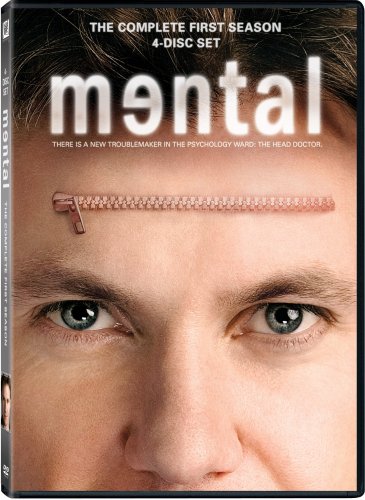
Things are tough all over. It seems that even the television networks aren't immune to the growing trend of cutting back. Fox decided that the answer was Bogota, Colombia. No, they didn't turn to the cocaine market. They all tried that in the 70's and we ended up with Joannie Loves Chachi. This time Bogota is an option for producing new television shows. The idea is that you can take an American cast, with a token Brit in this case, and ship them off to Columbia to do the show on the cheap. The good news is that you can hire crew for six bucks a day. The bad news is that the show ends up looking like it cost about six bucks to shoot. I suspect that the hombre who came up with this wonderful idea for Mental had a better understanding of mental illness than the average bear.

Dr. Jack Gallagher (Vance) has been hired by his ex-lover Nora Skoff (Sciorra) to run the mental health department at Wharton Memorial Hospital, where she is the hospital administrator. Gallagher might be bright, but he has some rather unorthodox methodology. He tends to put himself in the place of the patient. To see what they see. Attempt to feel what they feel. It's the kind of practice that ends up having him introduce himself to his new staff by stripping buck naked when an intake patient is seeing alien reptiles and has stripped down himself to prove he is human. The tactic might have calmed the patient and defused a volatile situation, but it didn't endear himself to his new colleagues.

"Have you ever been told of that fateful year when Christmas almost didn't happen? It was everyone's worst fear. There was no one to take Santa's big sack of toys and deliver the presents to the world's good girls and boys. But this Christmas season didn't begin with any trouble or fuss. It began with some singing, as all Christmases must."

The 1960's and 1970's saw an entire genre of holiday specials produced by the prolific studio of Rankin and Bass. The most popular of these specials is probably Rudolph The Red Nosed Reindeer. But there were many others that were released in a 10-15 year period. They all had a few things in common. They used stop motion puppets and sets to achieve their animation. Yes, the same magic that sent King Kong up the Empire State Building drove Rudolph on that foggy night to lead Santa's sleigh. There was a decidedly plastic appearance to the characters, and they were certainly distinctive. Within seconds of watching one of these specials you were able to identify it as a Rankin and Bass production. In the years since, stop motion has almost gone the way of the dinosaurs with very few practitioners working in the art form today. Tim Burton has been the most successful of late. And we can't help but owe a huge debt of thanks to Willis O’Brien and Ray Harryhausen for perfecting the craft. And so our childhood was amused by these annual favorites only surviving in chopped up syndicated reruns today.

Just in time for the holidays, the Buddies are back for more cute puppy action. All of the retriever Buddies are back for this one. You are introduced to the “Buddies” right at the start, so it doesn’t really matter if you saw any of their other films. There’s Bud-Ha (Cate), a wise meditational pup. Next up is Mud-Bud (Panitz), an always dirty pup with a fondness for rolling in the dirt. The female Buddy is Rose-Bud (Mumy), who is the girly part of the team all decked out in a bow. Bud-Derball (Flitter) is the normal one of the bunch, followed by the rappin’ pup, B-Dawg (Gisondo).

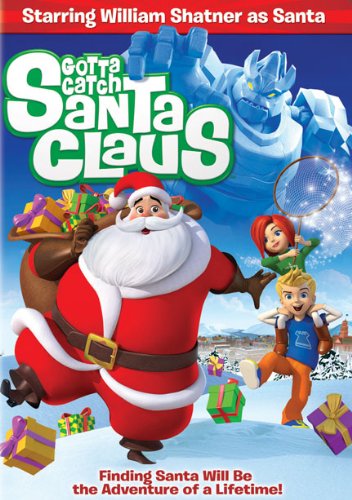
The North Pole is having a crisis. It’s getting close to Christmas and Santa’s workshop is having a shortage of magic power. Deep in a cave at the North Pole hangs the Christmas Icicle. It is the source of all Christmas magic that allows Santa and his gang to do their thing. It is powered by people having the Christmas Spirit. Lately, not enough people are believing in Christmas, so the icicle is shrinking. Finally, global warming that really is caused by humans. Another problem in the North Pole deals with Puppy Paws (Gordon) son of Santa’s right hand, eh … dog Santa Paws (Bosley). Puppy Paws wants to be like a normal dog and doesn’t want the responsibility that Christmas means to his family. He finds Bud-Derball in Santa’s naughty files and decides that’s the kind of pup he wants to hang with. So he stows away on one of Santa’s express trucks and heads to Washington to meet the Buddies. At first they find Puppy Paws to be a bit of a pain to hang with. But when Puppy Paws is captured by the mean old dogcatcher Stan Cruge (Lloyd) the Buddies go into action to save him. What they didn’t know was that Christmas depends on them freeing Puppy Paws. There’s a side story that has Stan Cruge turning from a mean old Scrooge character to finding his own Christmas Spirit, and helping to bring back the Christmas Icicle.

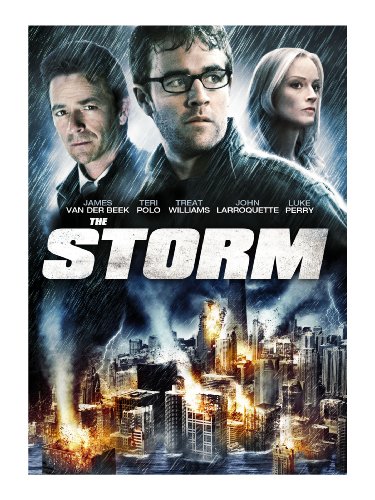
It’s really hard to explain but I feel like I have shared a small lifetime with a director named Bradford May. At first, it was a couple of Darkman sequels that were simply good doses of cult sequel fare. I didn’t expect much and I received back exactly that, so I was satisfied. But then as I continued to review more and more movies, as his films started to pop up in my queue. First there was Ring of Death & then Mask of the Ninja. Both could be described as typical action beat-em up movies. Then Bradford decided to take on direction for The Storm, a mini-series that was shown on NBC and somehow it ended up in my review pile. I’m starting to think that this is no mere coincidence anymore.

Dr. Jonathon Kirk (played by James Van Der Beek) is a renowned scientist working at the Atmospheric Research Institute. He is aided by his fellow scientist, Dr. Jack Hoffman (played by Rich Sommer) and newcomer Carly Meyers (played by Erin Chambers). They are being funded by the U.S. government to manipulate technology that will allow them to control the weather.

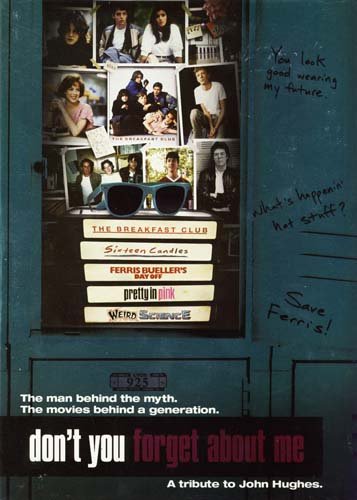
Don’t You Forget about Me is a documentary/tribute to the late John Hughes.  Four amateur filmmakers set out to find answers to the questions, why did you leave? How did you capture adolescence so perfectly in your films? Why do your films remain a fixture in popular culture?  After obtaining interviews with many of the John Hughes alumni such as Ally Sheedy, Judd Nelson, Alan Ruck and Andrew McCarthy, the filmmakers came to the realization that they required an interview with John Hughes to complete the film. The documentary combines the interview footage as well as covers the filmmaker’s road trip from Toronto to Illinois to acquire an interview with the reclusive director. 

The marketing potential of this film rose greatly upon John Hughes’ unfortunate passing.  These filmmakers are deeply interested and moved by the works of Hughes and audiences can see that.  However, there is nothing compelling about the filmmakers.  They are not interesting or provocative. I found myself bored with their stories and opinions. What is problematic about this documentary is the forced fusion of two stories; One being the story of John Hughes and the other being the group of filmmakers. In my opinion, the latter should have been jettisoned altogether. Audiences are engaged in these interviews and suddenly the flow is disrupted with the tiresome antics of these four filmmakers.

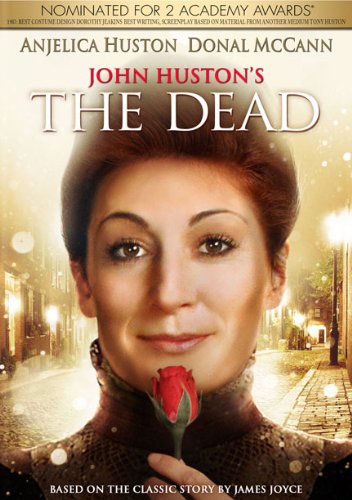
In early-20th-Century Dublin, a winter's musical gathering is being held. The first two-thirds of the film takes us through the course of the evening, from the arrival of the guests, to the musical entertainment, to the dinner and its discussions (and arguments), and finally the departures. During the party, one is aware of a certain tension or distance between one couple: Donal McCann (nephew to the hostesses) and his wife (Anjelica Huston). As they prepare to leave, Huston hears one of the guests sing, and is rooted to the spot. Later, McCann asks her why the song affected her so much, and a painful memory from her past comes out.

John Huston's last film is suitably elegiac. Based on the James Joyce's short story of the same name, the movie is itself in short story form, barely clocking in at 73 minutes, and that's including the credits. The running time is just right, though, as this is a compact, moving tale, whose title does not become clear until the closing minutes. Were the film any longer, audiences would likely become restive at the apparent lack of story during the first two acts, but everything is present for good reason, working in unity towards a powerful conclusion. In all of this, the film is deeply faithful to the Joyce story. But the story also presents an enormous challenge: its conclusion relies on the thoughts of its protagonist, not on dialogue or action, the bread and butter of cinema. What to do? Huston takes what is probably the only path open to him, and goes for a voice-over as the camera gazes at mournful scenes of snow falling in the Irish night. The voice-over, having been absent until this very moment, is a bit jarring, even as its necessity is understandable. So the film might not be flawless, but it is a heartbreakingly moving valedictory gesture from one of cinema's greatest directors.

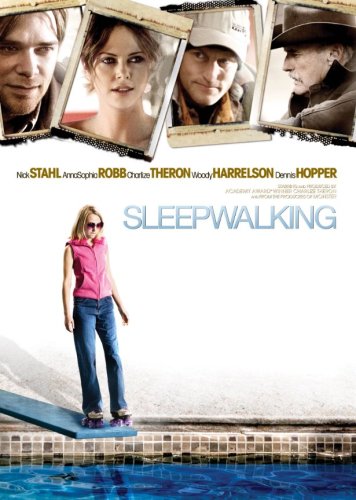
This is the story of an unfortunate underachiever who is left with his niece after his even less fortunate sister abandons them. Unhappy with social services and the places they are forced to live, they take what little money they have to fund an aimless trip across the country until arriving at the home of his abusive father.

This film relies on the performances since the story is so utterly bleak at times that all the audience has to cling to sometimes  is the recognition of the stars within it. Filling up the smaller roles are the likes of Woody Harrelson, playing  the goofy friend, Dennis Hopper, who is devouring the scenery as the aforementioned abusive father, and Charlize Theron, who is greatly missed during most of the film for she delivers probably the most solid and engrossing performance as the troubled mother. Theron controls the first fifteen minutes then becomes nothing more than a reference for the better part of the proceeding film.

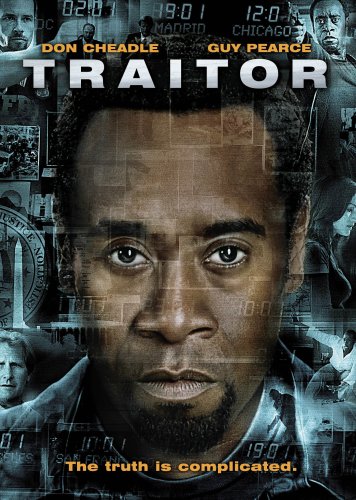
Some thirty years after seeing his father killed by a car bomb, Samir Horn (Don Cheadle) is a dealer in explosives. When he is imprisoned in Yemen along with members of a militant group he was about to make a sale to, he is drawn in and becomes an integral part of the group's terrorist activities. But wait – is he in fact an intelligence agent who has infiltrated the group in order to bring down their leader? Meanwhile, FBI agent Guy Pearce is hot on Samir's trail, but if he catches up, will that be a good thing or a bad one?

Given that we are, after all, talking about the lead in a mainstream Hollywood release, it should come as no surprise that the answer to the question of Samir's ultimate loyalty comes as no surprise. Fortunately, the question mark is dispensed with about an hour into the film, and the real suspense shifts to more urgent concerns, such as whether a ghastly bombing plot can be averted. Without venturing into spoiler territory, I must say that the climax leads to as clever a bit of cinematic prestidigitation as I have seen in quite some time, so kudos. Though the film is, first and last, a suspense thriller, and quite the effective one at that, it also makes a few telling points. Though the villains are suitably dastardly, a number of the characters on that side are also humanized – Sarmir's best friend (Saïd Taghmaoui) may be a terrorist, but he is also a man whose motivations are entirely understandable, and he is clearly acting out of genuine conviction. By contrast, intelligence operative Jeff Daniels is willing to go to such lengths to stop the terrorists that he becomes morally indistinguishable from them. And when was the last time that Hollywood had a devout Muslim as the protagonist of an action film? Rank this, then, with The International and The Kingdom as another satisfying exercise in suspense that leaves its audience with plenty to talk about after the closing credits roll.

When we left J.D., Turk, and the rest of the staff of Sacred Heart Hospital at the end of their seventh season, there were good reasons to believe we had seen the last of Scrubs:

1) The show had suffered the lowest ratings in its history.

“It’s almost Christmas. Get into the spirit.”

Ever wonder what the kids of South Park might be like if they ever made it to adulthood? While I’ve not seen that many episodes of the FX series It’s Always Sunny In Philadelphia, that was the first observation that came to mind. These are the South Park kids all grown up. They’re crude, raunchy, mean, and most importantly, they are as politically incorrect as ever. If you need an example, I can offer one right from this episode. The guys have a Christmas tradition that dates back to their childhood of throwing rocks at moving trains. An episode I caught a while back had two of the guys going to an abortion rally because they suspected that pro-choice chicks gotta be easy. Sound like anyone we know? If you love irreverent humor that’s not afraid to cross over the line, this F/X series has everything you’re looking for and without those silly construction paper animation limitations. These are real dudes.